Category: We Remember

  • Corporal Francis D. Knobel comes home

    Corporal Francis D. Knobel comes home

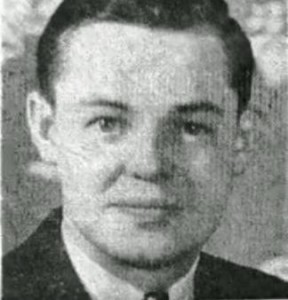
    Francis D. Knobel

    Hondo told you back in December that Corporal Francis D. Knobel’ s remains had been identified by the Department of Defense last December. This week the good corporal will finally rest in Arlington cemetery. The LaCrosse Tribune pieces together the bits available about his life;

    He was born in 1930. His father is listed in city directories as a laborer; his mother worked at the Electric Auto Lite factory. His name does not appear in city high school yearbooks.

    Knobel enlisted when he was 19. About five months later he went overseas and took part in the battle of Inchon, the invasion that led to the recapture of South Korea, according to a story in the La Crosse Tribune when he was declared missing.

    Knobel’s father died in 1952. His mother and sisters later moved to Arizona.

    According to the Department of Defense, they’ve had his remains for decades, but only now had the technology to identify them;

    [C]ommunist forces turned over 25 boxes of remains that were believed to be American servicemen who were recovered near where Knobel was lost. The remains were transferred to the U.S. Army’s Central Identification Unit (CIU) in Kokura, Japan, for analysis. From the 25 boxes transferred to the CIU, 17 servicemen were identified; one box was believed to contain a Korean national, and the last seven boxes of remains could not be identified. When all attempts to associate the unidentified remains to American servicemen were unsuccessful, a military review board declared the remains to be unidentifiable and the remains were transferred to the National Memorial Cemetery of the Pacific, commonly known as the Punchbowl.

    In 2014, with advances in technology, the Department of Defense re-examined records from the CIU and concluded it was possible to identify the remains. The remains were exhumed and analyzed.

    To identify Knobel’s remains, scientists from DoD and the Armed Forces DNA Identification Laboratory (AFDIL) used circumstantial evidence, radiographs, and dental comparison.

    Julie Houx, the corporal’s next of kin, along with her children, will accompany her uncle to his final rest and receive his decorations at Arlington;

    Houx had to decide where her uncle should be buried.

    “My first thought was Hawaii is so beautiful and he’s been there, why don’t we just rebury him there,” she said.

    A few days later she called back and asked if he could be buried in Arlington.

    “He paid the ultimate price,” she said. “I think he deserves the ultimate tribute.”
  • Jack Redman comes home to fanfare (Updated)

    Jack Redman comes home to fanfare (Updated)

    Gene and Jack Redman

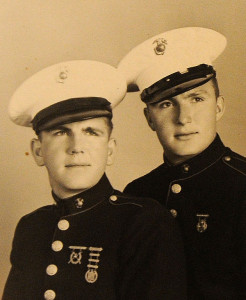
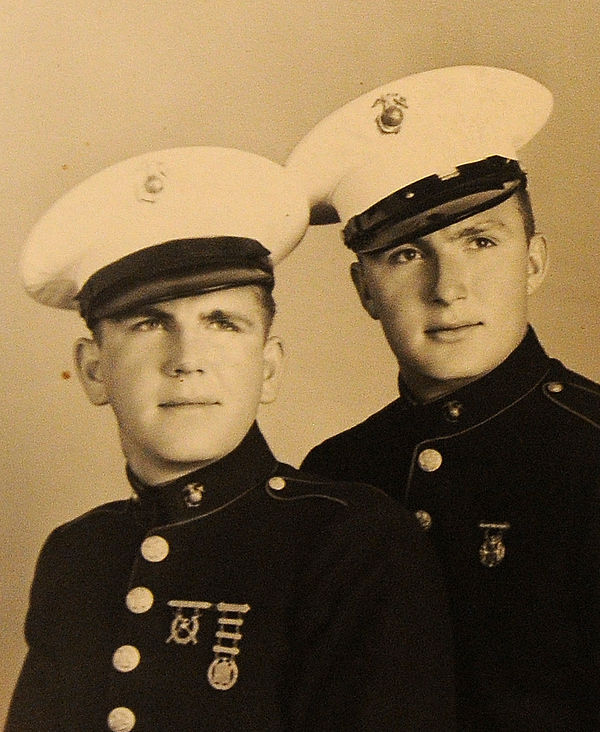
    Hondo told you back in January that Jack Redman (on your right in the above photo with his brother Hobe) was coming home after his remains were identified where he fell on Tarawa in November, 1943. One of our ninjas send us a link to the preparations his hometown, Watseka, Illinois, are making for his last welcome home;

    “First, we have decided to move the service from the funeral home to the First United Methodist Church, just south of the home,” [Steve Knapp, the Watseka funeral director] said. “Our capacity might be 150 to 160, but the church will hold 330. If the crowd outgrows that, well, we’ll work with that Saturday.

    “And, now, it looks like we’re going to have a motorcade from O’Hare on Friday,” he added. “The Marines are sending an escort and Gov. [Bruce] Rauner is sending a representative. We will meet at the airport around 11 a.m., and then the family will be in one car, and a Marine honor guard will travel with us in a van as we head back to Watseka.”

    […]

    “We would like to see Route 24 lined with people and flags. There will also be a flag line at cemetery,” Bicking said. “And, after all is done, we will be doing a cookout for everyone at Veterans Park.”

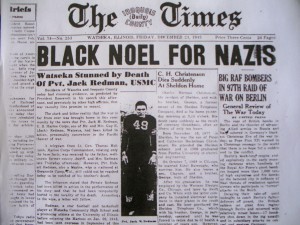
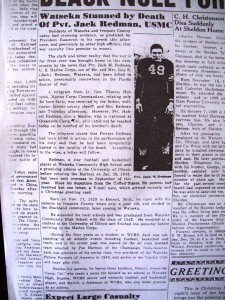
    Updated May 16, 2015; Last night a local historian sent us some news clippings that announced Jack’s death in 1943. He was a local sports hero, apparently. His record of scoring 34 points in one high school basketball game stood for 25 years.

    On the gridiron where he received All-State recognition as an end, before the annual Veterans Day football game against Milford for the R. M. Hampton trophy in 1941, the local newspaper referred to him as ““Jolting Jack” Redman, senior fullback and one of the best ground-gainers in Warrior history.”

    Here’s the newspaper clipping that stunned the community;

    Redman clipping

    Redman clipping2

    I’m glad that the community finally gets to welcome their hometown hero back where he belongs.

  • Lest We Forget . . . .

    Forty-six years ago today – just before midnight EDT on 14 April 1969 – Deep Sea 129 was shot down by North Korea.

    Burn in hell, Kim Il-Sung. Burn in hell.

  • Another Purple Heart Returned

    During World War II, Raymond Ferrer served in the US Army. He served in the European Theater.

    During the Battle of the Bulge, Ferrer was wounded. He was awarded the Purple Heart.

    He returned home after the war. Eventually, he apparently passed away.

    At some point in time – exactly when is unknown, even to his family – Ferrer’s Purple Heart medal was lost. It ended up in a Connecticut pawn shop.

    I’m sure longtime readers can see where this is heading. Yeah, you’re right. Enter CPT Zachary Fike and Purple Hearts Reunited.

    The Ferrer’s Purple Heart has now been returned to Mr. Ferrer’s descendants – specifically, to his grandson. He in turn plans to pass it along to his son in the future.

    I don’t often plug nonprofits. But if you have a spare coin or two and want to donate to a worthy and military-related cause, maybe you should look at Purple Hearts Reunited. IMO you could certainly do worse.

    Well done, CPT Fike. Damn well done.

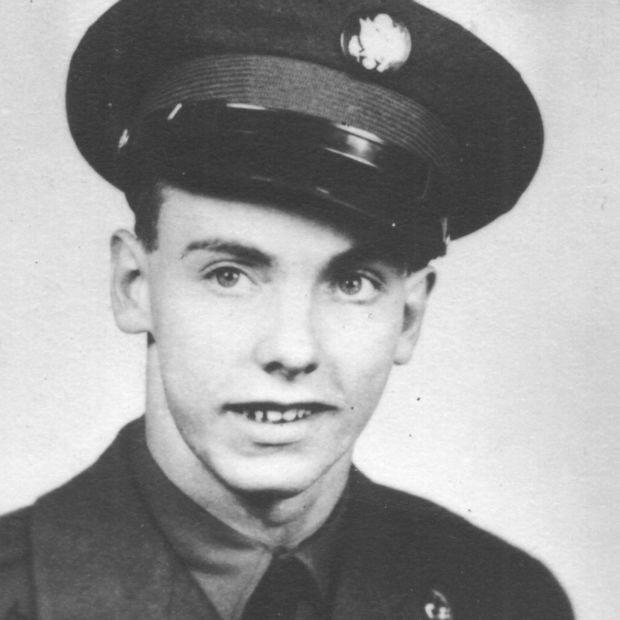
  • Pvt. Arthur “Bud” Kelder comes home

    Pvt. Arthur “Bud” Kelder comes home

    kelder

    After 72 years, Private Arthur H. Kelder will join his relatives in a family plot near Chicago. Kelder was one of the American troops captured in the Philippines and endured the grueling Bataan Death March. Kelder survived the march, but succumbed to illness and was buried in a common grave with thirteen other prisoners near the Cabanatuan Prisoner of War Camp in Luzon. His remains have finally been identified and they’re awaiting acceptance from his surviving family;

    The Joint POW/MIA Accounting Command’s Central Identification Laboratory (JPACCIL) has identified the remains of Private Arthur H. Kelder from the remains associated with Cabanatuan Common Grave 717 that were disinterred from the Manila American Cemetery and Memorial in the Philippines.
    2. On January 22, 2015, Douglas Kelder, the Primary Next-of-Kin of PVT Kelder, was notified of the identification by telephone by William E. Cox, Casualty and Mortuary Affairs Operations Center, U.S. Army Human Resources Command.

  • 70 Years Ago Today: Wacht am Rhein

    Today is the 70th anniversary of the beginning of Unternehmen Wacht am Rhein – or, as it’s more commonly referred to in the US, the Battle of the Bulge. At 0530 (local time) on 16 December 1944, German forces in the Ardennes began a general offensive against American forces in northeastern Europe. The fighting was to last until 25 January 1945 – a total of forty-one days.

    The German operational objective was to capture the Belgian port of Antwerp. The strategic objective was to split British and US forces, cutting off the former in Belgium and the Netherlands, in hopes of causing the Western Allies to make a separate peace with Germany.

    From the beginning, the German offensive was a desperate gamble – some German commanders gave it only a 10% chance of success. However, at that point in the war the German high command felt they really had no choice. A continued defensive posture was viewed only as a way of prolonging eventual defeat.

    Due to a combination of missed indicators and overconfidence on the part of Allied commanders, German forces achieved near-complete operational and strategic surprise. That the offensive failed is due IMO largely to two factors. The first was the generally weakened state of German forces (due to massive prior losses in France and on the Eastern Front) at that point in the war. Had the Germans had stronger forces available, they possibly would have achieved their operational objective of Antwerp. (Whether that would have induced the US and UK to seek a separate peace with Germany is an open question.)

    The second reason for the German offensive’s failure was determined early resistance by US forces – at Elsenborn Ridge during the battle’s opening days, and in the much better-known (but probably less decisive) defense of Bastogne beginning somewhat later – prevented a German breakout. These determined defensive stands irreparably disrupted and delayed the German offensive, buying US forces sufficient time to react and contain it. German forces indeed forced a large salient in US lines – famously referred to as a “bulge” – but were unable to achieve a breakout to the English Channel and Antwerp.

    By Christmas 1944, the initial German advance in the Ardennes had been stopped. Over the next six weeks, German forces were forced back to their original lines at the beginning of the offensive.

    The Germans tried again in early January to continue their offense via operations against the US 7th Army in Alsace, which had sent troops to reinforce US forces farther north. German forces achieved some initial success in this supporting effort.  However, it was also contained. By late January, this supporting offensive also had ended.

    The Battle of the Bulge was the largest fought by US forces during World War II. It was also the most costly in human terms. Multiple published totals for US casualties exist, ranging from nearly 90,000 (including 19,000 killed and 23,000+ missing) to over 108,000 (including 19,000+ killed and 26,000+ missing). German casualties were on the same order as US casualties; official German casualty figures for the battle totaled 84,834.

    The Battle of the Bulge was almost an exclusively American-German battle. British casualties numbered 1,408: 200 killed, 969 wounded, and 239 missing.

    The battle’s effect on German forces in the Western theater was near-catastrophic. The battle depleted German theater reserves, and Germany could not adequately replace them. These losses doubtless hastened the end of World War II in Europe.

    As you go about your activities today, take time to remember 70 years ago. It’s history worth remembering.

  • “A Date Which Will Live In Infamy”

    Seventy-three years ago at the time of this article’s publication – 1248 UCT-5, AKA Eastern Standard Time; or 0748 UTC-10, AKA Hawaii-Aleutian Time – the Japanese attack on Pearl Harbor began. That attack (along with Germany and Italy’s declaration of war on the USA four days later) led to the USA’s formal entry into World War II.

    In human terms, the cost of the attack was substantial, but perhaps lower than you might first think. A total of 2,535 individuals (2,403 US military, 68 civilians, and 64 Japanese military) were killed during the attack. Wounded totaled 1,218 – 1,178 US military and 35 civilians. One Japanese sailor – ENS Kazuo Sakamaki – was taken POW.

    As Jonn’s article earlier today indicated, however, the physical and psychological effects of the attack were massive. The Navy’s Pacific Fleet was severely damaged; only great good luck (all US Pacific carriers were at sea or otherwise away from Pearl on 7 December, and the Japanese inexplicably chose not to target the oil storage facilities at Pearl – plus the incredibly one-sided engagement at Midway six months later) allowed us to contest the Pacific during the first year or so of the war.

    The psychological effect of the attack was perhaps even greater. Yamamoto was correct in fearing that the attack on Pearl “awakened a great, sleeping giant”. The “terrible resolve” part of his observation was likewise true – and was manifested in the massive destruction inflicted on the Japanese homeland and civilian fleet during the latter parts of the war.

    The passage of time and subsequent events have healed most wounds from that day. Rather than enemies, the US and Japan are today firm allies. Time has also claimed the majority of those who fought at Pearl Harbor on both sides. It has dulled both societies’ memories of that day as well.

    Still: as you go about your activities this Sunday, perhaps find time to pause. Take time to remember another Sunday exactly 73 years ago today. If you’re so inclined, say a prayer for those lost that day.

    And while you’re at it, maybe add a second prayer – that we never again see such an event.  Twice has been two times too often.

  • Remembering Colonel Chuck Hall

    Remembering Colonel Chuck Hall

    I once saw an Army Colonel in full class A uniform hug a man in battered fatigues and a boonie hat. Both had tears streaming down their faces. They had not met prior to that moment in time and probably never saw one another again. That date was November 11, 1984. My best friend Patrick and I were at the dedication of the Vietnam Veterans Memorial Statue. We were the guest of the Army Colonel. His name was Charles “Chuck” Hall.
    Those few days we spent with Colonel Hall impacted my life in ways I could not have imagined. I am sure others have a different view of him, but to me he will forever remain a kind and unassuming man who took the time to show two teenaged boys around Washington, and who shared part of his story with them. I am sure he had better things to do that weekend. Patrick’s father and Colonel hall were friends. Pat and I took a road trip to Washington where we were the guests of Colonel Hall.
    Neither one of us expected to have seats in the VIP section when President Reagan gave his speech. Colonel Hall arranged that. We didn’t expect anything from him. He took the time to play host and later teacher to us. He shared part of himself with two teenaged boys who were fascinated with the act of war but had no real understanding of its cost and the toll it takes on those who survive.
    That night at his apartment he showed us pictures from Vietnam. We saw a young man with his buddies. He named the names and used military terms we pretended to understand. He said things like ‘A team’ and ‘Montonyard.’ He took the time to explain what those words meant. I saw a flechette for the first time. I saw Montonyard bracelets that had been given to him as gifts. I saw him pause more than once to compose himself as we looked at photos. There were some he would not let us see. I saw photos of mass graves, the result of an attack on his base camp. I saw the real cost of war.
    I saw and learned things that weekend that I did not fully understand for years afterwards. I did not understand the significance of that hug between strangers who were also brothers. I did not understand how hard it must have been for him to share those parts of himself with two young men who were obsessed with the glory of war. I know now why he chose to share himself. The lesson was learned.
    I was looking up some information on the internet last night and found out that Colonel Hall had recently passed away. He served 27 years in the military and an additional 23 years as a government contractor. He did three tours in Vietnam and was a Purple Heart Recipient. He had a large family that he was dedicated to. It is my hope that his family will at some point read this and know that he had a profound impact on the lives of at least two teenaged boys who were better men for having known him.