Category: We Remember

  • Cold War Overflights of Russia – the Peripheral Missions

    My article the other day provided a pointer to information concerning US deep penetration overflights of the Soviet Union between 1950 and 1956 – before the U2 was flying.  Needless to day, these weren’t the only overflights of Soviet territory conducted by US aircraft during the “Cold War”.  Nor were they the only ones during which shots were exchanged.

    Far more numerous were peripheral missions – those that flew along the Soviet Union’s land or maritime borders.  I also found an article that gives a fairly good (if perhaps not fully comprehensive) rundown of this far more numerous type of Cold War Soviet overflight mission.

    You can find that article here.  It also seems to be of good quality, and I’d assess it as being reliable as well.  Also highly recommended.

  • USAF Overflights of Russia

    I ran across a fascinating article this morning.  I thought I’d share it.

    The article deals with USAF involvement in overflights of the Soviet Union between 1950 and 1956.  And no, not just quick in-and-out “border dashes”.  Some of the missions were indeed deep penetration overflights.

    The article is not sourced, and the author appears to desire anonymity.  I thus can’t give a good assessment of how credible the article is based on sources or author’s reputation.

    However, the article does generally square with other accounts generally accorded to be of high-reliability. It also provides details that lead me to believe the author had access to some . . . very good documentation.  My assessment is that very likely quite accurate.

    The CIA and the U2 generally get the bulk of the credit for overflying the Soviet Union. But the CIA weren’t the only “players” in that deadly Cold War game – which was at times neither “cold” nor played for low stakes.

    Fascinating reading.  Highly recommended.

    . . .

    (Note:  it’s been my experience that sites such as the one to which this article is posted are often ephemeral.  I’ve captured the article to PDF in the case it disappears.) 

  • Quotations From Some Old Pieces of Paper

    The papers in question concern events during a 3-day period in July, 1943.  What follows is an series of quotations from those pieces of paper.

    They’re a few of of literally hundreds of such pieces of paper from that era.

    What follows may not be comprehensive; I don’t have a copy, so I can’t say for sure.  However, other published accounts I’ve located give the following as quotations. I’m convinced they’re accurate.

    I’ve omitted names and certain other personal information as they’re not really pertinent to my point in writing this article.  Asterisks below are present in those secondary sources, and apparently represent information that did not scan to text correctly or was not legible.

    . . .

    The President of the United States of America, authorized by Act of Congress July 9, 1918, takes pleasure in presenting the Silver Star to Private XXXXX X. XXXXXXXXX (ASN: ########), United States Army, for gallantry in action while serving with Company I, 504th Parachute Infantry Regiment, 82d Airborne Division, in action on 9 July 1943, in Sicily. Private XXXXXXXX, with utter disregard for his personal safety, provided water to the soldiers of his company during the hours of **** – ****. During most of this time he was exposed to heavy machine gun and small arms fire of the enemy and was sniped upon on many occasions.
    Action Date: July 9, 1943

    The President of the United States of America, authorized by Act of Congress July 9, 1918, takes pleasure in presenting the Silver Star to First Lieutenant (Infantry) XXXXX  X. XXXXXXXX (ASN: 0-######), United States Army, for gallantry in action as a member of Headquarters Company, 1st Battalion, 505th Parachute Infantry Regiment, 82d Airborne Division, in action on 9 July 1943 south of ****, Sicily. Lieutenant XXXXXXXX landed by parachute in hostile territory with his section and immediately proceeded to secure his communications equipment in the face of intense machine gun fire. After destroying what he was unable to salvage, he organized his communications group as a rifle unit and led them through the subsequent action to successful completion of assigned missions.
    Action Date: July 9, 1943

    The President of the United States of America, authorized by Act of Congress July 9, 1918, takes pleasure in presenting the Silver Star to Private XXXXX X. XXXXXXXX (ASN: ########), United States Army, for gallantry in action while serving with Company A, 505th Parachute Infantry Regiment, 82d Airborne Division, in action on 9 July 1943, five miles west of ****, Sicily. An attack was launched on a fortified garrison by Private XXXXXXXX’s unit, during which Private XXXXXXXX after a hand-to-hand fight with two enemy soldiers, captured a light machine gun. Immediately following this action, a counter-attack was launched by the **** on the position and, under heavy artillery fire, the unit was forced to withdraw. Private XXXXXXXX and Lieutenant XXXXXXXX volunteered to stay in position until their unit completed withdrawal. Private XXXXXXXX and Lieutenant XXXXXXXX manned their post with enemy machine guns until another assault was made by the enemy. Seeing that their unit had by this time contacted friendly forces, Private XXXXXXXX and Lieutenant XXXXXXXX, although surrounded, began to withdraw. Lieutenant XXXXXXXX was killed. By passing through enemy lines, Private XXXXXXXX was able to rejoin his unit.
    Action Date: July 9, 1943

    The President of the United States of America, authorized by Act of Congress July 9, 1918, takes pleasure in presenting the Silver Star to Private First Class XXXXX  X.. XXXXXXXX (ASN: ########), United States Army, for gallantry in action while serving with Company B, 307th Airborne Engineer Battalion, 82d Airborne Division, in action on 9 – 10 July 1943, four miles southeast of ****, Sicily. Private First Class XXXXXXXX fractured his knee in a combat parachute jump southeast of ****, Sicily on 9 July 1943. He marched across country, taking part in guerrilla skirmished until the night of 10 July 1943, at which time he took part in the engagement northwest of ****, Sicily, against a portion of the **** **** **** Division. He made not complaint of the fractured knee during the two days of fighting. The morning of 10 July 1943, he reported to the medical aid station and was sent to the hospital to be treated for a fractured knee. In this gallant action Private First Class XXXXXXXX acquitted himself in a manner reflecting credit on himself and his country.
    Action Date: July 9 – 10, 1943

    The President of the United States of America, authorized by Act of Congress July 9, 1918, takes pleasure in presenting the Silver Star to Private First Class XXXXXX X.  XXXXXXXX (ASN: ########), United States Army, for gallantry in action while serving with Battery C, 456th Parachute Field Artillery Battalion, 82d Airborne Division, in action on 9 – 10 July 1943, about five miles southwest of ****, Sicily, and later about six miles northwest of ****, Sicily. In both instances, Private First Class XXXXXXXX, assistant gunner on a .50 caliber anti-aircraft machine gun crew, helped operate his gun against low-flying **** planes that were strafing the gun positions of his battery. Private First Class XXXXXXXX remained at his post in the face of heavy strafing. Two of the planes fired upon began to smoke heavily, rapidly lost altitude and are believed to have crashed. Later in the day, at another location, and again in the face of heavy strafing, a third **** plane was hit and observed rapidly losing altitude. In each instance the remaining planes flew away, permitting his battery to continue its mission.
    Action Date: July 9 – 10, 1943

    The President of the United States of America, authorized by Act of Congress July 9, 1918, takes pleasure in presenting the Silver Star to First Lieutenant (Infantry) XXXXXX X. XXXXXXXX (ASN: 0-#######), United States Army, for gallantry in action as a member of Headquarters Company, 3d Battalion, 505th Parachute Infantry Regiment, 82d Airborne Division, in action about five miles west of *** ***, in Sicily. Lieutenant XXXXXXXX, commanding a light machine gun platoon of the 505th Parachute Infantry Regiment, participated in the attack on Hill *** near Route *** which drove back a superior force approximately one-half mile. The enemy counter-attacked with support from heavy artillery, mortars, and***, *** and *** ** tanks. Lieutenant XXXXXXXX personally led his platoon in the face of the heavy enemy fire, through scanty orchard cover to within 50 yards of the tanks. He directed the fire of his men to such effect that the tanks were prevented from crossing the ridge, where they could have inflicted severe casualties on his battalion. In this gallant action Lieutenant XXXXXXXX acquitted himself in a manner reflecting credit upon himself and his country.
    Action Date: July 10, 1943

    The President of the United States of America, authorized by Act of Congress July 9, 1918, takes pleasure in presenting the Silver Star to Sergeant XXXXXX X. XXXXXXXX (ASN: ########), United States Army, for gallantry in action while serving with Company H, 505th Parachute Infantry Regiment, 82d Airborne Division, in action on 10 July 1943, six miles northwest of ***, Sicily. Sergeant XXXXXXXX was seeking to rejoin his regiment, having become separated during a night parachute descent on 8 July 1943. In response to the request of the Commanding Officer, 505th Parachute Infantry Regiment, 82d Airborne Division, Sergeant XXXXXXXX organized and led a squad of parachutists in a flanking attack on a strongly-held enemy position. Sergeant XXXXXXXX led his squad across the open terrain despite intense mortar and machine gun fire. They drove the enemy from the position, killing sixteen and capturing five enemy soldiers. The success of this attack was, in large part, due to the personal example and courage of Sergeant XXXXXXXX, and enabled the 505th Parachute Infantry Regiment to resume its advance.
    Action Date: July 10, 1943

    The President of the United States of America, authorized by Act of Congress July 9, 1918, takes pleasure in presenting the Silver Star to Private First Class XXXXXX X. XXXXXXXX (ASN: ########), United States Army, for gallantry in action while serving with Company H, 505th Parachute Infantry Regiment, 82d Airborne Division, in action on 10 July 1943, six miles northeast of ****, Sicily. Private First Class XXXXXXXX voluntarily entered an attack on an enemy position holding back the advance of the 505th Parachute Infantry Regiment, 82d Airborne Division,. During the attack a *** machine gun placed flanking fire upon Private First Class XXXXXXXX’s squad and pinned it down. Private First Class XXXXXXXX fired his rocket launcher at the enemy machine gun nest, but the launcher exploded. With utter disregard for his personal safety, Private First Class XXXXXXXX secured another rocket launcher and returned to his squad. Firing a second time, Private First Class XXXXXXXX blew up the enemy machine gun nest, killing its crew of four. This action permitted Private First Class XXXXXXXX’s squad to resume its advance to the successful accomplishment of its mission.
    Action Date: July 10, 1943

    The President of the United States of America, authorized by Act of Congress July 9, 1918, takes pleasure in presenting the Silver Star to Second Lieutenant (Infantry) XXXXXX X. XXXXXXXX (ASN: 0-#######), United States Army, for gallantry in action as a member of Headquarters Company, 1st Battalion, 505th Parachute Infantry Regiment, 82d Airborne Division, in action on 11 July 1943, south of ****, Sicily. Lieutenant XXXXXXXX rallied those around him to resist a hostile tank attack, and was eminently instrumental in preventing a general withdrawal. When his commanding officer was hit by a shell, Lieutenant XXXXXXXX attempted to render first aid under fire, and later, though wounded, refused to be evacuated until he had seen to the disposition of effects and burial of his commanding officer.
    Action Date: July 11, 1943

    And finally:  in the papers in question, the following text is repeated at least four times, and possibly more times than that.  The only change between the versions is different ranks and other personal information corresponding to the individuals involved. For what it’s worth:  the rank of at least 3 of the individuals was “Private”.

    The President of the United States of America, authorized by Act of Congress July 9, 1918, takes pleasure in presenting the Silver Star to Sergeant XXXXXX X. XXXXXXXX (ASN: ########), United States Army, for gallantry in action while serving with Headquarters Company, 3d Battalion, 504th Parachute Infantry Regiment, 82d Airborne Division, in action on 9 July 1943, northwest of ****, Sicily. Sergeant XXXXXXXX, Section Sergeant, together with seven other men, manned two anti-tank guns which had previously been captured from the enemy. The seven men and Sergeant XXXXXXXX knocked out an *** “tankette” while they were exposed to heavy enemy machine gun fire. This “tankette” was leading an estimated enemy battalion in the approach march. These men had no previous experience in the operation of the anti-tank guns. By their action the enemy battalion became disorganized and withdrew.
    Action Date: July 9, 1943

    . . .

    The quotations above come from General Orders No. 29, Headquarters, 82nd Airborne Division, dated 29 August 1943.  As I noted earlier:  it’s but one of literally hundreds of such documents issued by various division headquarters during World War II.

    People often forget just how bitter that war’s fighting was.  And we often forget just how many people exhibited extreme heroism during that conflict.

    It was my great good fortune – and my honor –  to know one of those men.  Sadly, he’s no longer among the living.

    Still, in looking over the above, I can’t help but feel that Patton was indeed right.  “It is foolish and wrong to mourn the men who died. Rather, we should thank God that such men lived.”

    Enjoy your Sunday, everyone.

  • A Unique Purple Hearts Reunited Success Story

    PVT John Bateman, US Army, was an infantryman. During World War II, he was assigned to the 21st Infantry Regiment, 24th Infantry Division.

    Bateman was assigned to the unit as a replacement. He joined the unit in Mindanao in the Philippines.

    One of the first people he met on arriving was John Trinca.  Both were from Chicago.  So they chatted a bit, then went on patrol.

    Unfortunately, not long after meeting Trinca – on June 3, 1945 – PVT John Bateman was KIA. Trinca was with him when he died.

    Bateman was awarded a posthumous Purple Heart.

    In the 1950s, Bateman’s Purple Heart was found by Tom McAvoy in the basement of a Chicago apartment building. It was on the floor in the basement of his apartment building – where the janitor was sorting igarbage.

    McAvoy, who was only a child at the time, removed the medal from the garbage and gave it to his mother. Being a child, he then forgot about it.

    A few years ago, one of McAvoy’s brothers mentioned to him that he’d found the medal in some of their late mother’s effects. McAvoy then realized that was the medal he’d found as a child – and decided to try and find the medal’s rightful owner.

    To make a long story short: eventually, McAvoy ended up in contact with Purple Hearts Reunited. Purple Hearts Reunited found Bateman’s son.  And this weekend, the medal is being returned to it’s rightful owner – the late PVT John Bateman’s surviving son, his NOK.

    That in and of itself is great – but isn’t what makes this case unique.

    In the process of finding Bateman’s son, Purple Hearts Reunited also located the man who was with Bateman when he died – John Trinca.

    Trinca will also be at the ceremony returning Bateman’s Purple Heart to his son. After 69 years, Bateman’s son will have the chance to meet and speak with the man who was with his father when he died.

    The Army Times has an article with more details. It’s longish, but well worth reading.  And the story is truly amazing – and inspiring.

    Kudos, Purple Hearts Reunited. Keep up the good work.

  • Purple Hearts Reunited Comes Through Again

    T/Sgt. Emilio Ricci was a medic in the Pacific during World War II. He was assigned to the 43rd Infantry Division.

    71 years ago today, he was KIA. His NOK at the time received his Purple Heart.

    Over the years, T/Sgt Emilio’s Purple Heart. . . wandered. The medal was rediscovered in a VFW attic in 2011.

    A recent vet – also a Purple Heart recipient – notified Purple Hearts Reunited. Today, the medal was returned to T/Sgt Ricci’s family.

    Well done, all. And especially well done, Purple Hearts Reunited.

  • News About a Former CINC

    Former President George H. W. Bush, to be precise.

    The man had a birthday yesterday – his 90th. He celebrated it in a rather novel way.

    With a parachute jump.

    What makes this one a bit unique is that the former POTUS no longer has the use of his legs. He was assisted in the jump by SFC (Ret) Mike Elliotta. Elliotta is a retired member of the US Army’s Parachute team, the Golden Knights. He guided the pair, jumping together, to a soft landing.

    Think about that for a minute. The man is 90 years old. He can no longer use his legs. And he celebrated his 90th birthday by making a freaking parachute jump.

    I don’t think we need to check his “man card” any time soon.  (smile)

    The former POTUS was uninjured. He departed the DZ without speaking to the press.

    Well done, sir.  Keep on jumping as long as you can.

    Oh, and all of you who voted for Perot:  freaking thanks heaps.  Hope you enjoyed Slick Willie’s Administration.

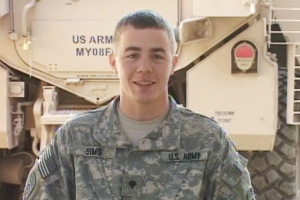
  • Isaac Sims killed in “gun fight” with police

    Isacc Sims

    Devil In Baggy Pants sends us a link from Time about his friend, Isaac Sims, an 82d Airborne Division vet of the Iraq War. It looks like he was gunned down by police in Kansas City.

    Tortured by symptoms of PTSD, turned away by an overbooked Veterans Administration hospital—his mother says she pleaded with doctors to let him sleep on the hospital floor—Sims was shot by Kansas City police on Sunday after they answered a neighbor’s 911 call. Police say Sims was firing a gun from inside his parents’ home and was killed when he moved to the garage and leveled the weapon at the SWAT team.

    Family members don’t believe that the 23-year-old veteran was a threat to police. “With his sniper training, if he was shooting at them he would’ve hit them,” his sister Shawnda Anderson told TIME. But everyone could agree that the root cause of the confrontation was that Staff Sergeant Sims was falling to pieces, and felt like he had nowhere to turn.

    It sounds to me that it more of “suicide by cops” situation, especially since none of the police were injured and folks who are victims of PTS are a bigger danger to themselves than they are to others.

    In April, after pleading guilty to two counts of domestic violence, Sims came under the supervision of Municipal Court Presiding Judge Ardie Bland. Widely admired for his work with troubled veterans, Bland placed Sims on probation through a program jointly run by the court and the V.A. Launched in 2009, the Veterans’ Treatment Court tries to restore veterans to “law abiding, productive lives within the country they have defended,” according to municipal court spokesperson Benita Jones. The probation was to include intensive treatment, random drug testing, and frequent reviews.

    […]

    Instead, the intensive treatment envisioned by the special court failed to materialize in time.

  • Remembering Our Forgotten Dead from Vietnam

    The Vietnam War claimed over 58,000 American men and women in uniform (the officially-recognized total today is 58,220).  It claimed a far greater number of Vietnamese.  This much we all know.

    Those US military personnel who died as a result of the “official” Vietnam War are permanently memorialized in Washington, DC, at the Vietnam Veterans Memorial.  That’s fitting, and the site is indeed an appropriate memorial for the Vietnam War.

    Visiting The Wall is indeed a moving experience.  This too is relatively well-known.

    Two other things are less well known.  The first “official” US death of the Vietnam war has changed over time.  Further, the Vietnam Veterans Memorial does not list all Americans who died while serving the nation in Vietnam.

    . . .

    The first “official” American death of the Vietnam War has changed over time. Four different individuals have been considered the first official US war dead from Vietnam.

    The database of war dead from the Vietnam Veterans Memorial initially was to use a start date of 1 January 1961.  However, that decision was changed prior to the opening of the memorial.   MAJ Dale R. Buis and MSG Chester M. Ovnand, US Army – who died in a Vietcong attack at Bien Hoa, Vietnam, on 8 July 1959 – were originally considered the first US dead from the Vietnam War.

    This changed in 1983, when CPT Harry G. Cramer, Jr., US Army, was deemed to be the “first” US military death of the Vietnam War.  CPT Cramer was killed at Nha Trang during a Vietcong attack on 21 October 1957 (accounts differ as to whether his death was a direct result of the attack or an accident which occurred concurrent with the attack).  His name was approved for addition to the Vietnam War Memorial.  CPT Cramer’s name was reportedly added out-of-sequence to the center section (stone 1E) at his son’s request.

    In 1999 the “official” start date for casualties from the Vietnam War was again changed.  The start date was now set to coincide with the creation of the Military Assistance Advisory Group – Vietnam as a separate headquarters on 1 November 1955  (MAAG-V had previously been a part of the Military Assistance Advisory Group – Indochina).  This change in turn made TSgt Richard B. Fitzgibbon, Jr., USAF – who was murdered in Vietnam on 8 June 1956 – the fist officially-recognized US military death of the Vietnam War.  He is so recognized today.

    . . .

    There are also other Americans who died in Vietnam while serving our nation.  But because they were not in uniform – or because they died at enemy hands before the war “officially” began – they are not formally recognized by the US government as being Vietnam War casualties.  They are thus not included among the 58,220 “official” Vietnam War casualties.

    The list of such “unofficial” war dead is not a particularly short one.  The US Merchant Marine lost 56 sailors while supporting operations in Vietnam.  The CIA lost 17 personnel in due to the conflict in Southeast Asianot counting more than 30 Air America personnel who died in Southeast Asia or the two CAT employees lost prior to the official start date of the Vietnam War (more on these two below).  USAID lost 37 personnel during the Vietnam War – including one who later posthumously was awarded both the Presidential Medal of Freedom the Distinguished Service Cross.  And at least 22 American journalists died in the Vietnam War as well, along with a number of other civilians unaffiliated with the US government.

    The list of unofficial Vietnam War dead is not all male, either.  Besides the eight US military women who died in Vietnam (and whose names are included on the Vietnam Soldiers Memorial), if one includes the 5 April 1975 crash of a US C-5A aircraft at Da Nang during Operation Babylift at least 59 US civilian women also died due to the Vietnam War.  Many were US civilian government employees; a number of them died as the direct result of hostile action.

    Time and space does not permit a comprehensive listing of all of these individuals, nor a full discussion.  I’m not sure a comprehensive list of such unofficial US Vietnam War dead even exists.

    Still, I’d like to relate five cases.  Collectively, IMO they’re representative of those others who died while serving this country in Vietnam – but for one reason or another, aren’t remembered as “official” Vietnam War dead.

    IMO, they are our forgotten Vietnam dead.

    . . .

    Shortly after the end of World War II – on 26 September 1945 – an American soldier was killed in Vietnam.  He was the first US citizen to die at the hands of communist Vietnamese forces.

    His name was LTC A. Peter Dewey, US Army.  He was the son of US Congressman Charles S. Dewey.  He was also a distant relative of Thomas A. Dewey, who would be a candidate for POTUS in 1948.

    LTC Dewey was a member of the OSS.  He was serving a post-World War II assignment to Vietnam at the time as his demise.

    LTC Dewey was killed while returning to Saigon from what is today Tan Son Nhut International Airport (then Tan Son Nhut Airfield) in a Viet Minh ambush.  The Viet Minh afterwards claimed it was a case of mistaken identity, and that they mistook LTC Dewey for a French soldier.  (Dewey spoke French, and had indeed yelled in French at three individuals near the ambush site immediately before the ambush occurred.)  The other US officer accompanying him was not injured.

    At the time he died, LTC Dewey was awaiting transportation to leave Vietnam.  The aircraft on which he was originally to depart Vietnam that day had been delayed.  He was returning from Tan Son Nhut to the OSS villa in Saigon for lunch when he was ambushed and killed.

    LTC Dewey’s body was never recovered. Vietnamese historical accounts indicate it was dumped by the Viet Minh in a nearby river.

    At the time, the French were US allies.  The Viet Minh were then communist-led rebels opposing the French.

    LTC Dewey was killed in the line of duty, by forces hostile to a US ally, in Vietnam.  We later fought those same hostile forces ourselves.  But because his death occurred prior to the “official” start date of the US Vietnam War Era, he is not listed on the Vietnam Veterans Memorial, nor is he officially recognized as a US war casualty in Vietnam.

    Rest in peace, my elder brother-in-arms.  Rest in peace.

    . . .

    Two American civilians were killed in action while serving our country during Vietnam.  They died prior to the start of the “official” Vietnam War era.  Because of this – plus the fact that they were civilians – they are not officially recognized as US casualties of the Vietnam War.

    During the Battle of Dien Bien Phu, the CIA (through its front operation Civil Air Transport, or CAT) provided aerial resupply for French forces.  CAT pilots, who were working for the CIA but technically were not CIA employees in a legal sense, flew these missions.

    Two such US pilots working for the CIA were killed on 6 May 1954, during the final resupply mission at Dien Bien Phu. Their names were James B. McGovern, Jr., and Wallace Buford.

    McGovern and Buford’s final mission was to air-deliver essential supplies and equipment (some accounts say a howitzer, while other accounts say ammunition) to besieged French forces at Dien Bien Phu.  Their aircraft crashed after being hit by Viet Minh antiaircraft fire.

    Their aircraft was hit twice by 37mm antiaircraft fire over Dien Bien Phu and was badly damaged.  Nonetheless, they nursed their damaged aircraft back towards a friendly airstrip in what is today Laos.  That airstrip was a bit over 75 miles away.

    They made it roughly 75 miles.  Unfortunately, less than a mile away from that airfield , one of their aircraft’s wingtips clipped a tree.

    They did not make the airstrip.

    McGovern and Buford died in the crash.  Reputedly McGovern’s final radio transmission, shortly before impact, was:  “Looks like this is it, son.”

    McGovern was 32 years old.  Buford was 28.

    Two passengers in the aircraft – a Malaysian paratrooper and a French officer, 2LT Jean Arlaux – were injured, but survived the crash.  The Malaysian paratrooper later died of his injuries.

    Arlaux recovered from his injures, and later retired from the French Army as a Colonel.  His account of the mission can be found here.

    McGovern’s body was recovered in 2002; his remains were positively identified in 2006.  He was buried in Arlington National Cemetery on 24 May 2007.

    Sadly, Buford’s remains have not been recovered to date.

    Like LTC Dewey, these two men also died at the hands of communist forces in Vietnam.  At the time, they too were performing official duties on behalf of the US government.  And like LTC Dewey, these individuals’ deaths also predated the “official” start date of the Vietnam War Era.  They are also not memorialized on the Vietnam Veterans Memorial, nor are they officially recognized as being US casualties of war in Vietnam.

    The government of France posthumously awarded McGovern, Buford, and all other surviving CAT pilots the Legion of Honor on 24 February 2005.  This award was made in recognition of their efforts in support of French forces at Dien Bien Phu.

    As I’ve stated elsewhere:  the French indeed have their faults.  But ingratitude and lack of a sense of honor don’t seem to be among those faults.

    . . .

    Barbara Ann Robbins was a civilian employee of the CIA.  She died in the line of duty on 30 March 1965 in Saigon.

    Robbins had been raised in North Dakota and Colorado.  She is regarded as the first US woman killed in the line of duty during the Vietnam War.

    Robbins was working under diplomatic cover for the CIA at the US embassy in Saigon.  On 30 March 1965, a car bomb exploded outside the US embassy.  Robbins – along with a US Navy storekeeper from the Philippines and 19 Vietnamese citizens – were killed.

    Robbins was one of the original 31 CIA employees lost in the line of duty who were honored with stars on the Agency’s Wall of Honor at its creation in 1974.  However, because of her assignment’s use of diplomatic cover it was not until May 2011 that Robbins’ name was formally added to the CIA’s Book of Honor and her role as an Agency employee formally and publicly acknowledged.

    Robbins volunteered for assignment to Vietnam; it was her first time overseas.  At the time of her death, she was not yet 22 years old.  She was the first female CIA employee to be killed in action.  To date, she is also believed to be the youngest CIA employee to have died in action.

    . . .

    A number of US civilian personnel received US military decorations in Vietnam.  Other than the Medal of Honor, policy at the time did not forbid award of the BSM or other US military decorations for valor to civilians serving with the military (the legal prohibition on receipt of the BSM by civilians dates only to 2000).

    While rare, the award of military decorations to civilians is not unknown.  US war correspondent Joe Galloway was awarded a BSM w/V Device for his actions at the Battle of Ia Drang.  The entertainer Joe Brown likewise was awarded a BSM during World War II for his extensive efforts supporting troop morale.

    However, only one US civilian was awarded the Distinguished Service Cross for service in Vietnam.  That individual was John Paul Vann.

    Vann served in the Army for 20 years, joining at age 18 in 1943 and receiving training as a pilot (World War II ended before he saw combat).  When the US Air Force became an independent service, Vann stayed with the Army, transferring to the Infantry.

    Vann saw combat in Korea, first at the Pusan perimeter and later as commander of the 8th Army Ranger Company for about 3 months.  He saw peacetime duty between Korea and Vietnam, then was assigned to Vietnam as an Advisor to the South Vietnamese Army

    Vann oversaw the disastrous ARVN effort at Ap Bac.  He became disillusioned with the US approach to the Vietnam War, becoming a rather vocal critic of US Vietnam operations.  He retired from active duty in 1963 as a Lieutenant Colonel.

    Roughly two years later, Vann returned to Vietnam as a civilian with USAID.  He first served as a provincial advisor; he soon became deputy director for the Civil Operations and Revolutionary Development Support (CORDS) program in one of Vietnam’s designated military regions.  Over a period of several years, he served in a number of high-level civilian positions in multiple regions of Vietnam.  His last assignment was as Senior US Advisor for Region II – his civilian grade was equivalent to a Major General – and while so serving became the first civilian to command US troops in combat.

    Vann was killed in a helicopter crash shortly after the Battle of Kontum.  He was posthumously awarded the Distinguished Service Cross for his actions during that battle (as a civilian, he was not eligible to be considered for the Medal of Honor).  He was also posthumously awarded the Presidential Medal of Freedom.

    At the time of his death, Vann had been serving his nation in Vietnam virtually continuously for over seven years (March 1965 – May 1972).

    . . .

    Should you chance to visit the Vietnam War Memorial in Washington, DC – or any other state or local Vietnam Memorial – please take a moment to remember our fallen from that war.  If you’re so inclined, say a prayer for their collective souls.

    But while you’re at it, please also take a second moment, and remember those other Americans who died in Vietnam – those whose names don’t appear on The Wall.  Maybe say a second prayer for these forgotten men and women as well if you can spare the time.  They also were killed by our enemies in Vietnam while serving our nation.

    They’re not listed among the “official” US war casualties in Vietnam.  But it only seems right that they should be remembered too.


    Author’s Notes

    1.  Three other US females – one an infant, two adults – died in Vietnam prior to Ms. Robbins death.  Two of them may have better claim to being the first US female killed due to enemy action in Vietnam. 

    Elanor Ardell Vietti was a US missionary serving at a leprosarium in Ban Me Thuot, Vietham.  She and two male missionaries – Dan Gerber and Archie Mitchell – were captured in a Viet Cong raid on 30 May 1962.  They were never seen again. 

    Janie A. Mackil was a 5-month-old infant when she died.  She appears to have been the infant daughter of US missionaries.  She was killed in an ambush in Dalat, Vietnam, on 4 March 1963.

    The third US woman to die in Vietnam prior to Robbins death – US Navy employee Regina Williams – died of a heart attack in Saigon during 1964.

    Ms. Robbins does, however, appear to be the first female US government employee – civilian or military – killed in the line of duty in Vietnam by enemy forces.

    2.  At least one other member of the US military died in Vietnam after 1 November 1955 who is currently not officially recognized as a Vietnam War casualty:  SSgt. Edward C. Clarke, USAF.  SSgt. Clarke died on the night of 8-9 July 1956 not long after he had murdered TSgt. Richard B. Fitzgibbon; whether his death occurred before or after midnight is not clear.  He died after falling off a balcony while attempting to escape Vietnamese police trying to take him into custody.  While technically eligible for inclusion on Vietnam War casualty rolls and on the Vietnam Veterans Memorial, to date TSgt. Clarke apparently has not been so honored – rightfully so IMO.