Category: Historical

  • Forty Years Ago

    At 2:15PM on 9 November 1975, the SS Edmund Fitzgerald – carrying a cargo of 26,116 long tons of taconite pellets – departed Superior, WI.  She was bound for a steel mill at Zug Island, MI (near Detroit).

    The following day, the ship encountered an early November gale on Lake Superior.  She did not complete her voyage.

    The SS Edmund Fitzgerald was lost shortly after 7:10PM on 10 November 2015 1975, going down roughly 15 miles NNE of Whitefish Point, MI.  All 29 on board perished.

    Rest in peace, men.


  • Two Amazing Feats of Marksmanship of Yesteryear

    Marksmanship is an essential military skill. And in truth, hitting a man-sized target out to around 300m isn’t that difficult with a well-zeroed weapon.

    But hitting a target of that size at extreme ranges is a different story. Doing that takes extraordinary marksmanship skill.

    Wikipedia maintains a reasonable list of the longest verified sniper kills in history. Two shots in particular on that list stand out.

    They stand out because they were done over 140 and 150 years ago, repectively.

    In late June 1874, buffalo hunter Billy Dixon performed such a shot – at Adobe Walls, Texas. Dixon and a party of settlers had been besieged by a party of Native Americans under Chief Quanah Parker. The siege lasted 3 days. During the siege, Dixon – using a borrowed Sharps .50-90 buffalo rifle – fired at a group of warriors near Chief Parker. His third shot dropped one of the warriors. The siege ended shortly afterwards, and the settlement was thereafter left alone.

    The distance for Dixon’s shot is credited today as being 1,406 meters – nearly a mile. It’s still the 11th longest confirmed sniper kill in history.

    Dixon later worked for the Army as a civilian scout. He was one of only 8 civilians ever awarded the Medal of Honor.

    1400+ meters, with a borrowed rifle, on the 3rd shot.  Amazing.

    And IMO, there’s one shot that’s even more amazing.

    During the US Civil War, Union forces blockaded the Confederate port of Charleston. During this blockade, Union forces occupied Battery Gregg; Confederate forces occupied Fort Sumner – 1,390 yards (1,271 meters) away. On 5 December 1864, an unnamed Confederate sharpshooter shooting from Fort Sumner – believed to have been using a muzzle-loading Whitworth rifle firing hexagonal .451 cal bulletsshot and killed a Union soldier at Battery Gregg. This shot today still ranks as the 14th longest confirmed sniper kill in history.

    Think about that:  over 1,250 meters – with a muzzle-loading rifle.  Also amazing.

    No confirmed sniper kills in World War I, World War II, or Korea (and only one from Vietnam) are longer than these two amazing shots from 140+ years ago. For close to 100 years – until Marine sniper Carlos Hathcock’s legendary shot in Vietnam in 1967 – these two shots from 1864 and 1874 ranked as the longest confirmed sniper kills in history.

  • ABCMR Supports Conner MoH Upgrade

    Last March, Jonn wrote about a Federal court denying the request to upgrade the Distinguished Service Cross awarded during World War II to 1LT Garlin Murl Conner to the Medal of Honor.  The denial was due to strictly legal grounds, based on the expiration of all statutes of limitations for appealing a previous action.

    Since then, there has been further action in the matter.  The case was further appealed, to a 3-judge panel of the 6th Circuit Court of Appeals.  That panel in turn partially reversed the earlier court’s decision, ordering the matter into mediation.

    The venue apparently chosen for mediation was the Army Board for Correction of Military Records.  The ABCMR heard the case; last week, it rendered its decision.

    The ABCMR recommended that the Senior Army Decorations Board recommend an upgrade of Conner’s DSC to the Medal of Honor.

    This isn’t by any means a final decision.  The Senior Army Decorations Board must make its recommendation; from there, assuming the Senior Army Decorations Board agrees with the ABCMR it would go to the Senate Armed Services Committee for further consideration.  The SASC would then make a recommendation to the POTUS.

    The full process could well take many months longer.  But this ABCMR decision supporting the upgrade is a key step forward, and may well be the critical turning point in the matter.

    Fox has a longish article on the matter; it has a brief summary of Conner’s World War II heroism (his DSC was not his only decoration for valor), and also details briefly his actions for which he received his DSC. Reading the article is well worth your time.  If you do so, be prepared to be awed.

    Let’s hope the Senior Army Decorations Board and SASC move out smartly here.  Based on accounts of his actions, it appears that Conner’s heroism on 24 January 1945 indeed was of a nature “above and beyond the call of duty”.  Though recognition will now be posthumous, that heroism should be properly recognized.  “Poor is the nation that has no heroes, but beggared is one that has and forgets them.”

    And special kudos to Richard Chilton, himself a combat veteran, who has spearheaded recent efforts to have Conner receive the recognition he is due.  Well done, sir.  Well done indeed.

  • A Word of Caution Regarding DPAA’s Korean War “POW/MIA Lists”

    The Defense POW/MIA Accounting Agency (DPAA) has the mission of accounting for those who never came home. And they do a credibly good job IMO of doing so.

    However, here’s a caution regarding some of the information on their website.

    DPAA maintains publicly-accessible lists of those US personnel still missing from past conflicts going back to World War II. These lists are excellent sources, and seem to be kept reasonably well up-to-date as additional personnel from those conflicts are identified.

    These lists are differently structured for World War II, Korea, and Vietnam. A bit of background about each of those lists is essential to understand what the lists are actually telling you. I decided to write this article to give that background.

    World War II.

    The DPAA World War II lists (they don’t provide a consolidated one) are simple to understand, if perhaps not so easy to use. The DPAA World War II lists (found here) list only those who have not yet been formally accounted for – e.g., whose remains were never recovered.  These lists are clearly identified as what they are – lists of those still missing.  DPAA does not provide a list of POWs who returned alive, escaped, etc . . . , from World War II, and none of their lists would lead one to believe that’s its subject.

    The DPAA World War II lists are broken out alphabetically and by service, so there are a relatively large number of individual lists; as a result, they’re not necessarily too easy to use. But if you know an individual’s name, finding out whether they’re still missing is fairly straightforward (if perhaps a bit tedious).

    Vietnam.

    DPAA provides numerous lists for Vietnam  (by service, by state, etc . . . ) as well. However, for Vietnam DPAA also provides consolidated lists.  Four are IMO the most useful: the consolidated lists of Escapees, Returned, Accounted-For, and Unaccounted-For personnel. The lists’ names are self-explanatory: the Escapee list lists all personnel who escaped from their captors in SEA and returned alive to US control; the Returned list, those who returned alive from captivity at the end of the war; the Accounted-For list, all whose fate is definitively known (including escapees, returnees, and the turncoat bastard Garwood); and the Unaccounted-For list includes those who are still missing. The lists are comprehensive; thus, they’re quite useful for ferreting out fake Vietnam POW claims.  If the individual isn’t on the Escapee or Returned lists, DoD doesn’t recognize them as a Vietnam POW. Period.

    Korean War.

    DPAA also maintains a page it calls “Korean War POW/MIA Lists”.  Unfortunately, some of these Korean War lists are problematic. Bluntly:  taken at face value some of them can be hugely misleading.

    The Korean War lists are structured exactly as are the Vietnam lists; one would thus expect them to contain the same information.  One group of them does.  One does not.

    There are two types of Korean War “POW/MIA” lists: the “Accounted-For ” lists and the “Unaccounted-For”
    lists. The latter are good sources of data regarding those still missing, and appear to be both comprehensive and accurate.  However, there is a huge issue with the former group – the “Accounted-For” lists.

    On the DPAA Vietnam “Accounted-For” lists, those who escaped captivity and who returned alive from same are included in those lists; they are explicitly identified by their status code as having returned at the end of the war or to have escaped.  (They’re also broken out on separate lists for ease of review.)  In contrast, the Korean lists do not appear to include those US POWs who returned alive during/after the war, or who may have escaped from captivity during the war itself and returned to US control.

    What first tipped me off (some time ago) regarding this issue was when I looked at the consolidated Korea “Accounted For” list and found it had around 300 names (even today it only shows 322 names). This is far less than 10% of the number of US POWs documented to have returned alive during or at the end of the Korean War.

    I haven’t been able to find data on how many US personnel (if any) escaped from NK/Red Chinese captivity and returned to US control during the Korean War, or who might have been rescued by Allied forces.  However, near and after the end of the Korean War the US and NK/Red China conducted two major prisoner exchanges:  Operation Little Switch and Operation Big Switch.  Over 3,700  US personnel returned alive from POW status during these operations.

    Operation Little Switch occurred during April and May, 1953. During this exchange, 149 ill and/or wounded US POWs were returned to US control. Operation Big Switch occurred between the armistice ending the Korean War and the end of 1953; during multiple exchanges, 3,576 US personnel were repatriated. The total number of former US POWs known to have returned alive to US control in 1953 is thus at least 3,725.*

    None of the US personnel who returned in either “Switch” operation appear to be included on the Korean War “Accounted-For” lists.  Rather, those lists only appear to include the names of those whose remains were returned and/or definitively identified after the end of Operation Big Switch..  So the fact that someone (1) claims he/his dad/ his uncle/whoever is or was a Korean War POW s, when (2) their name doesn’t appear on any of the Korean War “Accounted-For” lists tells you . . . nada.  US POWs who returned alive at the end of the Korean War simply aren’t listed there.

    Why?  Dunno.  Seems to me that DoD must have a by-name list of who came back alive from POW status in Korea in its archives.  For whatever reason, apparently they’ve chosen not to make that list readily available through DPAA.  I wish they would, if for no other reason than to complete the historical record.


    * Historical Note:  per the armistice agreement ending the Korean War all POWs from both sides were given the opportunity to remain with the enemy if they so chose. A total of 3,597 US personnel were offered the opportunity to return from captivity during Operation Big Switch. Shockingly, 23 US personnel initially refused repatriation. Two later changed their minds (the Armistice agreement provided for a 90-day window during which a POW  initially declining repatriation could change their mind and opt to return home instead) and returned to US control in 1953. However, a total of 21 disloyal bastards ultimately declined repatriation to the US and opted to remain in Communist custody.  Most later decided that had been a mistake and returned to the US after several years. However, at least 4 (and possibly 5) never did. One died not long after the end of the Korean War.  The other 3 or 4 lived out the rest of their  turncoat lives under Communism.

    A well-meaning error by the military allowed those who later returned to the US to do so without facing severe legal consequences.  All of the US personnel opting to remain with the Communists were given a dishonorable discharge from the military in absentia.  When they later returned to the US, the result was that they could not be prosecuted for misconduct under the UCMJ – because due to their dishonorable discharges they were no longer in the military.  I  strongly suspect that’s why policy today is to keep the individual “on the rolls” in deserter status in such a case:  to ensure they can receive the appropriate UCMJ “tender mercies” on return.


    (A link to this article has been added to the “Military Records” button on the TAH site banner.)
  • Simply an amazing day

    Before I begin I want to thank Jonn Lilyea, for allowing me to write here. It was this access that allowed all of the things below to happen.

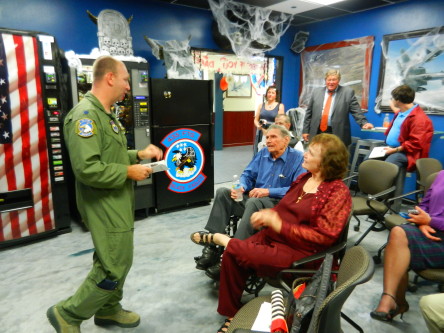
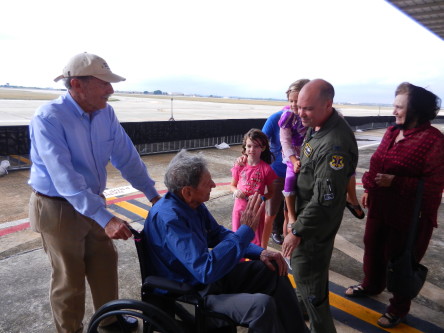
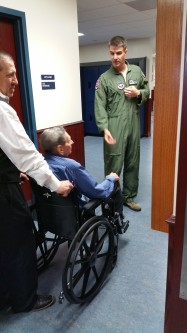
    Yesterday was simply an amazing day. I do not think that one could have planned it any better from start to finish. It started at the 12th Training Wing at Randolph Airforce Base after being escorted by the 12th Wing’s Staff Officers. The Wing was called to attention as Uncle Tommy entered the building. There was short tour going through the history of the unit from the photos on the walls. There was a presentation on what training is conducted at the 12th Training Wing and answered any questions that we had.

    12th Training Wing Uncle Tommy

    12th Wing Staff Officer  Uncle Tommy

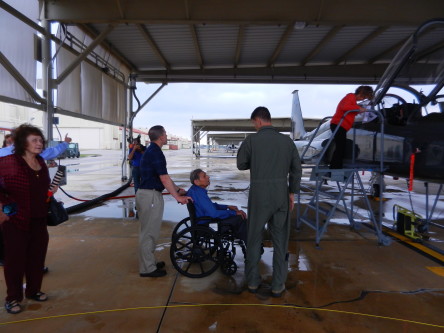
    Then we took a short break by going outside to T-38 Talon trainer and talking more about the aircraft that were being used on the base. After that we back inside and started talking about the history of the two men, the event in February 1952 and the unusual series of events that allowed this reunion to happen. There was a lot of history there to say the least.

    Uncle Tommy T-38

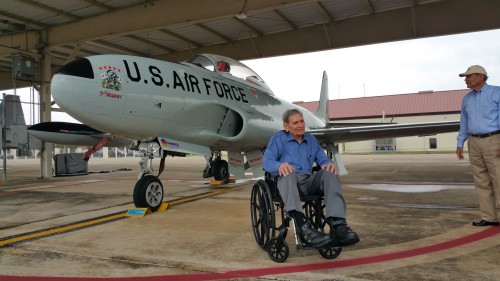
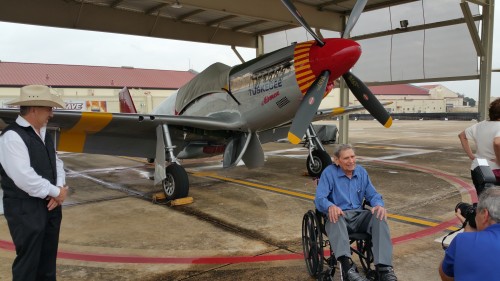
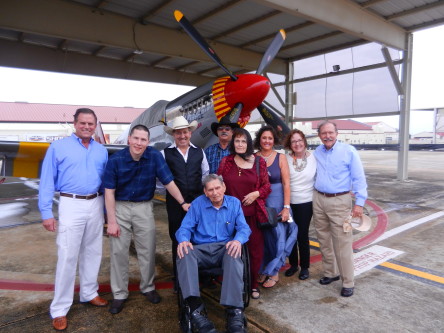
    We left the 12th Training Wing to go to where the air show was being held. The crowds were not there because we were invited to the air show rehearsal the day before. What was there was a static display of a P-51C Mustang and a T-33 Shooting Star. We managed to take many photos of Uncle Tommy with both aircraft. At this time we met with a reporting team from KSAT12, a local news group. They were filming as we were taking photos with each aircraft. ( I credited this website and Jonn for his part, I have no idea if they will link or not.)

    T-33 Uncle Tommy

    P-51C Uncle Tommy

    The Wing Commander 12th greeted us on the flight line.

    Uncle Tommy with the Wing Commander

    A few minutes later we watched the USAF Thunderbirds perform from the best seat in the house. There was some concern that the Thunderbirds were not going to be able to fly due to the weather. But the weather cleared up enough for the rehearsal to start and it was quite a show.

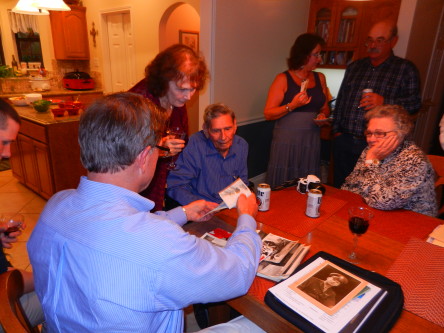
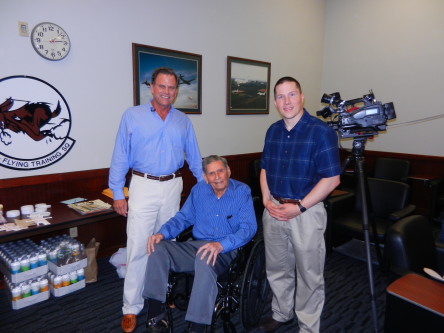
    After the conclusion of the Thunderbirds, we went inside to where Uncle Tommy and Mr. Jerry Swartz were interviewed by KSAT12. After that was over, we left the base to go to my parents’ house to celebrate Uncle Tommy’s 92nd Birthday. Mr. Jerry Swartz had managed to locate photos of the Squadron members that were with Uncle Tommy. As Mr Swartz went over each photo, Uncle Tommy would recall their call signs and stories about the crazy things that they did back then. I am going to coordinate with Mr Swartz about adding those photos to Wiki Commons with their names to help out of anyone else is looking for family members that served with the 160th Tactical Reconnaissance Squadron. Mr Swartz also found the original Flight Safety magazine that contained that storyboard write up.

    160th RTS photos Uncle Tommy

    Before everyone left, Uncle Tommy was able to facetime with my son and hear my son sing happy birthday. The only down side to all of this is “what to do for his 93rd birthday.”

    Mr. Jerry Swartz, Uncle Tommy and myself

    P-51C Uncle Tommy with family

    Update November 2nd 2015: The 12th Training Wing added more photos of the event on their facebook page.

  • PhotoShop? Pfft. Try This Civil War Equivalent.

    Here’s a photo from the Civil War.  It’s entitled “General Grant at City Point”.

    There’s only one problem:  it’s fake.  It’s the Civil War era equivalent of a modern-day Photoshopped image. The event “recorded” in the photo never happened.

    Fox has an interesting story concerning the fake photo.  It’s a short article, and IMO is well worth a few minutes of your time.

    FWIW:  it’s also IMO a better job of combining photos than that done by someone we all “know and love”.  And based on its copyright date (1902), it was done over a century earlier.

  • Vietnam Vet to Receive BSM Today

    On January 28, 1968, a US helicopter crashed in Vietnam.   It was shot down.

    There was at least one survivor.  That survivor needed assistance.

    Vernon Rose was in the Army at the time.  He was serving in Vietnam, in the vicinity of the crash.

    Rose assisted in recovery efforts.  He moved through thick brush, under enemy fire, and reached the downed aircraft. He then carried a wounded crewmember to safety.

    Rose’s heroism was noted, and he was recommended for an award. That award was approved.

    Unfortunately, through an admin foul-up the approved award was never presented to Rose.  That oversight was recently discovered.  Rose will be presented the Bronze Star Medal (presumably with “V” device) today at Fort Knox, KY.

    Well done, Mr. Rose.  Damn well done.  Thanks for being an excellent example for soldiers of today and tomorrow.

  • St. Crispin’s Day

    Since it’s Saint Crispin’s Day;

    This day is called the feast of Crispian:
    He that outlives this day and comes safe home,
    Will stand a tip-toe when this day is named,
    And rouse him at the name of Crispian.
    He that shall live this day, and see old age,
    Will yearly on the vigil feast his neighbours,
    And say, ‘To-morrow is Saint Crispian:’
    Then will he strip his sleeve and show his scars,
    And say, ‘These wounds I had on Crispin’s day.’
    Old men forget: yet all shall be forgot,
    But he’ll remember with advantages
    What feats he did that day. Then shall our names,
    Familiar in his mouth as household words,
    Harry the King, Bedford and Exeter,
    Warwick and Talbot, Salisbury and Gloucester,
    Be in their flowing cups freshly remembered.
    This story shall the good man teach his son;
    And Crispin Crispian shall ne’er go by,
    From this day to the ending of the world,
    But we in it shall be rememberèd;
    We few, we happy few, we band of brothers;
    For he to-day that sheds his blood with me
    Shall be my brother; be he ne’er so vile
    This day shall gentle his condition:
    And gentlemen in England, now a-bed
    Shall think themselves accursed they were not here,
    And hold their manhoods cheap whiles any speaks
    That fought with us upon Saint Crispin’s day.

    From this day to the ending of the world…he…that sheds his blood with me shall be my brother.