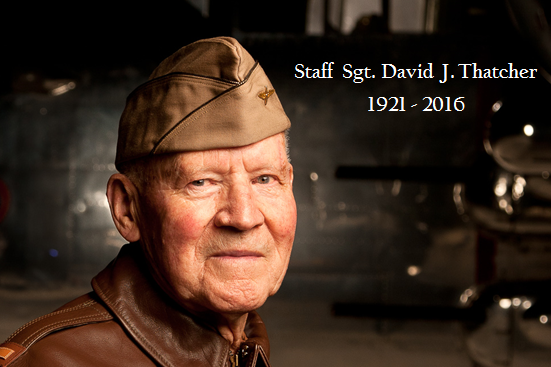
The Doolittle Tokyo Raiders announced the passing of Staff Sergeant David J. Thatcher, 94, who was the engineer-gunner for Crew 7 (Ruptured Duck). That leaves only Lieutenant Colonel Richard Cole, the co-pilot for Crew 1 as the sole survivor of that secret mission to payback Japan for the raid on Pearl Harbor.
After bombing targets in Tokyo, [The pilot of #7, Lieutenant Ted] Lawson headed the plane towards China. Running low on fuel, Lawson tried to land the plane on a beach in darkness and heavy rain, but instead crashed in the surf after hitting a wave causing the plane to flip over. The crash seriously injured all the members of the crew except for Thatcher, who was briefly knocked out in the crash but suffered only a bump to his head.
After regaining consciousness and making it to shore, Thatcher saved the lives of his crew by gathering them on the beach, administering first aid and making contact with some friendly Chinese guerillas who had come upon the crew. He convinced the guerillas to take the crew to safety in inland China. Over the next few days, the crew repeatedly barely escaped capture by Japanese patrols searching for the Raiders. For his bravery in saving the lives of his crew, Thatcher was awarded the Silver Star. His other decorations included the Distinguished Flying Cross, Air Medal with four Oak Leaf Clusters, and the Chinese Army, Navy and Air Corps Medal, Class A, 1st Grade.
After they were rescued, Thatcher went on to fly 26 more missions over Africa and Europe until the war ended. He was discharged in 1945
According to the Facebook announcement, Thatcher married to the love of his life for 70 years, Margaret Dawn Goddard Thatcher, and worked for the Post Office until his retirement in 1980.
A funeral service will be held at 10 a.m. on Monday, June 27 at Garden City Funeral Home in Missoula. A full military ceremony with honors will follow at 11:45 a.m. at Sunset Memorial Gardens where Thatcher will be buried. In lieu of flowers, memorials can be given to the Doolittle Raiders Foundation for scholarships or the River Valley Church, 308 W. Pine St., Missoula, MT 59803.
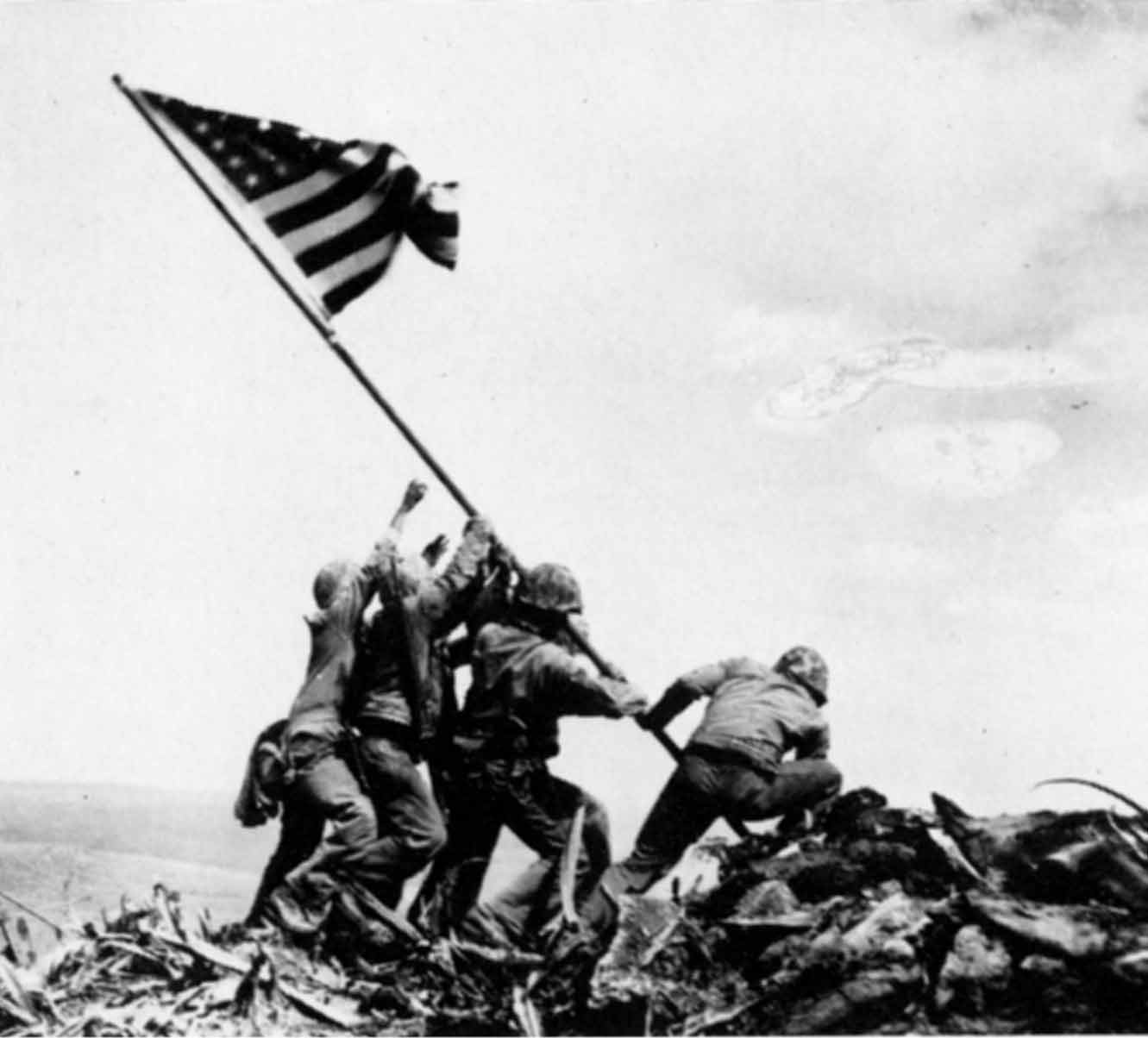
I heard a few months ago that there was an investigation into the identification of one of the Marines in the iconic photo taken on top of Mount Surabachi over the battle of Iwo Jima. I figured that I’d wait until the investigation was ended and it looks like, sure enough, one of the Marines was misidentified, according to CNN;
The investigation concluded that Navy Pharmacist’s Mate 2nd Class John Bradley was not in the photograph. Instead, the Marine Corps investigation identified the man who was in the photo: Private 1st Class Harold Schultz, from Detroit, Michigan.
Schultz never spoke publicly about being in the photo before he died in 1995.
According to Schultz’ stepdaughter, Dezreen MacDowell, remembers that he mentioned it once, from USAToday;
MacDowell now she recalls he said he was one of the flag raisers over dinner in the early 1990s when they were discussing the war in the Pacific.
“Harold, you are a hero,” she said she told him. “Not really. I was a Marine,” he said.
She described him as quiet and self-effacing.
John Bradley’s son says that his father had never made the claim that he was one of the Marines in the photo. From ABC News;
Bradley said that until he died in 1994, his father never spoke about his experiences on Iwo Jima, always changing the subject when he would ask him about what he went through.
“My father never independently said he was in that photo,” Bradley said. “He was lying in a hospital bed with post-traumatic stress after one of the worst battles in the history of the United States and the Marines approached him and said here you are in a photo, we’ve determined you’re in a photo. Then he finds himself in the Oval Office and the president is telling him he’s in a photo.”
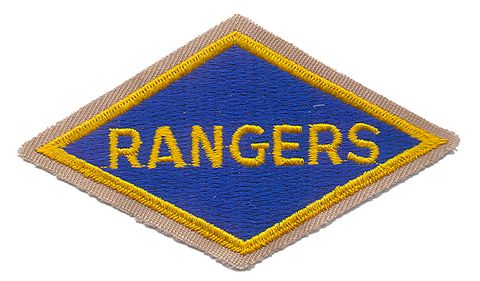
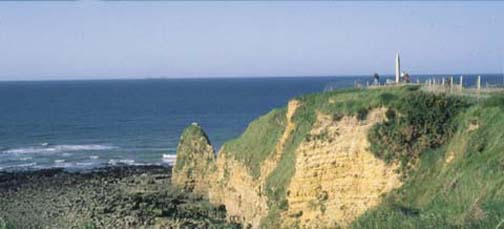
The Ranger Group, attached to the 116th Infantry and commanded by Lt. Col. James E. Rudder, was given the mission to capture Pointe du Hoc and destroy the guns. The Ranger Group was made up of two battalions: the 2d Rangers, under direct command of Col. Rudder, and the 5th Rangers, under Lt. Col. Max F. Schneider. Three companies (D, E, and F) of the 2d Battalion (Task Force A) were to land from the sea at H-Hour and assault the cliff position at Pointe du Hoc. The main Ranger force (5th Battalion and Companies A and B of the 2d, comprising Task Force B) would wait off shore for a signal of success, then land at the Point. The Ranger Group would then move inland, cut the coastal highway connecting Grandcamp and Vierville, and await the arrival of the 116th Infantry from Vierville before pushing west toward Grandcamp and Maisy.
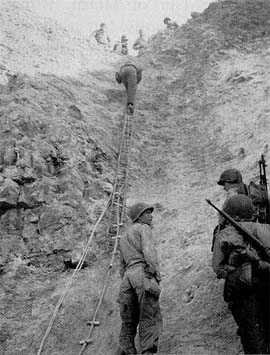
One DUKW was hit and sunk by 20-mm fire from a cliff position near the Point. The nine surviving LCAs came in and managed to land in parallel on a 400-yard front on the east side of Point du Hoc, landing about 0705. Allied naval fire had been lifted since H-Hour, giving the Germans above the cliff time to recover. Scattered small-arms fire and automatic fire from a flanking machine-gun position hammered the LCAs, causing about fifteen casualties as the Rangers debarked on the heavily cratered strip of beach. The grapnel rockets were fired immediately on touchdown. Some of the water-soaked ropes failed to carry over the cliff, but only one craft failed to get at least one grapnel to the edge. In one or two cases, the demountable extension ladders were used. The DUKWs came in but could not get across the cratered beach, and from the water’s edge their extension ladders would not reach the top of the cliff.
Despite all difficulties, the Rangers used the ropes and ladders to scramble up the cliff. The German defenders were shocked by the bombardment and improbable assault, but quickly responded by cutting as many ropes as they could. They rushed to the cliff edge and poured direct rifle and machine gun fire on the Rangers, augmented by grenades tossed down the slope. The Rangers never broke, continuing to climb amidst the fire as Ranger BAR men picked off any exposed Germans. The destroyer USS Satterlee (DD-626) observed the Rangers’ precarious position, closed to 1500 yards and took the cliff top under direct fire from all guns, a considerable assist at a crucial time.
Within ten minutes of the landing the first Americans reached the top of the cliffs.
I may just watch “The Longest Day” tonight. “What does ‘bitte, bitte’ mean?”
What follows will seem fantastic – much like any other “no sh!t” story. But with this tale there’s a difference.
In this case, what I’m about to describe actually happened. And it’s fully documented.
I’m about to relate the story of the US Air Force’s “Cornfield Bomber.”
. . .
On 2 February 1970, four F-106As from the 71st Fighter Interceptor Squadron, Malmstrom AFB, Montana, were scheduled for a training mission. The mission was to make history – but in a way that none could foresee.
The mission was scheduled to be a “2-on-2 combat maneuvering exercise”. As the name implies, two teams of two aircraft each would engage, attempting to get in position to score a simulated air-to-air “kill”.
Before takeoff, one aircraft experienced a mechanical issue – an on-ramp drag chute malfunction. To preclude scrubbing the mission, the day’s flight activities were altered to “2-on-1 combat maneuvering exercise”.
The remaining 3 aircraft took off, ascended to altitude – and engaged. The single aircraft made a high-speed approach at the other two, then went vertical. His two opponents followed.
. . .
In the maneuvering that followed, the pilot of one aircraft in the two-plane group – Capt. Gary Faust – appears to have “pushed the envelope” a bit too much while maneuvering. His aircraft stalled, then entered what aviators term a “flat spin” at approximately 35,000 feet elevation.
Now, I’m not a pilot. But even I know that a flat spin is some seriously bad juju. It’s essentially God (or Budda, Rama, Fate, Gaia, the Flying Spaghetti Monster, or whoever/whatever entity you choose to worship) telling you, “You are now in deep (trouble). You have a very short time to figure this out or we’ll be meeting in person.”
Faust attempted to recover. He was unsuccessful. So after falling somewhere between 21,000 and 27,000 feet while in said flat spin, he ejected.
Faust’s ejection was successful. He deployed his parachute, and drifted in his parachute into the local Bear Paw Mountains. He was rescued by local residents using snowmobiles.
. . .
Now, when an aircraft’s pilot ejects three things happen to the aircraft. First, the weight and center of gravity change. Second, the ejection seat imparts a substantial downward force to the front of the aircraft. And, third, loss of canopy changes the aerodynamics of the aircraft somewhat.
The combination of those changes caused something quite remarkable. On its own, Faust’s aircraft came out of its spin. It then began to glide – straight and level – at around 175 knots.
It seems that one of the things that Faust had done during his attempts at recovery was to put his aircraft’s control surfaces into “takeoff trim” settings. These settings turned out to be virtually perfect on the F-106A for gliding under the conditions the bird now exhibited (no pilot/ejection seat/canopy, idling engine producing minimum thrust, straight and level).
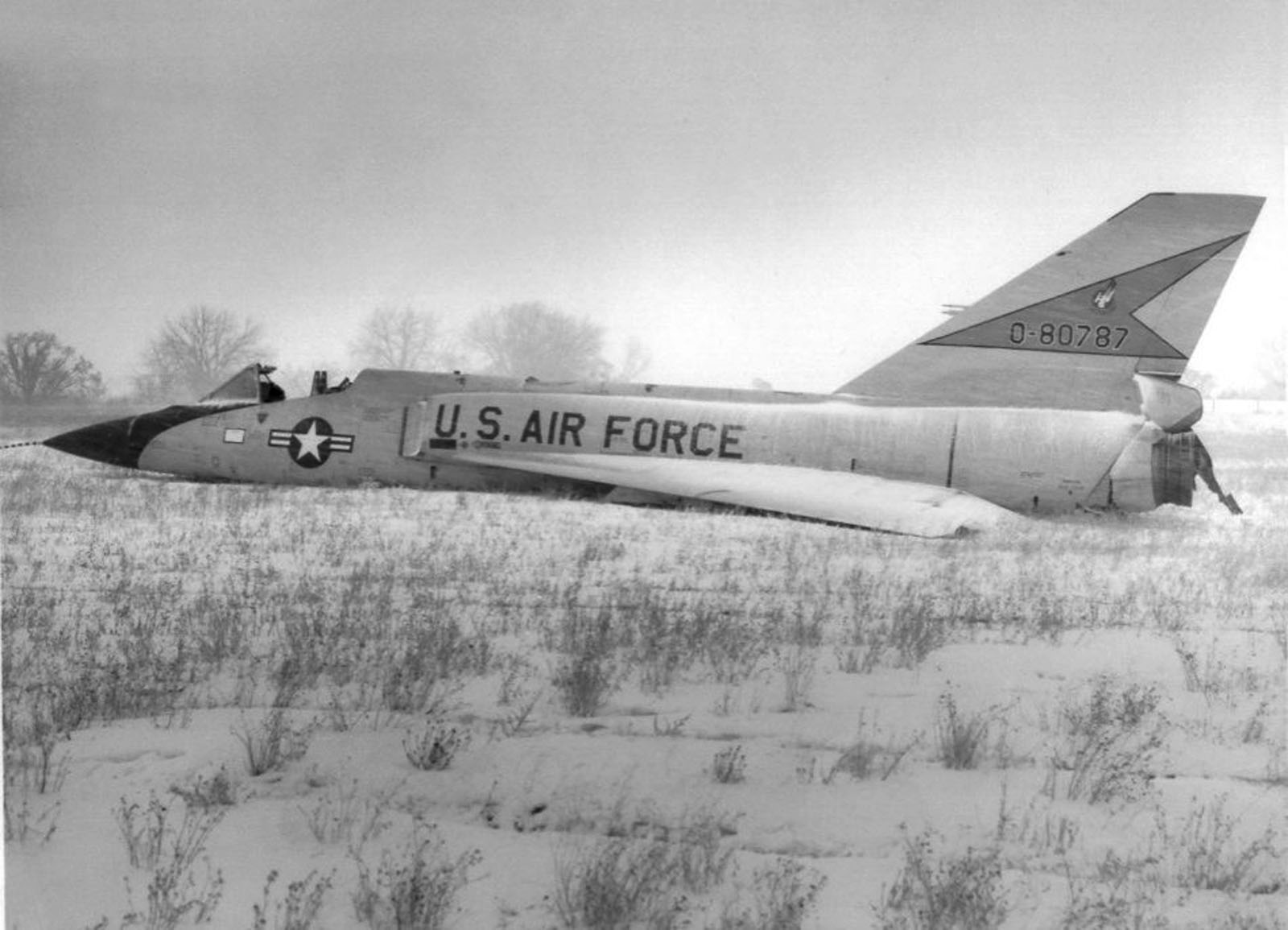
The aircraft – now somewhere between about 8,000 and 14,000 AGL (accounts vary), then flew/glided, straight and level, for a number of miles. It approached the ground in farming country near the town of Big Sandy, MT.
Being February in Montana, the ground was covered with several inches of snow. The aircraft touched down in a farmer’s field (one account says alfalfa, another wheat).
After touching down, the aircraft skidded a substantial distance along the snow-covered ground. A low stone wall was blocking its path. Somehow, with no pilot it turned about 20 degrees right while skidding and skidded through a gap in the wall. It came to rest.
The engine was still running when local LE authorities reached it. They contacted the USAF, who advised them to simply let the aircraft continue to idle until it ran out of fuel – which it did, about 1 hour and 45 minutes later.
. . .
USAF personnel went to the site afterwards and inspected the aircraft. It indeed seemed effectively intact. However, there was no good way on-site to determine the amount of damage to the aircraft’s underside.
The aircraft was partially disassembled, then recovered by the Air Force. Amazingly, there wasn’t much more than minor damage to the underside of the aircraft. One of those involved with recovery efforts reportedly commented that if there had been any less damage, they could have simply flown the aircraft out (there was a paved road nearby that was straight and level enough to allow that).
The aircraft was sent to McClellan AFB, California, for depot inspection and repair. (Ya think?) It was determined to be repairable, and was indeed repaired and return to service. Capt. Faust reportedly later flew the same aircraft while the aircraft was assigned to a unit at Tyndall AFB, Florida, and he was TDY there for training several years later.
. . .
Well, “That’s the story, and I’m sticking to it.” (smile)
But perhaps you think I’m “BS-ing” you? Well, if you think that – read/watch the links/videos below. They document the fact that the incident described here really happened.
The aircraft in question was tail number 58-0787. For unclear reasons, it came to be known as the “Cornfield Bomber” – though it was not a bomber and did not self-land in a cornfield. It today is on display at the National Museum of the United States Air Force.
Sometimes truth is seriously stranger than fiction.
Author’s Note: the title of this article is one version of the reported radio transmission made in jest by USAF Maj. Jimmy Lowe, flying as Faust’s wingman that day, on observing the aircraft come out of its spin and fly away on its own after Faust ejected.
(With appropriate apologies to Donald Roesner and Blue Öyster Cult. Regular TAH readers should recognize the inspiration for what follows.)
He said, good times now have come Threat from Karl Marx now is gone No one should fear the Commie Not in the wind, the sun or the rain . . . never be like they were Come on people . . . don’t fear the Commie Come talk to the hand . . . don’t fear the Commie They’re no longer a threat . . . don’t fear the Commie Baby that’s the plan . . .
Da da da da da Da da da da da
Dissidence is done Once was here but now is gone The kulaks and “enemies” Are in the gulag for eternity . . . kulaks and “enemies” 40,000 men and women everyday . . . like kulaks and “enemies” 40,000 men and women everyday . . . redefine “happiness” Another 40,000 coming everyday . . . you can be like they are Come on people . . . don’t fear the Commie Come talk to the hand . . . don’t fear the Commie They’re no longer a threat . . . don’t fear the Commie Baby that’s the plan . . .
Da da da da da Da da da da da
Ignore those chains around your heels Come with us to the killing fields Or to Hotel Lubyanka Where you check in but you never check out Your door kicked open when they appear Dissenting voices shall “disappear” The curtains part and then they appear . . . saying don’t be afraid There will be no pain . . . still they showed their fear They forced them to their knees . . . as they started to cry “Useful idiots” said goodbye . . . now would become like they are Cocked pistols in their hands . . . one bullet enters the brain Come on people . . . don’t fear the Commie
“Those who cannot remember the past are condemned to repeat it.”
— George Santayana
Author’s Note: the “one bullet enters the brain” line above is not a reference to suicide. A single pistol shot to the back of the head of a restrained prisoner (some accounts indicate the prisoner was forced to kneel) was the method of execution used by the NKVD at the Ostashkov prisoner of war camp during the Katyn massacre and, reputedly, elsewhere. The KGB also reputedly used the method.
Any sane person who is not a moron fears any and all authoritarian regimes. Historically, Communism taking power has uniformly resulted in one thing: the establishment of an authoritarian regime that has little or no respect for human rights – or for personal freedom.
According to KTLA, 95-year-old Lou Tirado last flew on a B-17 when it was shot down over Germany while he was a ball-turret gunner and he became a prisoner of war for eight months. The pilot and tailgunner didn’t make it, but Tirado and six others parachuted from the aircraft.
Some of his friends took up the money for his flight;
“It’s unbelievable. I still don’t believe it,” Tirado said. “The last time I was in a B-17 was the day we got shot down … 72 years in September.”
Tirado got choked up as he spoke about the two crew members who died.
“They deserve a lot more than this,” he said.
Tirado, who now lives in Laguna Woods, was able to get into the plane’s ball turret to take a look at the cramped seat in which he traveled into combat.
Someone sent us a link last night to this article about the “Highway of Death” along the roadway from Kuwait City back to Iraq.
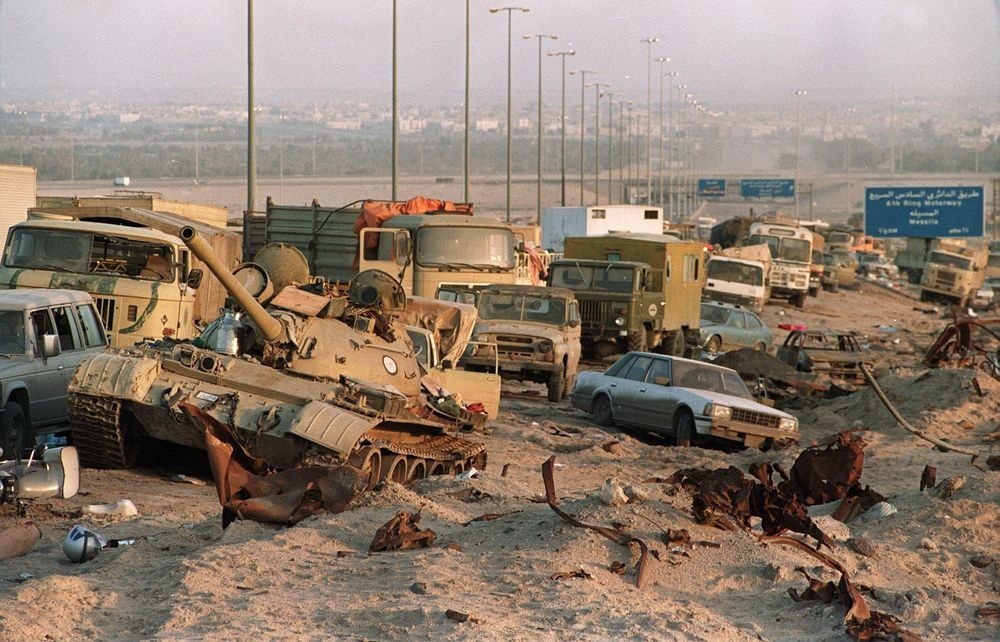
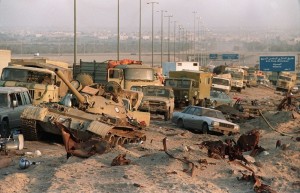
Twenty five years ago, one of the most brutal massacres in war history occurred in Iraq, along Highway 80, about 32 km west of Kuwait city. On the night of February 26–27, 1991, thousands of Iraqi soldiers and civilians were retreating to Baghdad, after a ceasefire was announced, when President George Bush ordered his forces to slaughter the retreating Iraqi army. Fighter planes of the coalition forces swooped down upon the unarmed convoy and disabled the vehicles in the front, and at the rear, so that they couldn’t escape. Then wave after wave of aircraft pounded the trapped vehicles for hours on end. After the carnage was over, some 2,000 mangled Iraqi vehicles, and charred and dismembered bodies of tens of thousands of Iraqi soldiers lay for miles along what came to be known as the “Highway of Death”. Several hundred more littered along another road, Highway 8, that leads to Basra. The scenes of devastation on these two roads became some of the most recognizable images of the Gulf War.
Grisly, huh? Well, except that it didn’t happen like that. I just happened to end our portion of that war on the Highway the following day – the first US troops on the scene. There was a lot of Destruction on the road, but not much Death. There weren’t “tens of thousands” of Iraqi soldiers strewn along with the vehicles. certainly there were a couple of dead, but not thousands, not even a hundred. It was pretty much like the pictures that accompanied the article at the link. Lots of scrap metal, but no bodies – my platoon found one dead body in our sector.
The article continues on about how Saddam Hussein had announced to the world that he was withdrawing from Kuwait, that the war was pretty much over, but we bombed the poor Iraqis anyway, in violation of the Geneva Convention.
First, I’d like to know what portion of the Geneva Conventions says that you can’t attack armed enemy forces that are on the field of battle. Notice the tanks in the picture above. You can’t get more armed than having a tank.
Secondly, when the cease-fire came, we turned left and ceased combat operations, there were still Iraqis firing at us – bullets were pinging off my turret. A few days after the cease-fire began, the 24th Infantry Division was attacked by a Republican Guards division, which the 24th destroyed within a few hours – but it proves that not all of the Iraqis were ready to give up the war.
A few weeks after the cease fire, my unit moved into Iraq for Operation Provide Comfort – to protect Shi’ite Iraqis from Hussein’s Ba’athists who were using what little equipment they had left against those minorities. They weren’t using the thousands of vehicles that were destroyed on the Highway that day. We spent two months deep inside Iraq, confident that much of the Iraqi Army had been destroyed while we were on our humanitarian mission.
The Left loves to make the US out to be some barbaric hegemonic power that kills needlessly, but that “Highway of Death” thing isn’t the hill they should want to plant their flag on. It was completely justified and much more humane than they’d like it to be. The Air Force destroyed a lot of equipment that day and took very few lives along that road.
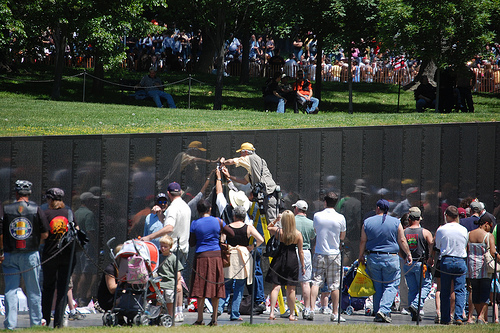
Today has been designated as Vietnam Veterans Day.
The Vietnam War used to be the longest war in our history until the media decided to call the war against terror our longest war. The war in Vietnam lasted from November 1955 until April 30, 1975, when Saigon collapsed. 3.4 million Americans served in the theater and 2,594,000 served in Vietnam and off it’s shores between 1965 and 1973. They were 9.7% of their generation. Only 38% of draftees served in Vietnam.
47,378 of the US military died in hostile actions. One nurse was KIA. 17,539 were married men. 17,725 were draftees. 5,977 were Reservists, 101 were National Guardsmen. 61% were aged less than 21 years.
79% of Vietnam veterans had completed a high school education or higher. 75% came from families who were earning above the poverty level. 97% of Vietnam veterans were honorably discharged. 66% of Vietnam veterans said they would serve again if asked. 82% of those who saw combat say we failed in Vietnam because of political will, 75% of Americans agree with them.
2,338 were listed as Missing in Action. 766 were listed as POWs, 114 died in captivity. Statistics from this link.