Wondering what I’m talking about? Well, perhaps this headline will explain it.
Hmm. Soup and a sandwich for dinner tonight sounds pretty good . . . . (smile)
Wondering what I’m talking about? Well, perhaps this headline will explain it.
Hmm. Soup and a sandwich for dinner tonight sounds pretty good . . . . (smile)
Jonn lets me do a verbal, off-topic “walkabout” here from time to time. What follows is such a ramble – an off-the-wall thought or two that’s not necessarily directly concerned with one of TAH’s normal topics.
Consider yourself forewarned.
. . .
We’ve all heard Lord Acton’s axiom: “Power tends to corrupt, and absolute power corrupts absolutely.” It’s perhaps one of the most widely-known quotations in the English language.
Most regard it as a truism. And on the surface, it does indeed appear to be on the mark.
Even in the military examples seem to be common. It’s hard to argue against it when you see things such apparently confirmatory examples as Gerald “PX Ranger” Green; the aptly named James “Two-Timing Fraud” Johnson; former BG, now retired LTC Jeffrey “Coersion” Sinclair; and Generals David Petreaus and Kip Ward.
Enlisted personnel and civilian defense officials to a lesser extent show the same faults from time to time as well. Witness the periodic drill sergeant scandals, the antics of former SMA Gene McKinney, and the former Acting Secretary of the Army John Shannon.
It’s not just an Army problem. Examples exist from all services that seem to confirm Acton’s thesis.
You also find similar conduct in other professions that are based on trust. Don’t believe me? Just take a look at clergy and cops. Finding public examples of corrupt conduct in either profession isn’t particularly difficult.
Until recently, I thought Acton was probably right, at least to some extent. I don’t believe that any more.
I now think Acton got it wrong; that’s not what’s going on here. I don’t think power itself is to blame at all.
Power doesn’t corrupt. Rather, power reveals.
I didn’t come up with that thesis. At the end of this ramble, I’ll give credit to the unusual source that to my knowledge first voiced that thesis – and convinced me that’s the case.
. . .
We seem to see so many such examples of corrupt behavior by people in positions of high trust. Yet in truth, such instances are rare. Consider:
• For every Gerald Green, there are literally hundreds of LTCs who played it straight and advanced on their own merit.
• For every James “Bigamist” Johnson, there are hundreds of Colonels who didn’t commit bigamy and defraud the government to support their mistress.
• For every Jeffrey Sinclair, there are dozens of GO/FOs who did not attempt to strong arm subordinates into a sexual relationship.
• For every Kip Ward, there are dozens of GO/FOs who followed the rules concerning TDY travel to the letter.
• For every David Petraus, there are dozens of GOs/FOs who did not retain and store classified materials improperly, then show them to his biographer afterwards.
If Acton were right, then those kinds of corrupt conduct would be the rule at high levels. But it’s not. It’s the gross exception, not the rule.
We hear about such behavior today when it happens. The media – both traditional and electronic – thrive on scandal. Given advances in technology they’re more efficient today than they were even 20 years ago about getting the story out. The traditional media today also seem to be more concerned with deadlines than accuracy. So when something along these lines happens, we hear about it relatively quickly; they don’t bother to wait and “check it out” first.
In short, the conduct we’re talking about is IMO quite rare. The vast majority don’t engage.
However, the conduct we hear about does appear to be concentrated at higher ranks. Why is that?
. . .
Part of the reason IMO is simply selective reporting. Think about it for a moment – is it really news if some PFC or 2LT (or even a CPT) does something bad? No, not really – though you might hear about it, briefly, in the case of the CPT. Even then, unless the case is sexually tawdry or involves a great deal of money, for most misbehavior below the grade of E9 and O5, you’ll likely not hear about it.
Why? Unless big dollars or sex is involved, the media just doesn’t seem to care all that much. Outside of training commands, contracting, and comptroller positions, most junior officer and NCO assignments don’t really provide the opportunity for a scandal that the media will find “interesting”.
IMO, that’s part of the reason. But it’s not all. Another factor is at work.
. . .
The military does a pretty good job of screening its people as they advance. Those with a tendency to abuse either the public trust or their subordinates tend to get weeded out as they progress.
However, like any process created or implemented by humans, the military’s screening process is imperfect. Some with seriously flawed character slip through from time to time.
Why? Sometimes their bosses simply are biased in their favor, or are flawed themselves. Maybe their supervisor has an inkling of the problem, but isn’t sure (or doesn’t realize it’s as serious a flaw as it really is) and in today’s “zero defect”, highly inflated evaluation system doesn’t want to kill a promising career – so he/she gives them the benefit of the doubt. Sometimes they’re good actors and manage to hide the flaw. Perhaps they are forced by supervision and lack of authority to “toe the line” and suppress the flaw. Dunno.
Hell – perhaps they actually change over time. I personally don’t think that happens often if at all, but I’m not a shrink and I guess it is at least theoretically possible.
For whatever reason, some that shouldn’t slip through the cracks. They get promoted until they are selected for and placed in a position of wide-ranging authority – a position of high trust, with less direct supervision and where their decisions are less likely to be questioned.
I can’t speak for the other services, but in the Army – outside of contracting and comptroller work – a position involving truly serious authority over hundreds or serious financial clout generally doesn’t happen until O5 for officers, and really not until the CSM level on the enlisted side. (Company commanders and First Sergeants just don’t typically have enough authority over enough people and resources IMO to qualify.) So it’s not until the E9 and O5 grades that individuals with such flaws have the opportunity to show it.
But now . . . for the first time in their career, they actually have the power to do something they’ve been disposed to do all along, with what they believe is a reasonable chance of evading detection. So they do.
“Corrupted by power?” Hardly. Their attaining power simply revealed what was there all along.
. . .
I said earlier I’d give credit to the individual who convinced me Acton was wrong. That individual is in many ways somewhat surprising; it was Robert A. Caro. He’s neither government nor military; he’s a biographer, and has done some truly fascinating work. Caro wrote an acclaimed biography of NYC’s Robert Moses, and has done a multi-volume biography (still incomplete) of LBJ. All of his work I’ve read so far is an excellent read; I’d highly recommend it.
Caro has been fascinated by power and its use his entire career; he’s studied it in detail. Here’s what Caro had to say on the subject:
We’re taught Lord Acton’s axiom: all power corrupts, absolute power corrupts absolutely. I believed that when I started these books, but I don’t believe it’s always true any more. Power doesn’t always corrupt. Power can cleanse. What I believe is always true about power is that power always reveals. When you have enough power to do what you always wanted to do, then you see what the guy always wanted to do.
I think Caro, not Acton, nailed this one. Power doesn’t corrupt; power is neutral. Achieving a position of power merely gives those who possess it the opportunity to reveal their true nature.
. . .
That’s the end of the ramble for today. Back to the res.
Regular TAH readers know that I’m a music fan. And they also know that Jonn tolerates my occasional ]off-topic ramble on the subject.
Well, brace yourselves – here comes another such ramble. You’ve been warned. (smile)
. . .
It’s no secret that popular music went through a massive change in the 1960s. The impetus for much of that change came from Britain – the famed “British Invasion”.
Many bands and individuals were part of that change. Most lost popularity or broke up shortly thereafter. Few had real “staying power” into the 1970s and 1980s; I’ve written here previously about one band that continued to grow and change with the times.
Yet there was a second band from Britain from this era that did the same. And for a while, they rivaled the Stones and others as a draw.
The Who.
The Who’s early work can best be described (with one exception) as catchy, formula pop tunes – though some of them did explore serious subjects. I mean, really: give a listen to “I Can’t Explain”, “Happy Jack” and “Pictures of Lilly”. Pure pop pablum, though the latter did address a somewhat more controversial than most. The exception in their early work was “My Generation”; it captured the mood of British early-1960s youth perhaps better than most tunes of the era.
Like the Stones, the Who also grew up musically . But unlike the Stones – whose growing-up was over a period of about a year, and appears to have been due to personal difficulties and the possibility of jail – IMO you can pinpoint when the Who changed from being yet another group playing “cute pop” into a bona fide musical force. That happened in October, at the end of 1967’s “Summer of Love”:
From that point forward, the Who weren’t merely purveyors of catchy, formula pop. They were rockers – serious ones, and truly innovative. Their work contains much that is legendary: multiple excellent albums and two released “rock operas” (Tommy and Quadrophenia). A third such rock opera was planned – Lifehouse – but never made. In a way, that’s a pity; music written for Lifehouse led to two albums and some additional music released as singles. It’s possible it would have been the best of the three.
(If you doubt that assertion about Lifehouse, consider: one of the two albums made from music initially destined for Lifehouse was Who’s Next. I’d argue that it’s perhaps the finest rock album made in the 1970s – and one of the best ever.
The second album derived from the Lifehouse? Who Are You. Plus “Pure and Easy” and “Join Together”, which were initially released as non-album singles, were also intended for Lifehouse.)
The Who continued making exceptional music for a full 15 years after coming of age – from 1967’s The Who Sell Out through 1982’s It’s Hard. They are also considered one of the great live acts as well; their Live at Leeds albums is considered one of the best live albums ever recorded.
Oh, and they were one of the headliners at Woodstock, too – early morning hours of 17 August 1969. As you might guess from the timing, they performed Tommy. (smile)
Today, The Who is considered one of the most influential rock and roll bands of all time. Pink Floyd considered them a formative influence. Jimi Hendrix adopted Townsend’s “Marshall stack” amp setup in the mid 1960s, as well as adopting and expanding Townsend’s pioneering use of sound effects. Even the Beatles were reputed to have been influenced by the Who in at least two of their later tunes. Tommy is considered the first rock opera.
Here’s a sample of The Who’s music between 1967 and 1982. Enjoy.
Yeah, I guess you could say the kids really were all right.
. . .
If you’re still reading this – thanks. Hope you didn’t find it boring.
I was planning to try and write a thoughtful article about how life is what happens while you’re making other plans. And I guess I could try and do that – and attempt to wax eloquent on how that’s OK and how we make it anyway, even though it’s at times confusing and frustrating.
Then I thought some more, and decided I’d simply post this instead. It says the same thing, probably better than I can. And unless I’m badly mistaken, I’m guessing it will resonate a bit with many of TAH’s readers.
The lads were right. When I really think about it, I realize I don’t want to know with full certainty precisely what the future holds.
Have a good holiday, everyone. Hope this wasn’t too much of a downer.
Author’s Note: What follows is not normal TAH fare. But I’ve seen so much scientifically illiterate speculation and bogus commentary on this particular issue that I could damn near hurl. And all our regular readers know how I am about running numbers to ground. (smile)
That illiteracy includes a whopper of a “rookie” mistake that appeared in the original version of this article (forgetting to change from gauge pressure to absolute pressure – hey, it’s been approaching 40 years since I took thermodynamics, so I plead the proverbial “senior moment” here). It’s corrected below.
. . .
We’ve all heard about “deflate-Gate” recently.
A quick refresher: 11 of the 12 game balls used by the NE Patriots in their conference championship game were found to be substantially underinflated. The Patriots claim that the balls were inflated to the lower end of the NFL’s specification (between 12.5 and 13.5 PSI – gauge pressure – inclusive) prior to inspection by the game’s referee. What I’ve seen indicates the underinflated balls were reportedly later all found to be approx 2 PSI below the lower limit.
Each team provides their own game balls for use on offense during the game. The balls are inspected prior to the game, and marked as compliant by the game’s referee. They are then in the possession of that team throughout the game.
Various theories have been offered. Chief among them is, “The cold temperature during the game caused the pressure to drop.” The NE Patriots claim no wrongdoing, and to have followed the NFL’s rules “to the letter”.
Well, let’s look at this.
A Bit of Science Background
Provided its chemical composition remains unchanged, gas behavior in a closed system is governed by the ideal gas law
PV=nRT
where
P is pressure – absolute, not gauge
V is volume
n is the number of gas molecules present
R is the universal gas constant
and T is temperature – Kelvin, not Celsius or Fahrenheit
This equation is equivalent algebraically to
P = nRT/V
Since R is a constant, if there’s no change in chemical composition of the gas only 3 things can change the pressure of a gas in a closed system. Those are (1) a change in temperature, (2) a change in volume, (3) removal of some of the gas molecules, or (4) a combination of the three. It really is that simple.
Change in Temperature
OK, now let’s assume the change was due solely to a change in temperature.
10.5 and 12.5 PSI (gauge) equate to 25.2 and 27.2 PSI (absolute), respectively. The balls in question were found to be inflated to (25.2 PSI) / (27.2 PSI) = 0.9265 of the minimum allowable pressure. However, they were inflated in (presumably) environmentally controlled conditions – let’s say 70F. The game conditions were in the high 40sF – let’s say 47F. Could the game temperature being 47 F have caused the discrepancy?
In a word: no.
Unlike a balloon, a football’s volume doesn’t change much if any when the internal pressure rises from 25.2 PSI to 27.2 PSI. Rather, the football’s volume remains essentially constant. And if no gas was removed, that means the number of gas molecules is constant between the two pressure measurements.
Let’s let P1 and T1 be the temperature when inspected; P2 and T2 are similarly the later pressure and temperature.
That means we have
0.9265 = P2/P1 = (nRVT2) / (nRVT1) = T2/T1
A common mistake here is to fail to convert to degrees Kelvin (yeah, it does indeed matter here). 70F is 294.26 K. Doing the math, we find that
T2 = 0.9265 x T1 = 0.84 x 294.26 K = 272.62 K
272.68 K is about 31 F. Since the game was played in conditions in the high 40’s F, um, no that isn’t the case here. This was a cool and rainy – but not exceptionally cold – winter day in New England, but the rain wasn’t freezing.
The game temperature (47 F) only explains a pressure drop of about 1.2 PSI, or somewhat more than half of the observed discrepancy. What I’ve seen indicates the 11 underinflated balls were all reportedly around 2 PSI below the lower limit – or 0.8 PSI lower than can be explained by the game temperature alone.
Change in Volume
Well, NFL teams reportedly “prepare” the surface of game balls after inspection to ensure the surface is to their quarterback’s liking after they’ve been inspected by the referee. If this “preparation” process somehow added enough volume to the ball to account for the measured discrepancy, that might explain the incident.
However, we now know the actual pressure drop due to the temperature change from 70 F to 47 F – 1.2 PSI. That makes P1’ – the expected pressure at 47 F in the absence of tampering – 26 PSI (absolute), or about 11.3 PSI (gauge). So let’s see how much additional volume at 47 F would be required to account for an additional 0.8 PSI pressure drop. Here, T1=T2=47 F. As above,
V1/V2 = 25.2/26.0 = 0.969 = P2/P1’ = (nRT2V1) / (nRT1V2)
which means that
V2 = V1/.969 = 1.032
The observed pressure of 10.5 PSI (gauge) would require an increase in volume of 3.2% at 47 F. Thus, if the “preparation” process causes a gain in volume of the football by about 3.2%, the observed low-pressure conditions in the 11 of 12 game balls would be explained.
Let’s see if that’s plausible.
Per this article, a football can be approximated by an ellipsoid of rotation with major axis a = 14.0 cm and minor axis b = 8.5 cm. Since the equation for the volume of an ellipsoid of rotation is known – V = (4/3)(PI)ab2 (where PI is the physical constant 3.1415926 . . . ) – if we assume that the proportions between a and b remain constant we can calculate how much larger the football would have to be for this to be the case.
Assuming proportionality will be retained, since 14/8.5 = 28/17, replacing a with 28/17 b yields the simplified equation
V = (4/3)(PI)(28/17)b3 = (112/51)(PI)b3
Using the necessary increase in volume of 3.2%, this yields
Vnew/V = 1.032 = [(112/51)(PI)bnew3] / [(112/51)(PI)b3] = (bnew3)/b3
Since b = 8.5cm, this yields
Vnew/V = 1.032 = (bnew3)/614.125, or bnew3 = 1.14(614.125) = 633.62
This means bnew is approximately 8.59cm.
Since proportionality is assumed retained this gives revised axis dimensions of b = 8.59cm and a = 14.14cm.
If the pre-game prep process caused the footballs to expand somewhat, that might explain the rest of the discrepancy. That’s only a slight difference (about 2mm in “fatness” and about 3mm in length) in size. Even professional athletes might not notice that small of a difference.
Still: I’d have to see that demonstrated to be the case before I’d buy it.
Change in Number of Gas Molecules
OK, that leaves a change in the number of gas molecules to explain the difference.
One way is to use gases that react chemically – like hydrogen and oxygen, for example. The problem here is that most such reactions are also exothermic (heat-producing) and fast – and would raise the football’s internal temperature and pressure to the point it would likely cause the football to explode. They also generally require something to initiate the reaction, like a spark. Those reactions that don’t generate heat generally require long times and/or some heat source. I think we can rule those out.
Inflating the footballs with gas that begins to condense at around 50 F would also be a possibility, since condensation removes gas molecules also. However, I don’t know of such a gas – and controlling that to achieve a specific pressure drop would be a nightmare. Moreover, if the weather got colder than expected, that could result in complete deflation. I think we can ignore this one also.
That leaves the possibility of gas molecules being removed.
While air does diffuse through rubber, it’s a very slow process; it’s one reason why your tires lose pressure over time. A 2 PSI drop just doesn’t happen to 11 out of 12 footballs naturally in one half of football.
A Last Possibility
There is one other possible explanation that I can think of. Suppose the footballs were intentionally inflated with heated air, then immediately inspected? Leather and rubber are thermal insulators – not great insulators, but they provide some insulation. If the time between inflation and inspection was very short, the heated air used to inflate the balls might not be apparent. This might be the case if the ball was inflated in a referee’s presence, then immediately handed to them for inspection.
Let’s see if this is feasible. How hot would the air have to be to cause a 2 PSI drop between inflation and game temp of 47 F?
From above, if volume is constant and no air is removed then P2/P1 = T2/T1. That means
P2/P1 = 25.2/27.2 = 281.483/T1, or T1 = (27.2/25.2) x 281.483 = 303.77 K, or about 87 F
So, if the footballs were intentionally inflated in the presence of the referee using air heated to around, say, 87 F to 90 F vice ambient temperature, during the game they’d drop to about 10.5 PSI (gauge).
My Guess
Based on the above, I’m guessing one of two things happened.
First, and IMO most likely, possibility: someone intentionally let some air out of the game balls in question, dropping the pressure by about 1 PSI or so. In doing that they missed one, accounting for 11 of 12 balls with low pressure.
Second: one ball was inflated previously using air at 70F, then given to the referee for his inspection. The remainder were inflated in the referee’s presence using air heated to around 87 to 90 F. This would also explain the observed conditions.
That said, it’s close. Most teams would be given the benefit of the doubt. But given the Patriots’ history, well, I’m not inclined to give them that benefit. IMO, even in 2007 NFL teams just didn’t give up a 1st round draft pick when they were alleged to have broken league rules w/o a fight if they were innocent. YMMV.
If I had to bet, I’d bet on the first. But either is possible. And IMO either is absolutely shady and unethical conduct.
The sad thing is that if this was indeed a case of tampering, like many cases we see regarding stolen valor it just simply wasn’t necessary. The way the Patriots were playing that day, as Andrew Luck – quarterback of the Indianapolis Colts – put it: “They could have used soap for balls and they’d have still won.”
Again: sorry for the rookie error in the original, but it’s been a while since I dealt with this stuff.
TAH has a wide age range in it’s readership – from teens to those in their 80s (hello, Sam). Though many of our older readers may enjoy what follows, I’m writing this primarily for our younger readers – those who are maybe 30 and younger.
For those younger readers, here’s a bit of unsolicited free advice. Take it or not as you see fit.
I’d suggest you get high-quality audio copies of the tunes below. Set them aside for a while – maybe a couple of decades or so. When you turn about, say, 50 . . . give them a listen.
They might not exactly be your “cup of tea” now. But I think you’ll view them differently at that point in your life. As one age, one’s perspectives and tastes change.
These particular tunes age quite well.
Youth and Infatuation
A Unique Time and Place
and, with apologies to Marcel Proust:
Remembrance of Things Past
FWIW: the above can be found on Al Stewart’s albums “Year of the Cat” and “Time Passages”. The sound quality on both is exquisite; Alan Parsons engineered both albums. They’re also on at least one of his “Greatest Hits” collections.
As I said above: unsolicited advice, so give it the value you deem apropos.
. . .
We now return you to your regular TAH programming. (smile)
For better or worse, McDonalds is an American cultural icon. So is heavy metal music.
And when the two meet, the result is . . . well, just plain weird. In a kinda-creepy-but-it-works-anyway way.
Enjoy – I think. (smile)
If you’re still “hungry” after that, here’s a second helping.
Hey, I warned ya it was both kinda creepy and weird. (smile)
We hear that phrase from time to time. But it’s rarely done in practice.
However, check out this little gem from Vietnam:
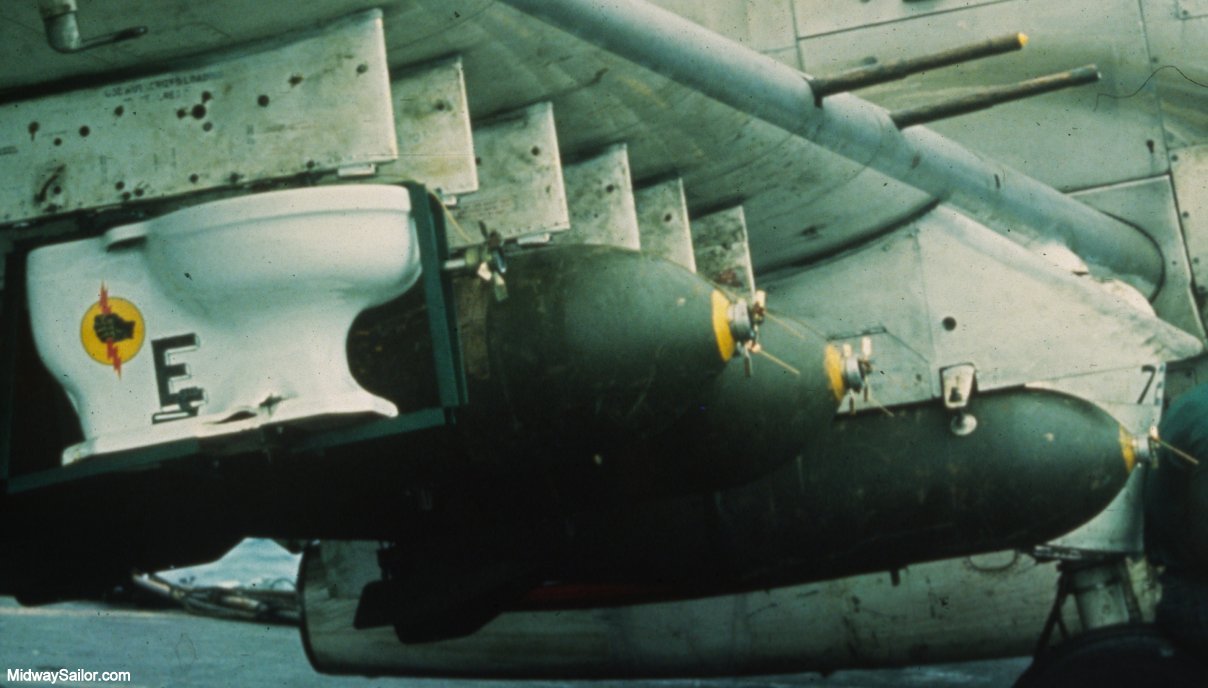
Yes, that is EXACTLY what you think it is slung under the wing of that aircraft (an A-1H belonging to the US Navy’s VA-25). For the details, check out this story about VA-25 in Vietnam. An alternate version may be found here, with video (if you can get it to run – I can’t).
No word on whether the intended target for that unique bit of “ordnance” was a VC field latrine. (smile) Regardless, hopefully the lads packed the damn thing full of C4 and rigged it to blow when the nose fuse went off.
You nautical types are sometimes kinda weird. But we still love ya like brothers (and sisters) anyway. (smile)
Hat tip to Poetrooper for the first link above.