Author: AW1Ed

  • 80-Year-Old Marine Veteran to Receive Medal of Honor

    navy moh

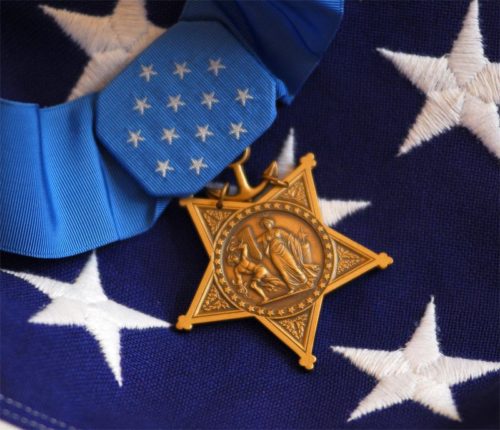
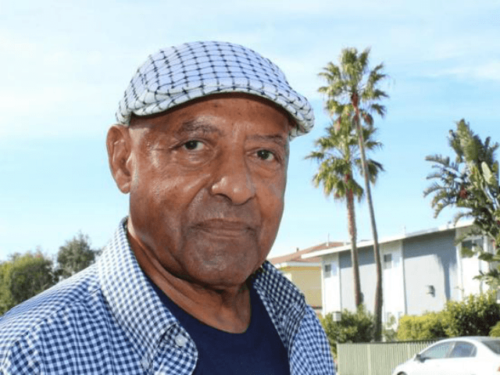
    Retired Sgt. Major John Canley, an 80-year-old Marine veteran, will receive the nation’s highest military honor for his conspicuous gallantry during the Vietnam War.
    John Canley navy moh

    President Trump announced Tuesday that the Marine veteran will be awarded the Medal of Honor on 17 October at the White House, becoming the sixth American and third Vietnam veteran to receive the award from Trump.

    “It means a lot to me,” Canley told USA Today. “Mostly for my Marines because we’ve had to wait 50-plus years to get any kind of recognition.”

    John Ligato, a Marine and FBI agent who has written a book about Canley’s time in Vietnam, said he was amazed at Canley’s calm composure during the battle.

    “He never ran and he never ducked,” Ligato told Newsweek. “You know, it’s just amazing. I don’t know if he had some sort of death wish or what — Gunny says that he just gets into a zone and does what he has to do. … I don’t know how the bullets didn’t hit him.”

    Though not specifically mentioned if the Medal of Honor is an upgrade for, or in addition to, his Navy Cross, the citation speaks for itself.

    Navy Cross
    AWARDED FOR ACTIONS
    DURING Vietnam War
    Service: Marine Corps
    Battalion: 1st Battalion
    Division: 1st Marine Division (Rein.) FMF
    GENERAL ORDERS:

    Authority: Navy Department Board of Decorations and Medals
    CITATION:

    The President of the United States of America takes pleasure in presenting the Navy Cross to Gunnery Sergeant John L. Canley (MCSN: 1455946), United States Marine Corps, for extraordinary heroism while serving as Company Gunnery Sergeant of Company A, First Battalion, First Marines, FIRST Marine Division (Reinforced), Fleet Marine Force, during operations against the enemy in the Republic of Vietnam from 31 January to 6 February 1968. On 31 January, when his company came under a heavy volume of enemy fire near the city of Hue, Gunnery Sergeant Canley rushed across the fire-swept terrain and carried several wounded Marines to safety. Later, with the company commander seriously wounded, Gunnery Sergeant Canley assumed command and immediately reorganized his scattered Marines, moving from one group to another to advise and encourage his men. Although sustaining shrapnel wounds during this period, he nonetheless established a base of fire which subsequently allowed the company to break through the enemy strongpoint. Retaining command of the company for the following three days, Gunnery Sergeant Canley on 4 February led his men into an enemy-occupied building in Hue. Despite fierce enemy resistance, he succeeded in gaining a position immediately above the enemy strongpoint and dropped a large satchel charge into the position, personally accounting for numerous enemy killed, and forcing the others to vacate the building. On 6 February, when his unit sustained numerous casualties while attempting to capture a government building, Gunnery Sergeant Canley lent words of encouragement to his men and exhorted them to greater efforts as they drove the enemy from its fortified emplacement. Although wounded once again during this action, on two occasions he leaped a wall in full view of the enemy, picked up casualties, and carried them to covered positions. By his dynamic leadership, courage, and selfless dedication, Gunnery Sergeant Canley contributed greatly to the accomplishment of his company’s mission and upheld the highest traditions of the Marine Corps and of the United States Naval Service.

    No better friend, no worse enemy.

    The article may be viewed in its entirity Here.
  • Elizabeth Warren Attacks Admiral over Party He Attended 14 Years Ago

    warren_fuller

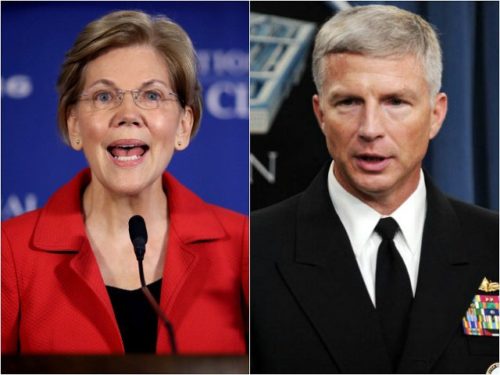
    Sen. Elizabeth Warren (D-MA), a potential 2020 Democratic presidential contender, attacked Navy Vice Adm. Craig Faller Tuesday during his confirmation hearing to become commander of U.S. Southern Command (SOUTHCOM) over a decision 14 years ago to attend a party during a port visit to Hong Kong.

    Faller’s attendance at the 2004 party was reported in a Washington Post article the day before the confirmation hearing. The article described a lavish party for more than 50 Navy officers from the USS Abraham Lincoln aircraft carrier strike group during a port visit to Hong Kong at a luxury hotel “where they savored cocktails, cigars and courses of Oscietra caviar, black truffles and lobster thermidor.”

    The article said “mingling with the guests were attractive young women dressed as Santa’s little helpers, wearing red hats, black boots and skimpy yuletide costumes.”

    Sounds pretty evil to me. How dare Naval Officers attend an evening event hosted by a Foreign National? If he didn’t attend, sounds like he would have missed a pretty good time, not to mention missing “face time” points with Higher.

    The party was hosted, of course, by Fat Leonard.

    The commander of the strike group, now-Ret. Navy Adm. W. Douglas Crowder, told the Post that he asked Navy lawyers to review the invitation beforehand and was told it was permissible to attend, and he gave his officers the green light to go and nothing “untoward” happened at the party. He said Faller left the dinner with him.

    Despite being cleared by the DOJ and the Navy, Warren seized on Faller’s decision to attend the party as evidence of his bad judgment.

    “Now I know that both the Department of Justice and the U.S. Navy cleared you of wrong-doing, and that your superior supposedly signed-off on the 2004 dinner, but I just have to say — this does not pass the smell test for me,” she said.

    The irony! Fauxcahontas chiding a Naval Officer on his conduct 14 years ago, long before the Fat Leonard debacle was discovered. No doubt she never refuses a chance to press the flesh at every soiree she can get to; then there’s that whole 1/16th Indian blood she claimed for racial preference, but has yet to produce a DNA test to verify that.

    Here.

  • US Navy says assault rifles were seized from Persian Gulf boats

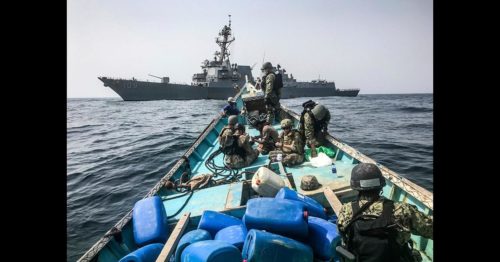
    ddg jason dunhamA team from the guided-missile destroyer USS Jason Dunham inspects a dhow while conducting maritime security operations. A U.S. military video released Aug. 31, 2018, purported to show small ships in the Gulf of Aden smuggling weapons amid the ongoing war in Yemen, with officials saying they seized over 2,500 arms from the vessels. (U.S. Navy via AP)
    A boarding team from the guided-missile destroyer Jason Dunham captured more than 1,000 AK-47 rifles from a vessel sailing in the Gulf of Aden.

    Navy officials said the warship intercepted the stateless skiff while it was drifting without engine power on Tuesday.

    The boarding team determined that the vessel was not flagged to any nation and then discovered the cache of weapons.

    The Navy’s Bahrain-based 5th Fleet gave the updated total in a statement Wednesday.

    It boarded a skiff and a dhow, a traditional ship in the Persian Gulf, during routine checks in the Gulf of Aden on Aug. 28.

    The Navy added: “The origin and intended destination of the skiff have not yet been determined.

    I’ll take, “Who Are Iran and Yemen?” for thousand, Alex.

    The entire article may be viewed Here.

  • 12 Gauge Pistol- Just Because You Can…

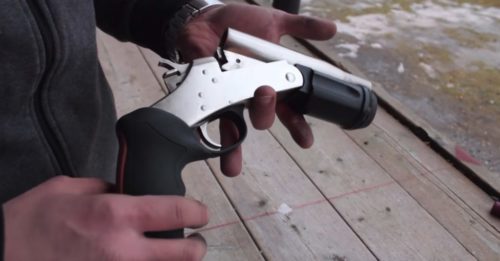
    12 gauge pistol

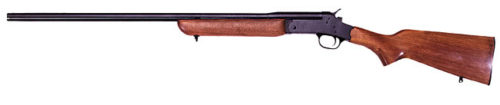
    …doesn’t mean you should. Fortunately only five or so of these monsters are in existence. They started life as drab but reliable-as-a-hammer Rossi break-action, single-shot shotgun that was cut down and then reclassified as a pistol. This 12 gauge pistol is completely custom, and the only versions seen were found in Canada, surprising nobody.

    rossieRossi Single Shot

    When normal people think of a pistol-shotgun, one of the Taurus ‘Judge’ family comes to mind, or perhaps a Bond Arms derringer in .410/45LC.

    Cap guns in comparison.

    So I’ma goin’ to take my derringer and go home, but I won’t have a broken wrist.

  • On This Day In The Navy, 1918

    sopwith camel

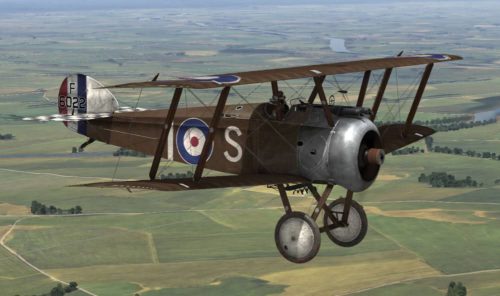
    LTJG David S. Ingalls, while on a test flight in a Sopwith Camel, sighted an enemy two-seat Rumpler over Nieuport. In company with another Camel he attacked and scored his fifth aerial victory in six weeks to become the U.S. Navy’s first (and only) WWI ace, with six total credited aerial victories.

    Flying the Sopwith Camel around Dunkirk, Ingalls began to chalk up victories. One of his final air to air victories was a result of an engine failure. Engine out and descending to a suitable field, his engine restarted, and he was able to regain flight. However, he was now behind enemy lines. As a result, he was able to attack the Germans from behind and destroyed a Fokker D.VII.

    The entire article can be viewed Here.

    Anyone who has owned an English motorcycle or sports car can empathize with Ingalls’ balky engine.

  • Navy sailor struck by propeller

    e-2c hawkeye

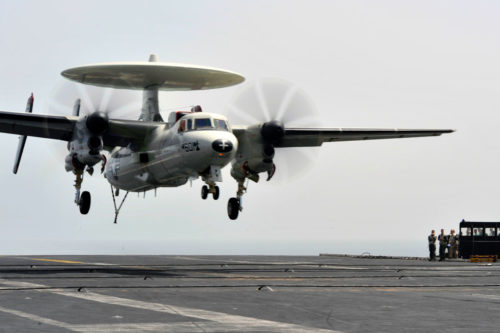
    Last week, Mick brought us the sad news of a death onboard the aircraft carrier USS George H.W. Bush, while conducting routine flight operations in the Atlantic ocean. The Navy has released the Sailor’s name and the cause of death.

    A sailor who died aboard an aircraft carrier in the Atlantic Ocean during routine flight operations on the flight deck was struck by the turning propeller of a plane, the U.S. Navy said.

    The Navy said in a statement on Wednesday that Airman Apprentice Joseph Naglak had just secured an E-2C Hawkeye radar plane to the flight deck.

    Naglak’s death occurred Monday aboard the USS George H.W. Bush in the Atlantic. The aircraft carrier was supposed to go to sea for training along with 30 other warships, and Hurricane Florence moved up the date a few days earlier.

    The Navy said the incident remained under investigation.

    The flight deck of an aircraft carrier has been described as one of the most dangerous places on earth. Fair winds and following seas, Airman Apprentice Naglak.

    The entire article may be viewed Here.

  • ‘WATCH YOUR DECK!’ The story behind last summer’s Tiger II crash

    F-5N

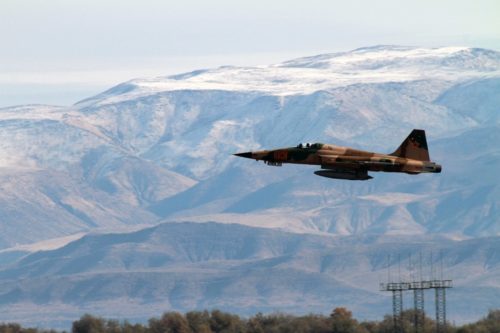
    A year ago, an F-5N Tiger II tactical fighter aircraft the US Navy purchased from the Swiss Air Force crashed into the Atlantic Ocean forcing the pilot to eject.

    The event took place on 09 August, about 20 nautical miles southeast of Naval Air Station Key West.

    The unnamed pilot, assigned to Fighter Squadron Composite (VFC) 111, was quickly recovered by a Coast Guard helicopter at approximately 1:15 p.m.

    He was reported to have no significant injuries.

    The pilot — whose name is redacted in the report — was flying a standard training mission for the “Sun Downers” of Fighter Composite Squadron 111 that day, playing the role of an aerial adversary, according to the report.

    This is the narrative from the mishap report.

    The flight seemed routine until after he heard the call of “Fights On” and he “pulled the nose toward vertical … and noticed the nose tracking slow” at about the 70-degree mark, according to his official statement.

    He tried to keep the nose from “getting parked close to vertical,” but the right rudder input seemed sluggish.

    “I do not recall an altitude or airspeed as I was looking at my opponent at this time,” he said. “The aircraft departed controlled flight.”

    That laconic statement belies the chaos that ensued over the coming seconds.

    The jet inverted, slicing and rolling left before kicking into a fully inverted left spin, according to the report.

    “Knock it off, Viper 2, watch the deck,” his colleague in the other jet warned.

    But the jet continued to fall.

    Upside down, the pilot recalled seeing “a number of items from the cockpit collect on the canopy above me.”

    “I think the pens came out of my g-suit pocket.”

    With the altimeter reading between 8,000 and 9,000 feet, he said that he tried to apply procedures to right the aircraft. He moved to roll the jet upright but failed, a sign he believed that the plane was gyrating after the stall.

    “The situation was unbelievably disorienting as I was ‘hanging in the straps’ and waiting for control effectiveness to return,” the pilot said.

    “Watch your altitude,” the other pilot warned again. “WATCH THE DECK!”

    “I remember thinking I was rapidly losing the opportunity to eject as my altitude decreased,” the pilot said. “I grabbed the handles and commanded ejection.”

    The next few seconds became a blur.

    The “Knock it off” call is used whenever anyone involved in an evolution feels an unsafe condition exists, which clearly was the case here. To read the rest of the article, click Here.

    Note: The article was too lengthy to post in its entirety. I highly recommend following the link for the remainder- it’s a real world water survival evolution, and should be required reading for all who fly in military aircraft.
    AW1Ed

  • Valor Friday

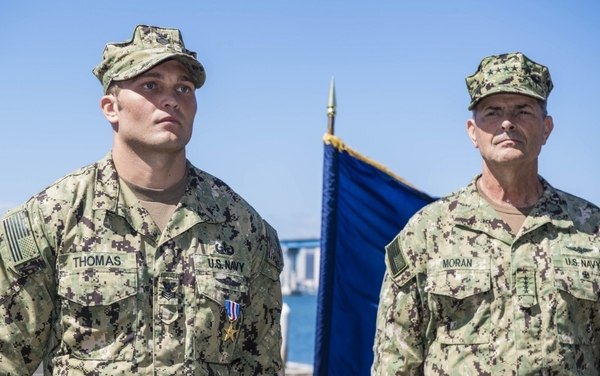
    eod po1 silver starExplosive Ordnance Disposal Technician 1st Class Jeffrey Thomas stands at attention alongside Vice Chief of Naval Operations Adm. Bill Moran after being awarded the Silver Star (MC3 Christopher A. Veloicaza).

    The Navy Times has recently started a weekly “Valor Friday” article to highlight the exceptional bravery demonstrated by our armed forces in conflicts around the globe.

    Today’s VF is dedicated to Navy EOD Tech Petty Officer First Class Jeffery Thomas, and his activities during Oct. 20 and 21, 2016, as his convoy conducted IED clearance operations against the Islamic State of Iraq and Syria (ISIS).

    His convoy encountered stiff resistance from entrenched ISIS jihadis, with mortars, small arms, and RPG fire.

    When the convoy was finally ordered to break contact and make their way out of the kill zone, the lead vehicle rolled over one of seven daisy-chained improvised explosive devices.

    The massive explosion killed the EOD supervisor, Thomas’ friend and mentor.

    Realizing the dire situation, the sailor assigned to Coronado-based Explosive Ordnance Disposal Mobile Unit 3 exited his vehicle and hastily got to work, sweeping the rest of the area for explosives despite a hail of enemy rounds, RPGs and mortars impacting around him.

    Clearing a path of additional explosives allowed medics enough time to reach the disabled vehicles and evacuate casualties. Still exposed to enemy fire, Thomas guided the convoy out of the intricate mine field and safely to a medical evacuation landing zone.

    To read more of Petty Officer Thomas’ deeds, visit the Navy Times