Category: Historical

  • Weekend Open Thread

    No, that’s not a photo of an SR-71 nursing its child after giving birth, nor is it creative work with Photoshop. (smile) It’s a photo of one of the two Lockheed M-21s ever built.

    The M-21 was a 2-seat derivative of Lockheed’s A-12 (the SR-71 was also a 2-seat A-12 derivative) that resulted from the downing of Gary Powers’ U-2 over the Soviet Union on 1 May 1960. It was intended to launch Mach 3+ drones over denied territory having an air defense threat deemed too high to allow manned reconnaissance flights. In the photo above, it’s carrying one such drone.

    The drone it’s carrying is the Lockheed D-21. The D-21 had a range of 3,000 nautical miles, a maximum speed of Mach 3.3+, and an operational altitude of 90,000+ feet. It carried a high-resolution camera, which went active at a specified point or points along its pre-programmed course. The camera, film, and accompanying control unit were contained in a module called a “hatch” (don’t ask me why) which would be ejected post-mission at a predetermined point. The “hatch” was to be recovered; the rest of the drone was designed to self-destruct after ejecting it.

    The launch aircraft and drone were designed under Project Tagboard. Multiple test flights – including four drone launches – were executed as part of the project. The last test flight was a disaster, causing the loss of one M-21 and the death of the aircraft’s “back-seater” Launch Control Officer (the aircraft’s pilot survived). The photo above appears to have been made during one of the early captive test flights.

    After the disastrous final test flight of the M-21/D-21, the project’s operational concept was changed to underwing launch of the drone from a B-52 “mothership” using a rocket booster. (The D-21 was ramjet powered and required acceleration to high speed before its engine would function. Even at top speed, a B-52 simply wasn’t fast enough to do that.) The photo below shows a B-52 “mothership” ship carrying 2 modified drones mounted on their booster rockets.

    The drones modified for underwing launch from a B-52 were designated the D-21B. (There was no D-21A; the original drones were designated D-21 without letter suffix.) A number of these survive today and are on display to the public in various locations – including one on display in the Chinese Museum of Flight in Peking, PRC (more about this below).

    The surviving M-21 “mothership” aircraft is similarly on display at the Seattle Museum of Flight. Though not 100% historically accurate, for display it has a D-21B drone mounted in carry position.

    The B-52 launched version of the drone, the D-21B, was used to overfly China’s nuclear test site at Lop Nor multiple times in the late 1960s and early 1970s under a project codenamed Senior Bowl. Due to various technical problems those overflights were unsuccessful, and the program was terminated. The last of those unsuccessful overflights is believed to have provided the D-21B currently on display in Peking. (smile)

    OK, that’s enough aviation history. Enjoy this week’s open thread, everyone.
  • USS Nautilus (SSN-571); On This Day

    USS Nautilus (SSN-571); On This Day

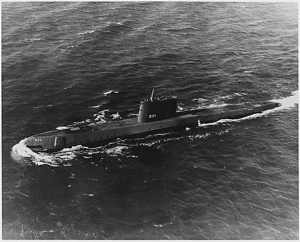
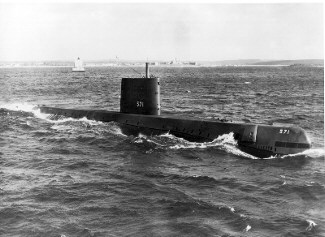
    USS Nautilus (SS-571), the U.S. Navy’s first nucelar-powered submarine, on its initial sea trials, 10 January 1955.

    On August 3, 1958, the U.S. nuclear submarine Nautilus accomplishes the first undersea voyage to the geographic North Pole. The world’s first nuclear submarine, the Nautilus dived at Point Barrow, Alaska, and traveled nearly 1,000 miles under the Arctic ice cap to reach the top of the world. It then steamed on to Iceland, pioneering a new and shorter route from the Pacific to the Atlantic and Europe.

    The USS Nautilus was constructed under the direction of U.S. Navy Captain Hyman G. Rickover, a brilliant Russian-born engineer who joined the U.S. atomic program in 1946. In 1947, he was put in charge of the navy’s nuclear-propulsion program and began work on an atomic submarine. Regarded as a fanatic by his detractors, Rickover succeeded in developing and delivering the world’s first nuclear submarine years ahead of schedule. In 1952, the Nautilus’ keel was laid by President Harry S. Truman, and on January 21, 1954, first lady Mamie Eisenhower broke a bottle of champagne across its bow as it was launched into the Thames River at Groton, Connecticut. Commissioned on September 30, 1954, it first ran under nuclear power on the morning of January 17, 1955.

    Much larger than the diesel-electric submarines that preceded it, the Nautilus stretched 319 feet and displaced 3,180 tons. It could remain submerged for almost unlimited periods because its atomic engine needed no air and only a very small quantity of nuclear fuel. The uranium-powered nuclear reactor produced steam that drove propulsion turbines, allowing the Nautilus to travel underwater at speeds in excess of 20 knots.

    In its early years of service, the USS Nautilus broke numerous submarine travel records and on July 23, 1958, departed Pearl Harbor, Hawaii, on “Operation Northwest Passage”–the first crossing of the North Pole by submarine. There were 116 men aboard for this historic voyage, including Commander William R. Anderson, 111 officers and crew, and four civilian scientists. The Nautilus steamed north through the Bering Strait and did not surface until it reached Point Barrow, Alaska, in the Beaufort Sea, though it did send its periscope up once off the Diomedes Islands, between Alaska and Siberia, to check for radar bearings. On August 1, the submarine left the north coast of Alaska and dove under the Arctic ice cap.

    The submarine traveled at a depth of about 500 feet, and the ice cap above varied in thickness from 10 to 50 feet, with the midnight sun of the Arctic shining in varying degrees through the blue ice. At 11:15 p.m. EDT on August 3, 1958, Commander Anderson announced to his crew: “For the world, our country, and the Navy–the North Pole.” The Nautilus passed under the geographic North Pole without pausing. The submarine next surfaced in the Greenland Sea between Spitzbergen and Greenland on August 5. Two days later, it ended its historic journey at Iceland. For the command during the historic journey, President Dwight D. Eisenhower decorated Anderson with the Legion of Merit.

    After a career spanning 25 years and almost 500,000 miles steamed, the Nautilus was decommissioned on March 3, 1980. Designated a National Historic Landmark in 1982, the world’s first nuclear submarine went on exhibit in 1986 as the Historic Ship Nautilus at the Submarine Force Museum in Groton, Connecticut.

    Nautilus travels under North Pole

    History of USS NAUTILUS (SSN 571)

    Take a 360° Tour of the USS Nautilus

    Construction of USS Nautilus was made possible by the successful development of a nuclear propulsion plant by a group of scientists and engineers at the Naval Reactors Branch of the Atomic Energy Commission, under the leadership of Captain Hyman G. Rickover, USN. Chaim Godalia Rickover was born on January 27, 1900 in Poland, later his parents changed his name to Hyman. Upon acceptance to the United States Naval Academy and taking the oath, Rickover, who did not use his middle name, listed his middle name as George.

    Known as the “Father of the Nuclear Navy”, Rickover served in a flag rank for nearly 30 years (1953 to 1982). With his service beginning in 1918, Hyman G. Rickover retired after 63 years of active duty service in 1982 which made him the longest-serving naval officer and the longest serving member of the U.S Armed Forces in history. Admiral Rickover died at his home in Arlington, Virginia, on July 8, 1986 at 86 years of age, the same as that of his father, Abraham, before him.

    USS Hyman G. Rickover (SSN-709) was launched on August 27, 1983, sponsored by the admiral’s second wife, Mrs. Eleonore Ann Bednowicz Rickover, commissioned on July 21, 1984, and deactivated on December 14, 2006. It was commissioned two years before the admiral’s death, making it one of the relatively few United States Navy ships to be named for a living person.

    In 2015, the Navy announced that a new Virginia-class submarine, USS Hyman G. Rickover (SSN-795), would be named for Admiral Rickover.


  • OPLAN 34A

    OPLAN 34A

    On August 1, 1964, the North Vietnamese government accuses South Vietnam and the United States of having authorized attacks on Hon Me and Hon Ngu, two of their islands in the Tonkin Gulf.

    The North Vietnamese were partly correct; the attacks, conducted just after midnight on July 30, were part of a covert operation called Oplan 34A, which involved raids by South Vietnamese commandos operating under American orders against North Vietnamese coastal and island installations. Although American forces were not directly involved in the actual raids, U.S. Navy ships were on station to conduct electronic surveillance and monitor North Vietnamese defense responses under another program called Operation De Soto. The Oplan 34A attacks played a major role in events that led to what became known as the Gulf of Tonkin Incident.

    On August 2, North Vietnamese patrol boats attacked the destroyer USS Maddox which was conducting a De Soto mission in the area. Two days after the first attack, there was another incident that still remains unclear. The Maddox, joined by destroyer USS C. Turner Joy, engaged what were thought at the time to be more attacking North Vietnamese patrol boats. Although it was questionable whether the second attack actually happened or not, the incident provided the rationale for retaliatory air attacks against the North Vietnamese and the subsequent Tonkin Gulf Resolution, which became the basis for the initial escalation of the war in Vietnam and ultimately the insertion of U.S. combat troops into the area.

    North Vietnamese accuse South Vietnam and the United States of attack

    NSA: The DESOTO Patrols and OPLAN 34A

    Seven months later, the first U.S. ground troops arrived in Da Nang marking the beginning of 10-year-long direct involvement of the U.S. in the Vietnam War.

    Over the roughly eight years in operation, OPLAN 34A sent over 1,000 missions into waters off North Vietnam. Nearly all missions were successful and achieved their primary or secondary objective.

  • USS Indianapolis (CA-35)

    USS Indianapolis (CA-35)

    USS Indianapolis (CA-35)

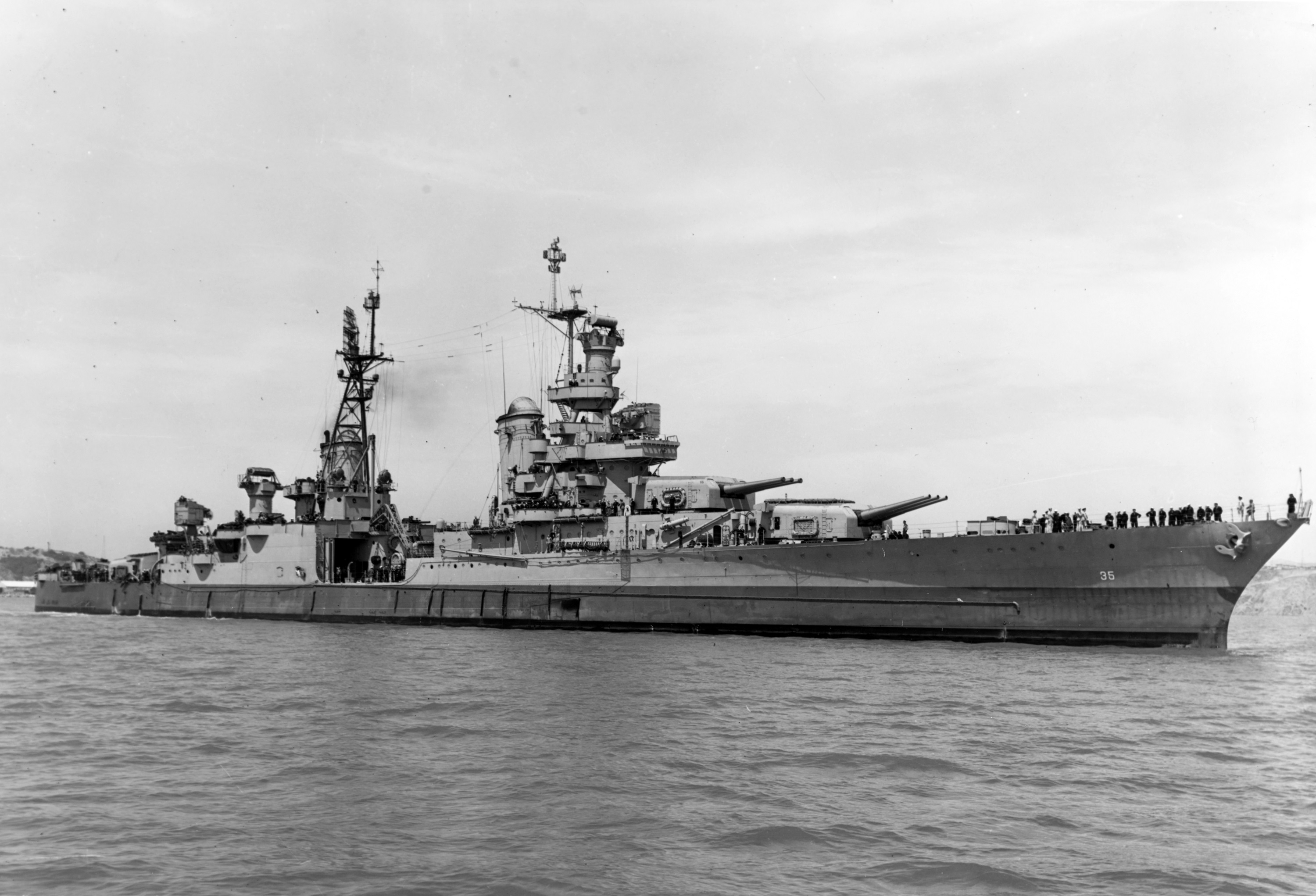
    Photo was captured on July 10, 1945 off Mare Island.

    On this day in 1945, the USS Indianapolis is torpedoed by a Japanese submarine and sinks within minutes in shark-infested waters. Only 317 of the 1,196 men on board survived. However, the Indianapolis had already completed its major mission: the delivery of key components of the atomic bomb that would be dropped a week later at Hiroshima to Tinian Island in the South Pacific.

    Shortly after midnight on July 30, halfway between Guam and Leyte Gulf, a Japanese sub blasted the Indianapolis, sparking an explosion that split the ship and caused it to sink in approximately 12 minutes, with about 300 men trapped inside. Another 900 went into the water, where many died from drowning, shark attacks, dehydration or injuries from the explosion. Help did not arrive until four days later, on August 2, when an anti-submarine plane on routine patrol happened upon the men and radioed for assistance.

    In the aftermath of the events involving the Indianapolis, the ship’s commander, Captain Charles McVay, was court-martialed in November 1945 for failing to sail a zigzag course that would have helped the ship to evade enemy submarines in the area. McVay, the only Navy captain court-martialed for losing a ship during the war, committed suicide in 1968. Many of his surviving crewmen believed the military had made him a scapegoat.

    The Final Crew of the USS Indianapolis (CA-35)

    In October 2000, Captain McVay was exonerated for the loss of Indianapolis and in July 2001, the United States Secretary of the Navy ordered McVay’s official Navy record cleared of all wrongdoing. The wreck was located on 19 August 2017, at a depth of 18,000 feet (5,500 m).

  • Pointe du Hoc

    Pointe du Hoc

    Republished almost every year;

    a0139_small.gif

    Rangers Mission for D-Day, 6 June 1944

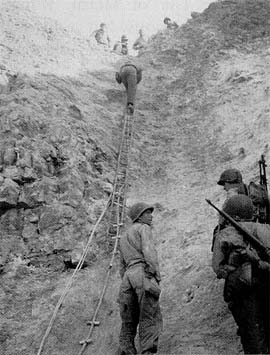
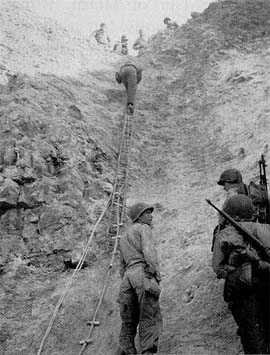
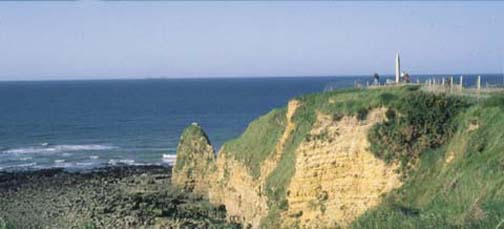
    The Ranger Group, attached to the 116th Infantry and commanded by Lt. Col. James E. Rudder, was given the mission to capture Pointe du Hoc and destroy the guns. The Ranger Group was made up of two battalions: the 2d Rangers, under direct command of Col. Rudder, and the 5th Rangers, under Lt. Col. Max F. Schneider. Three companies (D, E, and F) of the 2d Battalion (Task Force A) were to land from the sea at H-Hour and assault the cliff position at Pointe du Hoc. The main Ranger force (5th Battalion and Companies A and B of the 2d, comprising Task Force B) would wait off shore for a signal of success, then land at the Point. The Ranger Group would then move inland, cut the coastal highway connecting Grandcamp and Vierville, and await the arrival of the 116th Infantry from Vierville before pushing west toward Grandcamp and Maisy.

    dday_pointeduhoc_375.jpg

    One DUKW was hit and sunk by 20-mm fire from a cliff position near the Point. The nine surviving LCAs came in and managed to land in parallel on a 400-yard front on the east side of Point du Hoc, landing about 0705. Allied naval fire had been lifted since H-Hour, giving the Germans above the cliff time to recover. Scattered small-arms fire and automatic fire from a flanking machine-gun position hammered the LCAs, causing about fifteen casualties as the Rangers debarked on the heavily cratered strip of beach. The grapnel rockets were fired immediately on touchdown. Some of the water-soaked ropes failed to carry over the cliff, but only one craft failed to get at least one grapnel to the edge. In one or two cases, the demountable extension ladders were used. The DUKWs came in but could not get across the cratered beach, and from the water’s edge their extension ladders would not reach the top of the cliff.

    Despite all difficulties, the Rangers used the ropes and ladders to scramble up the cliff. The German defenders were shocked by the bombardment and improbable assault, but quickly responded by cutting as many ropes as they could. They rushed to the cliff edge and poured direct rifle and machine gun fire on the Rangers, augmented by grenades tossed down the slope. The Rangers never broke, continuing to climb amidst the fire as Ranger BAR men picked off any exposed Germans. The destroyer USS Satterlee (DD-626) observed the Rangers’ precarious position, closed to 1500 yards and took the cliff top under direct fire from all guns, a considerable assist at a crucial time.

    Within ten minutes of the landing the first Americans reached the top of the cliffs.

    rangers_pointe_du_hoc_700_01.jpg

    I may just watch “The Longest Day” tonight.

  • Poking the Bear: Gest Kozakiewicza

    In general, Americans love sports. But Americans didn’t follow the 1980 Summer Olympics particularly closely.

    The reason? The 1980 Summer Olympics were held in Moscow – and the US was boycotting the games due to the Soviet Union’s December 1979 invasion of Afghanistan. With no US Olympic Team competing, most American’s weren’t particularly interested in those games.

    In a way, that’s a pity. Because that means that most Americans, including myself, missed one of the great gestures of defiance of the Cold War.

    Or, more precisely, two of them.

    . . .

    1980 was a rough year in Poland. At the time of the Summer Olympics, Poland – perhaps then the most restless of the Soviet Warsaw Pact nations – was in the midst of serious labor unrest. (Two months later, this labor unrest would give rise to Solidarity.) And Poland’s historical distrust (many would say dislike) of Russia was showing again.

    Still, Poland sent a team to the Moscow Olympics that summer. And one of those on the team was a pole vaulter named Wladyslaw Kozakiewicz.

    Kozakiewicz had had a generally successful – but turbulent – career as a pole vaulter for the Polish national team. He’d competed in the Olympics previously, in 1976; however, he’d injured himself early during that competition and finished 11th. He was a former European champion, and for a time held the world record in the pole vault. But he was somewhat of a free spirit; he’d been suspended repeatedly for insubordination and poor performance.

    Further, 1980 hadn’t started particularly well for Kozakiewicz. However, the month prior to the Olympics Kozakiewicz had briefly held the world record in the pole vault. So he was definitely a threat to medal, if not win the competition in Moscow.

    The pole vault final was held on 30 June 1980 at Moscow’s Central Lenin Stadium. Predictably, the crowd was solidly behind the Soviet favorite, Konstantin Volkov. And the crowd’s sportsmanship left much to be desired; they jeered all non-Soviet competitors in the pole vault.

    The crowd’s behavior irritated Kozakiewicz. And as a Pole, it’s likely he wasn’t all that fond of Russia anyway.

    So he decided he’d give the Soviet crowd his best – along with a piece of his mind.

    Kozakiewicz cleared 5.70 meters – the highest height yet cleared during the competition. He then secured the win by clearing 5.75 meters (the world record in the pole vault, set by Philippe Houvion of France just before the Olympic games began, was only 2 cm higher at 5.77 meters).

    But that’s not what made him famous.

    What made Kozakiewicz famous was his conduct after each of those two vaults. After clearing each of those heights, he turned to the pro-Soviet crowd and summed up his feelings (and those of many if not most of his countrymen towards the Soviet Union) with the following gesture:

    Finally, for good measure Kozakiewicz vaulted again, clearing 5.78 meters – and setting a new world record in the pole vault. That hadn’t happened at the Olympics since 1920.

    Predictably, the Soviets were not amused. After the Games, the Soviet Ambassador to Poland demanded that Kozakiewicz’s Olympic Medal be stripped from him due to his “insult to the Soviet people.”

    The Polish government’s response was perfect – and hinted at Poland’s true feelings towards Russia (and thus the Soviet Union). Poland’s government refused to strip Kozakiewicz of his medal. The official response of the Polish government was that Kozakiewicz’s arm gestures “had been an involuntary muscle spasm caused by his exertion.”

    The crude gesture known elsewhere as the bras d’honneur (as well as by other names) became known in Poland as “gest Kozakiewicz”. It was viewed there as symbolizing resistance to Soviet domination of Poland.

    Poking the bear, indeed. (smile)

  • Russell Warriner and altered history

    Russell Warriner and altered history

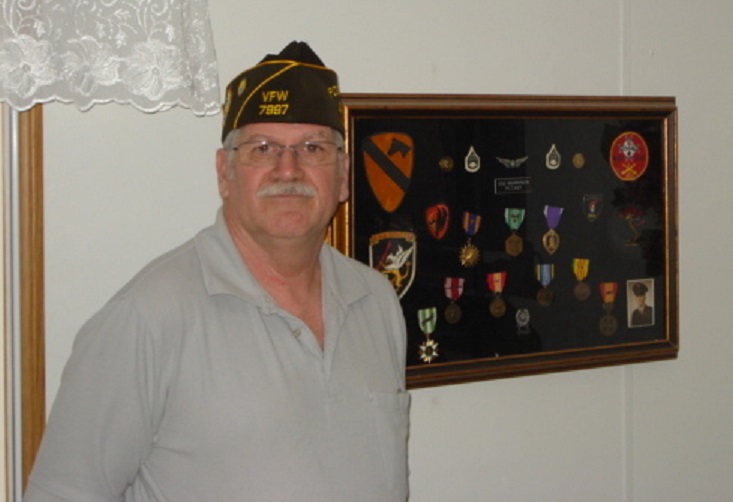
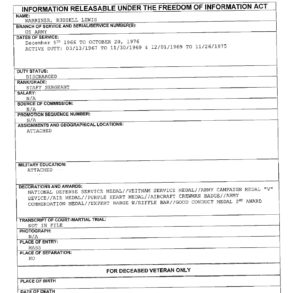
    The Bangor Daily News printed a story told to them by Russell Warriner who served in Vietnam as a helicopter crew chief and left the service in 1975 as a staff sergeant. He served with Battery C, 2d Battalion, 20th Artillery of the 1st Cavalry Division from October 1967 to June 1969. He was awarded the Purple Heart and 14 Air Medals including one Air Medal with a Valor device.

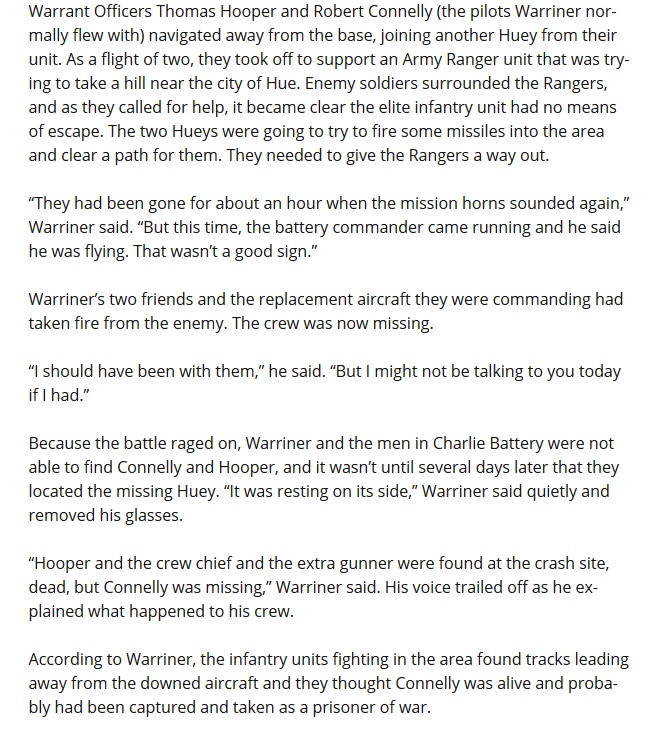
    The problem comes with Bangor Daily News article when he describes an incident where his pilot and co-pilot flew another helicopter while he was left to repair his own craft on February 4th, 1968.

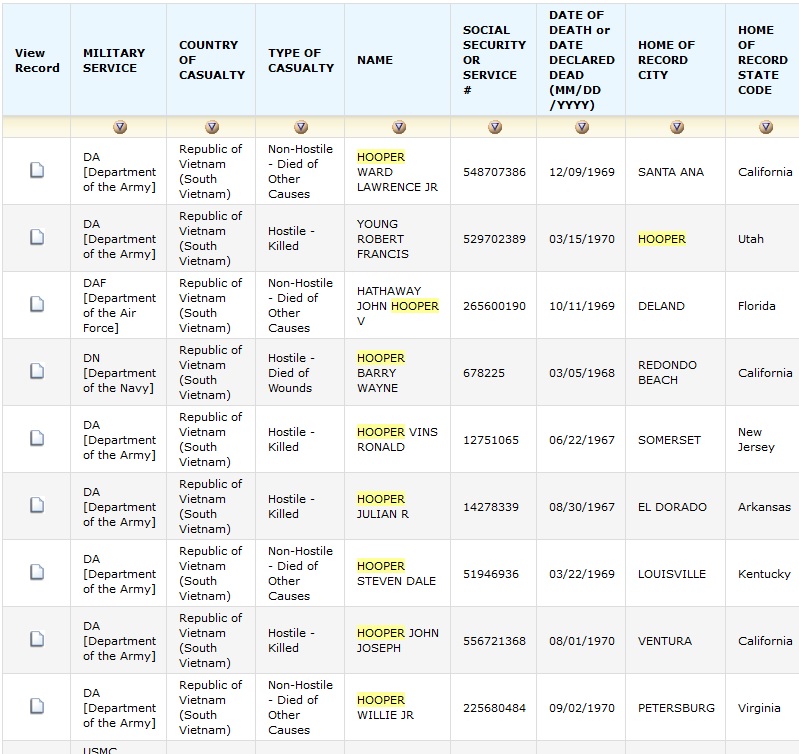
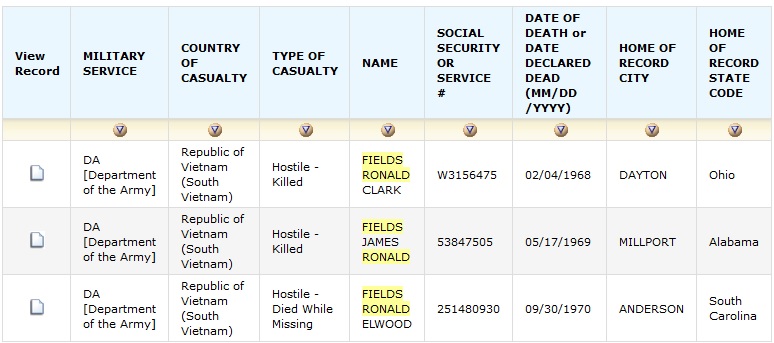
    In the story, he claims that the co-pilot, Thomas Hooper was killed. According to the National Archives, there was no Thomas Hooper killed in Vietnam;

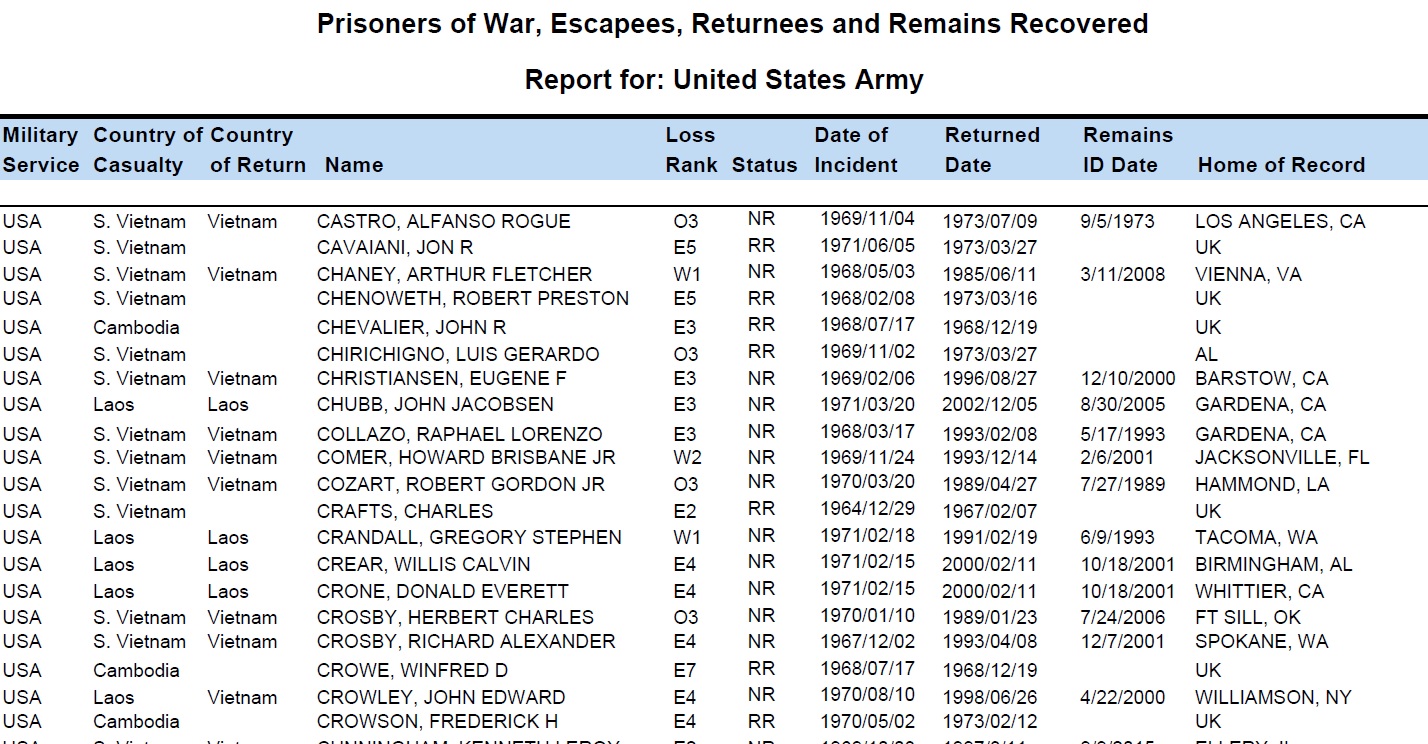
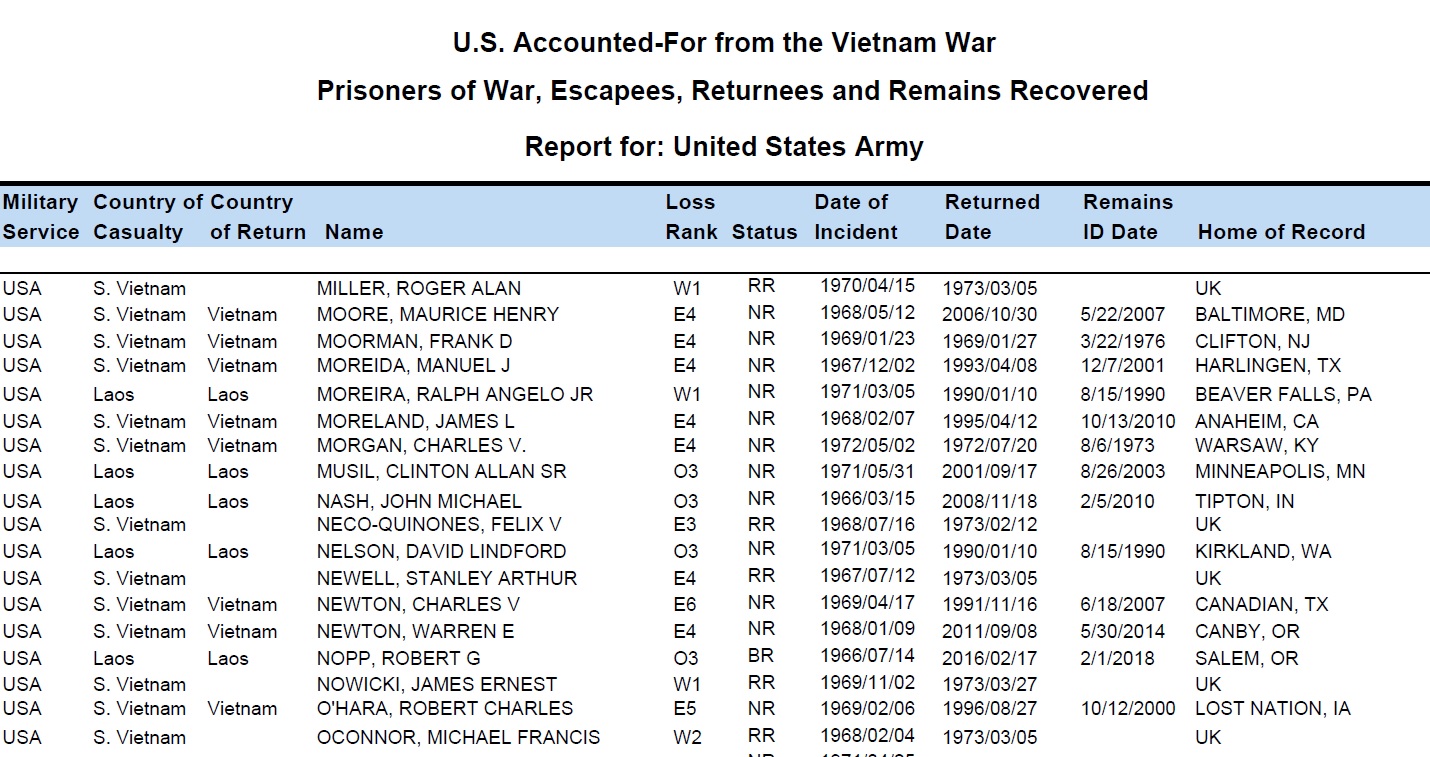
    He also claims that Robert Connelly was captured and imprisoned at the Hanoi Hilton. The historian of NAM POW, Captain Mike McGrath, an actual POW of the Vietnam War, says that there was no Robert Connelly captured and held as a POW or returned in 1973 with Captain McGrath. DPAA agrees;

    Doing my due diligence, I searched for more of SSG Warriner’s stories and found a 2012 version of the same article in which he gives the names of the pilot and copilot as Warrant Officers Ronald Fields and Michael O’Connor.

    Checking the NARA and DPAA websites confirms that SSG Warriner merely mis-remembered the names of his crew in his telling of the story for the Bangor Daily Times;

    Welcome home, SSG Warriner and Warrant Officer O’Connor.

  • Battle of Norfolk; 27 years ago today

    Battle of Norfolk; 27 years ago today

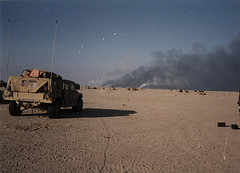
    The Battle of Norfolk was the cousin of the Battle of 73 Easting. Objective Norfolk was just the other side of that invisible line in the sand. Wiki says of that battle;

    No less than 14 divisions participated in this particular battle. In reality this makes it quite possibly the largest battle of the entire war, however, the Battle of Medina Ridge involved the largest American and Iraqi divisions. Another factor was the media seemingly overlooked the details of the coalition ground campaign for some unknown reason. It would also be over a decade after the conflict before quality references would become available on most of the battles that took place during the 1st Gulf War.

    Task Force 1-41 passed through elements of the 2d ACR at about 30 minutes after midnight in total darkness after a day-long march to get to the battle. The horizon in front of 2/2 Cav was dotted with burning armored vehicles, hundreds of Iraqi prisoners sat in tiny groups waving white flags so they wouldn’t get shot by the advancing armored vehicles. We could make out them and their flags through our thermal optics. As soon as we passed through the Cav’s vehicles, it became a 360-degree battle. Bravo Company’s commander became disoriented and led a platoon diagonally across the battlefield where they were mistaken for Iraqi armor by M1 gunners who immediately destroyed three of the Bradleys. Remarkably, only six of that 35-member platoon were killed.

    The rest of Task Force 1-41 watched the sun come up six miles from where they had passed through 2/2 Cav’s line.

    The two attacking brigades of the U.S. 1st Infantry Division, including the 3rd Brigade of the 2nd Armored Division, were positioned along the 75 Easting, 2,000 meters east of 73 Easting. The Brigades clashed with the Iraqi Tawakalna Division of the Republican Guard, including the 37th Brigade of the 12th Iraqi Armored Division. The 12th Iraqi Armored Division would be destroyed during this engagement. A total of 80 Iraqi armored vehicles would be destroyed in the process.

    4-3 FA Battalion, 2nd Armored Division(FWD) conducts artillery strikes on Iraqi positions during the 1st Gulf War. 4-3 FA was the primary fire support battalion for Task Force 1-41 during the 1st Gulf War, February 1991.
    British Army Challenger 1 main battle tank during Operation Desert Storm. The Challenger proved to be a deadly opponent at the Battle of Norfolk.

    With air support from the 2nd Battalion, 1st Aviation’s attack helicopters and fire support from both the 4-3 FA Battalion and the 210th Field Artillery Brigade preventing Iraqi artillery from interfering, the U.S. 1st Infantry Division conducted a passage of the 2nd ACR’s lines. In the following three hours the U.S. 1st Infantry Division methodically crossed the 6.2 miles (10.0 km) of Objective Norfolk, destroying Iraqi tanks, trucks, and infantry through thick fog. The 3rd Brigade of the 2nd Armored Division destroyed 60 Iraqi tanks and 35 AFVs along the IPSA pipeline. In the thick of the fog of war, U.S. units became mixed with Iraqi units dispersed throughout the desert. This confusion led to some friendly fire incidents.

    By dawn, the U.S. 1st Infantry Division controlled Objective Norfolk and the Tawakalna Mechanized Infantry Division had ceased to exist as a fighting force. A total of eleven Iraqi divisions were destroyed. American casualties were six soldiers killed (all but one by friendly fire) and 25 wounded.

    We reconsolidated after a sleepless night and set out for Kuwait from there. Eventually, we began running out of fuel and the whole Brigade lagered up the night of the 27th and waited for the fuelers – and we got our first real sleep since we’d crossed into Iraq three days before only because our fuel tanks were nearly empty. I laid on top of our TOW missile launcher while I waited for the troops to get their own sleeping gear situated and woke up with the sun in my face the next morning with a few hours left before the ceasefire so we mounted up and moved out.

    As the ceasefire deadline approached, we engaged with remnants of the Iraqi Army left behind by their leadership (which had fled back to Iraq on the nearby Highway One – the Highway of Death) and at 0800 local time, we turned left and stopped firing.

    Task Force 1-41 was awarded a Valorous Unit Citation which read;

    For extraordinary heroism in action against an armed enemy. Task Force 1-41 was the first coalition force to breach the Saudi Arabian border on 15 February 1991 and conduct ground combat operations in Iraq engaging in direct and indirect fire fights with the enemy on 17 February 1991. The Task Force was part of the VII Corps main attack beginning 24 February 1991 as it conducted a forward passage through 1st Infantry Division elements and began a mission to clear a zone which again resulted in enemy contact. On 26 February, following a 60 kilometer road march, the Task Force immediately engaged in ground combat with armored and dismounted enemy of brigade size. For six hours it was involved in continuous combat with a tenacious and determined enemy occupying extremely well prepared and heavily fortified bunkers. Task Force infantry elements dismounted and engaged the enemy in numerous short range fire fights while methodically clearing the extensive bunker complex. By morning the Task Force had systematically reduced the entrenched enemy positions in zone. Continuing as part of the VII Corps attack the Task Force travelled 85 kilometers in less than 24 hours while engaging at short range multiple, dug in enemy tanks in ambush positions. The Task Force reached its final objective 28 February 1991 with a push which continued the destruction of enemy armored vehicles. During the entire ground campaign, involving their attack through Iraq into Kuwait, Task Force 1-41 travelled over 200 Kilometers in 72 hours and destroyed 65 armored vehicles and 10 artillery pieces, while capturing over 300 enemy prisoners.