Category: Historical

  • Weekend Open Thread

    Many TAH readers have flown on a C-130. But it’s possible few know the aircraft’s true maximum possible passenger capacity.

    Oh, sure – the book says that the earlier models can hold “64 paratroopers or 92 combat troops”. But when push comes to shove, the bird can carry a few more than that.

    As in over 350 more. And I am not joking.

    . . .

    Tan Son Nhut Air Base, 29 April 1975. The North Vietnamese were advancing on Saigon, and a massive evacuation of US and other friendly personnel was underway. Originally planned as an evacuation of 13,000, the evacuation is estimated to have moved nearly 130,000 persons to safety.

    At the time Tan Son Nhut was literally a war zone. Over 100 aircraft were either damaged and/or destroyed on the air base flight line, with some still burning.

    However, one C-130 – tail number 56-0518 – remained there in flyable condition. It has been a USAF asset from delivery in 1957 until 1972, but was then transferred from the USAF to the RVNAF.

    Its pilot on 29 April 1975 was an RVNAF officer named Major Phuong (regrettably, I couldn’t determine the man’s full name). As he prepared to leave, his aircraft was being mobbed by literally hundreds.

    So many people boarded the plane that while taxiing the loadmaster informed Maj Phuong that he couldn’t close the rear ramp. Phuong then slammed on the brakes, which pushed the mass of passengers forward. (Some accounts say he did this multiple times in order to make room for more evacuees.) The doors were closed, and the aircraft – though overloaded by an amount estimated to be at least 5 tons – successfully took off.

    Accounts indicate the aircraft needed more than 10,000 feet to get airborne – and the runway at Tan Son Nhut was only 10,000 feet. The bird didn’t lift off until it was on Tan Son Nhut’s 1,000’ runway overrun.

    After an eventful flight (in addition to the high APF takeoff, they also became disoriented over the Gulf of Thailand), Phuong and his aircraft eventually reached safety. After landing, 452 personnel exited the plane – 32 of whom had been crammed into the cockpit.

    . . .

    No, this isn’t some bogus “tall tale”. It actually happened. It’s documented here, here, here, and here. Multiple other accounts also exist, though not all are accurate (some sources indicate, erroneously, that the aircraft was a USMC C-130).

    Living free vice under a Communist dictatorship is often a powerful motivation to do truly amazing – and insanely dangerous – things.

    Afterwards, the aircraft was returned to the USAF. It continued to fly until 1989, at which point it was retired.

    The aircraft wasn’t send to Davis-Monthan AFB and scrapped, though. In recognition of the fact that it was the last C-130 to leave Vietnam, the aircraft was retained as a memorial. It is today on static display outside the main gate of Little Rock AFB, AR.

    OK, enough aviation history for today. Enjoy the WOT, everyone – and the weekend.

  • Weekend Open Thread

    Most readers probably know that between 1956 and 1960, the US conducted U2 overflights of the Soviet Union. Most also probably know that those overflights “ended” when Gary Powers’ ill-fated flight was shot down near Sverdlovsk on 1 May 1960.

    Yes, the “ended” above is in quotations for a reason. While Powers’ flight was the last acknowledged intentional US overflight of Soviet territory by a U2, it was not the last such overflight. At least one other overflight occurred – and it occurred at perhaps the worst possible time in human history.

    . . .

    The week of Monday, 22 October 1962, should need no introduction to either regular TAH readers or those with a knowledge of Cold War history. That week was the public part of the Cuban Missile Crisis – e.g., the week the US and USSR very nearly played a “game” called Global Thermonuclear War.

    During the Saturday of that week, Captain (later Vice Admiral) Vasili Alexandrovich Arkhipov of the Soviet Navy prevented another Soviet Naval officer from using a nuclear-armed torpedo against US warships. Also on that same day a U2 piloted by Maj. Rudy Anderson, USAF, was shot down while overflying Cuba on a recon mission, killing Maj. Anderson.

    But at the same time that Maj. Anderson’s aircraft was downed, another U2 mission was underway. And it wasn’t over Cuba. Rather, it was 5,000+ miles to the northwest.

    . . .

    Even during the Cuban Missile Crisis, U2s were operating elsewhere in the world. The USSR had resumed atmospheric nuclear testing in 1961, at Novaya Zemlaya. So in October 1962 the US was regularly sending sampling missions over the Arctic to obtain fallout samples from those tests in an operation called “Project Star Dust II”.

    The route of the mission scheduled for 27 October 1962 was simple. It was to take off from Eielson AFB, AK; fly north to the North Pole, obtaining fallout samples (if there were any); and return. The flight was a routine one, scheduled well in advance.

    The execution wasn’t exactly as planned.

    . . .

    The pilot of the sampling flight in question was Capt. Charles Maultsby, USAF. He would have preferred to have been flying missions over Cuba, but his current assignment was flying missions over the Arctic.

    Maultsby’s flight to the North Pole on 27 October 1962 went reasonably well. However, as he approached the North Pole he had to determine the correct south heading for his return (all directions from the North Pole are by definition south, but obviously most headings won’t result in a return to Eielson AFB).

    Further: at high northern latitudes, a compass isn’t particularly useful. So on such missions the U2 pilot had to use celestial navigation – e.g., star sightings via sextant. And as Maultsby made his early-morning (Alaska time) approach to the North Pole, the aurora was particularly strong.

    To make a long story short: Maultsby’s navigation was off. Instead of returning to Alaska, he flew west of Wrangel Island and ended up over far eastern Siberia’s Chukot Peninsula.

    SAC HQ was monitoring Maultsby’s flight. For whatever reason, the Soviets were not using strong encryption on their Siberian Air Defense network. The US had discovered this – and unknown to the Soviets the US was monitoring that network in virtually real time. But this fact was, obviously, a critically important secret. Radioing Maultsby a message to the effect that, “Um, guy, you are currently over the Soviet Union; turn due east” would disclose that secret – and was simply not going to happen.

    A second complicating factor was the fact that USAF procedures of the day mandated a change in ordnance on frontline US air defense interceptors when the US went to DEFCON 3. Specifically, the F-102’s based in Alaska at that point changed from conventional air-to-air missiles to ones having small nuclear warheads.

    Earlier during the week, we’d gone to DEFCON 3 – then DEFCON 2. So our Alaska-based interceptor aircraft were now armed with air-to-air missiles having nuclear warheads.

    The USSR wasn’t exactly thrilled at the fact that another US U-2 was flying over Soviet territory. They scrambled interceptors from two Siberian airfields on the Chukot Penisula – airfields near the towns of Pevek and Anadyr – in an unsuccessful attempt to intercept Maultsby’s U-2. In response, the US launched F-102s from the former Galena AFB in Alaska in the event Maultsby required air support during his return.

    . . .

    After penetrating some distance into eastern Siberia, Maultsby determined he was likely over the USSR. He was able to contact one of his mission’s support/search and rescue aircraft via radio; they advised Maultsby that it was sunrise over central Alaska and asked him if he could see the sunrise. Since he could not (Maultsby was several hundred miles west at the time), this information confirmed that he was indeed over the USSR and needed to head east. He did so.

    One problem: by this time, Maultsby no longer had enough fuel to reach Alaska under his own power. He’d taken off with 9 hours 40 minutes of fuel; his flight, now a substantially longer one, would take in excess of 10 hours. However, the U2 glides well – up to 250 miles when starting at high altitude. So with about 12 minutes fuel remaining, Maultsby cut his engines and glided until he was met by two US F-102s from Galena AFB over extreme western Alaska. They suggested to him a landing at a USAF radar station near Kotzebue (about 150 miles NNE of Nome).

    Maultsby successfully landed there. After being assisted from his cockpit by one of the radar site’s crew, to paraphrase the late Frank Zappa he then emulated the famous Huskies and immediately “made a bunch of yellow snow”. No word on whether he used the opportunity to write his initials – or his name – in said snow. (smile)

    Maultsby’s U2 flight was the longest duration U2 flight on record at the time. He’d flown for 10 hours and 25 minutes – on 9 hours 40 minutes worth of fuel. He’d also inadvertently overflown several hundred miles of Soviet territory, including flying within intercept range of two Soviet air bases. Only the fact that he was at a much higher altitude than Soviet interceptors of the day could reach saved him. (The fact that the Soviets had indeed twice tried to intercept him during his inadvertent Soviet overflight wasn’t made known to Maultsby until well after he’d landed.)

    Maultsby was not disciplined by the USAF for the mission gone awry. However, at least one other account of his flight (besides the ones linked below) exists and indicates he was never again allowed to fly polar sampling missions.

    Maultsby later flew 200+ combat missions in Vietnam, retiring from the USAF as a Colonel in the late 1970s. He passed away on 14 August 1998 in Tucson, AZ.

    . . .

    An account of Maultsby’s 27 October 1962 mission can be found in Michael Dobbs’ excellent book about the Cuban Missile Crisis One Minute to Midnight in chapters 8, 9, and 11. These can be found online here, here, and here. (Later chapters also give post-flight details, including an account of Maultsby’s personal briefing to the CINCSAC – Gen. Thomas Power – afterwards.) The graphic accompanying this article is from that source.

    A shorter account of Maultsby’s flight can also be found on the National Security Archive website here. Both of these accounts provide additional background and/or details not discussed above.

    As of 2008, the official USAF investigation into Maultsby’s flight remained classified. To my knowledge, it remains classified today and has never been released to the public. The information Dobbs used to prepare the graphic in his book was found in State Department files in the National Archives during his research for the book. An image of the map of Maultsby’s flight Dobbs found in the National Archives can be seen here.

    However, the official USAF history Maultsby’s unit (the 4080th Strategic Wing) for October 1962 has been released to the public in redacted form. It refers to Maultsby’s flight as having been “100 per cent successful”.

    I guess the official history is correct, technically speaking. Presumably “100 per cent successful” in this context means that Maultsby’s flight returned with samples usable by Project Star Dust II. The fact that the flight also involved an unauthorized overflight of the USSR on the absolute worst day of the Cuban Missile Crisis and could easily have sparked World War III is merely an “irrelevant minor detail”. (smile)

    FWIW: tomorrow will be the 56th anniversary of Maultsby’s Soviet overflight. Rest in peace, Colonel Maultsby.

    . . .

    OK, enough Cold War history. Enjoy the WOT, everyone – and the weekend.

  • Marine veteran, 80, receives Medal of Honor for Vietnam bravery | Fox News

    Marine veteran, 80, receives Medal of Honor for Vietnam bravery | Fox News

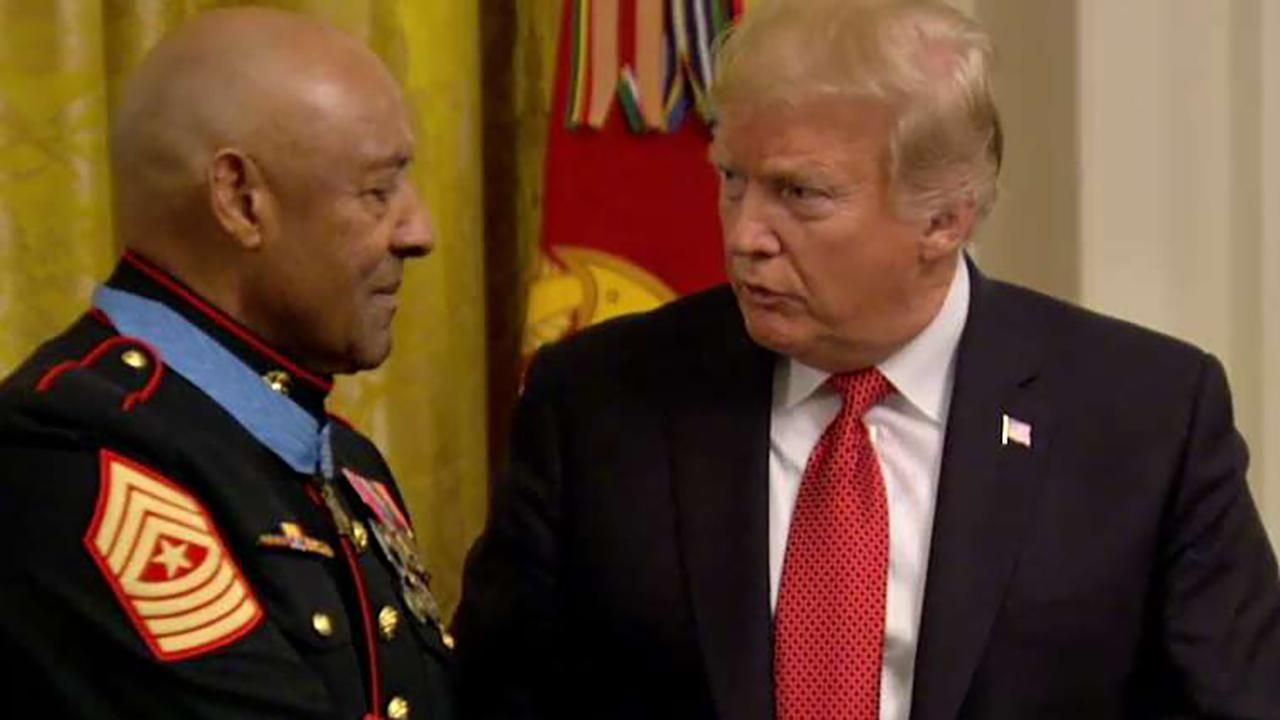
    Marine veteran John Canley, now 80 and a retired sergeant major, received the nation’s highest military honor Wednesday for his “conspicuous gallantry” during the Vietnam War 50 years ago.

    President Trump bestowed the award for valorous action at The White House, beginning the ceremony, saying: “I like brave people, and you meet them right here.”

    Trump noted the utmost respect Canley’s fellow warriors have for him, quoting John Ligato, a Marine and FBI agent, who attended the ceremony: “‘We followed him because he was a true leader, he was totally fearless. He loved his Marines, and we loved him back.’”

    Trump said that Canley still goes to the gym, and his fellow Marines call him a Marine Warrior, “who is bigger than life and beyond the reach of death.”


    Source: Marine veteran, 80, receives Medal of Honor for Vietnam bravery | Fox News

  • Engineer who changed the way the Navy designed ships and fought discrimination dies at 83 – U.S. – Stripes

    Engineer who changed the way the Navy designed ships and fought discrimination dies at 83 – U.S. – Stripes

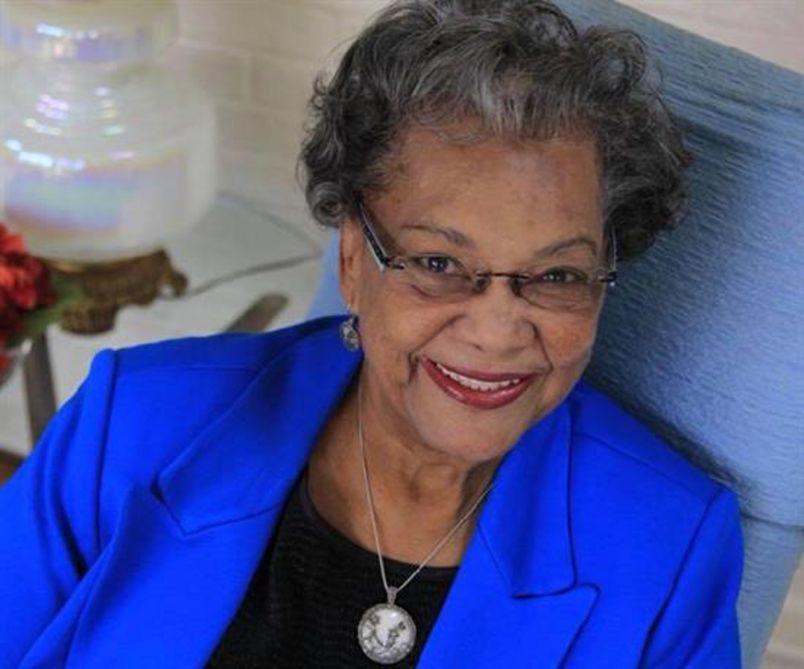
    Raye Montague, a trailblazing black woman from Arkansas who revolutionized the way the U.S. Navy designed ships, has died. She was 83.

    Montague, who had a 33-year career in the Navy, developed a computer program that created rough drafts of ship specifications. She told the Arkansas Democrat-Gazette in 2012 that the program allowed the Navy to cut the time it took to build a ship’s draft design from two years to 18 hours and 26 minutes.

    The newspaper reports she died Wednesday at a hospital in Little Rock. Her son, David Montague, says his mother died of congestive heart failure.

    Raye Montague, a civilian engineer, fought discrimination during her career. When a co-worker wouldn’t show her how to operate a computer, she taught herself.

    A remarkable story of success against the odds.  I hope you get the time to follow the link.

    Source: Engineer who changed the way the Navy designed ships and fought discrimination dies at 83 – U.S. – Stripes

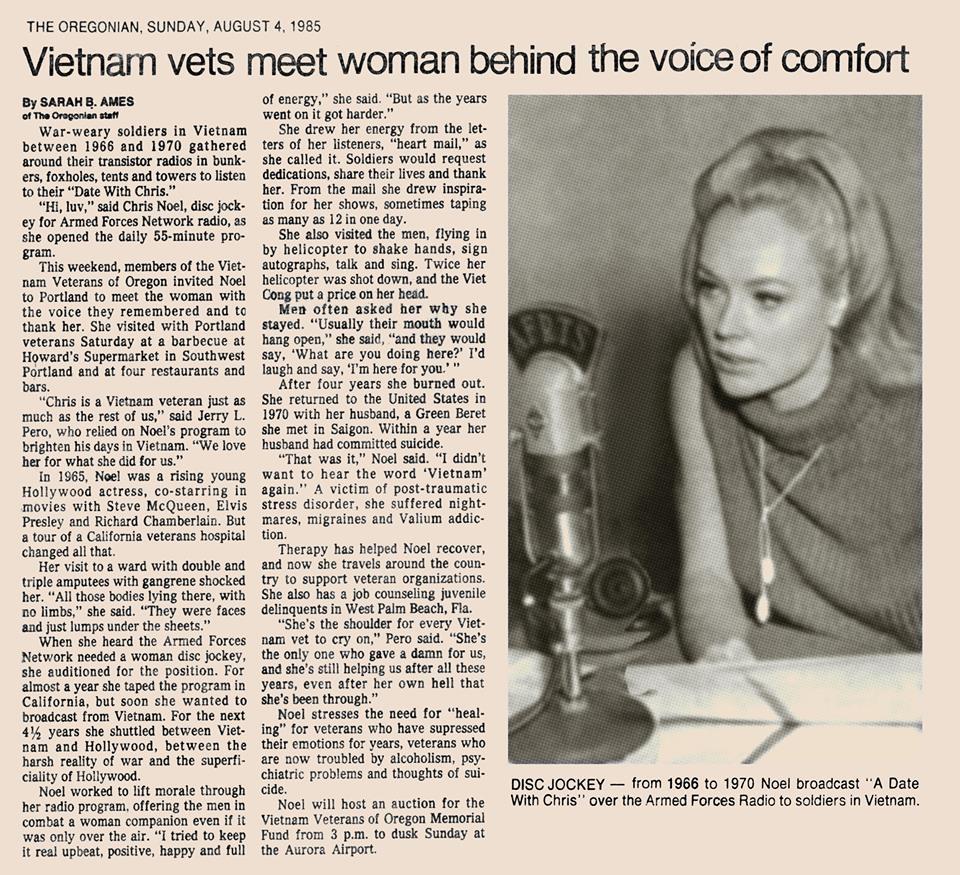
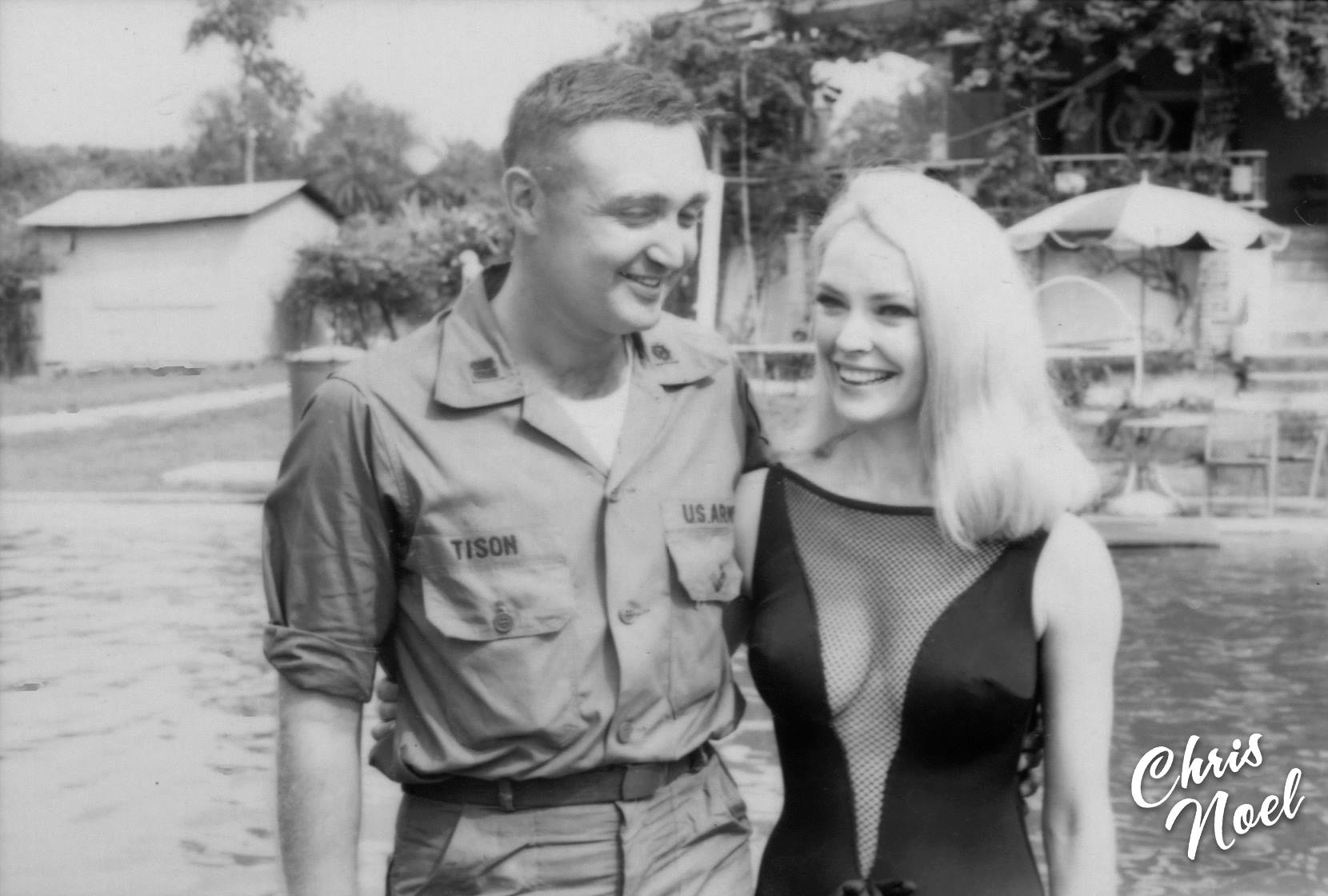
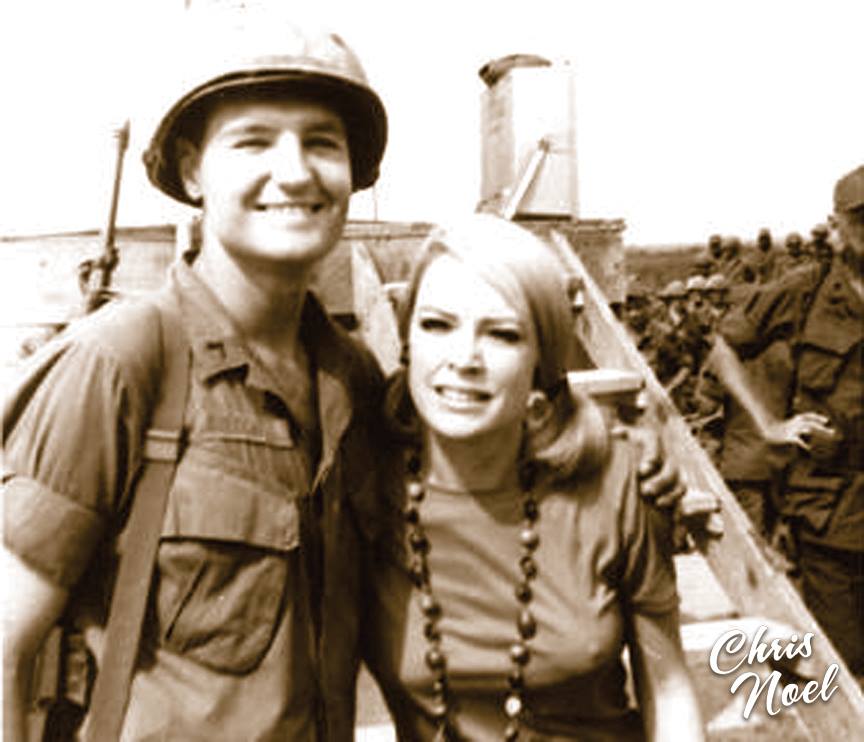
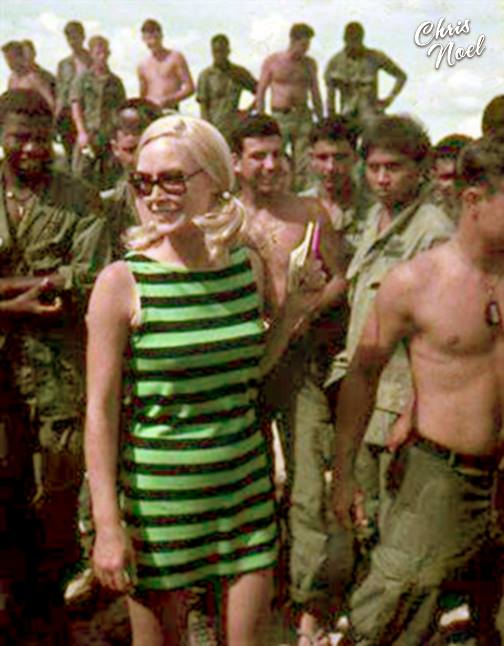
  • The North had Hanoi Jane…but we had Chris Noel

    The North had Hanoi Jane…but we had Chris Noel


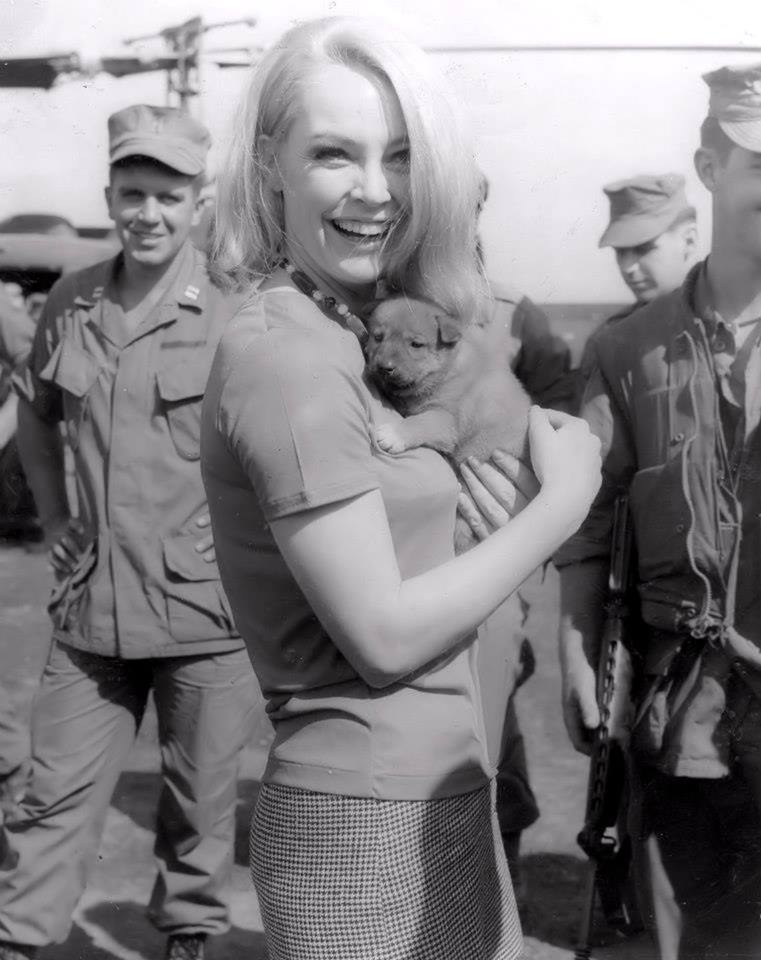
    I was doing some research on a case and ran across her story more than once.  There might be one or two youngsters that remember “A Date With Chris”.

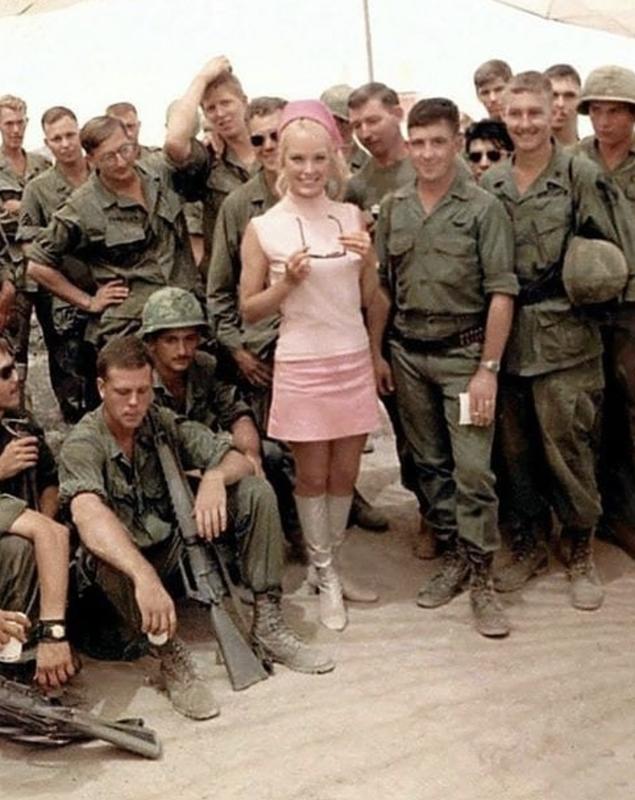
    Chris Noel was a Hollywood sex symbol who became a Vietnam War icon. She was a model who turned actress – who then turned to entertaining the troops in Vietnam. Noel worked on the Armed Forces Radio And Television Service. Her program “A Date With Chris” made her fondly known by vets as “the voice of a California dream girl” by many Viet vets – while her pin up pics were very popular with the troops.

    Noel entertained four tours of Vietnam and her helicopter was shot down twice.  For her work, she received the Distinguished Vietnam Veteran award in 1984 from the Veterans Network.

    It seems to me that she gave up the better part of an acting career to support the fighting men in Vietnam.   She has a remarkable story to tell.  She has a selfless courage that is all too rare.

    For those of you that might have known her you can walk down memory lane  HERE. 


  • Weekend Open Thread

    Most TAH readers know a bit (or more than a bit) about the Lockheed U-2. I’d guess some may even have worked on projects or operations involving that airccraft.

    But without a bizarre-sounding suggestion from one of the technicians during the early days of the project, the aircraft may have been doomed to failure. Once upon a time, “feminine sanitary supplies” may indeed have saved the U-2 project from failure.

    Seriously.

    . . .

    The earliest U-2s suffered from an oil-loss problem with potentially catastrophic consequences.

    The first U-2’s cockpit defogging systems used compressed air from the aircraft’s engine, bled off after the compressor stages, as its source. The original engine was designed for operation at much lower altitudes; at the U-2s very high altitudes, lubricating oil seeped around seals and formed a fine mist in that compressed air.

    This resulted in oil loss while flying – very severe oil loss, enough to threaten the aircraft with total oil loss on a long mission. And although most of that lost oil was burned in the engine, because some air was bled off from the compressor for the defogging system it also resulted in a significant amount of oil deposited on the aircraft’s windscreen. That (oil mist in the cockpit air with depositing of oil film on the windscreen) resulted in both fire and visual hazards.

    Either problem by itself? Not good. Both together? “Double-plus ungood.” (smile)

    Accounts vary somewhat on what happened next. The late Ben Rich – Kelly Johnson’s successor at Lockheed’s famous Skunk Works, which designed and built the U-2 – was at the time responsible for the air intake system on the U-2. His account, found in his book Skunk Works, states that one of the Lockheed technicians suggested to him that that they “pack Kotex around the damn thing and absorb the mess before it hits the windshield” (or words to that effect). Rich in turn pitched the idea to Kelly Johnson; Johnson’s response was reportedly words to the effect of, “What the hell, give it a try.” And it worked.

    Air&Space Magazine (Jan 1999) has a somewhat different variation of the story. They say that a metal box was installed in the defogger line and filled with sanitary napkins to absorb the oil mist. They also say that the pressures involved during flight deformed that metal box. (See page 2 of the linked story.)

    I don’t know which account is closer to the truth. My guess is that there’s an element of truth to both. The box in the defogger line makes sense and would likely have been a relatively quick and easy retrofit, but I’d also guess the solution’s origin was much as Rich described. Either way, I’d guess it was a crusty old Lockheed technician – possibly one who was a World War II or Korean War vet who’d worked in aviation maintenance and/or fabrication then and since – who originally came up with the idea.

    For a while, the U-2 program reportedly used large quantities of “female sanitary napkins” (Rich’s account says they were periodically delivered in large quantities to the Skunk Works plant). The solution, while not permanent, worked well enough to allow the program to continue.

    The problem was apparently solved permanently by adoption of a different engine sometime in 1956. The newer engine was optimized to operate at very high altitudes, and as a result didn’t create oil mist in extreme quantities.

    So, there ya have it. Without the use of “feminine sanitary supplies”, the U-2 program could easily have been a failure. Their use saved the program – or at least greatly contributed to its success.

    Truth sometimes is stranger than fiction. (smile)

    . . .

    OK, enough oddball Cold War history for today. Enjoy the WOT, everyone.

  • America’s deadliest battle took place 100 years ago.

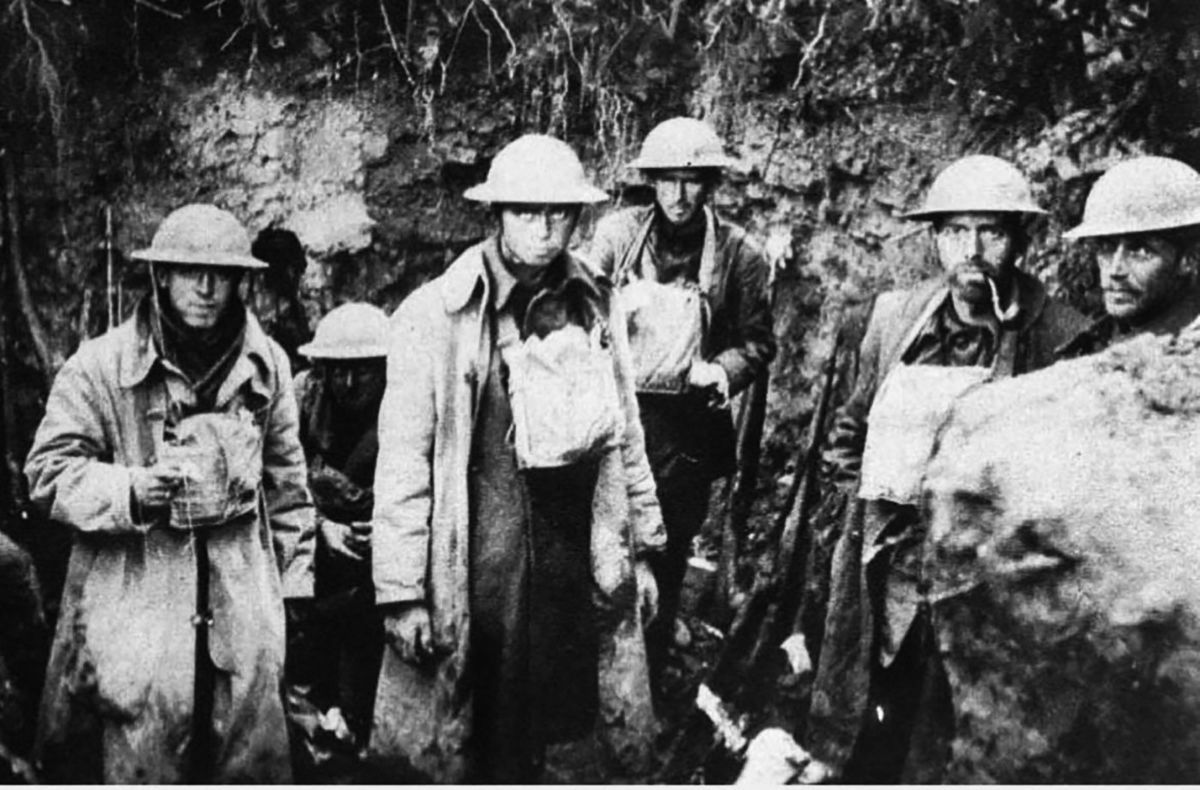
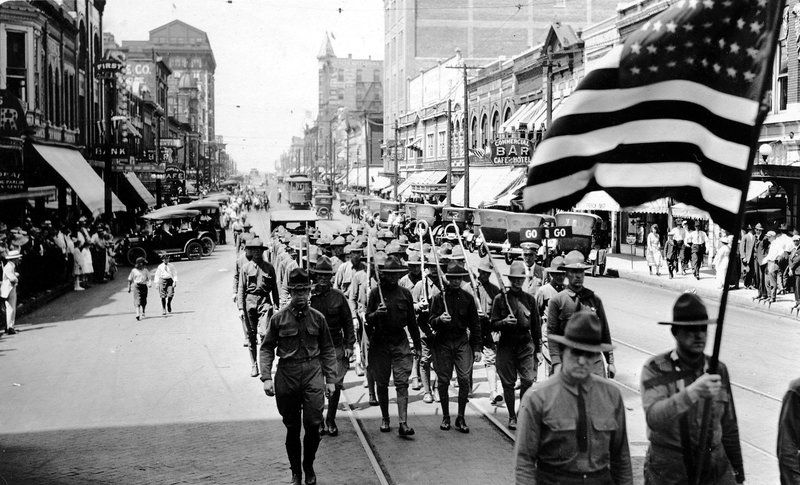
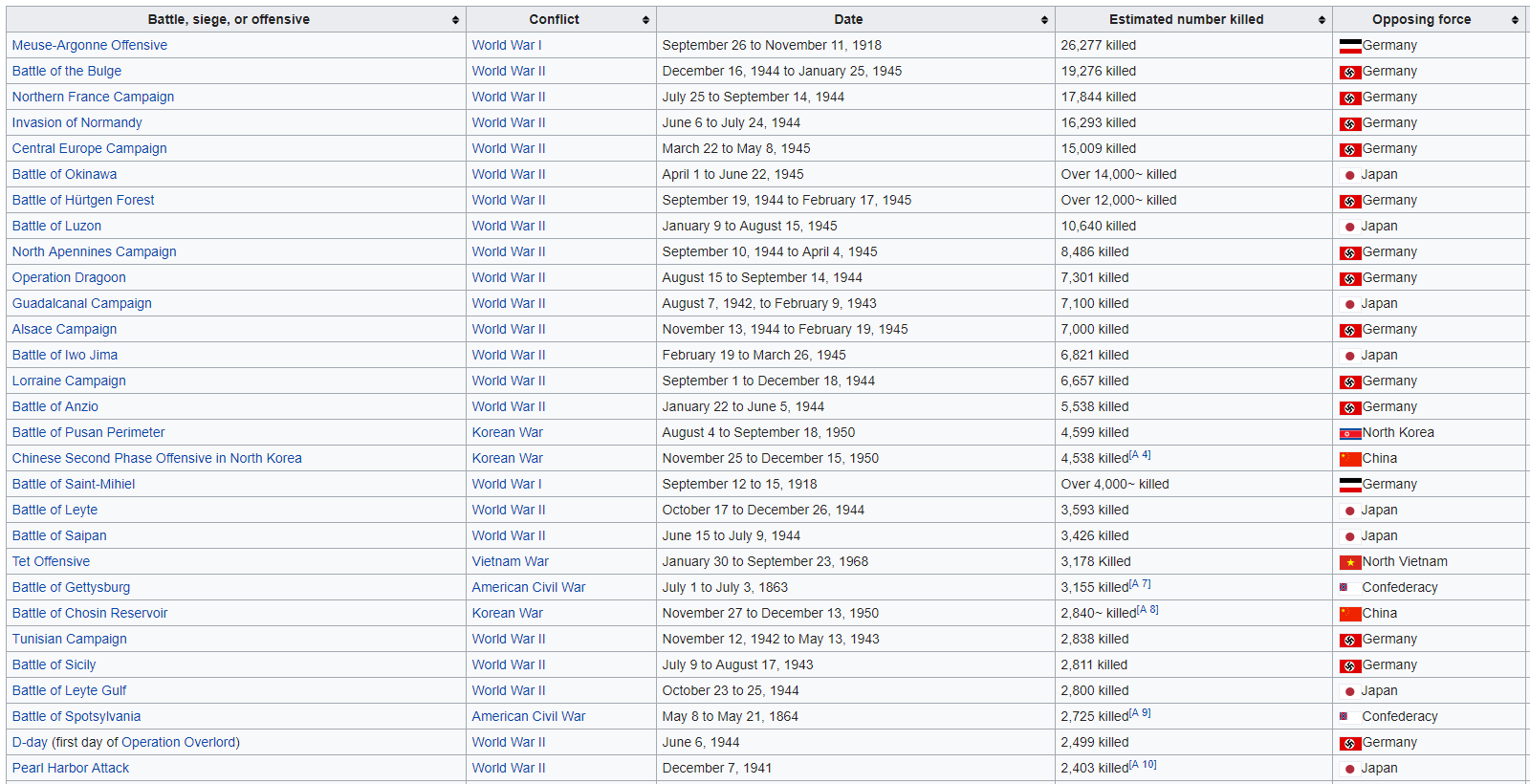
    It was America’s deadliest battle ever, with more than 26,000 U.S. soldiers killed, tens of thousands wounded and more ammunition fired than in the whole of the Civil War. The Meuse-Argonne offensive of 1918 was also a great American victory that helped bring an end to World War I.

    A remembrance ceremony took place on Sunday afternoon in the Meuse-Argonne cemetery, which is surrounded by green fields and forests in Romagne-sous-Montfaucon, a village in northeastern France. More than 14,000 graves will be lit with candles to honor those buried there.

    List of battles with most United States military fatalities

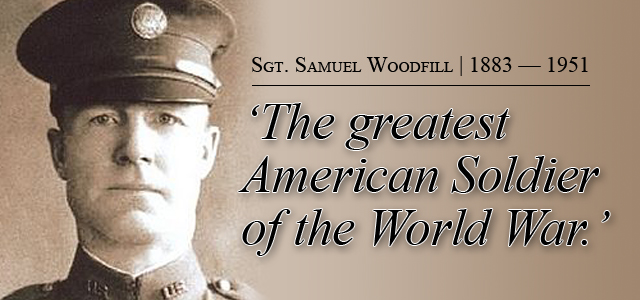
    The Meuse-Argonne offensive produced warrior heroes like Sgt. Samuel Woodfill.

    On Oct. 12, according to his Medal of Honor citation, Woodfill was leading his company through a dense fog towards the village of Cunel when it came under heavy fire. Then a lieutenant, Woodfill set out ahead of his line with two Soldiers trailing and located a German machine gun nest. Woodfill successfully flanked the nest and eliminated three of its four occupants with his rifle. The fourth occupant charged Woodfill. After a hand-to-hand struggle, Woodfill killed the enemy with his pistol.

    The company continued its advance when it came under fire again. Woodfill once again rushed ahead. Despite being hindered by the effects of mustard gas, Woodfill shot several of the enemy while taking three others prisoner. Minutes later, Woodfill rushed a third machine gun pit and killed five men with his rifle before jumping into the pit with his pistol, where he encountered two German soldiers. With his ammunition exhausted, Woodfill grabbed a nearby pickax and killed both.

    With the machine guns silenced, Woodfill’s company continued its advance through Cunel under severe fire.


    During 47 days of combat, 1.2 million American troops led by Gen. John J. Pershing fought to advance on the entrenched positions held by about 450,000 Germans in the Verdun region. More than 26,000 U.S. troops were killed and about 96,000 were wounded.

    The offensive that started on Sept. 26, 1918, was one of several simultaneous Allied attacks that brought the four-year war to an end, leading the Germans to retreat and sign the armistice on November 11.

    Pershing said “the success stands out as one of the very great achievements in the history of American arms.”


  • Weekend Open Thread

    Quick question: who was the first American to break the “sound barrier”? Chuck Yeager, right?

    Most people would say that. Might want to guess again.

    Persuasive evidence – apparently suppressed for roughly 50 years – indicates that an American quite likely if not almost certainly had broken the mythical “sound barrier” prior to Chuck Yeager doing so on 14 October 1947. Twice.

    Yeager wasn’t the American who very likely did that. And rather than the Bell X-1, this was the aircraft that very likely did it:
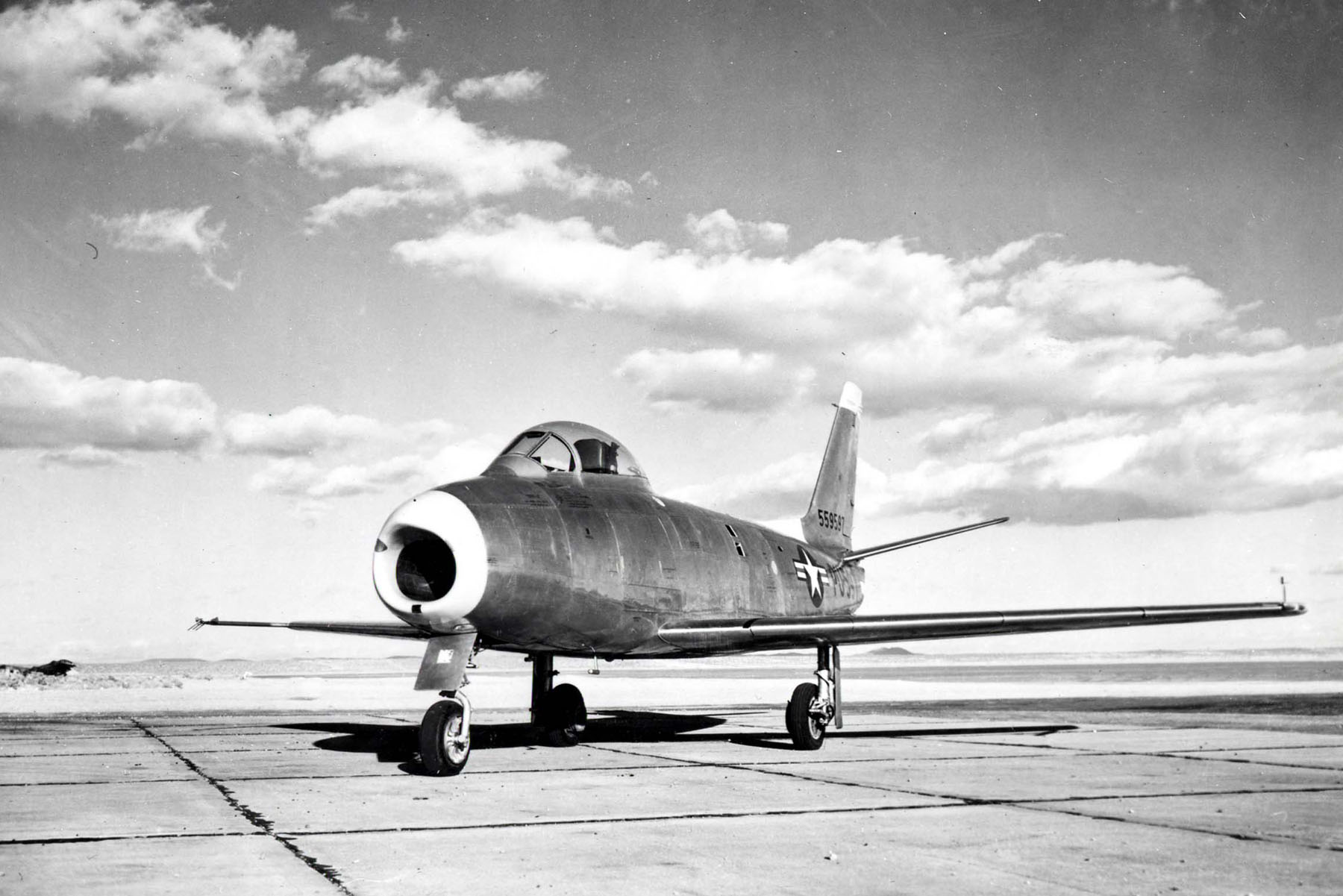
    . . .

    The American who almost certainly first exceeded the mythical “sound barrier” was a former Army Air Forces war hero. His name? George Welch.

    Those with knowledge of aviation history might recognize the name. Yes, that would be the same George Welch who (along with Ken Taylor) was awarded the Distinguished Service Cross for aerial heroics at Pearl Harbor. Welch went on to become one of America’s premier World War II aces, with 16 confirmed kills by late 1943.

    Unfortunately, Welch was flying in the South Pacific. Malaria nailed him – badly. It was severe enough to send him stateside early from the Pacific. And after serving stateside for a while, with the Army’s blessing he left the service to become a test pilot for North American Aviation.

    Shortly after World War II, North American was developing the F-86. It was capable of high subsonic speed. Had we known about “area rule” design as applied to supersonic aircraft at that time, it would almost certainly have been America’s first supersonic aircraft.

    Now, Welch wasn’t a big fan of Bell Aircraft. They’d designed the P-39 Aircobra which Welch flew early in World War II. When asked what he liked about the Aircobra, Welch said, “Well, it’s got twelve hundred pounds of Allison armor plate.” (Welch was referring to the aircraft’s engine, which was built by Allison and located behind the pilot. Performance-wise the Aircobra itself was a dog; Welch later got himself transferred to a unit flying Lockheed P-38s.)

    Welch knew that Bell Aircraft was preparing to go supersonic with their experimental X-1 in the near future, at Muroc Field (what is today Edwards AFB). Bell had the Air Force’s blessing; the X-1 project was an Air Force favorite, and reputedly President Truman had promised Bell’s board chairman that Bell would be the first to break the “sound barrier”.

    However, Welch was at the time also at Muroc; he was there to test North American’s prototype XF-86, which was capable of high subsonic flight. And the XF-86’s flight testing called for investigating the “high Mach region” – e.g., speeds close to the speed of sound.

    . . .

    So, what happens when you put an aircraft into a dive? It speeds up . . . right?

    You guessed it: on 1 October 1947, Welch took the XF-86 up for a test flight – and investigated the “high Mach region”. And while doing that, Welch dove.

    Welch had previously told one of the regulars at Pancho Barnes’ Rancho Oro Verde Fly Inn Dude Ranch (AKA the “Happy Bottom Riding Club” – yes, both the individual and the place portrayed in the book and movie The Right Stuff did exist) to look for the sound of an explosion. If they heard one, Welch told them to note the exact time and observe the reactions of those who heard it.

    During Welch’s flight, the sound of what appeared to be a detonation was observed at the Fly Inn. Welch later compared notes with the individual he’d previously told to keep an ear out for sounds of an explosion.

    The individual had in fact heard the sound – and noted the time. The time was during Welch’s dive.

    Welch did the same again on 14 October 1947. This time, he did so approximately 20 minutes before Yeager’s more famous flight. And the sonic boom from Welch’s flight that day was also heard at the Fly Inn – and was reportedly far louder than that from Yeager’s flight.

    . . .

    The Air Force never acknowledged Welch’s October 1947 flights. Why? Dunno. But I can hazard a guess.

    The Bell X-1 project was an Air Force favorite, and was expensive; its existence had to be justified. (Secretary of the Air Force Stuart Symington had told North American that they were not to exceed Mach 1 with the XF-86 until after Bell had done so with the X-1.) Welch was a civilian employee of North American Aviation, while Yeager was a serving USAF officer. The optics of having someone in uniform be the first to “break the sound barrier” vice a civilian contractor would obviously have been better for the USAF from a PR standpoint.

    Plus, the head of Bell Aircraft, Lawrence Bell, reputedly knew President Truman. You really think the USAF is gonna chance royally p!ssing-off the POTUS within a few weeks of becoming an independent military service? (smile)

    But reportedly there are not only confirmatory ground reports of a sonic boom associated with of each of Welch’s October 1947 flights. There are supposedly instrumentation readings from the Muroc test range’s radar theodolite from roughly a month later that lend credence to claims on Welch’s behalf. (Welch himself never claimed to have been first to break the “sound barrier”.) Those radar theodolite readings verify that Welch did, in fact, officially exceed Mach 1 twice during testing of the XF-86 in November 1947. (Some accounts imply that radar theodolite readings exist for one or both of Welch’s October 1947 flights as well, but that may not be true.) Plus, Welch accurately described to one of North American’s aircraft designers the “Mach jump” instrumentation anomaly noted in early supersonic flight – and he did so not long after his 1 October 1947 flight, nearly 2 weeks before Yeager supposedly “first” observed that same anomaly.

    Decide for yourself. History gives Yeager the credit – but I don’t think he was actually the first American to “break the sound barrier” during a controlled flight. I’m guessing that was George Welch.

    . . .

    Some might argue that Welch doesn’t deserve any credit for breaking the “sound barrier” because he had to dive in the XF-86 to exceed Mach 1. On the surface, that argument may appear to have merit. But bear with me for a moment. Because one can also make a similar – though somewhat different – argument about Yeager’s 14 October 1947 supersonic flight in the X-1.

    Yeager’s first supersonic Bell X-1 flight is well-chronicled, so there’s no need to discuss it in detail. And it was indeed the first time the “sound barrier” was broken in level flight – technically speaking.

    I say “technically speaking” because the Bell X-1 didn’t make that entire flight under its own power. Though capable of taking off from the ground, Yeager’s X-1 did not do so on Yeager’s 14 October 1947 flight. Rather, on that date it was carried to a high altitude by a B-29. It was then released to fly under its own power.

    Would the Bell X-1 have been able to fly to altitude and then exceed Mach 1 in level flight that day? Who knows? (It certainly didn’t do so on 14 October 1947.) But if diving is a “NO-GO” regarding breaking the “sound barrier”, well, pray tell: why is flying only half of a typical air mission (no powered takeoff, being carried aloft instead by another aircraft and then released at high altitude) acceptable?

    In fact, only one Bell X-1 flight involved a takeoff under the aircraft’s own power. Reputedly that flight indeed exceeded Mach 1, with Yeager at the controls – but it also occurred on 15 January 1949, nearly 15 months after Yeager’s first supersonic flight.

    Personally, I think the credit should be split – with Welch recognized as the first American to break the “sound barrier”, and Yeager as the first to do so in level flight. But nearly 50 years of having the truth about Welch’s October 194 flights apparently withheld – plus Welch’s early death in a 1954 flight test accident – has led to Yeager getting sole credit.

    . . .

    OK, enough history. Enjoy the Weekend Open Thread, everyone – and the weekend.

    References:

    The first part of Welch’s career is is summarized here; the second part is summarized here. Both linked articles are excellent if somewhat biased reading (the author’s obviously a huge fan of Welch). Other claims are discussed in an article linked in the following author’s note.

    Yeager’s career and accomplishments need no discussion. He truly was one of the “larger than life” figures of the early days of jet flight.

    A few other Wikipedia articles were also used as background, mostly for checking dates and/or other specific items.

    —–

    Author’s Note: FWIW: while it’s generally accepted that an American was the first to break the “sound barrier”, there’s a chance that the first person to break the “sound barrier” wasn’t even an American. Several Germans flying jet- or rocket-powered aircraft during the latter stages of the war could conceivably have done so; some claims to this effect have been made. But most of those cases have been investigated in detail and have been reasonably (but not categorically) found to be “NO-GOs”. Most of them are listed here, along with Welch’s flights and a few other debunked claims.

    However, two cases are worth mention as possibilities.

    The first possibility is the case of Luftwaffe test pilot Lothar Sieber. It’s entirely possible that Sieber in fact exceeded Mach 1 on his first – and only – test flight of the Bachem Ba349 “Natter” (IMO a truly YGBSM! manned interceptor design developed and partially tested by Nazi Germany out of desperation late during the war) on 1 March 1945.

    Read the linked article if you’d like more details on the Natter and its design. Suffice it to say that IMO both its design and operational conept would have made Rube Goldberg proud.

    In any case: Sieber’s test flight was the first vertical launch of a manned rocket. He may well have exceeded Mach 1 at some point during this single manned test flight of the Ba349.

    However, Sieber never claimed to have “gone supersonic”. The test was a failure, and Sieber did not survive the flight.

    The second is the case of Luftwaffe pilot Hans Mutke. Like Welch, it’s possible he may have exceeded Mach 1 in a dive with his Me262 late in World War II (9 April 1945). His account, and flight profile (including a high-speed high-power dive), track Welch’s account from a few years later reasonably well. (His aircraft didn’t fare as well, though; it was damaged too badly to ever be flown again from aerodynamic stress.)

    Initial analysis indicated that exceeding Mach 1 was not possible with the Me262 because that aircraft’s design would make the aircraft’s controls useless above Mach 1. This in turn would make the aircraft uncontrollable; it was believed that a safe return to subsonic flight would not be possible.

    However, later analysis has indicated that the Me262 might indeed have been recoverable after exceeding Mach 1. Hans Mutke having exceeded Mach 1 in a dive during his flight on 9 April 1945 thus can’t be definitively ruled out.