Category: Historical

  • Burning Washington 200 years ago

    Burning Washington 200 years ago

    Burning_of_Washington_DC_1814

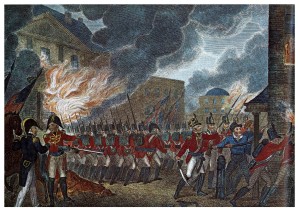
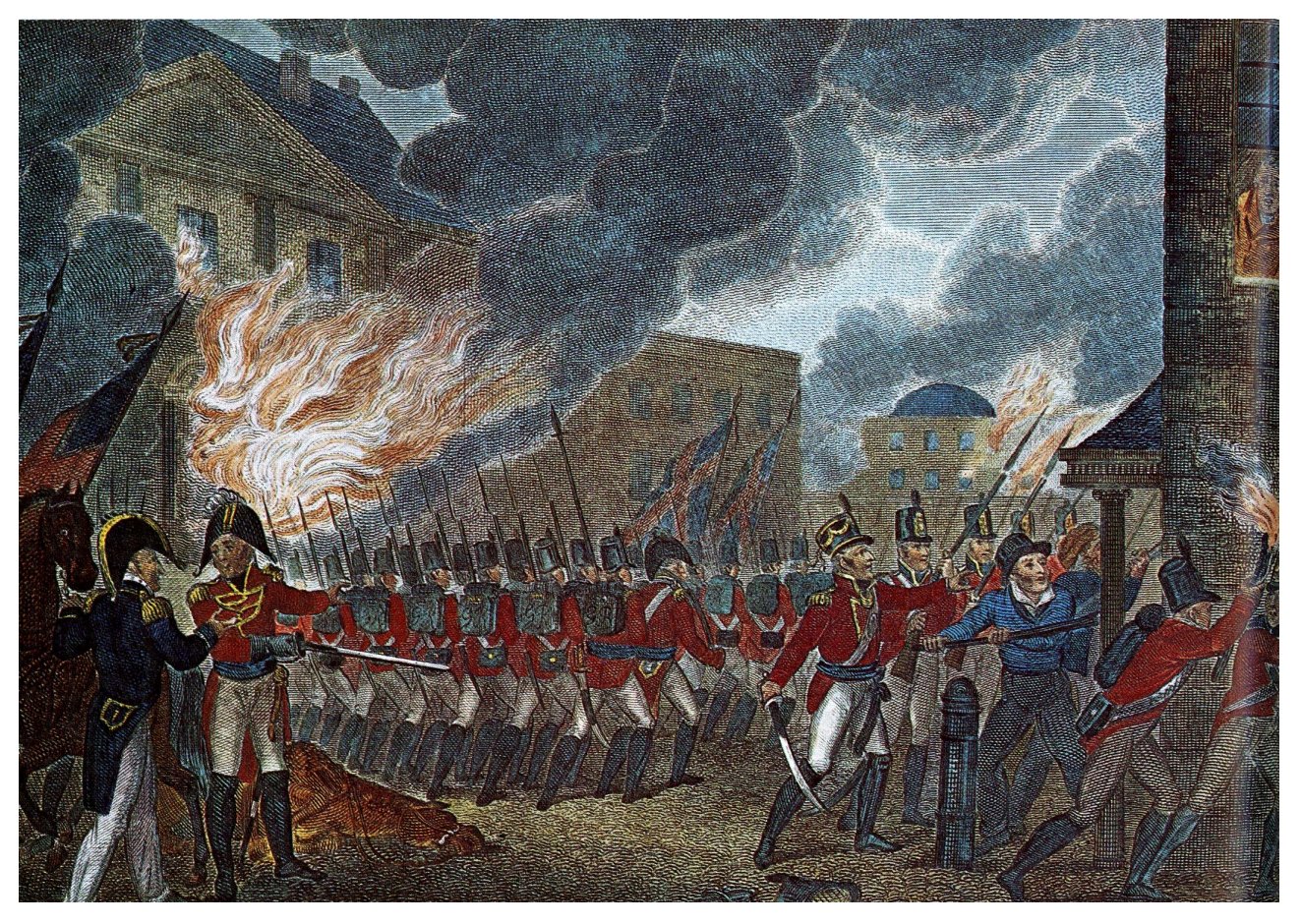
    So, today marks the 200th Anniversary of the burning of our nation’s Capitol by invading British forces. On August 24th, 1814, a brief skirmish occurred between British and poorly trained and equipped Americans at Bladensburg, Maryland, a few miles from Washington. When the Americans broke, it was a clear path to the Capitol;

    Reaching Washington on the evening of August 24, the British found a city largely deserted, with the only resistance being ineffective sniper fire from one house. The first order of business for the British was to attack the navy yard, but retreating Americans had already set fires to destroy it.

    British troops arrived at the US Capitol, which was still unfinished. According to later accounts, the British were impressed by the fine architecture of the building, and some of the officers had qualms about burning it.

    According to legend, Admiral Cockburn sat in the chair belonging to the Speaker of the House and asked, “Shall this harbor of Yankee democracy be burned?” The British Marines with him yelled “Aye!” Orders were given to torch the building.

    The British troops worked diligently to set fires inside the Capitol, destroying years of work by artisans brought from Europe. With the burning Capitol lighting the sky, troops also marched to burn an armory.

    At about 10:30 p.m., approximately 150 Royal Marines formed up in columns and began marching westward on Pennsylvania Avenue, following the route used in modern times for inauguration day parades. The British troops moved quickly, with a particular destination in mind.

    By that time President James Madison had fled to safety in Virginia, where he would meet up with his wife and servants from the president’s house.

    Arriving at the president’s mansion, Admiral Cockburn reveled in his triumph. He entered the building with his men, and the British began picking up souvenirs. Cockburn took one of Madison’s hats, and a cushion from Dolley Madison’s chair. The troops also drank some of Madison’s wine and helped themselves to food.

    With the frivolity ended, the British Marines systematically set fire to the mansion by standing on the lawn and hurling torches through the windows. The house began to burn.

    The British troops next turned their attention to the adjacent Treasury Department building, which was also set on fire.

    The fires burned so brightly that observers many miles away recalled seeing a glow in the night sky.

    More on the story from the Washington Post.

  • USAF Overflights of Russia

    I ran across a fascinating article this morning.  I thought I’d share it.

    The article deals with USAF involvement in overflights of the Soviet Union between 1950 and 1956.  And no, not just quick in-and-out “border dashes”.  Some of the missions were indeed deep penetration overflights.

    The article is not sourced, and the author appears to desire anonymity.  I thus can’t give a good assessment of how credible the article is based on sources or author’s reputation.

    However, the article does generally square with other accounts generally accorded to be of high-reliability. It also provides details that lead me to believe the author had access to some . . . very good documentation.  My assessment is that very likely quite accurate.

    The CIA and the U2 generally get the bulk of the credit for overflying the Soviet Union. But the CIA weren’t the only “players” in that deadly Cold War game – which was at times neither “cold” nor played for low stakes.

    Fascinating reading.  Highly recommended.

    . . .

    (Note:  it’s been my experience that sites such as the one to which this article is posted are often ephemeral.  I’ve captured the article to PDF in the case it disappears.) 

  • Happy Birthday, Old Friend

    This Saturday will be an old friend’s 60th birthday. On 23 August 1954, the Lockheed C-130 made its first flight.

    It’s not the US military aircraft with the longest operational history. That honor goes to the B-52, which first flew on 15 April 1952 and entered operational service on 29 June 1955 (the C-130 entered operational service on 9 December 1956).

    However, like the B-52 the C-130 has been a US military fixture – and workhorse – as far back as I can remember.

    It was not the first military aircraft in which I ever flew. That would have been either a UH-1 or a C-123. After three plus decades, I can’t remember with certainty which of those two was the first – I think it was a UH-1, but I’m not positive.

    However, it was indeed a C-130 that took me from Kuwait to Iraq – both times. And I left Iraq both times on one.  It was also the military aircraft on which I flew last while in uniform.

    Over the years, I flew on a number of C-130s – including at least one that might have literally been older than I was. When I was young, the Air National Guard still had a few “A model” C-130s in their inventory.   Some of those C-130As supported my unit on one exercise.

    The C-130 always put me down safely, and took me where I wanted to go (with one minor hiccup, discussed here).  Unless, of course, I was jumping out of the bird’s jump doors – or walking off it’s loading ramp at jump altitude (got the chance to do a tailgate jump or two – they were a blast).  (smile)

    The C-130 has been called the most successful military aircraft in history.   Frankly, it’s hard to argue with that characterization.  It’s a helluva fine piece of military hardware.

    Finally:  believe it or not – you can indeed get more than 450 people on-board a C-130, take off – and land safely. It’s been done at least once. And yes, this last link is indeed worth your time to read.

    Happy birthday, Herc. I hope to be here for your 70th and beyond.


    PS, and FWIW:  according to his autobiography, Ben Rich helped designed the intakes on the C-130 in his pre-Skunk Works days.  Maybe that’s one reason why the bird was so successful.  (smile)

  • 74th National Airborne Day

    74th National Airborne Day

    COB6

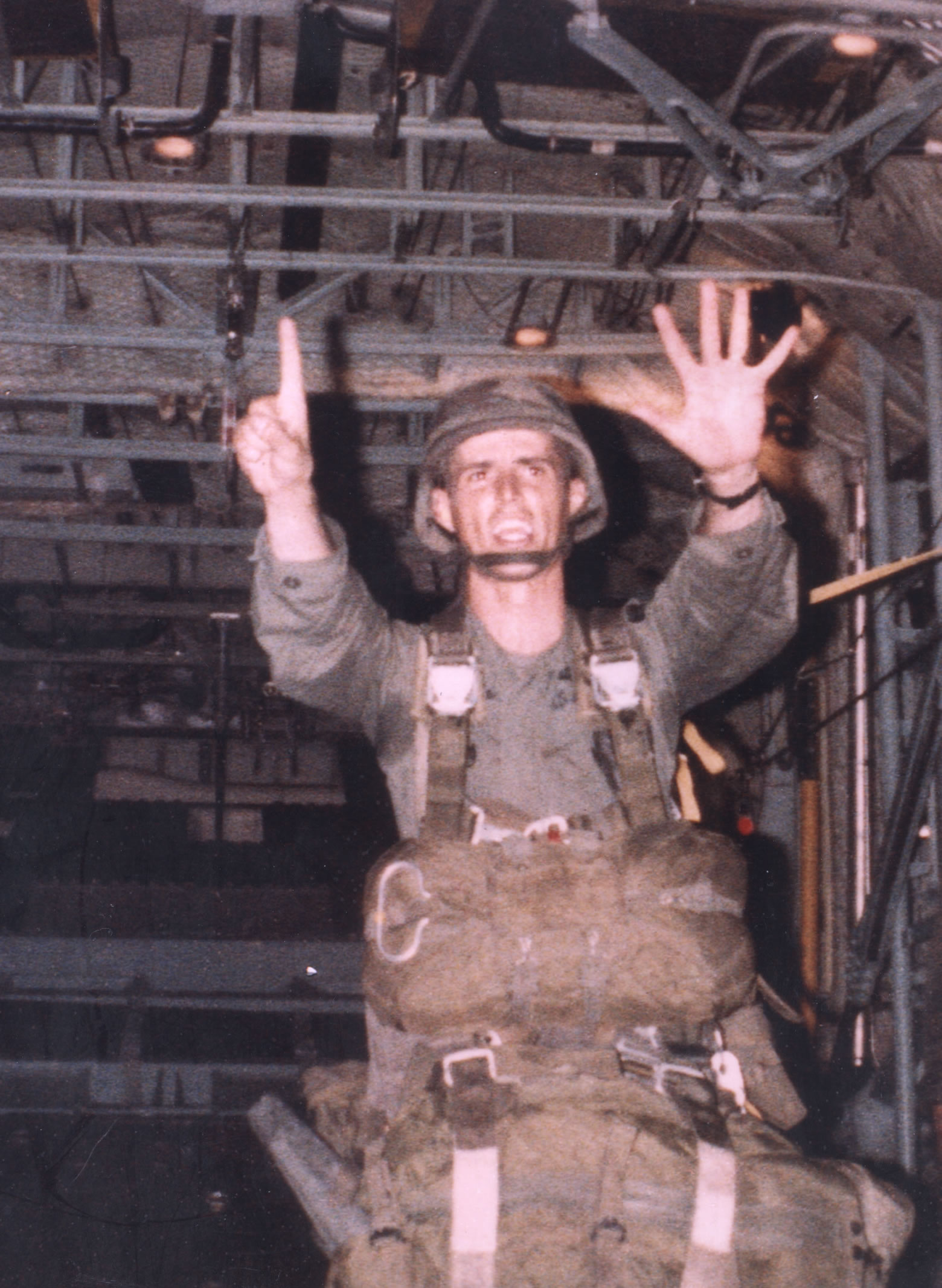
    That’s COB6 giving you the six minute warning above.

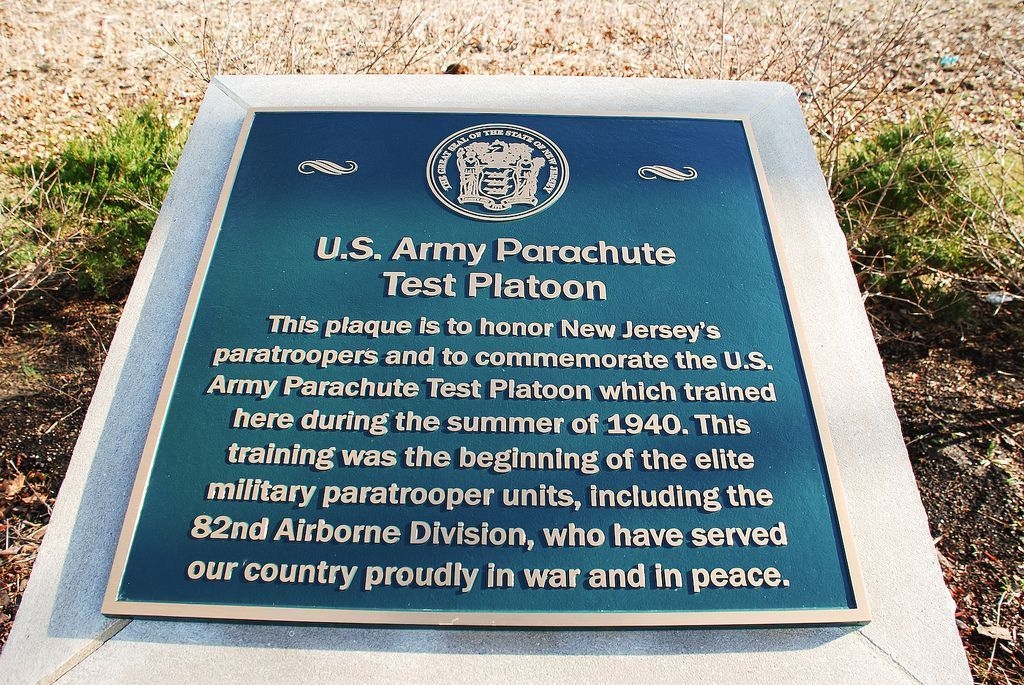
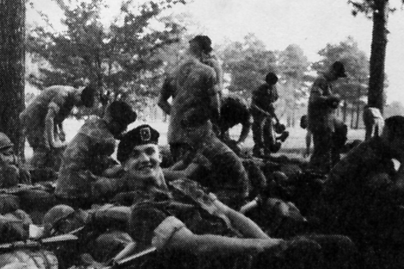
    National Airborne Day is set on the day of the first parachute jump conducted by the Army’s Parachute Test Platoon on August 16th, 1940.

    On the morning of 16 August 1940 the jump began. After the C-33 leveled off at 1500 feet and flew over the jump field, Lt. Ryder was in the door ready to jump. Warrant Officer Wilson knelt in the door waiting to pass the Go Point. When this was reached, he slapped Lt. Ryder on the leg and the first jump was made. Now Number One moved into position. Slap! “Go! Jump!”

    Still no movement.

    It was too late now to jump on this pass. Mr. Wilson motioned Number One to go back to his seat. As the plane circled Mr. Wilson talked to Number One. Number One wanted another chance. Okay, this time we’ll do it. Back into the jumping position and once again, slap!

    Sadly, no movement. Number One returned to his seat.

    Private William N. “Red” King moved into the jumping position in the door. Slap! Out into American military immortality leaped Red King… the first enlisted man of the test platoon to jump out of an airplane. Number One was transferred to another post and anonymity. Now there were forty-seven. Was Number One a coward? I don’t think many experienced jumpers would say so. There are things some men cannot do at a given time. Possibly another time would have been fine. He wanted to. He intended to. He just could not… at least that morning.

    The first US airborne operation was in support of Operation Torch, November 1942, in North Africa when 531 members of the 2nd Battalion 509th Parachute Infantry Regiment flew 1600 miles in 39 C-47s, of which only ten aircraft dropped their pacs, the rest landed because of navigation difficulties and low fuel.

    Ten years ago, 3rd Battalion, 75th Rangers secured an airfield in Kandahar in support of Operation Enduring Freedom on October 19, 2001. On March 23rd, 2003, A Company, 3/75th conducted an airborne operation to secure an airfield in Northern Iraq a few days before the 173rd Airborne Brigade parachuted into Northern Iraq when the Turks wouldn’t allow the 4th Infantry Division to off-load and invade Iraq from their borders.

    In years past, the 82d Airborne Division Association, mostly the DC Chapter, had to lobby to get recognition for National Airborne Day from the Senate every year, until 2009 when the Senate made it permanent.

    We used to get a Presidential Proclamation every year, but for some reason, we haven’t had any since 2008.

    That’s me, on my ass as usual, in the days before Eric Shinseki;

  • “Well, who was the a**hole that did this?”

    With the recent 40th anniversary of Nixon’s resignation in 1974 about a week ago, there have been a number of articles about Watergate in the media.  That’s to be expected.

    Predictably, there have also been more “hit piece” articles about Nixon in the media recently – like this one from MSNBC.  That’s also to be expected. Nixon and the mainstream media hated each other.  The media and the left still hate him with a passion even today, though he’s been dead over 20 years.

    One of the typical allegations made by some in the media (and many leftists) is that Nixon ordered the Watergate break-in.  It’s strongly implied – but not stated outright – in the MSNBC hit piece linked above.

    That allegation has been known to be false for over 40 years.  Indeed, proof of that fact is on the famous “smoking gun” tape that sealed Nixon’s fate when it became public on 5 August 1974.

    Still, some on the left (like the author of the MSNBC hit piece above) still today refuse to admit the truth about that.  They keep trotting out the old canard.

    Don’t believe me?  Well, decide for yourself.  Here’s a link to a transcript of part of that 23 June 1972 conversation between Haldeman and Nixon – from the famous “smoking gun” tape itself.

    That conversation clearly shows that Nixon had no clue who ordered the Watergate break-in.  Indeed, the title of this article is a direct quote of Nixon’s question to Haldeman asking who had ordered the Watergate break-in.  (Other sources give the quotation as “Who was the a**hole who ordered it?”, but after listening to audio from the tape personally I think this source seems more accurate.)

    Still don’t believe me? Hell, here’s a link to the audio; listen for yourself. Pay particular attention to the tone of voice in Nixon’s question.  It occurs around 4:14 or so in the linked audio.

    It seems quite clear to me that the man was incredulous that someone had been so stupid.  It also seems clear that he had no prior knowledge of the break-in.  YMMV.  (It likewise is manifestly obvious that Nixon approved the Watergate cover-up – but for 40+ years that has never been in dispute.  It’s also a very different thing than ordering the break-in.)

    Nixon had many faults.  IMO, he was an unscrupulous bastard and a shameless liar.  He clearly conspired with others to obstruct justice.  He deserved his fate for attempting to be above the law, and for trying to use the machinery of the Federal government to pervert justice and cover up the Watergate break-in.  He was damned lucky to escape prison.

    But whatever Nixon’s faults, he was no one’s fool.  He certainly wasn’t stupid enough to have ordered Watergate personally – and hard evidence indicates he didn’t.  Yet there are some in the media who keep making that false claim.

    Sheesh.  You’d think that the press could quit lying about the man more than 20 years after his death.  The simple truth about Watergate is damning enough.

  • Fifty Years Ago Yesterday

    On 10 August 1964, Public Law 88-408 was signed by the POTUS, and became effective.

    It’s better known today as the Gulf of Tonkin Resolution. That resolution was described by then-Undersecretary of State Nicholas Katzenbach as “the functional equivalent of a declaration of war.”

    The resolution was passed by Congress at the request of the LBJ administration in Joint Assembly of Congress on 7 August 1964.  A “pair” of “hostile fire incidents” in the Gulf of Tonkin involving US Navy ships – the destroyers USS Maddox and USS Turner Joy – on the nights of 1- 2 and 3-4 August 1964 were the stated reason for the LBJ administration’s request.

    The first incident involving the USS Maddox was legitimate. Best evidence indicates that the second “incident” involving both ships actually was not a hostile fire incident at all, but was due to sonar/radar reflections being misinterpreted as possible hostile vessels and torpedo tracks.

    In reality, there was no second “hostile fire incident”.  In 1999, Robert McNamara – SECDEF at the time of the incidents – publicly acknowledged that fact.

    The evidence also indicates that LBJ likely knew full well that the second incident was questionable, and probably had not actually happened. He chose to ask Congress for the resolution nonetheless.

    Why? LBJ was wary of appearing “soft on Communism”. His opponent in the upcoming 1964 Presidential Election – Senator Barry Goldwarter of Arizona – was widely viewed as the more strongly conservative, anticommunist candidate. Getting Congressional backing for stronger action in Vietnam would neutralize Vietnam as a political issue – particularly if LBJ reacted strongly to a “provocation”.

    Further, LBJ had been urged over 2 months earlier by his Foreign Affairs Advisor, McGeorge Bundy, to declare the defense of Vietnam “essential” to the US – and that a declaration of authority and intent to use force was desirable. And of course, there’s this statement by LBJ to the Joint Chiefs of Staff in December 1963 (some of whom were also pushing for more US involvement in Vietnam): “Just get me elected, and then you can have your war.”

    At the time of his statement to the Joint Chiefs, LBJ may well have been playing one faction against another – classic “backroom politics”, at which LBJ was a master. But by mid-1964, that no longer appears to have been the case.

    The resolution gave LBJ carte blanch authority to maneuver the US into Vietnam in strength – without further consultation with Congress. He did exactly that, by stealth, beginning in early 1965.

    After he’d been reelected.

    The Army Times has an excellent article today on the Tonkin Gulf Resolution. It’s worth a read.

    And afterwards, maybe also take a moment to remember those who didn’t come back from that questionable conflict.

  • Quotations From Some Old Pieces of Paper

    The papers in question concern events during a 3-day period in July, 1943.  What follows is an series of quotations from those pieces of paper.

    They’re a few of of literally hundreds of such pieces of paper from that era.

    What follows may not be comprehensive; I don’t have a copy, so I can’t say for sure.  However, other published accounts I’ve located give the following as quotations. I’m convinced they’re accurate.

    I’ve omitted names and certain other personal information as they’re not really pertinent to my point in writing this article.  Asterisks below are present in those secondary sources, and apparently represent information that did not scan to text correctly or was not legible.

    . . .

    The President of the United States of America, authorized by Act of Congress July 9, 1918, takes pleasure in presenting the Silver Star to Private XXXXX X. XXXXXXXXX (ASN: ########), United States Army, for gallantry in action while serving with Company I, 504th Parachute Infantry Regiment, 82d Airborne Division, in action on 9 July 1943, in Sicily. Private XXXXXXXX, with utter disregard for his personal safety, provided water to the soldiers of his company during the hours of **** – ****. During most of this time he was exposed to heavy machine gun and small arms fire of the enemy and was sniped upon on many occasions.
    Action Date: July 9, 1943

    The President of the United States of America, authorized by Act of Congress July 9, 1918, takes pleasure in presenting the Silver Star to First Lieutenant (Infantry) XXXXX  X. XXXXXXXX (ASN: 0-######), United States Army, for gallantry in action as a member of Headquarters Company, 1st Battalion, 505th Parachute Infantry Regiment, 82d Airborne Division, in action on 9 July 1943 south of ****, Sicily. Lieutenant XXXXXXXX landed by parachute in hostile territory with his section and immediately proceeded to secure his communications equipment in the face of intense machine gun fire. After destroying what he was unable to salvage, he organized his communications group as a rifle unit and led them through the subsequent action to successful completion of assigned missions.
    Action Date: July 9, 1943

    The President of the United States of America, authorized by Act of Congress July 9, 1918, takes pleasure in presenting the Silver Star to Private XXXXX X. XXXXXXXX (ASN: ########), United States Army, for gallantry in action while serving with Company A, 505th Parachute Infantry Regiment, 82d Airborne Division, in action on 9 July 1943, five miles west of ****, Sicily. An attack was launched on a fortified garrison by Private XXXXXXXX’s unit, during which Private XXXXXXXX after a hand-to-hand fight with two enemy soldiers, captured a light machine gun. Immediately following this action, a counter-attack was launched by the **** on the position and, under heavy artillery fire, the unit was forced to withdraw. Private XXXXXXXX and Lieutenant XXXXXXXX volunteered to stay in position until their unit completed withdrawal. Private XXXXXXXX and Lieutenant XXXXXXXX manned their post with enemy machine guns until another assault was made by the enemy. Seeing that their unit had by this time contacted friendly forces, Private XXXXXXXX and Lieutenant XXXXXXXX, although surrounded, began to withdraw. Lieutenant XXXXXXXX was killed. By passing through enemy lines, Private XXXXXXXX was able to rejoin his unit.
    Action Date: July 9, 1943

    The President of the United States of America, authorized by Act of Congress July 9, 1918, takes pleasure in presenting the Silver Star to Private First Class XXXXX  X.. XXXXXXXX (ASN: ########), United States Army, for gallantry in action while serving with Company B, 307th Airborne Engineer Battalion, 82d Airborne Division, in action on 9 – 10 July 1943, four miles southeast of ****, Sicily. Private First Class XXXXXXXX fractured his knee in a combat parachute jump southeast of ****, Sicily on 9 July 1943. He marched across country, taking part in guerrilla skirmished until the night of 10 July 1943, at which time he took part in the engagement northwest of ****, Sicily, against a portion of the **** **** **** Division. He made not complaint of the fractured knee during the two days of fighting. The morning of 10 July 1943, he reported to the medical aid station and was sent to the hospital to be treated for a fractured knee. In this gallant action Private First Class XXXXXXXX acquitted himself in a manner reflecting credit on himself and his country.
    Action Date: July 9 – 10, 1943

    The President of the United States of America, authorized by Act of Congress July 9, 1918, takes pleasure in presenting the Silver Star to Private First Class XXXXXX X.  XXXXXXXX (ASN: ########), United States Army, for gallantry in action while serving with Battery C, 456th Parachute Field Artillery Battalion, 82d Airborne Division, in action on 9 – 10 July 1943, about five miles southwest of ****, Sicily, and later about six miles northwest of ****, Sicily. In both instances, Private First Class XXXXXXXX, assistant gunner on a .50 caliber anti-aircraft machine gun crew, helped operate his gun against low-flying **** planes that were strafing the gun positions of his battery. Private First Class XXXXXXXX remained at his post in the face of heavy strafing. Two of the planes fired upon began to smoke heavily, rapidly lost altitude and are believed to have crashed. Later in the day, at another location, and again in the face of heavy strafing, a third **** plane was hit and observed rapidly losing altitude. In each instance the remaining planes flew away, permitting his battery to continue its mission.
    Action Date: July 9 – 10, 1943

    The President of the United States of America, authorized by Act of Congress July 9, 1918, takes pleasure in presenting the Silver Star to First Lieutenant (Infantry) XXXXXX X. XXXXXXXX (ASN: 0-#######), United States Army, for gallantry in action as a member of Headquarters Company, 3d Battalion, 505th Parachute Infantry Regiment, 82d Airborne Division, in action about five miles west of *** ***, in Sicily. Lieutenant XXXXXXXX, commanding a light machine gun platoon of the 505th Parachute Infantry Regiment, participated in the attack on Hill *** near Route *** which drove back a superior force approximately one-half mile. The enemy counter-attacked with support from heavy artillery, mortars, and***, *** and *** ** tanks. Lieutenant XXXXXXXX personally led his platoon in the face of the heavy enemy fire, through scanty orchard cover to within 50 yards of the tanks. He directed the fire of his men to such effect that the tanks were prevented from crossing the ridge, where they could have inflicted severe casualties on his battalion. In this gallant action Lieutenant XXXXXXXX acquitted himself in a manner reflecting credit upon himself and his country.
    Action Date: July 10, 1943

    The President of the United States of America, authorized by Act of Congress July 9, 1918, takes pleasure in presenting the Silver Star to Sergeant XXXXXX X. XXXXXXXX (ASN: ########), United States Army, for gallantry in action while serving with Company H, 505th Parachute Infantry Regiment, 82d Airborne Division, in action on 10 July 1943, six miles northwest of ***, Sicily. Sergeant XXXXXXXX was seeking to rejoin his regiment, having become separated during a night parachute descent on 8 July 1943. In response to the request of the Commanding Officer, 505th Parachute Infantry Regiment, 82d Airborne Division, Sergeant XXXXXXXX organized and led a squad of parachutists in a flanking attack on a strongly-held enemy position. Sergeant XXXXXXXX led his squad across the open terrain despite intense mortar and machine gun fire. They drove the enemy from the position, killing sixteen and capturing five enemy soldiers. The success of this attack was, in large part, due to the personal example and courage of Sergeant XXXXXXXX, and enabled the 505th Parachute Infantry Regiment to resume its advance.
    Action Date: July 10, 1943

    The President of the United States of America, authorized by Act of Congress July 9, 1918, takes pleasure in presenting the Silver Star to Private First Class XXXXXX X. XXXXXXXX (ASN: ########), United States Army, for gallantry in action while serving with Company H, 505th Parachute Infantry Regiment, 82d Airborne Division, in action on 10 July 1943, six miles northeast of ****, Sicily. Private First Class XXXXXXXX voluntarily entered an attack on an enemy position holding back the advance of the 505th Parachute Infantry Regiment, 82d Airborne Division,. During the attack a *** machine gun placed flanking fire upon Private First Class XXXXXXXX’s squad and pinned it down. Private First Class XXXXXXXX fired his rocket launcher at the enemy machine gun nest, but the launcher exploded. With utter disregard for his personal safety, Private First Class XXXXXXXX secured another rocket launcher and returned to his squad. Firing a second time, Private First Class XXXXXXXX blew up the enemy machine gun nest, killing its crew of four. This action permitted Private First Class XXXXXXXX’s squad to resume its advance to the successful accomplishment of its mission.
    Action Date: July 10, 1943

    The President of the United States of America, authorized by Act of Congress July 9, 1918, takes pleasure in presenting the Silver Star to Second Lieutenant (Infantry) XXXXXX X. XXXXXXXX (ASN: 0-#######), United States Army, for gallantry in action as a member of Headquarters Company, 1st Battalion, 505th Parachute Infantry Regiment, 82d Airborne Division, in action on 11 July 1943, south of ****, Sicily. Lieutenant XXXXXXXX rallied those around him to resist a hostile tank attack, and was eminently instrumental in preventing a general withdrawal. When his commanding officer was hit by a shell, Lieutenant XXXXXXXX attempted to render first aid under fire, and later, though wounded, refused to be evacuated until he had seen to the disposition of effects and burial of his commanding officer.
    Action Date: July 11, 1943

    And finally:  in the papers in question, the following text is repeated at least four times, and possibly more times than that.  The only change between the versions is different ranks and other personal information corresponding to the individuals involved. For what it’s worth:  the rank of at least 3 of the individuals was “Private”.

    The President of the United States of America, authorized by Act of Congress July 9, 1918, takes pleasure in presenting the Silver Star to Sergeant XXXXXX X. XXXXXXXX (ASN: ########), United States Army, for gallantry in action while serving with Headquarters Company, 3d Battalion, 504th Parachute Infantry Regiment, 82d Airborne Division, in action on 9 July 1943, northwest of ****, Sicily. Sergeant XXXXXXXX, Section Sergeant, together with seven other men, manned two anti-tank guns which had previously been captured from the enemy. The seven men and Sergeant XXXXXXXX knocked out an *** “tankette” while they were exposed to heavy enemy machine gun fire. This “tankette” was leading an estimated enemy battalion in the approach march. These men had no previous experience in the operation of the anti-tank guns. By their action the enemy battalion became disorganized and withdrew.
    Action Date: July 9, 1943

    . . .

    The quotations above come from General Orders No. 29, Headquarters, 82nd Airborne Division, dated 29 August 1943.  As I noted earlier:  it’s but one of literally hundreds of such documents issued by various division headquarters during World War II.

    People often forget just how bitter that war’s fighting was.  And we often forget just how many people exhibited extreme heroism during that conflict.

    It was my great good fortune – and my honor –  to know one of those men.  Sadly, he’s no longer among the living.

    Still, in looking over the above, I can’t help but feel that Patton was indeed right.  “It is foolish and wrong to mourn the men who died. Rather, we should thank God that such men lived.”

    Enjoy your Sunday, everyone.
  • World War One Centenary

    A hundred years ago Sunday, there was celebration in the streets of Berlin and Paris at the announcement that war had been declared – it all went downhill from there. It had been 44 years since the two countries had battled, and Germany’s big surprise attack was to attack through the Ardennes forest – it wasn’t the first time nor would it be the last. The countries marked the anniversary yesterday according to the Agency Press France;

    French President Francois Hollande recalled Germany’s invasion of neutral Belgium in early August 1914 that turned a Balkans war into a global conflagration, raising current day parallels.

    “How can we remain neutral today when a people not far from Europe is fighting for their rights?” Hollande said, clearly referring to the Ukraine crisis.

    “How can we remain neutral when a civilian airliner is brought down … when there is conflict in Iraq, Syria, Lebanon, Gaza?”

    “We cannot remain neutral … Europe must live up to its responsibilities with the United Nations,” he told an audience that included Britain’s Prince William and his wife Catherine, heads of state and representatives of some 80 countries.

    Hindsight is 20/20. If Europe had learned it’s lessons that brought us that great conflagration in 1914, maybe we wouldn’t have those conflicts today. It’s almost funny to me that Hollande talks about Europe’s responsibility at a ceremony and acts completely differently when faced with the realities of the world. I haven’t seen the Europeans do anything but sit on their hands. Even when things happen in their own backyards – Bosnia comes to mind.

    Where was France in Iraq? They were the first to withdraw from Afghanistan. When the world is engulfed in flames, they’ll wring their hands some more. Like they blew their opportunity to lead in Libya. Hollande can name the conflicts in our world today, but what, exactly, has France done to end those wars? Or anyone else in Europe for that matter?

    The Mons ceremony will focus on the small military cemetery of St Symphorien, where 229 Commonwealth and 284 German solders were buried together in a gesture of reconciliation even as the fighting raged.

    Empty gestures of reconciliation are all the Europeans are good at – after the troops pay the price. Heaven forbid that they learn a lesson from their past mistakes.