Category: Historical

  • An Arlington Article

    The Navy Times recently published an interesting, if short, article on Arlington National Cemetery.  It gives a brief rundown of the Cemetery’s history, and gives a few vital statistics.

    The article also lists a few less-well-known facts about the cemetery.  Three examples:

    • The Cemetery’s founder’s son – Lieutenant John Rodgers Meigs, son of cemetery founder MG Montgomery Meigs – is buried there.
    • Tombstones with gold lettering (there are over 400) are the final resting place of Medal of Honor recipients.
    • A 3-year-old girl who perished on board American Airlines Flight 77 at the Pentagon on 11 September 2001 whose remains were never identified is memorialized in Arlington, only several hundred feet from the Pentagon.

    There are a number of other fascinating facts in the short article, with brief explanations/background for each.  If you have a few minutes, IMO reading it is definitely worth the time.


    Author’s note:  as multiple commenters have noted below, the identity of the 3 year old buried in the mass grave for the Pentagon is in fact known.  As the link provided by Fm2176 notes, the name of the young girl killed at the Pentagon was Dana Falkenberg.  The original Navy Times article indicated the young girl’s remains were “unidentified” and buried in a mass grave at Arlington.  However, the Navy Times not indicate that her identity was in fact known and did not give her name. 

    In fact, no individually-identifiable remains were ever found for Falkenberg and four other individuals – Rhonda Rasmussen, Ronald Hemenway, James Lynch, and Ronald Golinski.  Falkenberg and these other four individuals are memorialized in the mass grave for 9/11 at Arlington. 

    My apologies for the error in the original article.

  • RIP, John Houbolt

    John Houbolt, former employee of NASA, died a few days ago.  He was 95.

    Most Americans do not have a clue as to who he was.  Frankly, until today I didn’t either.

    That’s a shame.  Because Houbolt is arguably the individual most responsible for the US moon landing on July 20, 1969.

    During the early 1960s, NASA debated the various options for landing humans on the moon.  There were three:

    • Direct ascent – which would fly a craft directly to the moon from the earth’s surface.
    • Earth orbit rendezvous – which would assemble the lunar vehicle in low earth orbit, but would require the successful launch 2 or more rockets for each lunar mission as well as assembly in space;
    • Lunar orbit rendezvous – the option ultimately selected for the Apollo program (orbiter orbits moon while smaller module descends to moon, returns, and rendezvous with orbiter to allow crew to return to earth).

    Houbolt was a very vocal proponent of the Lunar rendezvous option.  He took the unusual step of going around his management to present the concept directly to senior NASA officials.    He held that it was the only viable option to succeed prior to 1970.  He bluntly asked, in a 1961 letter to NASA Associate Administrator Robert Seamans, “Do we want to go to the moon or not?”

    Houbolt was at the time ridiculed by many of his peers.  Some went as far as to claim he was lying, or to imply that he was professionally incompetent. (In truth, though Houbolt was in general correct, some of his initial estimates did turn out to be substantially off-the-mark.)

    But Houbolt stood his ground, and in the end was proven right.  The risks associated with the earth orbit rendezvous option were too large; initial studies showed up to 15 initial-design Saturn launches might be required (final studies and Saturn design refinements allowing larger payload finally showed that two redesigned Saturn-III vehicles might possibly work).  The direct ascent option would require the development of rockets even larger than the Saturn V (the never-built Nova) – which simply couldn’t be done in time, as development and production would require construction of new facilities to build them.  And both direct ascent and earth orbit rendezvous missions would require landing massive, complex vehicles on the moon – inherently a risky operation – which in the end was also deemed too risky.

    NASA’s internal debates and final decision are documented here.  The story is fascinating reading – and clearly illustrates Houbolt’s critical role in the decision.  Without his persistent advocacy, the decision process would have stretched out far longer, delaying the US moon mission – and given the rising demands of Vietnam in the 1960s and the economic downturn of the 1970s, the delay perhaps would have been permanent.

    In the end, NASA selected the concept Houbolt championed, and developed a final Saturn modification (the Saturn-V) that would perform the mission with a single launch.  And on 20 July 1969, mankind’s long dream of humans walking on the moon became reality – courtesy of the USA.

    Without John Houbolt, that reality might still be a dream.

    Rest in peace, Dr. Houbolt.

    Many thanks.

  • Remembering Our Forgotten Dead from Vietnam

    The Vietnam War claimed over 58,000 American men and women in uniform (the officially-recognized total today is 58,220).  It claimed a far greater number of Vietnamese.  This much we all know.

    Those US military personnel who died as a result of the “official” Vietnam War are permanently memorialized in Washington, DC, at the Vietnam Veterans Memorial.  That’s fitting, and the site is indeed an appropriate memorial for the Vietnam War.

    Visiting The Wall is indeed a moving experience.  This too is relatively well-known.

    Two other things are less well known.  The first “official” US death of the Vietnam war has changed over time.  Further, the Vietnam Veterans Memorial does not list all Americans who died while serving the nation in Vietnam.

    . . .

    The first “official” American death of the Vietnam War has changed over time. Four different individuals have been considered the first official US war dead from Vietnam.

    The database of war dead from the Vietnam Veterans Memorial initially was to use a start date of 1 January 1961.  However, that decision was changed prior to the opening of the memorial.   MAJ Dale R. Buis and MSG Chester M. Ovnand, US Army – who died in a Vietcong attack at Bien Hoa, Vietnam, on 8 July 1959 – were originally considered the first US dead from the Vietnam War.

    This changed in 1983, when CPT Harry G. Cramer, Jr., US Army, was deemed to be the “first” US military death of the Vietnam War.  CPT Cramer was killed at Nha Trang during a Vietcong attack on 21 October 1957 (accounts differ as to whether his death was a direct result of the attack or an accident which occurred concurrent with the attack).  His name was approved for addition to the Vietnam War Memorial.  CPT Cramer’s name was reportedly added out-of-sequence to the center section (stone 1E) at his son’s request.

    In 1999 the “official” start date for casualties from the Vietnam War was again changed.  The start date was now set to coincide with the creation of the Military Assistance Advisory Group – Vietnam as a separate headquarters on 1 November 1955  (MAAG-V had previously been a part of the Military Assistance Advisory Group – Indochina).  This change in turn made TSgt Richard B. Fitzgibbon, Jr., USAF – who was murdered in Vietnam on 8 June 1956 – the fist officially-recognized US military death of the Vietnam War.  He is so recognized today.

    . . .

    There are also other Americans who died in Vietnam while serving our nation.  But because they were not in uniform – or because they died at enemy hands before the war “officially” began – they are not formally recognized by the US government as being Vietnam War casualties.  They are thus not included among the 58,220 “official” Vietnam War casualties.

    The list of such “unofficial” war dead is not a particularly short one.  The US Merchant Marine lost 56 sailors while supporting operations in Vietnam.  The CIA lost 17 personnel in due to the conflict in Southeast Asianot counting more than 30 Air America personnel who died in Southeast Asia or the two CAT employees lost prior to the official start date of the Vietnam War (more on these two below).  USAID lost 37 personnel during the Vietnam War – including one who later posthumously was awarded both the Presidential Medal of Freedom the Distinguished Service Cross.  And at least 22 American journalists died in the Vietnam War as well, along with a number of other civilians unaffiliated with the US government.

    The list of unofficial Vietnam War dead is not all male, either.  Besides the eight US military women who died in Vietnam (and whose names are included on the Vietnam Soldiers Memorial), if one includes the 5 April 1975 crash of a US C-5A aircraft at Da Nang during Operation Babylift at least 59 US civilian women also died due to the Vietnam War.  Many were US civilian government employees; a number of them died as the direct result of hostile action.

    Time and space does not permit a comprehensive listing of all of these individuals, nor a full discussion.  I’m not sure a comprehensive list of such unofficial US Vietnam War dead even exists.

    Still, I’d like to relate five cases.  Collectively, IMO they’re representative of those others who died while serving this country in Vietnam – but for one reason or another, aren’t remembered as “official” Vietnam War dead.

    IMO, they are our forgotten Vietnam dead.

    . . .

    Shortly after the end of World War II – on 26 September 1945 – an American soldier was killed in Vietnam.  He was the first US citizen to die at the hands of communist Vietnamese forces.

    His name was LTC A. Peter Dewey, US Army.  He was the son of US Congressman Charles S. Dewey.  He was also a distant relative of Thomas A. Dewey, who would be a candidate for POTUS in 1948.

    LTC Dewey was a member of the OSS.  He was serving a post-World War II assignment to Vietnam at the time as his demise.

    LTC Dewey was killed while returning to Saigon from what is today Tan Son Nhut International Airport (then Tan Son Nhut Airfield) in a Viet Minh ambush.  The Viet Minh afterwards claimed it was a case of mistaken identity, and that they mistook LTC Dewey for a French soldier.  (Dewey spoke French, and had indeed yelled in French at three individuals near the ambush site immediately before the ambush occurred.)  The other US officer accompanying him was not injured.

    At the time he died, LTC Dewey was awaiting transportation to leave Vietnam.  The aircraft on which he was originally to depart Vietnam that day had been delayed.  He was returning from Tan Son Nhut to the OSS villa in Saigon for lunch when he was ambushed and killed.

    LTC Dewey’s body was never recovered. Vietnamese historical accounts indicate it was dumped by the Viet Minh in a nearby river.

    At the time, the French were US allies.  The Viet Minh were then communist-led rebels opposing the French.

    LTC Dewey was killed in the line of duty, by forces hostile to a US ally, in Vietnam.  We later fought those same hostile forces ourselves.  But because his death occurred prior to the “official” start date of the US Vietnam War Era, he is not listed on the Vietnam Veterans Memorial, nor is he officially recognized as a US war casualty in Vietnam.

    Rest in peace, my elder brother-in-arms.  Rest in peace.

    . . .

    Two American civilians were killed in action while serving our country during Vietnam.  They died prior to the start of the “official” Vietnam War era.  Because of this – plus the fact that they were civilians – they are not officially recognized as US casualties of the Vietnam War.

    During the Battle of Dien Bien Phu, the CIA (through its front operation Civil Air Transport, or CAT) provided aerial resupply for French forces.  CAT pilots, who were working for the CIA but technically were not CIA employees in a legal sense, flew these missions.

    Two such US pilots working for the CIA were killed on 6 May 1954, during the final resupply mission at Dien Bien Phu. Their names were James B. McGovern, Jr., and Wallace Buford.

    McGovern and Buford’s final mission was to air-deliver essential supplies and equipment (some accounts say a howitzer, while other accounts say ammunition) to besieged French forces at Dien Bien Phu.  Their aircraft crashed after being hit by Viet Minh antiaircraft fire.

    Their aircraft was hit twice by 37mm antiaircraft fire over Dien Bien Phu and was badly damaged.  Nonetheless, they nursed their damaged aircraft back towards a friendly airstrip in what is today Laos.  That airstrip was a bit over 75 miles away.

    They made it roughly 75 miles.  Unfortunately, less than a mile away from that airfield , one of their aircraft’s wingtips clipped a tree.

    They did not make the airstrip.

    McGovern and Buford died in the crash.  Reputedly McGovern’s final radio transmission, shortly before impact, was:  “Looks like this is it, son.”

    McGovern was 32 years old.  Buford was 28.

    Two passengers in the aircraft – a Malaysian paratrooper and a French officer, 2LT Jean Arlaux – were injured, but survived the crash.  The Malaysian paratrooper later died of his injuries.

    Arlaux recovered from his injures, and later retired from the French Army as a Colonel.  His account of the mission can be found here.

    McGovern’s body was recovered in 2002; his remains were positively identified in 2006.  He was buried in Arlington National Cemetery on 24 May 2007.

    Sadly, Buford’s remains have not been recovered to date.

    Like LTC Dewey, these two men also died at the hands of communist forces in Vietnam.  At the time, they too were performing official duties on behalf of the US government.  And like LTC Dewey, these individuals’ deaths also predated the “official” start date of the Vietnam War Era.  They are also not memorialized on the Vietnam Veterans Memorial, nor are they officially recognized as being US casualties of war in Vietnam.

    The government of France posthumously awarded McGovern, Buford, and all other surviving CAT pilots the Legion of Honor on 24 February 2005.  This award was made in recognition of their efforts in support of French forces at Dien Bien Phu.

    As I’ve stated elsewhere:  the French indeed have their faults.  But ingratitude and lack of a sense of honor don’t seem to be among those faults.

    . . .

    Barbara Ann Robbins was a civilian employee of the CIA.  She died in the line of duty on 30 March 1965 in Saigon.

    Robbins had been raised in North Dakota and Colorado.  She is regarded as the first US woman killed in the line of duty during the Vietnam War.

    Robbins was working under diplomatic cover for the CIA at the US embassy in Saigon.  On 30 March 1965, a car bomb exploded outside the US embassy.  Robbins – along with a US Navy storekeeper from the Philippines and 19 Vietnamese citizens – were killed.

    Robbins was one of the original 31 CIA employees lost in the line of duty who were honored with stars on the Agency’s Wall of Honor at its creation in 1974.  However, because of her assignment’s use of diplomatic cover it was not until May 2011 that Robbins’ name was formally added to the CIA’s Book of Honor and her role as an Agency employee formally and publicly acknowledged.

    Robbins volunteered for assignment to Vietnam; it was her first time overseas.  At the time of her death, she was not yet 22 years old.  She was the first female CIA employee to be killed in action.  To date, she is also believed to be the youngest CIA employee to have died in action.

    . . .

    A number of US civilian personnel received US military decorations in Vietnam.  Other than the Medal of Honor, policy at the time did not forbid award of the BSM or other US military decorations for valor to civilians serving with the military (the legal prohibition on receipt of the BSM by civilians dates only to 2000).

    While rare, the award of military decorations to civilians is not unknown.  US war correspondent Joe Galloway was awarded a BSM w/V Device for his actions at the Battle of Ia Drang.  The entertainer Joe Brown likewise was awarded a BSM during World War II for his extensive efforts supporting troop morale.

    However, only one US civilian was awarded the Distinguished Service Cross for service in Vietnam.  That individual was John Paul Vann.

    Vann served in the Army for 20 years, joining at age 18 in 1943 and receiving training as a pilot (World War II ended before he saw combat).  When the US Air Force became an independent service, Vann stayed with the Army, transferring to the Infantry.

    Vann saw combat in Korea, first at the Pusan perimeter and later as commander of the 8th Army Ranger Company for about 3 months.  He saw peacetime duty between Korea and Vietnam, then was assigned to Vietnam as an Advisor to the South Vietnamese Army

    Vann oversaw the disastrous ARVN effort at Ap Bac.  He became disillusioned with the US approach to the Vietnam War, becoming a rather vocal critic of US Vietnam operations.  He retired from active duty in 1963 as a Lieutenant Colonel.

    Roughly two years later, Vann returned to Vietnam as a civilian with USAID.  He first served as a provincial advisor; he soon became deputy director for the Civil Operations and Revolutionary Development Support (CORDS) program in one of Vietnam’s designated military regions.  Over a period of several years, he served in a number of high-level civilian positions in multiple regions of Vietnam.  His last assignment was as Senior US Advisor for Region II – his civilian grade was equivalent to a Major General – and while so serving became the first civilian to command US troops in combat.

    Vann was killed in a helicopter crash shortly after the Battle of Kontum.  He was posthumously awarded the Distinguished Service Cross for his actions during that battle (as a civilian, he was not eligible to be considered for the Medal of Honor).  He was also posthumously awarded the Presidential Medal of Freedom.

    At the time of his death, Vann had been serving his nation in Vietnam virtually continuously for over seven years (March 1965 – May 1972).

    . . .

    Should you chance to visit the Vietnam War Memorial in Washington, DC – or any other state or local Vietnam Memorial – please take a moment to remember our fallen from that war.  If you’re so inclined, say a prayer for their collective souls.

    But while you’re at it, please also take a second moment, and remember those other Americans who died in Vietnam – those whose names don’t appear on The Wall.  Maybe say a second prayer for these forgotten men and women as well if you can spare the time.  They also were killed by our enemies in Vietnam while serving our nation.

    They’re not listed among the “official” US war casualties in Vietnam.  But it only seems right that they should be remembered too.


    Author’s Notes

    1.  Three other US females – one an infant, two adults – died in Vietnam prior to Ms. Robbins death.  Two of them may have better claim to being the first US female killed due to enemy action in Vietnam. 

    Elanor Ardell Vietti was a US missionary serving at a leprosarium in Ban Me Thuot, Vietham.  She and two male missionaries – Dan Gerber and Archie Mitchell – were captured in a Viet Cong raid on 30 May 1962.  They were never seen again. 

    Janie A. Mackil was a 5-month-old infant when she died.  She appears to have been the infant daughter of US missionaries.  She was killed in an ambush in Dalat, Vietnam, on 4 March 1963.

    The third US woman to die in Vietnam prior to Robbins death – US Navy employee Regina Williams – died of a heart attack in Saigon during 1964.

    Ms. Robbins does, however, appear to be the first female US government employee – civilian or military – killed in the line of duty in Vietnam by enemy forces.

    2.  At least one other member of the US military died in Vietnam after 1 November 1955 who is currently not officially recognized as a Vietnam War casualty:  SSgt. Edward C. Clarke, USAF.  SSgt. Clarke died on the night of 8-9 July 1956 not long after he had murdered TSgt. Richard B. Fitzgibbon; whether his death occurred before or after midnight is not clear.  He died after falling off a balcony while attempting to escape Vietnamese police trying to take him into custody.  While technically eligible for inclusion on Vietnam War casualty rolls and on the Vietnam Veterans Memorial, to date TSgt. Clarke apparently has not been so honored – rightfully so IMO.
  • Sgt. Reckless, Revisited

    Jonn got an e-mail from one of our TAH readers recently, and forwarded it to me.  It was the story of “Sgt Reckless” – the equine Marine.

    I guess the reader must have missed the story I wrote and posted at TAH about Sgt Reckless some months back.   Still, it’s worth repeating.

    ———————

    Yesterday (author’s note:  this article was originally published here at TAH on 27 July 2013), the Commandant of the Marine Corps honored a “Marine” from the “Forgotten War” – Korea.  A statue was dedicated in her honor at a park near the National Museum of the Marine Corps.

    Yes, you read that correctly – “her”.  The statue was of “Sgt. Reckless”.  She had four feet – or, more precisely, four hooves.

    “Sgt. Reckless” was a war horse.  Literally.

    Though not today particularly well-remembered, pack animals were used by the US military in both World War II and the Korean War.  They were at times literally lifesavers.

    For the Marines fighting near Outpost Vegas in March 1953, “Sgt. Reckless” was indeed a lifesaver.  (emphasis added)

    When the Chinese first attacked, lighting up the sky with tons of incoming fire, Reckless was frightened. She ran to a bunker, where the Marines found her covered with sweat. But the Marines calmed her and sent her on her mission.

    Reckless is credited with making 51 trips in a single day from the ammunition point to the recoilless rifles, which were firing continuously as Marines fought to push the Chinese back.

    She carried 386 rounds of ammunition totaling more than 9,000 pounds and walked over 35 miles. Most of the time she walked alone, knowing the route by instinct. “Her gun crew kept firing,” Wadley said.

    Outpost Vegas was retaken after a five-day battle.

    The Army Times has an excellent story on the dedication, giving additional background.  It’s well worth taking the time to read it.

    And in case you’re wondering:  yes, the USMC did indeed bring her back to the US at the end of the war.  She died at Camp Pendleton in 1968.

    Well done, “Sgt. Reckless”.  Damn well done.

  • Extraordinary Fidelity

    Not all POWs are military personnel.  The Third Geneva Convention of 1949, Article 4, paragraph A.4., also accords POW status to civilian personnel serving with or accompanying armed forces in the field, provided that certain conditions are met.

    In various conflicts, US civilians serving with US or allied militaries have been taken prisoner by hostile forces.  One such US civilian taken prisoner in Southeast Asia was held in excess of 7 years 10 months.

    However, not all US personnel held by US adversaries technically qualify as POWs.  A number of US personnel taken captive while performing official duties during the Cold War were imprisoned by US adversaries for extended periods of time.  Yet few if any of them technically qualify as “Prisoners of War”.

    This article is a brief account of two such individuals.  These individuals exhibited truly amazing perseverance and endurance while imprisoned because of their official duties.  Yet few have likely ever heard of them.

    These individuals were Richard G. Fecteau and John T. Downey.  They were civilian employees of the Central Intelligence Agency.

    What makes these individuals’ story worthy of note?  They were imprisoned by Communist China during the height of the Cold War.

    In Fecteau’s case, he was held for just over nineteen years.

    Of the two, Fecteau was the “lucky” one.  Downey was a prisoner for over two decades.

    . . .

    Downey and Fecteau were two young men in the early 1950s, just out of college.  Seeking adventure as well as employment, they joined the CIA – Downey in June 1951, Fecteau a few months later.

    They were assigned to activities supporting the development of a “Third Force” in mainland China.  This “Third Force” was to be composed of alleged Chinese dissident military personnel, and was to be separate and distinct from Chiang Kai-shek’s Nationalist Chinese forces on Taiwan.  The specific operations to which Downey and Fecteau were assigned involved linking these supposed dissidents with CIA-trained Chinese agents.

    Yeah, I know you’re probably thinking, “Huh? What the . . . ?” about now.  In retrospect, the program obviously turned out to be a case of, “Well, it seemed like a good idea at the time . . . .”

    Though it occurred during the Korean War, this “Third Force” program was not itself strictly a part of that conflict.  Rather, it predated the Korean War, having been initiated well before that war started.  The program began in 1949, during or shortly after the Communist takeover of mainland China.  Its long-term objective was to develop a mainland opposition to the Communist regime.

    At the time of their ill-fated mission, Downey had been assigned to support the “Third Force” program for about a year; Fecteau was recently arrived.  For Fecteau, it was to be both his first and last operation with the program.

    The clandestine operation that resulted in Fecteau’s and Downey’s capture today seems somewhat fantastic – if not borderline insane.  The operation would (1) fly into Manchuria in an ostensibly civilian C-47 cargo aircraft provided by Civil Air Transport (CAT), a CIA-front company; (2) proceed to a prearranged ground location marked by bonfires; (3) deliver supplies/equipment to agents on the ground via parachute; (4) perform a Fulton extraction of a courier bearing documents; then (5) return this courier and his documents to base. Downey and Fecteau were on board the aircraft to push out cargo being parachuted to Chinese agents and to operate the winch that would “reel in” the courier to the plane after extraction (and/or otherwise assist with his recovery).

    Yes, I’m serious.  That really was the mission. Cojones muy grandes – de piedra.

    During the night of 29-30 November 1952, the CAT C-47 penetrated Chinese airspace.  The pilots found the marker bonfires; the aircraft air-dropped its cargo.  It overflew the extraction location on a “dry run”; everything seemed to be in order.  So the pilots then circled around and came in “low and slow” to execute the Fulton extraction.

    Unfortunately, the operation had been compromised.  When the CAT C-47 approached the extraction location the second time – flying at extremely low altitude and very slow (just above stall speed) – it was engaged by concealed Chinese .50 caliber antiaircraft guns.  Fire appeared to be primarily focused on the aircraft’s cockpit and engines; this fact likely saved Downey’s and Fecteau’s lives.

    The aircraft was disabled, and belly-landed in an open field near where it had been ambushed.  The two CIA pilots – Norman Schwartz and Robert Snoddy – are believed to have died at the scene.  They were never seen alive again.   (Snoddy’s remains were recovered from the site in 2004, and identified in 2005.  Schwartz’s remains have yet to be located.)

    Fecteau and Downey were not injured.  Instead, they were taken prisoner.

    It was not long after midnight – the early morning of 30 November 1952.

    . . .

    Fecteau and Downey were held incommunicado under austere conditions for two years – first in Manchura, then in Bejing.  Other than being beaten during capture, they were not significantly tortured physically (they were on occasion physically manhandled).  However, they were interrogated at extreme lengths, sometimes for up to 20 hours daily, for a protracted period of time; were subjected to extensive sleep deprivation; and held in isolation.  Their fate was unknown outside of China.

    Downey had it the worst, as the communist Chinese knew much about him and his role with the CIA.  (The Chinese had apparently captured and broken some of the Chinese agents Downey had trained.  This is also believed to be how the operation on which they were captured was compromised.)  Fecteau was new, and was thus an unknown quantity to the Chinese; he had more latitude to MSU and get away with it.  But he wasn’t treated much if any better by their captors.

    After two years in prison, Fecteau and Downey were tried together by a Chinese military tribunal.  It was the first time they had seen each other since shortly after their capture.

    Downey – deemed to be the “Chief Culprit” by the Chinese – received a sentence of life imprisonment from the tribunal.  Fecteau – deemed to be the “Assistant Chief Culprit” – received a lesser sentence of “only” 20 years.

    They were returned to prison.  Each endured long periods of isolation.  In one case, one of the two (it’s not clear which, or if this pertained to both) was held in solitary confinement for six years.  Their cells were drab, small, cold, drafty – and constantly lighted.

    When US POWs held by China from the Korean War (there were 11) were returned to US custody in 1955, Downey and Fecteau were not released.  They remained in China.

    During their captivity, they were usually not permitted to communicate with each other.  And the Chinese played substantial “mind games” with them – alternately relaxing conditions, then making conditions much more severe – on an irregular basis.  They attempted to “reeducate” each in the “goodness” of Marxism.

    This went on and on, for literally years – first 5, then 10, then 15.  Their captivity simply . . . continued.

    No, they didn’t endure the extreme physical abuse that many US POWs in Vietnam endured.  But they also didn’t get released after a few years in captivity, either.  Take the longest-held US POW ever, add a decade to his captivity – and that doesn’t equal the length of their imprisonment.

    Unfortunately, progress concerning negotiating their release was glacial. The years dragged on and on; nothing much happened regarding their release.  Diplomatically, securing their release from China was a “non-starter”.

    Then came the US-Chinese diplomatic “thaw” of the early 1970s.  A Chinese tribunal convened during that thaw authorized Fecteau’s release; he entered Hong Kong from Canton on 13 December 1971.  The same tribunal reduced Downey’s sentence from life to time already served plus an additional 5 years.  He was retained by the Chinese until after his mother had suffered a severe stroke in early March 1973.  Downey was released not long afterwards, on 12 March.

    At the time of his release, Fecteau had spent 19 years 13 days as a prisoner.  Downey had been imprisoned for 20 years 3 months 12 days when he was released.

    . . .

    Contrary to some published accounts, the CIA did not “abandon” Downey and Fecteau.  When they were revealed by the Chinese to be still alive, both were reinstated on the CIA payroll at full pay.  Their cases were championed by the CIA’s then Chief of Casualty Affairs (and later Deputy Director for Personnel), Ben DeFelice.  Each was promoted while imprisoned to the level it was reasonably expected they would have attained at that point in their career as Agency employees, eventually reaching the journeyman level (which at the CIA was GS-13 for Intelligence Officers).  They were also promoted one additional grade (each retired as GS-14s).  Comprehensive efforts were made to manage their financial affairs in their absence; their families’ financial needs were taken care of, and their pay invested on their behalf.  On release each had a substantial net worth ($140,000 for Fecteau, $170,000 for Downey – in the early 1970s).  Further, US officials consistently worked to secure their release from Communist China.

    Downey and Fecteau were extensively debriefed after their release from captivity.  Afterwards, each was restored to full CIA employment.  The Agency engaged in a bit of “creative personnel management” to allow each to recuperate from their imprisonment, and to retire from the Agency if they desired.  Maximum possible service credit was given to each.  All of their technically-forfeited leave was restored, and they were also each granted a full year of additional paid “convalescent leave”.  (The same was common practice at the time for military POWs released from captivity.) While convalescing, Downey went to Harvard Law School.  Fecteau chose to work on various home projects, supported his aged parents, and worked temporarily as a probation officer.

    Downey retired from the Agency in 1976; Fecteau, in 1977.  Each was honored by the CIA with the Distinguished Intelligence Medal.  In 1998 – 25 years after Downey’s release – they were further honored by being awarded the Director’s Medal.

    Both men lived full, productive post-Agency lives.  Downey received his law degree and later became a judge in Connecticut, specializing in juvenile matters.  He’s now retired from that second career, but as of 2006 was still hearing cases 3-4 days weekly on an as-needed basis.

    Fecteau sought permanent employment as a parole officer after his retirement from the CIA.  (Ironically, Fecteau was disqualified from permanent employment in that field because he’d spent 19 years in prison – and he was not hired.  “Teh stoopid” regarding government hiring rules is apparently not a recent development.)  Fecteau was hired by his alma mater, Boston College; he eventually became their assistant Athletic Director.  He reconnected with his then-adult daughters (they were 2 when he was taken prisoner), and also remarried his first wife.  Like Downey, Fecteau has now retired from his second career.

    Both men are still alive today.

    . . .

    An unclassified, official CIA account of Fecteau’s and Downey’s ordeals from 2006 can be found here.  It’s fascinating reading, and is IMO worth the time.

    In 2011, the CIA took the unusual step of publicly releasing an hour-long film detailing Fecteau and Downey’s ordeal.  The film is entitled “Extraordinary Fidelity”; it is available for viewing on YouTube.  A full transcript of the film is also available here.  If you watch the film, it might be a good idea to have a handkerchief or tissue handy.

    No Downey and Fecteau weren’t military.  And I guess they weren’t technically POWs, either.  But IMO they deserve the same respect as is due any POW.  YMMV.

    The film’s title is IMO apropos.  “Extraordinary Fidelity”, indeed.

    . . .

    This is inadequate as hell, but I’ll say it anyway.  Thank you, gentlemen.  Thank you.

    And thank you as well, Ben DeFelice – for making sure these men were not forgotten.  May you rest in peace.


    Author’s Notes:

    1.  Except as noted below, sources used are linked in the body of the article.

    2.  The DPMO list of US personnel who were unaccounted for after Cold War incidents may be found here.  Including Downey and Fecteau, only 18 of these 172 individuals returned to US control alive.  Though all are now presumed dead, some have still not been fully accounted for today.

    Six civilian personnel – all employees of the CIA – are on that list.  (A seventh individual on that list is listed as “CIV”, but this appears to be an administrative error.  That individual is also listed as having a service number, having the the rank of “ENS”, and was lost in an incident involving  the shootdown of a USN PV2 having a military crew over the Formosa Strait on 18 January 1953.) 

    Four of these US civilian personnel – Downey, Fecteau, Snoddy, and Schwartz – are discussed in the article above.  The other two Cold War civilian MIAs were Wallace Buford and James McGovern, CIA civilian pilots who were lost in the crash of a CAT C-119 at Dien Bien Phu, North Vietnam, on 6 May 1954.

    McGovern’s and Snoddy’s remains have been located and repatriated.  Buford’s and Schwartz’s remains have not.

    3.  Two US military pilots were held captive in China during the Vietnam war – Capt. Philip E. Smith, USAF, and LT Robert J. Flynn, USN.  Both were shot down over Chinese territory during the Vietnam War.  (Smith was held captive for a time with Downey and Fecteau).  Both were released on 15 March 1973.  Like Downey and Fecteau, they were released in Canton and walked across the border into Hong Kong.

    Since both Smith and Flynn were military personnel participating in military operations of the Vietnam War when they were captured, both are formally recognized as former POWs by the US Government.  To the best of my knowledge, all personnel on the Cold War list – civilian and military – who were taken captive and later repatriated are not.

  • One Reason We Do This

    Most TAH readers have heard about the POW held second-longest in Southeast Asia – CDR Everett Alvarez Jr., US Navy.  He was taken prisoner on 5 August 1964, and was released on 12 Februray 1973.  He was held POW for over 8 1/2 years.

    And yes – you did read that correctly.  CDR Alvarez was not the US POW held longest by our enemies in Southeast Asia.

    That individual was COL Floyd James Thompson, 7th Special Forces Group, US Army.  Thompson was captured well before CDR Alvarez – on 26 March 1964 in South Vietnam.  He was not released until 15 March 1973 – over a month after CDR Alvarez.  In total, he was held captive for 8 years 355 days –  10 days short of 9 years.  He was the longest-held US POW in any conflict in US history.

    Frankly, I don’t think I’d heard of Thompson myself – until the other day.  I ran across an article that mentioned him.

    The article can be found here, on pages 16-18; it’s in Adobe PDF.  It covers – briefly – each man’s captivity and post-Vietnam life.  Books have also been written about both men.

    Fair warning:  especially regarding Thompson, the article is somewhat depressing.  Both men were abused horribly in captivity, and much of Thompson’s post-Vietnam life was not pleasant.  If you’re having a bad day, you might want to defer reading the linked article until another time.

    Any time someone asks, “Why do we care about false [POW/Purple Heart/other military claims]?”, I wish I could take about 50 copies of this article, roll them into a hard, tight roll – and whack them hard a few times across the mouth with that roll.  Then I’d like to stuff a copy in their mouth and tell them:  “Read this, asshole.  That’s who they’re stealing from when they make false claims about being a military ‘hero’.  That’s why it matters.  That’s why we care.”

    Today, CDR Everett Alvarez Jr. is still with us.  Regrettably, COL Floyd James Thompson passed away 16 July 2002 – aged 69 years and 8 days – at his home in Key West, Florida.  May he rest in peace.

  • Les Parraines d’Épinal

    There are many towns in the French province of Lorraine.  One of those towns – about 40 miles SSE of Nancy – is called Épinal.

    During both World Wars, Épinal was occupied by Germany.  In World War II it was liberated by forces of the US 7th Army on 23 September 1944.

    War has many costs; some of those costs are measured in terms of lives.  Thus, not long after its liberation a wartime cemetery was established near Épinal.  By the end of the war over 6,000 German dead were buried there – along with over 7,750 Americans.

    The cemetery remains today, as the Épinal American Cemetery and Memorial.  It is the final resting place for 5,255 American war dead.

    Shortly after the cemetery began operations, the mayor of Épinal asked members of his town to “adopt” American graves in the cemetery as a way of thanking their liberators.  Those adopting graves would tend them, and bring them flowers from time to time.

    That tradition has continued until the present, continuously.  Sometimes the caretaker duty is performed by the same person for life.  At least one local resident has been doing exactly that for one of the Épinal graves for 68 years.

    The practice is called parrainage – literally, “sponsorship”.  Here, it refers to the adoption of a US grave for care.  Those adopting a grave refer to themselves as “godfathers” for that grave:  les parraines.

    . . .

    Most have never heard of les parraines d’Épinal.  And I probably would never have heard of them either.  Except . . . .

    I ran across a news article the other day.  The headline caught my attention, and I read it.

    It seems that one of the grave caretakers in Épinal – M. Joel Houot – wanted to know more about the individual buried in the grave for which he cared.   He sought assistance.

    Houot was able to determine that the soldier was from Wisconsin.  So last fall, Houot found the e-mail address of a Professor of History at the University of Wisconsin – Dr. Mary Louise Roberts – and e-mailed her, requesting her assistance.

    Call it fate, luck, or whatever – the hand of God, if you like.  But it turns out that Professor Roberts had written professionally about World War II, and teaches a popular undergraduate course on the subject.  She was teaching her World War II course last fall.

    Roberts thought helping M. Houot would make an excellent extra credit project for one of her students.  So one day, she told the class about the request, and asked for a volunteer for an extra-credit project.

    Forty-three hands went up.  The entire class volunteered.

    Roberts then corresponded with M. Houot.  She asked for additional names of soldiers from Wisconsin who might be buried at Épinal.

    Two weeks later, a list of 30 names of Wisconsin natives buried at Épinal arrived from the current director of parrainage at Épinal, Mme. Jocelyne Papelard-Brescia.  Roberts’ students were able to find good information on 25 of the individuals.

    The class’ research was called, simply, The Épinal Project.  It is introduced here; the full project may be viewed here.  It documents the class’ work; IMO, it’s worth a look.

    . . .

    In the great scheme of things, perhaps all of this is “small stuff”.  And yet . . . IMO it matters.

    I think for most soldiers the greatest fear isn’t death or disability.  Rather, that greatest fear is the fear of being abandoned  – and forgotten – after they’re lost.  Indeed, I believe that’s why the US military goes to such great lengths to account for each and every missing Soldier/Sailor/Airman/Marine, to rescue those captured – and to recover each and every set of remains that can possibly be recovered, so that they can receive a proper burial.

    Les parrianes d’Épinal prevented that fate for the US war dead buried at Épinal American Cemetery and Memorial.  They made sure these US war dead were not abandoned, not forgotten.  Dr. Roberts’ and her class provided faces and history for some of those honored dead.  They enhanced the legacy – the memory – of those fallen.

    Each of those is a “good thing”, and is indeed worthwhile.

    As a nation and a society, from a US perspective the French certainly have their faults.  But regardless of their faults, the French do indeed have a sense of honor, and of gratitude.

    If you doubt that, visit Épinal.

    . . .

    À chacun des parrianes d’Épinal – Merci, mes amis. Merci beaucoup.

  • Posers at Little Big Horn

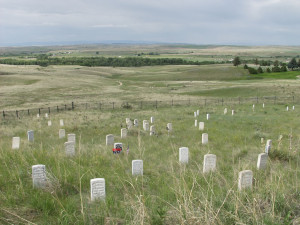
    Little Big Horn

    BinhTuy66 sends us a link which is a few years old at “Little Big Horn History” which says that more than 200 men claimed to be the lone survivor at the famous battle. We tend to think that being a military phony is a recent phenomenon of the last century, but apparently not;

    The newspapers of the day ran hundreds of such stories. Most of the accounts are complete flights of fantasy and offer no documentation to support their claim. Some of the men and their fanciful tales have believers to this day and have entered the realm of Little Big Horn folklore.

    So, journalists have been regularly enablers of these posers, more interested in the story than the fact. Here are some examples;

    Joe Blonger- Blonger (Belonger) (1847-1933) Claimed he missed the Battle of the Little Big Horn because there weren’t enough horses to go around. He said he arrived on the battlefield after the massacre and questioned the Indian children about what really happened. The Indian children also told him who killed Custer, a secret he only shared with family members. Blonger was good friends with Sitting Bull, Geronimo, Cochise and Wild Bill Hickock. He also scouted with Buffalo Bill. The Apaches called Blonger “Joe straight tongue.” Died 1933 Seattle, WA.

    William Theodore Dugard- (1864-1937) Dugard claimed to be one of Custer’s ‘Mississippi Scouts.” Unfortunately Dugard was only twelve years old at the time of the battle and Custer had no “Mississippi Scouts.” During his lifetime Dugard was somewhat of a celebrity in his hometown of Tupelo, Miss., and played organ from the back of a wagon during parades. Buried Tupelo, Miss. In 2001 Mississippi erected a military tombstone with the inscription- “Custer Co. -Mississippi Scouts- Battle of the Little Bighorn .”

    Curly Hicks- Sent to Gen. Terry for reinforcements, Hicks escaped the battlefield by using two dead Indians as a shield. Hicks claimed he was the famed scout for Custer known as Curly.

    You can see similarities to modern days phonies’ stories. But, it seems to me that if there were this many survivors at the battle, the Indians might have noticed a crowd of 200 phonies getting their stories straight.