Category: Historical

  • Annie, Get Yer Gun!

    Ran across this bit of history the other day.  I thought all our readers who are current and former cannon-cockers would enjoy it.

    That’s the old 280mm M65. Twenty were built in the early 1950s. They were nicknamed “Atomic Annie”, likely after the famous German “Anzio Annie” rail gun of World War II.

    Eight still survive today as museum pieces. The one that fired the first (and only) live nuke round is on static display at the US Army Artillery Museum at Fort Sill, OK.

    Here’s a movie of that test-firing, including some neat info about the system as well as the test event itself. Enjoy – and try not to get too big of a chub, guys. (smile)

  • 70th Anniversary of the Cabanatuan Raid

    70th Anniversary of the Cabanatuan Raid

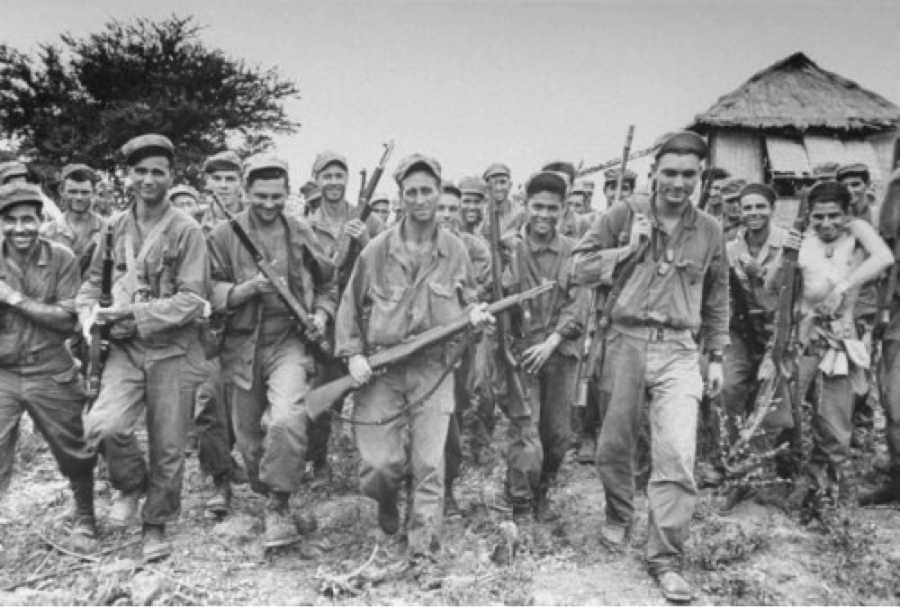
    cabanatuan rescuers

    I’m a few days late, luckily they weren’t. But The Great Raid on the Cabanatuan POW Camp on the Philippine island of Luzon happened on January 30th, 1945, 70 years ago. The prisoners there had survived the Bataan Death March which began on April 9, 1942 with the surrender of the ill-prepared 60-80,000 US and Filipino troops after their three-months battle with the Japanese Army. Cabanatuan was the largest POW camp at one time housing more than 9000 POWs.

    Fearing that the Japanese would execute the POWs left at Cabanatuan, Lt. Col. Henry Mucci, the commander of the 6th Rangers led about 120 Rangers from C and F companies. They infiltrated enemy lines and humped 30 miles to the camp. The force linked up with about 200 local partisans and raided the camp.

    The Japanese lost about 500 troops in the raid, the Americans lost two raiders. Two prisoners died in the attempt, one died of excitement as he was being carried by a Ranger before he could get through the gate, another died of illness during the trip back.

    Edwin Rose, a deaf British prisoner, slept through the raid while he was in the latrine. When he awoke the next morning, he noticed that everyone was gone, so he walked out of the camp and was rescued by partisans.

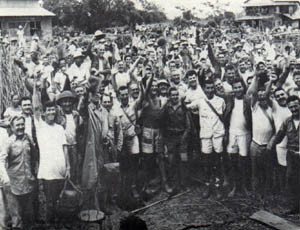
    All in all, 492 Americans, 23 British (including Edwin Rose), three Dutch, two Norwegians, one Canadian, and one Filipino were rescued from the camp. Unfortunately, 2,656 Americans died at the camp during their 3-year imprisonment.

    cabanatuan POWs_celebrate

  • The CIA’s 2014 “Top-10 List”

    For the past several days, the CIA has been highlighting the most read articles it’s released this year for public consumption.  Naturally, they’re doing this on Twitter.

    However, some of their “top 10” are worthwhile reading.  I’ve written about the number one release here at TAH already – and I also appear to have perhaps linked to a substantially less-redacted version of the document than the one the CIA references in their top-10 list.  (smile).   If you haven’t read it, it’s IMO worth some time.  Be forewarned:  it’s lengthy.

    But there’s another gem on that list “top 10” list that’s even more worthwhile IMO.  Remember the movie “Argo”?  Well, number 7 on that list is the official CIA history of “Argau” – told by the man responsible for pulling it off – Antonio J. Mendez

    IMO it’s just as worthy of taking the time to read.  And it’s not as long as the other linked historical document.


    PS:   no, “Argau” above isn’t a misprint.  Read the linked history.  (smile) 

    Happy New Year to all.

  • Operation Just Cause 25th Anniversary

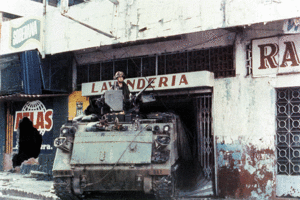
    just-cause

    Yup, it’s been a quarter century since we removed Manuel Noriega from Panama so he can sue Activision video game makers for using him in their graphics for the latest Call of Duty game.

    But there was a cost;

    ARMY

    Staff Sgt. Larry Barnard 3/75th Rangers Hallstead, Pa.
    Pfc. Roy D. Brown Jr. 3/75th Rangers Buena Park, Calif.
    Pvt. Vance T. Coats 82nd Airborne Division Great Falls, Mont.
    Spec. Jerry S. Daves 82nd Airborne. Division Hope Mills,N.C.
    Sgt. Michael A. Deblois 82nd Airborne Division Dubach, La.
    Pfc. Martin D. Denson 82nd Airborne Division Abilene,Texas
    Pfc. William D. Gibbs 7th Infantry Division. Marina, Calif.
    Spec. Phillip S. Lear 2/75th Rangers Westminster, S.C.
    Spec. Alejandro Manriquelozano* 82nd Airborne Division Lauderhill, Fla.
    Pfc. James W. Markwell 1/75th Rangers Cincinnati, Ohio
    Cpl. Ivan M. Perez 5th Infantry Division Pawtucket, R.I.
    Pfc. John M. Price 2/75th Rangers Conover, Wis.
    Pfc. Scott L. Roth 89th Military Police Brigade Killeen, Texas
    Pvt. Kenneth D. Scott 5th Infantry Division Princeton, W.Va.
    1st Lt. John R. Hunter 160th Aviation Victor, Montana
    CWO2 Wilson B. Owens 160th Aviation Myrtle Beach,S.C.
    CWO2 Andrew P. Porter 7th Infantry Division Saint Clair, Mich.
    Pvt. James A. Taber Jr. 82nd Airborne Division Montrose, Colo.

    NAVY

    Lt. jg John Connors Special Warfare Group Arlington, Maine
    BM1 Chris Tilghman Special Warfare Group Kailua, Hawaii ENC
    Donald McFaul Special Warfare Group Deschutes,Ore.
    TM2 Issac G. Rodriguez III Special Warfare Group Missouri City,Texas

    MARINE CORPS

    Cpl. Garreth C. Isaak 2nd Marine Division home town unknown.

    Another of our “wars of imperialism” in which we didn’t occupy or annex the country. When will we learn to get it right?

  • 70 Years Ago Today: Wacht am Rhein

    Today is the 70th anniversary of the beginning of Unternehmen Wacht am Rhein – or, as it’s more commonly referred to in the US, the Battle of the Bulge. At 0530 (local time) on 16 December 1944, German forces in the Ardennes began a general offensive against American forces in northeastern Europe. The fighting was to last until 25 January 1945 – a total of forty-one days.

    The German operational objective was to capture the Belgian port of Antwerp. The strategic objective was to split British and US forces, cutting off the former in Belgium and the Netherlands, in hopes of causing the Western Allies to make a separate peace with Germany.

    From the beginning, the German offensive was a desperate gamble – some German commanders gave it only a 10% chance of success. However, at that point in the war the German high command felt they really had no choice. A continued defensive posture was viewed only as a way of prolonging eventual defeat.

    Due to a combination of missed indicators and overconfidence on the part of Allied commanders, German forces achieved near-complete operational and strategic surprise. That the offensive failed is due IMO largely to two factors. The first was the generally weakened state of German forces (due to massive prior losses in France and on the Eastern Front) at that point in the war. Had the Germans had stronger forces available, they possibly would have achieved their operational objective of Antwerp. (Whether that would have induced the US and UK to seek a separate peace with Germany is an open question.)

    The second reason for the German offensive’s failure was determined early resistance by US forces – at Elsenborn Ridge during the battle’s opening days, and in the much better-known (but probably less decisive) defense of Bastogne beginning somewhat later – prevented a German breakout. These determined defensive stands irreparably disrupted and delayed the German offensive, buying US forces sufficient time to react and contain it. German forces indeed forced a large salient in US lines – famously referred to as a “bulge” – but were unable to achieve a breakout to the English Channel and Antwerp.

    By Christmas 1944, the initial German advance in the Ardennes had been stopped. Over the next six weeks, German forces were forced back to their original lines at the beginning of the offensive.

    The Germans tried again in early January to continue their offense via operations against the US 7th Army in Alsace, which had sent troops to reinforce US forces farther north. German forces achieved some initial success in this supporting effort.  However, it was also contained. By late January, this supporting offensive also had ended.

    The Battle of the Bulge was the largest fought by US forces during World War II. It was also the most costly in human terms. Multiple published totals for US casualties exist, ranging from nearly 90,000 (including 19,000 killed and 23,000+ missing) to over 108,000 (including 19,000+ killed and 26,000+ missing). German casualties were on the same order as US casualties; official German casualty figures for the battle totaled 84,834.

    The Battle of the Bulge was almost an exclusively American-German battle. British casualties numbered 1,408: 200 killed, 969 wounded, and 239 missing.

    The battle’s effect on German forces in the Western theater was near-catastrophic. The battle depleted German theater reserves, and Germany could not adequately replace them. These losses doubtless hastened the end of World War II in Europe.

    As you go about your activities today, take time to remember 70 years ago. It’s history worth remembering.

  • “A Date Which Will Live In Infamy”

    Seventy-three years ago at the time of this article’s publication – 1248 UCT-5, AKA Eastern Standard Time; or 0748 UTC-10, AKA Hawaii-Aleutian Time – the Japanese attack on Pearl Harbor began. That attack (along with Germany and Italy’s declaration of war on the USA four days later) led to the USA’s formal entry into World War II.

    In human terms, the cost of the attack was substantial, but perhaps lower than you might first think. A total of 2,535 individuals (2,403 US military, 68 civilians, and 64 Japanese military) were killed during the attack. Wounded totaled 1,218 – 1,178 US military and 35 civilians. One Japanese sailor – ENS Kazuo Sakamaki – was taken POW.

    As Jonn’s article earlier today indicated, however, the physical and psychological effects of the attack were massive. The Navy’s Pacific Fleet was severely damaged; only great good luck (all US Pacific carriers were at sea or otherwise away from Pearl on 7 December, and the Japanese inexplicably chose not to target the oil storage facilities at Pearl – plus the incredibly one-sided engagement at Midway six months later) allowed us to contest the Pacific during the first year or so of the war.

    The psychological effect of the attack was perhaps even greater. Yamamoto was correct in fearing that the attack on Pearl “awakened a great, sleeping giant”. The “terrible resolve” part of his observation was likewise true – and was manifested in the massive destruction inflicted on the Japanese homeland and civilian fleet during the latter parts of the war.

    The passage of time and subsequent events have healed most wounds from that day. Rather than enemies, the US and Japan are today firm allies. Time has also claimed the majority of those who fought at Pearl Harbor on both sides. It has dulled both societies’ memories of that day as well.

    Still: as you go about your activities this Sunday, perhaps find time to pause. Take time to remember another Sunday exactly 73 years ago today. If you’re so inclined, say a prayer for those lost that day.

    And while you’re at it, maybe add a second prayer – that we never again see such an event.  Twice has been two times too often.

  • 73rd Pearl Harbor Day

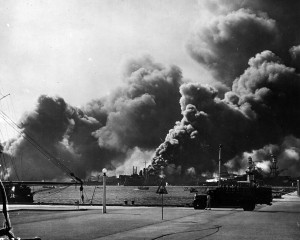
    Pearl Harbor burning

    Seventy-three years ago today we were “suddenly and deliberately attacked by naval and air forces of the Empire of Japan” leading to our ultimate involvement in the war which the rest of the world had been fighting for more than two years. Wiki records our casualties on that day;

    All eight U.S. Navy battleships were damaged, with four being sunk. All but one were later raised, and six of the eight battleships returned to service and fought in the war. The Japanese also sank or damaged three cruisers, three destroyers, an anti-aircraft training ship,[nb 5] and one minelayer. 188 U.S. aircraft were destroyed; 2,402 Americans were killed[16] and 1,282 wounded. Important base installations such as the power station, shipyard, maintenance, and fuel and torpedo storage facilities, as well as the submarine piers and headquarters building (also home of the intelligence section) were not attacked. Japanese losses were light: 29 aircraft and five midget submarines lost, and 65 servicemen killed or wounded. One Japanese sailor was captured.

    Ex-PH2 sends a link to NBC which reports that we haven’t completely forgot, yet, about the event that led us to war and leadership in the world;

    On Friday, Hawaii Gov. Neil Abercrombie and Honolulu Mayor Kirk Caldwell lead a day of remembrance at the USS Arizona Memorial center near the site of the initial attack.

    The Freedom Bell in Washington, D.C. — cast in bronze with metal from the World Trade Center — rang in honor of those who served in the armed forces, NBC affiliate KHNL reports. Skydivers also unfurled American Flags over Pearl Harbor.

    On Saturday, the Virginia War Memorial in Richmond, Va., will host Pearl Harbor Remembrance Day with speakers and a laying of a wreath in honor of the fallen members of the military as well as civilians killed.

    In Little Rock, Ark., bad weather forced the cancellation of ceremonies scheduled there for Saturday.

    Here is a link to President Roosevelt’s request to Congress for a declaration of war the following day.

  • The Little Drummer Boy . . . General

    We often say that truth is stranger than fiction. We say that because, well, it’s true.

    If someone told you that a lad had (1) run away from home to join the Army at age 9; (2) was a Sergeant at age 12; (3) by age 13 was a twice-wounded, exchanged POW, and had been discharged; (4) made the Army his career; and (5) retired as a General . . . well, you’d probably accuse the person telling you that of telling tall tales, or talking about some third-world country. Or maybe engaging in an episode of “better living through recreational chemistry.” (smile)

    Problem is, they’d be talking about US history. They’d be talking about John Lincoln Clem.

    They’d also be telling the truth.

    . . .


    John Joseph Klem was born in Ohio in August 1851. (He later adopted the spelling “Clem” for his last name; as a youth, he adopted the middle name “Lincoln” in place of his given middle name Joseph). When he was 9, his mother died.

    Clem’s earliest military history is not well documented. However, generally accepted history is it that he ran away from home at age 9 after his mother’s death and attempted to join multiple Union regiments forming after the outbreak of the Civil War. Some research casts doubts on this, and indicates he actually left home a year or two later.

    Clem’s earliest documented service was with the 22nd Michigan. He was initially rejected by the 22nd Michigan as well, due to his young age and small size. However, accepted history is that Clem followed the regiment anyway; after a time, the regiment’s officers adopted him as mascot and drummer boy, chipping in to give him a “regular soldier’s” pay. After a time (in May, 1863), Clem was allowed to formally enlist – at age 12.

    Though often rumored to have served at the Battle of Shiloh and been the “Johnny Shiloh” of Ray Bradbury short-story and Disney movie fame, the former claim appears almost certainly apocryphal. The 22nd Michigan, with whom Clem did serve, was not at Shiloh. However, it appears that Clem’s service at Chickamauga was indeed the inspiration for the Civil War song “The Drummer Boy of Shiloh”, which was first published after Chickamauga and which doubtless inspired Bradbury’s story and the Disney movie.

    Clem is documented to have served at the Battle of Chickamauga in 1863. At Chickamauga, Clem did more than merely beat a drum. During the Union retreat, Clem is reported to have served with an artillery caisson withdrawing from the battlefield. That caisson was reportedly intercepted by a Confederate Colonel, who demanded Clem surrender. Accounts state that Clem – using a musket with a stock shortened so that he could carry it properly – shot the Confederate Colonel vice surrendering, and escaped with the caisson.

    Though later research has cast some doubt on the “shot a Confederate Colonel” portion of this account – Confederate records do not show a Colonel to have been wounded at Chickamauga – the Union Army accepted the story at the time. Clem was promoted to Sergeant not long afterwards, becoming the youngest NCO in Army history (age 12). He was also later decorated for his actions at Chickamauga.

    Clem was taken prisoner in October 1963 while serving as a train guard. (Other accounts indicate he was taken prisoner during the latter stages of Chickamauga.) He was returned to Union control as part of a prisoner exchange not long afterwards; he resumed service with Union forces of the Army of the Cumberland, serving in multiple battles as a mounted orderly. While serving, Clem was wounded twice. In September, 1864, he was discharged.

    After the Civil War, Clem completed high school. He applied for admission to West Point, but failed the entrance exam and was refused admission. Almost certainly because of his well-known wartime record, President Grant appointed Clem a Second Lieutenant in 1871. While the appointment may have been political, it turned out to be an excellent move on Grant’s part.

    As a Lieutenant, Clem served initially with the 24th US Infantry. He later attended artillery school, then was transferred to the Army’s Quartermaster Department in 1875. He was to remain a Quartermaster officer the remainder of his career.

    Clem retired from active duty on 13 August 1915 – on reaching the Army’s mandatory retirement age of 64. He’d attained the rank of Colonel. As was customary for retiring Civil War veterans who had achieved that rank, he was promoted to Brigadier General on retirement – indeed, Clem was the last Civil War veteran to serve on active duty. A bit over a year later, he received a promotion on the retired list to Major General.

    Clem lived more than two decades after his retirement from the Army. Just before World War II, a ship was named after him – the USAT (later USAHS) John L. Clem.

    Clem died on May 13, 1937 – roughly seventy-six years after he’d reportedly run away from home to join the Army. He is buried at Arlington National Cemetery.

    Drummer boy at Chickamauga. WIA twice, without permanent disability. POW. Youngest NCO in Army history. Direct commissioned by the President. Last Civil War veteran to serve on active duty. Retired a General.  Ship named in his honor.

    Yes, I’d certainly call that the proverbial “life well-lived”. We all should be so lucky.

    Rest in peace, General Clem. Rest in peace.


    Sources:

    http://www.civilwar.org/education/history/biographies/john-clem.html
    http://en.wikipedia.org/wiki/John_Clem
    http://www.arlingtoncemetery.net/jlclem.htm
    http://www.ohiohistorycentral.org/w/Johnny_Klem
    http://www.patheos.com/blogs/mcnamarasblog/2011/09/johnny-clem-%E2%80%9Cthe-drummer-boy-of-chickamauga%E2%80%9D.html
    http://histclo.com/bio/c/bio-clem.html
    http://www.old-picture.com/defining-moments/Boy-Soldier.htm
    http://www.gacivilwar.org/story/john-lincoln-clem-an-american-legend
    http://en.wikipedia.org/wiki/USAT_John_L._Clem