Category: Historical

  • 70th anniversary of Operation Varsity

    70th anniversary of Operation Varsity

    Operation Varsity

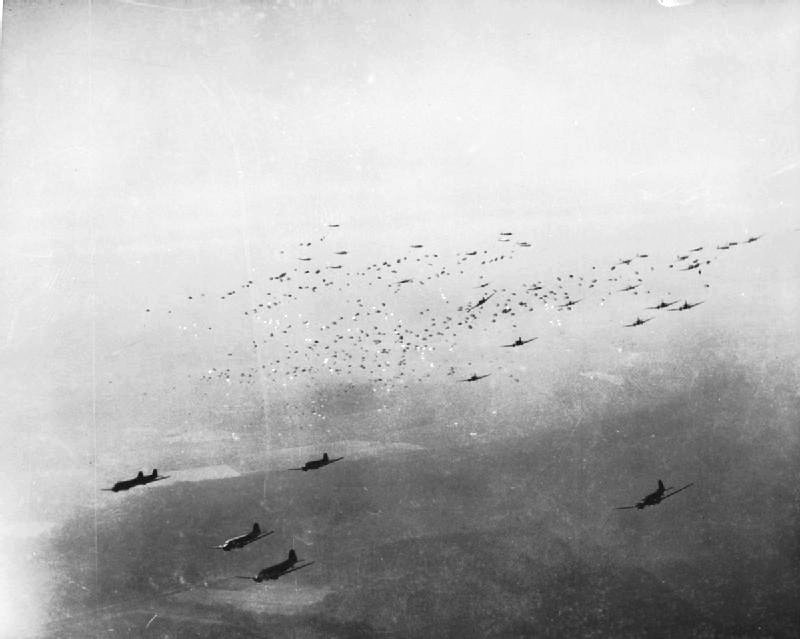
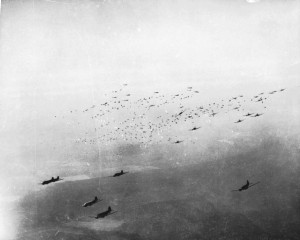
    Seventy years ago yesterday saw the largest single-day, single drop airborne operation of the Second World War. Divisions of the American (17th Airborne Division), British (6th Airborne Division) and Canadian paratroopers assaulted across the Rheine River to assist in the invasion of Germany. About 17,000 troops dropped during the daylight jump on top of German defenders. Almost 3,000 Allied paratroopers were casualties, 3500 Germans were captured.

    Operation Varsity was considered the most successful airborne operation of the war, mostly because it incorporated the lessons learned on D-Day and Operation Market Garden to secure the area behind the bridgeheads while the ground forces secured the actual bridgehead.

    Many of the casualties occurred among the glider infantry units (including the US 194th Glider Infantry Regiment). Three years later, the Army abandoned the glider concept for delivering troops and equipment into combat. 12 gliders were totally lost to anti-aircraft fire while 140 were damaged. West Virginian Technical Sergeant Clinton M. Hedrick of the glider regiment earned the Medal of Honor posthumously a few days later.

    21 of the aircraft carrying paratroopers were lost before they could deliver their load. 59 others were damaged.

    70 years ago today on 24th March 1945, Operation VARSITY was launched. The largest airborne operation ever carried out, it saw some 17,000 troops from the British 6th Airborne Division and American 17th Airborne Division land by parachute and glider to capture crossings over the River Rhine.The mission achieved its aims, with the paratroopers securing bridgeheads and the first tanks crossing the Rhine in the early hours of 25 March to take the advance into Germany.Video: Copyright: Airborne Assault Museum, Duxford

    Posted by 16 Air Assault Brigade on Tuesday, March 24, 2015

  • A Cooling “Blast from the Past”

    In keeping with the spring      thaw     snowstorm hitting the NE USA, I thought I’d provide this link.  It’s to an article from Harper’s Magazine – in September, 1958.

    The Coming Ice Age

    The thesis then was that continued global warming would melt the Arctic ice cap.  That would cause a rise in global sea levels – and more precipitation, including more snow.

    However, unlike modern-day      Cassandras       Chicken Littles       prophets of doom      climate warming “true believers”, the theory then was that this ongoing global warming would trigger another ice age.

    Seriously.

    You see, some of that increasing amount of the snow would never melt during the summer.  That non-melting snow would start to form permanent snow cover, then glaciers.  Those glaciers would grow, then merge.  Winds from the north would begin to cool the weather farther and farther south.  Ice sheets would form, and begin to creep south.  In fact, ice sheets up to two miles thick would cover the US and Europe in “several thousand years!”

    Of course, they were also predicting in 1958 that the Arctic Ocean could be ice-free by 1978, too.  They seem to have been a bit off about that, too.  (smile)

    Today, the Arctic is still supposedly melting.  But now that’s allegedly evidence of runaway man-made global warming and a sign that the planet is about to overheat.  Go figure.

    Or at least, maybe today’s climatologists need to “go figure”.  Maybe they need to acknowledge that perhaps they don’t really know enough about what’s causing the earth’s climate to change over time well enough to predict squat with accuracy.

    After all, they’ve not exactly had a great track record over the last 60 years.  Nor have they been exactly consistent in their predictions and claims.

    (Hat tip to Drudge and to Michaal Bastasch at The Daily Caller, who provided this story containing the link to the Harper’s article.)

  • “Stop crying. I have to get these people out safely.”

    The following is not fiction. But first, a bit of background.

    I’d also suggest grabbing a Kleenex or two.

    . . .

    Depending on which source you consult, there are either six or eight Celtic nations. Five of the six commonly-accepted ones are the Irish, Welsh, Bretons, Scots, and the original inhabitants of the Isle of Man.

    The sixth commonly-accepted Celtic nation is the Cornish: the inhabitants of Cornwall, the south-westernmost part of Great Britain. Though today part of England, the people there are of Celtic origin; they are descendants of the Celtic Cornovii tribe. They are today a recognized minority nationality within Great Britain.

    They were referred to in early English accounts as the “West Welsh”. Their culture, though Anglicized, is considered to be based on Celtic vice Anglo-Saxon traditions.

    Celtic peoples have traditionally been considered brave, stouthearted people, both in peace and war.  The Cornish are no exception.

    Though small in population and area, Cornwall has produced a number of persons of noted accomplishment. This article deals with one of them.

    . . .

    Roughly 100 days before the start of World War II, a boy was born in a small town in Cornwall.

    During the war, his hometown was headquarters to a US Army unit preparing for D-Day – as were many other towns in the UK. The boy came to idolize the GIs. His association with them led to his desire to be a soldier.

    The boy grew to be a young man. He was gifted athletically, was smart and perceptive, and was charismatic.

    At age 16, he left home to join the Army. At 17, he joined and trained with the British Parachute Regiment. He then served in an intel assignment in Cyprus between 1957 and 1960.

    It was hardly a quiet assignment. This was during the height of the EKOA insurgency in Cyprus.

    At the end of this assignment, the man accepted an assignment as a paramilitary police inspector for the Northern Rhodesia Police – today, the Zambia Police Service. He served there from 1960-1963.

    This assignment changed his life – again, at least in part due to the presence of an American soldier. In Northern Rhodesia the Cornish man became lifelong friends with a US soldier who was there at the time. He also developed a lifelong hatred of Communism.

    In 1963, the Cornish man returned to England and became a policeman for a short time. He then emigrated to America.  Accounts vary whether it was because “Britain is fresh out of wars” or not.  But his hatred of Communism was indeed part of the reason.

    Since World War II, he’d always wanted to be a soldier.  Now, he again became one – for his new country. He joined the US Army.

    The Army saw potential in the young British immigrant. They sent him to OCS, and then to Vietnam.

    In Vietnam, unlike most new “90 day wonders” he actually knew what he was doing. (That stands to reason, since before going to Vietnam he had close to 6 years of military and/or paramilitary experience during times of hostilities – including 3 years in the African bush.) He was tactically proficient, leading from the front; he maintained a hard but upbeat attitude that was infectious.  He was also a calming influence during combat.  During truly nasty times, he sang to his men to keep their spirits up and to keep their mind off their peril.

    He was highly decorated during his time in Vietnam, earning the Silver Star and Bronze Star for Valor.  He was WIA and received the Purple Heart.

    He also cared deeply for his men. If they were wounded, he’d spend time with them, trying to reassure them.

    He did this even when they were mortally wounded.

    After Vietnam, the man became a US citizen. But not long after that, he left active duty – though it was obvious he was destined for high rank if he stayed. Many who knew him think dealing with the loss of his troops in combat was what finally led him to leave active service after Vietnam.  He simply couldn’t stand the thought of losing any more of his men.

    The man went to school, earning a degree, then a law degree. He taught college. And the man remained in the Army Reserve. He retired from the Army Reserve in 1990 – as a Colonel.

    In many cases, that would be the end – early active duty including war, retirement from the Army Reserve after a successful career, then a quiet normal life thereafter.

    But for this man, that was wasn’t the case at all.

    . . .

    In the mid-1980s, the man decided to return to the security business from academia. He became chief of security for a large Wall Street firm.

    That firm had offices in the World Trade Center. The man was worried; he thought that the building was insecure, and that his charges were at risk.

    He contacted his old friend from his days in Northern Rhodesia – that same US soldier who’d been instrumental in convincing him to come to America in the first place. The two of them inspected the building from a security perspective.

    His friend told him that the parking garage was the primary place of vulnerability. He pointed out that the major load-bearing columns supporting the building were exposed there. He also said that a truck full of explosives could be parked next to one of them, and might bring down the building.

    If this sounds eerily familiar – it should. That’s precisely what happened several months afterwards – in February, 1993, during the World Trade Center bombing. The Cornish man and his friend had been unable to convince those managing World Trade Center security to implement adequate security measures for their parking garage.

    In the aftermath, though the tower did not collapse 6 persons were killed; over a thousand were injured; and the building suffered serious damage. A larger bomb using better explosives (the one used was estimated to have been only around 600kg of improvised ANFO explosive) could well have dropped the tower.

    Adequate security measures for the parking garage were implemented afterwards.

    . . .

    The Cornish man was still worried, however. He thought that the attack would be repeated; he just didn’t know how. So he again reached out to his former Army friend, and asked him his opinion on how a future attack would occur.

    His friend, after viewing the building’s physical security, predicted an attack from the air. He specifically predicted that the World Trade Center would likely be rammed by a cargo plane, possibly carrying explosives or some form of non-nuclear WMD, and would cause the building to collapse.

    Yeah.  Really.

    The man from Cornwall tried to get his employer to move the firm’s offices to a complex outside the World Trade Center. Unfortunately, their lease ran through 2006 – so the move would be delayed that long.

    As chief of security, the Cornish man did what he could. He implemented regular emergency evacuation drills, and convinced management to back them. They were inconvenient, yes. But the man from Cornwall was resolute – he knew somehow that a future attack would come, and that they’d be needed. And management kept backing him.

    . . .

    The Cornish man had developed cancer. And by 2001, he was 62 years old.

    His daughter was getting married in mid-September of that year. However, one of his subordinates had planned an overseas family vacation including at least part of the second full week in September. The Cornish man was covering for his subordinate until he returned.

    He was thus at the World Trade Center on the morning of 11 September 2001 – in Tower 2. He heard the impact of the first plane striking Tower 1, then saw it burning.

    World Trade Center authorities advised everyone to shelter in place. The Cornish man’s response to that order has been variously reported as being typically British – and rather coarse. The rough equivalent of his actual words appears to be, “Screw that, I’m getting my people out of here.”

    The evacuation began prior to the second plane hitting Tower 2. Fortunately, that plane hit above the floors on which their firm’s offices were located.  The building shook violently, but held; the evacuation continued.

    During the evacuation, as he’d done in Vietnam the Cornish man sang to those evacuating – to calm them, and to keep their mind off the danger and on more immediate matters. As before . . . it worked.

    His employer had nearly 2,700 personnel who worked at the World Trade Center complex. All but a handful of them – various accounts put the total lost from his company at between 6 and 13 – got out alive.

    When the vast majority of people from his firm had been evacuated, the man from Cornwall was told by a colleague he needed to evacuate himself now. His response? “As soon as I make sure everyone else is out”.

    The Cornish man was last seen on the 10th floor of the South tower, heading upward. Shortly thereafter, the South Tower collapsed.

    His remains were never found.

    . . .

    Why does an individual do something like this? How do they find the strength of will, and the guts, to face virtually certain death to save others when they have an honorable “out”?

    Honestly, I don’t know. IMO it’s simply off the scale of normal human behavior.

    Perhaps the man feared he was eventually going to die from cancer, and that emboldened his acts that day. A cynic might even say he chose intentionally to end his life quickly, and took foolish chances that day because he had little to lose.

    Perhaps that was a part of it; perhaps not. However, I don’t really think so. I think the man from Cornwall simply felt it was his duty to get everyone out of that building that he could.

    Remember: he was chief of security for his company, and this was an emergency. He was therefore the site commander; everyone else there that day were his troops. He was simply doing his duty – and taking care of his troops.

    . . .

    The Cornish man’s given name was Cyril. He didn’t much care for it, and on joining the British army chose to go by a diminutive form of his middle name – “Rick”, short for Richard.

    His full birth name was “Cyril Richard Rescorla”. Much has been written about him. I’ll not attempt to list those various sources here; a quick Internet search will yield more than I care to list. But reading even a fraction of that will show I’ve only scratched the surface concerning his life and heroism. He truly was an example for all – and a living definition of the word “hero”.

    Here are two rather famous photos of the man. The first shows him as a young man:
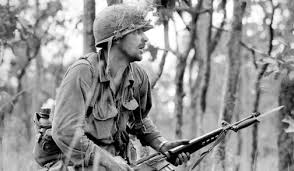
    Yes, this was indeed the same “Rick Rescorla” who fought at the Battle of Ia Drang in 1965. That’s his photo on the cover of “We Were Soldiers Once . . . And Young.”

    The second photo, nearly as iconic, was taken nearly 36 years later during the evacuation of the World Trade Center.  It shows him in action that day – as well as the bloating caused by some of the anti-cancer treatments he’d been taking:

    . . .

    There is a theory that some men are simply not destined to die in bed, but are fated instead to die on their feet. Perhaps that’s true.

    If that’s true, Rick Rescorla was certainly one such man.

    Rest in peace, Colonel. In the words of a great British poet: “You’re a better man than I am.”


    (Author’s note: the title of this article comes from the last telephone conversation between Rescorla and his second wife, which occurred as he was evacuating the Morgan-Stanley offices in the World Trade Center complex. The full quote from which that is taken is as follows: 

    “Stop crying. I have to get these people out safely.

    If something should happen to me, I want you to know I’ve never been happier. You made my life.”

    At the time of his death, Rescorla and his second wife Susan had been married just over 2 1/2 years.)
  • Happy 100th “Birthday”, NASA

    Let me start by saying that I don’t know if NASA celebrates today as their birthday or not. But if they don’t – they should.

    Technically, the National Aeronautics and Space Administration (NASA) was created on 1 October 1958. On that date, per the National Aeronautics and Space Act of 1958 the newly-created agency called NASA absorbed the functions of a number of other Federal activities and began operations under it’s own name.

    Less than 11 years later, we put a man on the moon.

    However, one of those “other Federal activities” NASA absorbed was a thing called NACA:  the National Advisory Committee on Aeronautics. The National Aeronautics and Space Act of 1958 abolished NACA – and transferred its functions and assets, part and parcel, to NASA. So in my book NASA traces its lineage directly to NACA, inheriting its accomplishments and history.

    Those accomplishments were hardly trivial. On 30 September 1958, NACA facilities included a few you might have heard of:   the Langley Memorial Aeronautical Laboratory at Hampton, Virginia; the Ames Aeronautical Laboratory at Moffett Field, CA; the Aircraft Engine Research Laboratory (Lewis Research Center) in Cleveland, OH; and the Muroc Flight Test Unit at Edwards Air Force Base, CA.

    Mach 1, Mach 2, and Mach 3 flight were achieved under NACA – not NASA – managed efforts. The Bell X-1  (Mach 1), Douglas D-558-2 (Mach 2), and Bell X-2 (Mach 3) were all NACA projects. Ditto a host of other experimental flight programs dating well back before World War II.

    Why bring this up today? Because NACA – NASA’s direct predecessor – was established on 4 March 1915, or exactly 100 years ago today.  Establishing NASA and reaching the moon would IMO have been one helluva lot harder if that had never happened.

    So even if you don’t celebrate it (and IMO you should):   happy 100th, NASA.  In my book, today is your true birthday.


    (Edited to add that Mach 3 flight was also achieved under NACA.)

  • Battle of Norfolk; 24 years ago today

    Battle of Norfolk; 24 years ago today

    The Battle of Norfolk was the cousin of the Battle of 73 Easting. Objective Norfolk was just the other side of that invisible line in the sand. Wiki says of that battle;

    No less than 14 divisions participated in this particular battle. In reality this makes it quite possibly the largest battle of the entire war, however, the Battle of Medina Ridge involved the largest American and Iraqi divisions. Another factor was the media seemingly overlooked the details of the coalition ground campaign for some unknown reason. It would also be over a decade after the conflict before quality references would become available on most of the battles that took place during the 1st Gulf War.

    Task Force 1-41 passed through elements of the 2d ACR at about 30 minutes after midnight in total darkness after a day-long march to get to the battle. The horizon in front of 2/2 Cav was dotted with burning armored vehicles, hundreds of Iraqi prisoners sat in tiny groups waving white flags so they wouldn’t get shot by the advancing armored vehicles. We could make out them and their flags through our thermal optics. As soon as we passed through the Cav’s vehicles, it became a 360-degree battle. Bravo Company’s commander became disoriented and led a platoon diagonally across the battlefield where they were mistaken for Iraqi armor by M1 gunners who immediately destroyed three of the Bradleys. Remarkably, only six of that 35-member platoon were killed.

    The rest of Task Force 1-41 watched the sun come up six miles from where they had passed through 2/2 Cav’s line.

    The two attacking brigades of the U.S. 1st Infantry Division, including the 3rd Brigade of the 2nd Armored Division, were positioned along the 75 Easting, 2,000 meters east of 73 Easting. The Brigades clashed with the Iraqi Tawakalna Division of the Republican Guard, including the 37th Brigade of the 12th Iraqi Armored Division. The 12th Iraqi Armored Division would be destroyed during this engagement. A total of 80 Iraqi armored vehicles would be destroyed in the process.

    4-3 FA Battalion, 2nd Armored Division(FWD) conducts artillery strikes on Iraqi positions during the 1st Gulf War. 4-3 FA was the primary fire support battalion for Task Force 1-41 during the 1st Gulf War, February 1991.
    British Army Challenger 1 main battle tank during Operation Desert Storm. The Challenger proved to be a deadly opponent at the Battle of Norfolk.

    With air support from the 2nd Battalion, 1st Aviation’s attack helicopters and fire support from both the 4-3 FA Battalion and the 210th Field Artillery Brigade preventing Iraqi artillery from interfering, the U.S. 1st Infantry Division conducted a passage of the 2nd ACR’s lines. In the following three hours the U.S. 1st Infantry Division methodically crossed the 6.2 miles (10.0 km) of Objective Norfolk, destroying Iraqi tanks, trucks, and infantry through thick fog. The 3rd Brigade of the 2nd Armored Division destroyed 60 Iraqi tanks and 35 AFVs along the IPSA pipeline. In the thick of the fog of war, U.S. units became mixed with Iraqi units dispersed throughout the desert. This confusion led to some friendly fire incidents.

    By dawn, the U.S. 1st Infantry Division controlled Objective Norfolk and the Tawakalna Mechanized Infantry Division had ceased to exist as a fighting force. A total of eleven Iraqi divisions were destroyed. American casualties were six soldiers killed (all but one by friendly fire) and 25 wounded.

    We reconsolidated after a sleepless night and set out for Kuwait from there. Eventually, we began running out of fuel and the whole Brigade lagered up the night of the 27th and waited for the fuelers – and we got our first real sleep since we’d crossed into Iraq three days before only because our fuel tanks were nearly empty. I laid on top of our TOW missile launcher while I waited for the troops to get their own sleeping gear situated and woke up with the sun in my face the next morning with a few hours left before the ceasefire so we mounted up and moved out.

    As the ceasefire deadline approached, we engaged with remnants of the Iraqi Army left behind by their leadership (which had fled back to Iraq on the nearby Highway One – the Highway of Death) and at 0800 local time, we turned left and stopped firing.

    Task Force 1-41 was awarded a Valorous Unit Citation which read;

    For extraordinary heroism in action against an armed enemy. Task Force 1-41 was the first coalition force to breach the Saudi Arabian border on 15 February 1991 and conduct ground combat operations in Iraq engaging in direct and indirect fire fights with the enemy on 17 February 1991. The Task Force was part of the VII Corps main attack beginning 24 February 1991 as it conducted a forward passage through 1st Infantry Division elements and began a mission to clear a zone which again resulted in enemy contact. On 26 February, following a 60 kilometer road march, the Task Force immediately engaged in ground combat with armored and dismounted enemy of brigade size. For six hours it was involved in continuous combat with a tenacious and determined enemy occupying extremely well prepared and heavily fortified bunkers. Task Force infantry elements dismounted and engaged the enemy in numerous short range fire fights while methodically clearing the extensive bunker complex. By morning the Task Force had systematically reduced the entrenched enemy positions in zone. Continuing as part of the VII Corps attack the Task Force travelled 85 kilometers in less than 24 hours while engaging at short range multiple, dug in enemy tanks in ambush positions. The Task Force reached its final objective 28 February 1991 with a push which continued the destruction of enemy armored vehicles. During the entire ground campaign, involving their attack through Iraq into Kuwait, Task Force 1-41 travelled over 200 Kilometers in 72 hours and destroyed 65 armored vehicles and 10 artillery pieces, while capturing over 300 enemy prisoners.

  • The Belgian “godfathers”

    The Belgian “godfathers”

    Didier Dradon

    Marine_7002 sends us another link to a nice story about the “godparents” of US casualties buried in Belgium. They’ve taken it upon themselves to “adopt” the grave sites of fallen troops;

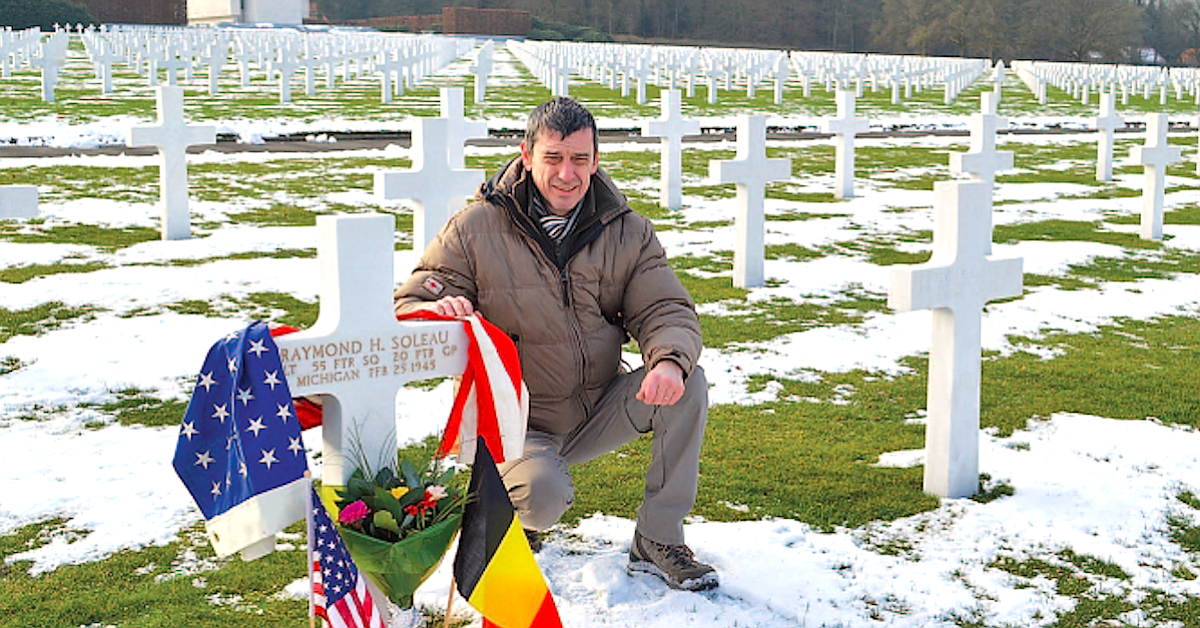
    Lt. Soleau [whose Mustang crashed into a farm field 70 years ago this month]’s remains were interred in the Ardennes American Cemetery and Memorial in Leige, Belgium, where many victims of the Battle of the Bulge were laid to rest. Today, seven decades later, his gravesite is tended to by Didier Dradon, a Belgian man who felt it was his duty to look after American graves.

    “We owe them that much for what they did for us during World War II,” Mr. Dradon said in French in an e-mail sent to The Monroe News. “We honor them by visiting the grave several times a year and placing flowers there each time … in order to never forget the sacrifice of these soldiers for our freedom.”

    […]

    Soleau’s sister, Theresa Balk, said she was pleased that members of a European community care enough to watch over her brother’s gravesite.

    “That’s wonderful,” said Mrs. Balk, who will turn 97 soon. “It’s very, very satisfying.”

  • John Lauriello; Iwo vet gets to land at beach again

    John Lauriello; Iwo vet gets to land at beach again

    Iwo

    Marine_7002 reminds us that the battle for Iwo Jima (Operation Detachment) began 70 years ago tomorrow and he sends us the story about a community which raised the funds to send 91-year-old veteran John Lauriello for his second landing on the island;

    Ade said donations as of Tuesday totaled nearly $20,000 — more than the goal of $12,000 to cover airfare, hotels and other expenses for the Lauriellos. The 10-day trip to the Pacific island starts March 16 and requires four flights between the U.S. and Iwo Jima.

    Ade said contributions will be turned over to the Iwo Jima Association of America to pay for the Lauriellos’ trip and possibly for another Iwo Jima veteran.

    […]

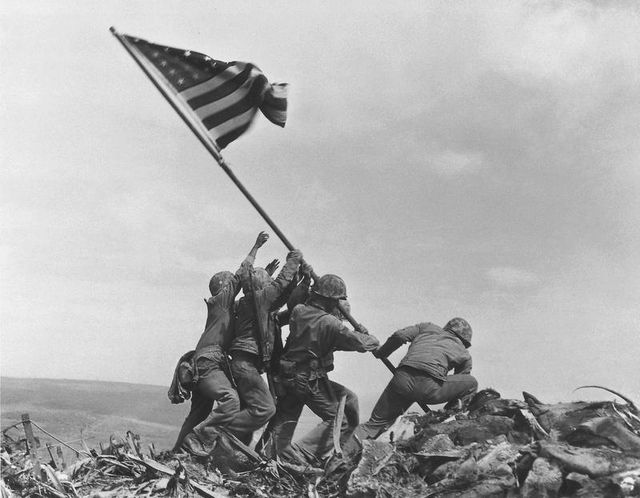
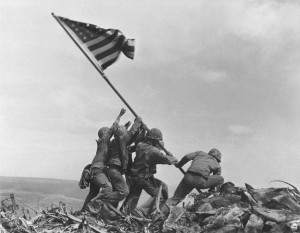
    Lauriello will be returning to where he landed with the first wave of Marines on the beach to fight an entrenched enemy that hid in caves and tunnels. The battle later was memorialized by a Marine statue depicting the U.S. flag-raising on Mount Suribachi — an event Lauriello witnessed from a distance as a member of the 5th Marines, 27th Regiment.

    “I’m just flabbergasted and so excited thinking about it,” he admitted. “I would like to extend my sincerest thanks to them for such a generous outpouring and for their concern.”

    According to Wiki, Mr. Lauriello was lucky – of the 70,000 Marines and soldiers who assaulted the island, about ten percent were killed and more than a quarter were wounded during the five-week battle.

  • Twenty-four years ago tonight

    Twenty-four years ago tonight

    This is republished from four years ago;

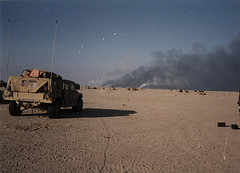
    Twenty years ago, Task Force 1-41 Infantry attached to the Third Brigade of the 1st Infantry Division (from the Third Brigade of the 2d Armored Division (Forward)), was the only US unit in Iraq. We were fifteen clicks from the Saudi border, screening for the sweep east of Schwartzkopf’s “Hail Mary” strategy. For two days we had been watched by Iraqis and had a little contact. with some reconnaissance elements. However on February 17th, my gunner spotted 5 T-55s about 1500 meters in front of our defilade position and I called for indirect fire. The first response came from an Apache unit. The pilot ignored his instruments and fired the wrong grid coordinate, directly to my west, striking two vehicles in our own Scout platoon anchoring our far west flank.

    COB6 was the platoon leader of the platoon between my platoon and the Scout elements. Despite the orders of our company commander (a phrase that I use in several other stories involving COB6 and our commander), COB6 pulled his vehicle off the line and rushed to the burning vehicles (An M3 and and an M113 from the GSR unit). COB6 and his crew pulled the broken bodies from the vehicles with burning ammunition exploding around him and shielded the injured Scouts with his own body. Two of those scouts were dead, but three others owe their lives to COB6 and his crew.

    Needless to say we stopped calling for Apaches and after slamming two TOWs into a berm about a hundred meters in front of us, we used artillery fire. My first ever call for indirect fire in total darkness. The following morning, M1s found the T-55s 5000 meters north of the spot my gunner had spotted them.

    These are the names of the members of 1/41 we lost throughout the war;

    Tony R. Applegate
    David R. Crumby
    Manuel M. Davila
    Anthony W. Kidd
    David W. Kramer
    Jeffery T. Middleton
    James C. Murray, Jr.
    Robert D. Talley

    Talley and Middleton were killed that night.

    We had the highest casualty rate of any other infantry unit in the war, I say it’s because both sides were shooting at us.

    And, oh, yeah, my granddaughter celebrates her 24th birthday today, too.