Category: Historical

  • Mitsubishi to apologize to US POWs

    Mitsubishi to apologize to US POWs

    Yumoto01

    The Associated Press reports that Mitsubishi Materials Corp., a company that used American Prisoner of War labor during World War II, will apologize to a former POW in a ceremony orchestrated by the Simon Wiesenthal Center;

    A senior executive of Mitsubishi Materials Corp. will apologize to 94-year-old James Murphy, of Santa Maria, California, and relatives of other former POWs who toiled at plants its predecessor company operated in Japan during the conflict.

    […]

    A press release from the Wiesenthal Center said the apology will be made by Hikaru Kimura, senior executive officer for Mitsubishi Materials Corp. The company did not immediately respond to a call seeking comment late Monday. Mitsubishi Materials U.S.A. Corp. said Tuesday it had no information about it.

    Masato Otaka, spokesman for the Japanese Embassy in Washington, said to the extent of his knowledge, it was an initiative of Mitsubishi Materials. He said the Japanese government has no involvement.

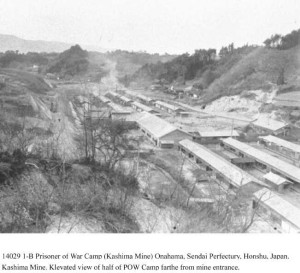
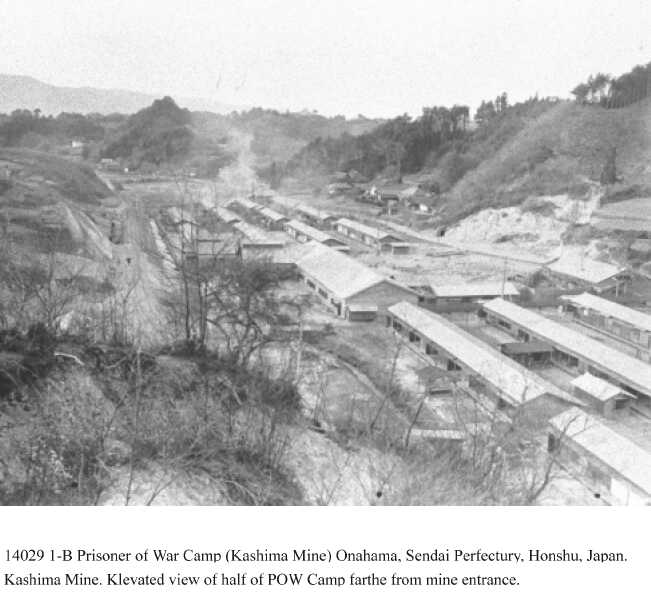
    The picture above is supposedly one of Mitsubishi’s POW camps at a mine in Hanshu, Japan.

  • “I just saw what was going on and did what I could to help.”

    Imagine, for a moment, that a man saves the lives of 669 people.  Then imagine that his good deeds remain hidden for almost 50 years – even from his wife.

    You don’t have to imagine that; it’s not fiction.  Such a man died one week ago today.

    His name was Sir Nicholas Winton, of Great Britain.  In late 1938, he was a young stockbroker.  He went to continental Europe on holiday.

    What happened next was . . . remarkable.  In many ways.

    Go here, here, and here for additional details.  I think you’ll be impressed – and likely awed.  You might also want to have a tissue handy.

    Afterwards, Winton kept quiet about what he’d done for nearly 50 years.  The title of this article is how Winton described his actions after they’d become public.

    That to me is nearly as impressive as the acts themselves.

    Sir Nicholas Winton passed away on 1 July 2015.  His last birthday was on 19 May of this year; it was his 106th.

    Rest in peace, Sir Winton.  Rest in well-earned peace.

    . . .

    Postscript:  Ironically, Winton has never received one honor that you might expect.  Although Winton was British and was baptized – and presumably raised – as a Christian, his parents were originally Jewish.  They emigrated from Germany to England 2 years before Winton was born; they converted to Christianity after arrival in England.

    The fact that Winton’s parents were originally Jewish apparently prevents him from being declared a “Righteous Gentile” by Israel and so honored at Yad Vashem.  Go figure.

  • That Prestigious NDSM!

    That Prestigious NDSM!

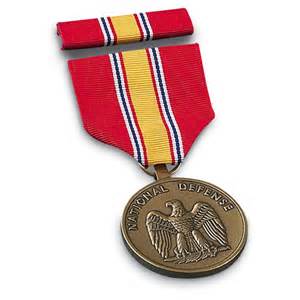
    One of our regulars here (sj) speaks very highly of the National Defense Service Medal – though from the context of his comments, if I’m reading him right I believe he’s doing so somewhat tongue-in-cheek.  But it turns out that there is a surprising quirk when it comes to this medal.

    Here’s a trivia question.  True or false: it is not possible for someone legitimately to rate the Vietnam Service Medal (VSM) unless they also qualified for the National Defense Service Medal (NDSM).

    It turns out that the answer to that question is somewhat surprising. At least, I was surprised by what I ran across the other day.

    Best I can tell, the answer to the question is, believe it or not, “False.”  It does appear possible for someone to legitimately rate the VSM without also qualifying for the NDSM.  In fact, there appear to be at least two different scenarios in which an individual might do exactly that.

    Here are the details.

    1.  DoDM 1348.33-V2, dated November 23, 2010, w/Change 2, specifies the eligibility criteria for the NDSM and VSM. The NDSM’s criteria are given in Enclosure 3, pp. 59-61, of the document; the NDSM’s, on pp. 66-70.

    2.  Per the DoDM, the NDSM Vietnam eligibility period runs from 1 January 1961 to 14 August 1974. The VSM’s eligibility period is from July 4, 1965, and March 28, 1973.

    So, that means it is not possible to have a legit VSM without the NDSM, right?  Well, that would seem to be true.

    Except it’s not.  There’s another thing that DoDM 1348.33-V2 also allows – called “AFEM conversion”.

    3.  Personnel serving in Vietnam between 1 July 1958 and 3 July 1965 were eligible to receive the AFEM for service in Vietnam.  On application, DoDM 1348.33-V2 allows these personnel at their option to elect to convert their AFEM for service in Vietnam to the VSM.

    (They may also opt to retain the AFEM – but they can’t receive both the AFEM and VSM for service in Vietnam.  So if an individual served in Vietnam both before and after 4 July 1965, it appears that DoD policy requires that they must remove any AFEMs awarded for service prior to that date to receive the VSM.)

    4.  Conversion of AFEM to VSM is also allowed for those personnel awarded the AFEM for service in Operation Frequent Wind (the evacuation of Saigon) on 29-30 April 1975.  The two conversions are specifically authorized in para 17.e.(2)(a) and para 17.e.(2)(b) of DoDM 1348.33-V2.

    What that means is that there are at least two hypothetical scenarios in which a person could technically – at the individual’s option – legitimately rate the VSM without rating the NDSM. The first such scenario would be that of a young Soldier who joined the Army in 1956, served in Vietnam very early (during 1959-1960), and then left active duty prior to the end of that year. The second scenario would be a young Airman, Sailor or Marine who enlisted in 1974 on or after 15 August, went to training, was assigned to a unit or ship supporting Frequent Wind, and later left the service prior to 2 August 1990.

    In both cases, the individual would have originally received the AFEM for their service in or supporting Vietnam.  However, conversion of that AFEM to the VSM would be authorized.  They could apply to the appropriate Board for Correction of Military/Naval Records to do so.  (I believe I’ve seen a case or two where an early Vietnam vet did exactly that – e.g., applied to the appropriate Board well after discharge to have their AFEM converted to the VSM.)

    But in neither case would the individual be eligible for the NDSM.  All of their service would be outside a qualifying period for award of the NDSM.

    So, I guess sj is right:  the NDSM really is a big deal after all.  It turns out you can rate a campaign medal and still not qualify for that prestigious NDSM!

    That’s my story, and I’m sticking to it. (smile)

    . . .

    For what it’s worth:  the same is true for the AFEM regarding service in a whole laundry list of operations.  And it’s also true for a number of operations qualifying for the Navy Expeditionary Medal or Marine Corps Expeditionary Medal.

    It’s also true for service qualifying for the Kosovo Campaign Medal if the individual joined the military after November 1995 and their service ended prior to 11 September 2001, too (provided they didn’t join the Selected Reserve or a National Guard unit after leaving active duty).

    . . .

    Remember, folks:  we’re talking DoD policy.  It doesn’t have to make any sense. (smile)
  • Pointe du Hoc; June 6, 1944

    Pointe du Hoc; June 6, 1944

    Republished almost every year;

    a0139_small.gif

    Rangers Mission for D-Day, 6 June 1944

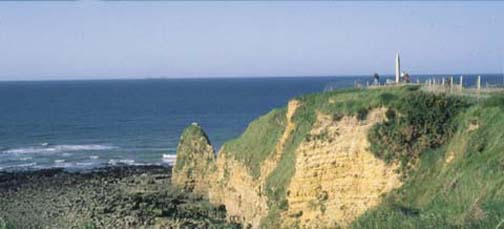
    The Ranger Group, attached to the 116th Infantry and commanded by Lt. Col. James E. Rudder, was given the mission to capture Pointe du Hoc and destroy the guns. The Ranger Group was made up of two battalions: the 2d Rangers, under direct command of Col. Rudder, and the 5th Rangers, under Lt. Col. Max F. Schneider. Three companies (D, E, and F) of the 2d Battalion (Task Force A) were to land from the sea at H-Hour and assault the cliff position at Pointe du Hoc. The main Ranger force (5th Battalion and Companies A and B of the 2d, comprising Task Force B) would wait off shore for a signal of success, then land at the Point. The Ranger Group would then move inland, cut the coastal highway connecting Grandcamp and Vierville, and await the arrival of the 116th Infantry from Vierville before pushing west toward Grandcamp and Maisy.

    dday_pointeduhoc_375.jpg

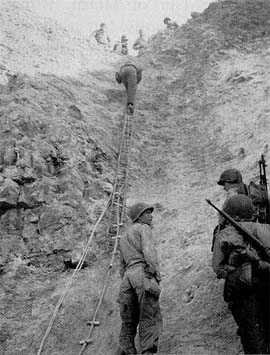
    One DUKW was hit and sunk by 20-mm fire from a cliff position near the Point. The nine surviving LCAs came in and managed to land in parallel on a 400-yard front on the east side of Point du Hoc, landing about 0705. Allied naval fire had been lifted since H-Hour, giving the Germans above the cliff time to recover. Scattered small-arms fire and automatic fire from a flanking machine-gun position hammered the LCAs, causing about fifteen casualties as the Rangers debarked on the heavily cratered strip of beach. The grapnel rockets were fired immediately on touchdown. Some of the water-soaked ropes failed to carry over the cliff, but only one craft failed to get at least one grapnel to the edge. In one or two cases, the demountable extension ladders were used. The DUKWs came in but could not get across the cratered beach, and from the water’s edge their extension ladders would not reach the top of the cliff.

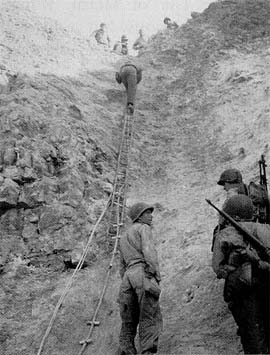
    Despite all difficulties, the Rangers used the ropes and ladders to scramble up the cliff. The German defenders were shocked by the bombardment and improbable assault, but quickly responded by cutting as many ropes as they could. They rushed to the cliff edge and poured direct rifle and machine gun fire on the Rangers, augmented by grenades tossed down the slope. The Rangers never broke, continuing to climb amidst the fire as Ranger BAR men picked off any exposed Germans. The destroyer USS Satterlee (DD-626) observed the Rangers’ precarious position, closed to 1500 yards and took the cliff top under direct fire from all guns, a considerable assist at a crucial time.

    Within ten minutes of the landing the first Americans reached the top of the cliffs.

    rangers_pointe_du_hoc_700_01.jpg

    I may just watch “The Longest Day” tonight. “What does ‘bitte, bitte’ mean?”

  • Derrick Jackson; boy scout rescues Medal of Honor hero from obscurity

    Derrick Jackson; boy scout rescues Medal of Honor hero from obscurity

    Chester Howard West1

    Parachutecutie sends us a link to the story about Derrick Jackson, a boy scout in Mason County, West Virginia who had seen on a television program the degraded state of a cemetery near his home that was the final resting place of World War One hero, Chester Howard West. West was a First Sergeant in Company D, 363d Infantry, 91st Division at Bois-de-Cheppy, France on September 26, 1918 when he earned his Medal of Honor;

    While making his way through a thick fog with his automatic rifle section, his advance was halted by direct and unusual machinegun fire from 2 guns. Without aid, he at once dashed through the fire and, attacking the nest, killed 2 of the gunners, 1 of whom was an officer. This prompt and decisive hand-to-hand encounter on his part enabled his company to advance farther without the loss of a man.

    West survived the war only to be murdered in his home by his landlord while West was working as a tenant farmer. He was buried in his wife’s family plot. Through the years, the cemetery became overgrown and virtually forgotten by locals. Until Derrick Johnson decided to make West’s recovery a Boy Scout project.

    You should read the whole story of the recovery effort at the link above.

  • V-E Day Anniversary

    V-E Day Anniversary

    Victory in Europe

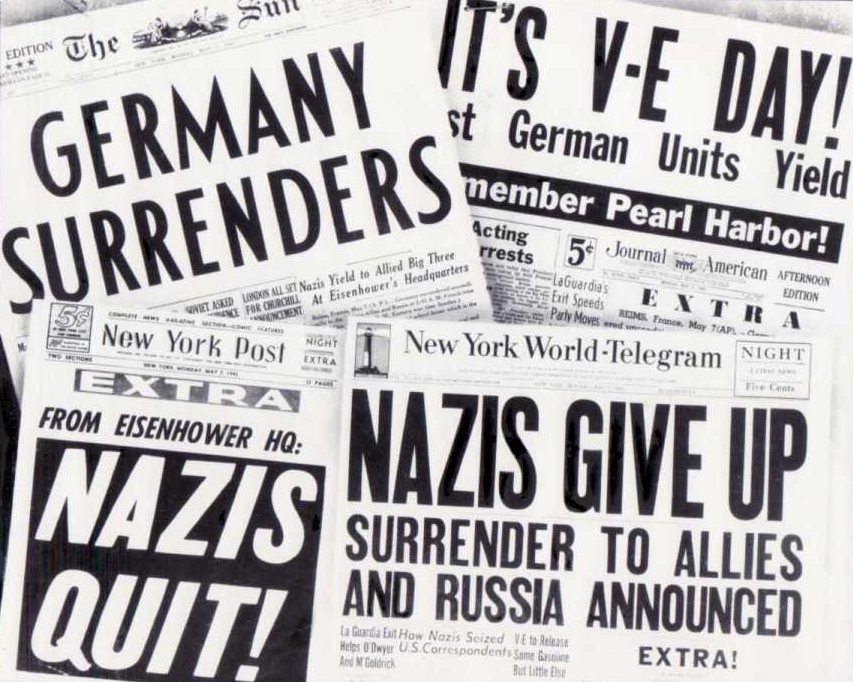
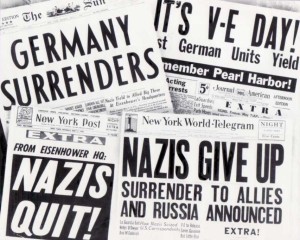
    It was 70 years ago today that the Nazi government of Germany capitulated to the Allies in Berlin, it was also US president Harry Truman’s 61st birthday. He became president on April 12th when President Franklin Roosevelt died just a few weeks before Adolph Hitler committed suicide on April 30th. The surrender document had been signed on May 7th in Reims, France, and again in Berlin on May 8th (largely for the benefit of the Soviets, but it was May 9th in Moscow when it was signed, so that’s their traditional V-E day) by the German government headed by Hitler’s sole surviving successor, Reichspräsident Karl Dönitz.

    Fighting continued in the East for weeks after the surrender, though, as German soldiers tried to get to the American and British zones of occupation instead of surrendering to the Red Army. Small German guerrilla units called Werewolf formed to resist the end of the war existed through the 1940s, mostly made up of Hitler Youth adherents who had known nothing but Naziism. The last German troops to surrender in the West, though, were on the Channel Island of Minquiers which had been bypassed during the war. The troops there surrendered to French fishermen on May 23rd.

  • LZ Carolyn anniversary

    LZ Carolyn anniversary

    firebaseCarolyn1970

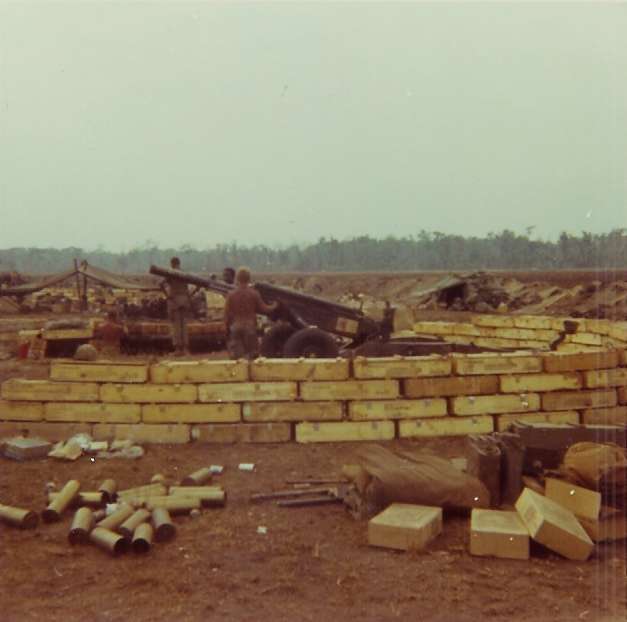
    Someone reminded me that today is the 46th anniversary of the battle at LZ Carolyn in the Republic of Vietnam,near the Cambodian border, wherein the Sky Troopers of the 2nd Bn. 8th Cav. of the 1st Cavalry Division, held back the 95th Regiment of the North Vietnam Army on May 6th, 1969. From an eyewitness to history;

    In the early morning darkness of 6 May, the NVA retaliated with an intensive rocket and mortar barrage, followed by a massive 95th Regiment pincer grand assault against 2 sides of the base an hour later. LZ Carolyn’s garrison was reduced by the absence of several line companies on patrol, and the withering defensive fires of the battalion’s COMPANY C and E were unable to prevent the onrushing battalions from storming through the wire and into the LZ from both directions.

    Six perimeter bunkers were overrun, one of the medium howitzers was captured, and the enemy threatened to slice through the center of the base.

    The Americans counterattacked with all available personnel, the officers involved being killed at the head of their troops. Artillerymen, supply and signal personnel, and engineers fought and died as emergency infantry reserves. The US counterattacks were hurled against both enemy penetrations, but the most violent fighting occurred on the northern side, where a seesaw battle raged for possession of the 155mm howitzer position. During the course of the battle, this weapon exchanged hands 3 times in hand-to-hand fighting deceded at close range with rifles and E-tools (entrenching tools, or shovels).

    Overhead, rocket-firing AH1G Cobra helicopters rolled in, ignoring heavy flak, and blasted the NVA with rockets and miniguns. Air Force AC47 SPOOKY and AC119 SHADOW aircraft, supported by fighter-bombers, were employed against the numerous enemy antiaircraft weapons ringing the perimeter.

    Controlled and uncontrolled fires were raging everywhere, and it seemed that the LZ was ablaze throughout its entire length. Waves of NVA infantry charging into the southern lines were met by defending troops who took advantage of the aviation gasoline storage area. The Americans shot holes into the fuel drums and ignited the flowing rivers of gas to create a flaming barrier, which effectively blocked further enemy penetration. In the LZ’s opposite sector, a medium howitzer gun pit received 3 direct hits, which touched off a fire in its powder bunker, yet the crew calmly stood by its weapon and employed it throughout the night.

    Both of the 105mm howitzer ammunition points were detonated by enemy fire at around 0330, and shrapnel from more than 600 disintegrating rounds in the 2 dumps sprayed the entire LZ for more than four hours. LZ Carolyn appeared threatened with total destruction as the thundering conflagration tossed detonating artillery projectiles to shower men and equipment with flying rounds and burning shell fragments.

    The defending artillerymen and mortar crews fought in desperation, heightened by the loss of communications between most weapons and their fire direction centers (FDC). The initial enemy barrage destroyed communication from the 155mm gun sections to their FDC, forcing crews to individually engage targets on their own volition by leveling tubes full of BEE HIVE or HE charges. When telephone lines from the mortar tubes to their Fire Direction Control were severed, the direction personnel switched to a bullhorn to relay fire commands across the deafening noise of the battlefield. The battalion mortar platoon’s four tubes fired 1500 rounds, ranging from critical illumination to searing WP. In all cases, effective fire support was maintained.

    Ammunition shortages quickly developed, and as on-hand mortar ammunition beside the weapons was exhausted, volunteers dashed through fire-swept open areas to retrieve more rounds from storage bunkers. The destruction of the 105mm ammunition points caused an immediate crisis in the light howitzer pits.

    The cannon cockers (artillerymen) were forced to redistribute ammo by crawling from one gun section to another under a hail of enemy direct fire and spinning shrapnel from the exploding dump. The crews continued rendering direct fire, even though they were often embroiled in defending their own weapons.

    One light howitzer section was caught in an enemy crossfire between a heavy machine gun and rifles, until the artillerymen managed to turn their lowered muzzle and pump BEE HIVE flechettes into the enemy. All enemy automatic weapon fire against the howitzer was instantly silenced. Cavalry counterattacks reestablished the perimeter, and the enemy force began withdrawing, breaking contact at 0600.

    US casualties were about 9 KIA and about 160 wounded. The NVA’s 95th Regiment suffered hundreds of dead and hundreds more wounded. The US abandoned the firebase two weeks later after the hard fought defense.

    Some news reports of the day;

  • Damn, I Missed This Yesterday

    Sorry I missed this yesterday, but better late than never.

    Four years ago yesterday, a tall ugly bastard named Usama began his eternal dirtnap. Hope he enjoys his 72 virgins, and all have this countenance:

    Burn in hell, bin Laden. Burn in hell.