I’m probably going to catch some grief for what follows. No matter. Some things are worth saying, popular or not.
Jonn wrote an article the other day concerning the famous Joe Rosenthal Iwo Jima flag raising photo. The bottom line: one of the individuals identified 7+ decades ago as being part of the “flag raising” – PhM2c John Bradly, USN – was recently determined by the USMC not to have actually been in that photo.
Predictably, since it concerned an icon this caused consternation – and accusations. Some commenters indicated that to them it “didn’t matter”. Others indicated a belief that it was part of some Leftist attempt to “smear” a hero.
It’s a free country, so to each his own. But I have a different point of view.
The photo is also part of US history. And accurately recording that history is damned important. We owe that much to future generations.
We also owe that to those who are now gone. We need to get their story as close to correct as we can – even when sometimes that’s painful.
What follows is a bit longish. Read or not as you desire.
. . .
Flags and Iwo Jima
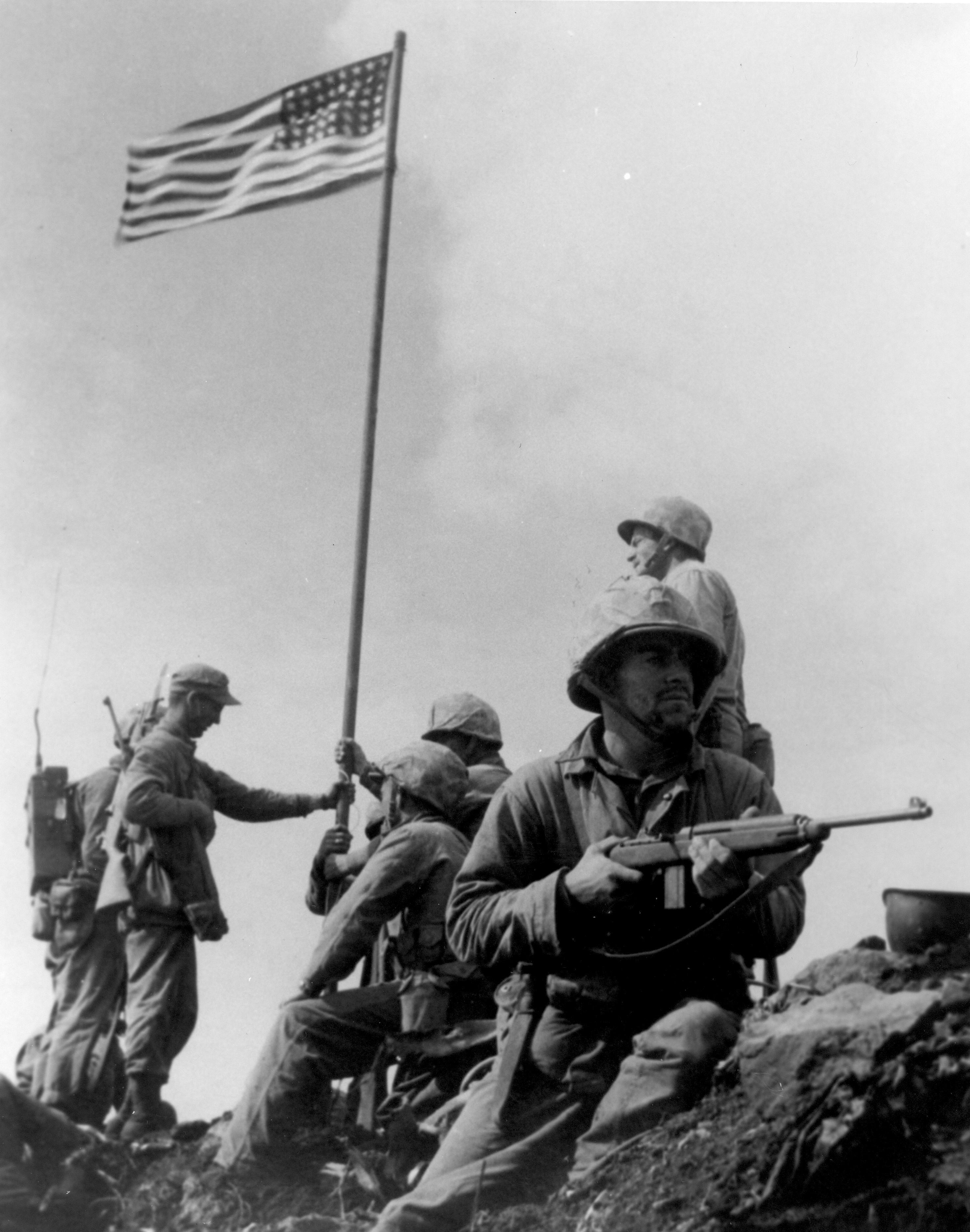
It turns out that “flag raising at Iwo Jima” is actually a quite complex subject. In truth, the famous and iconic flag raising photo on which the USMC Monument outside Arlington National Cemetery is modeled is only one of multiple different “flag photos” taken atop Mount Suribachi on 23 February 1945 – three of which have some degree of publicity. All three of those published photos are very different. Two of them were taken by Joe Rosenthal; the third was taken by SSgt Louis R. Lowery, USMC. There’s also newsreel footage corresponding to one of the three – Rosenthal’s famous photo – which was taken by yet a third photographer: SSgt. Bill Genaust, USMC.
It gets even more complex. There were actually two different “flag raisings” on the summit of Mount Surabachi on 23 February 1945. The photos Joe Rosenthal took – two different photographs, one of which became world-famous – were photographs of the SECOND flag raising that day. The first flag raising and its photos, though not completely unknown, are nowhere near as well known as the second. They are only rarely seen or discussed.
Two of the three famous photos taken that day were candid. One was indeed staged – and no, it wasn’t Rosenthal’s famous photo, which in turn means that the newsreel footage taken that day was also candid.
And to make the situation even more convoluted: Bradley does indeed appear in two of the three publicly-known flag raising photographs taken that day atop Mount Suribachi. However, per the latest USMC investigation announced last week he does not appear in Rosenthal’s iconic photograph.
Given the complexity of the situation and the fact that it occurred in combat, it’s perhaps understandable if not inevitable that errors were initially made in identifying the participants. But such errors can often be corrected – and if they can be corrected, they should be.
The Flag Raisings and the Photos
The first flag raising photo on Iwo Jima is not particularly well known. It was taken by SSgt. Louis R. Lowery, a USMC photographer. It is a photograph taken shortly after the first flag raising atop Mount Suribachi. (Lowery apparently took multiple photographs at the time; this is the most well-known one of the batch.) John Bradley appears in this photo; he’s the individual near the center of the group, standing and wearing a helmet, with his hand holding the flagstaff.
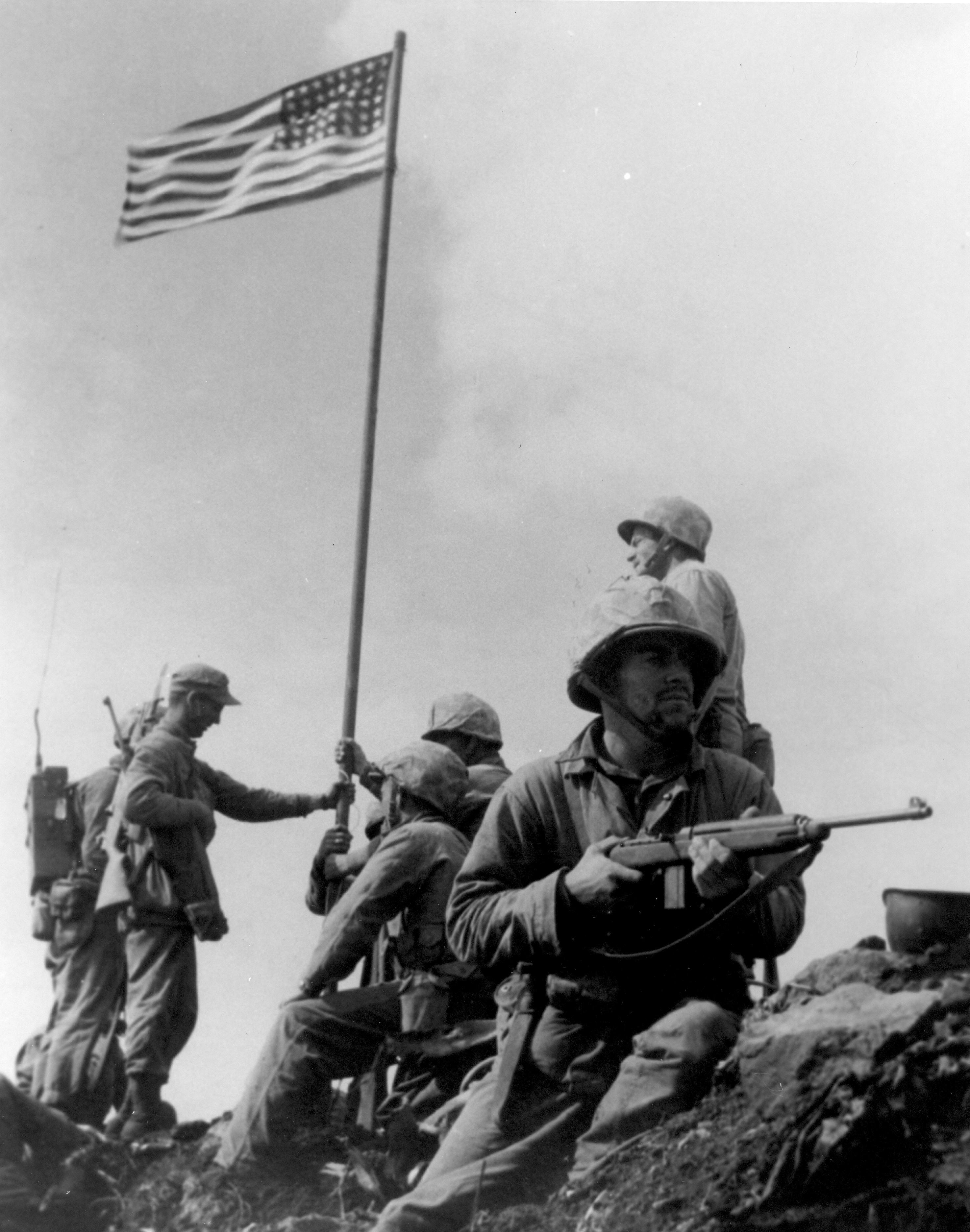
Historical accounts indicate that three Marines raised this first US flag on Mount Suribachi: 1stLt Harold G. Schrier, who led the patrol that took the flag to the top of the mountain; PltSgt Ernest Thomas, his Platoon Sergeant; and Sgt Hank Hansen. None of the three participated in the second, iconic flag raising photographed by Rosenthal.
So, why was there a second flag-raising at all? Well, it seems that a high Navy Department official – SECNAV James Forrestal, to be precise – had accompanied the landing force to Iwo Jima. On seeing the first flag raised on the summit of Mount Suribachi, Forrestal indicated he wanted that flag.
That order was in turn relayed to LtCol Chandler Johnson, the Battalion Commander of 2nd Bn, 28th Marine Regiment, 5th Marine Div, whose forces had topped Suribachi and erected that flag. Johnson’s exact words on receiving this order are recorded as being, “To hell with that!” He then ordered his subordinates to obtain a second flag and raise it – “And make it a bigger one.” A team of four Marines – led by Sgt Michael Strank and including Cpl. Harlon Block, Pfc Franklin R. Sousley, and Pfc Ira H. Hayes – was given the mission of raising the second flag.
One of the battalion’s runners (messengers) – Pfc Rene Gagnon, who also ended up participating in the second flag raising – ended up in possession of this the larger flag (historical accounts differ on precisely where that larger flag was obtained and who obtained it). He took it to SGT Strank’s team atop Mount Suribachi.
The flag and flagpole used in the second flag raising were quite heavy, weighing together well over 100lbs; there was also considerable wind. When Gagnon arrived with the flag, Sgt Strank ordered Gagnon and another individual already on the summit to help. Strank and his team – augmented by Gagnon and the other individual – raised the second flag. (Bradley was apparently also on or very near the summit at the time, as he’s known to have assisted in stringing and securing the rope installed shortly afterwards used to stabilize the makeshift flagpole after erection.) The original flag was lowered and returned to the Battalion’s command group.
This second flag-raising was captured in-progress on both still film and newsreel footage. Joe Rosenthal took the iconic still photo; he damn near missed it, as he was piling rocks to stand on for a better vantage point when the Marines involved started to raise the flag and had to shoot hurriedly. SSgt Bill Genaust, USMC, took the newsreel footage while standing about 3 feet away from Rosenthal. Below is Rosenthal’s original photo; the more famous version is a cropped version of this one.

Genaust’s newsreel footage of the 2nd flag raising is found beginning at approximately 1:30 in the video below.
Rosenthal later had a largish group of Marines from the unit pose for a second, “gung-ho” photo with the second flag atop Mount Suribachi. This was the third Iwo Jima flag photo taken that day. Three of those who participated in the second flag-raising (Hayes, Strank, and Sousley) appear in this photo as well. Bradley also appears in this photo.

Of the six men who raised the flag in Rosenberg’s iconic photo, three (Strank, Block, and Sousley) were later KIA on Iwo Jima – as was the photographer who took the newsreel footage, Genaust. The other three in the iconic photo survived the war.
To recap: Bradley was indeed on the summit of Mount Suribachi during or very shortly after each flag raising on 23 February 1945. He was not one of the three that raised the first flag on Mount Suribachi, but does appear in both Lowery’s first Iwo Jima flag photo and in Rosenthal’s “gung-ho” posed version relating to the second flag. Per the recently-concluded USMC investigation, he was not in Rosenthal’s iconic photograph of the second flag raising; another individual was in that photograph and was afterwards erroneously identified as having been Bradley. Bradley did assist immediately afterwards in placing rope used to stabilize the newly-erected second flag. However, he does not appear to have personally and directly participated in the act of raising either flag.
Prior Controversies
As you can see from the above, the circumstances surrounding the Iwo Jima “flag photos” are complex and somewhat confusing. There were two different flag raisings that day; none of the personnel who raised in the first flag participated in the second flag raising. There are also three different flag photos – but there is personnel overlap among those photos. There is also newsreel film of one flag raising (the famous one). And this all occurred during combat, where things are often of necessity not neatly organized or accurately recorded at the time.
As a result, there has been much confusion and multiple controversies concerning the events.
Initially, Hayes didn’t want to be identified as being one of the “flag raisers”; he wanted to remain anonymous. He secured a promise from Gagnon, who knew Hayes had participated in the second flag raising, not to reveal his identity. It took an order – and a blunt reminder that refusal to obey orders was a crime subject to prosecution – before Gagnon identified Hayes as being one of the six in the photo.
At the time and afterwards, there were accusations concerning Rosenthal’s iconic photo that “the photo was staged”. And indeed, one of the photos taken that day was staged. But the “staged photo” wasn’t the iconic photo taken by Rosenthal; it was his second photograph, which is very obviously not a candid shot. Confusion on this point has led to numerous arguments over the years.
There have also been previous errors concerning the identities of those in Rosenthal’s iconic photo. Originally, there was another error in identifying the participants. Cpl. Harlan Block was not identified as being one of the six in that iconic photo; Sgt. Hank Hansen, one of the three individuals involved in raising the first flag to be raised on Mount Suribachi, was mistakenly identified as being in the photo in Block’s place (at the base of the makeshift flagpole). It took two years and a Congressional investigation to sort that out. Indeed, had Pfc. Ira Hayes – one of the six individuals in the Rosenthal photo – not come forward and spoken up regarding the misidentification, that error would likely never have been corrected.
“At this point, what difference does it make?”
Well, I guess that depends. And yes, the choice of language above was intentional – and was done to make a point.
IMO whether it matters or not depends on what you think is more important: truth, or appearances.
If you think appearances are more important, well, I guess then it doesn’t really matter who’s in Rosenthal’s iconic photo. That photo – regardless of who’s actually in it – is uplifting, stirring, and heroic. It projects the image of the heroic American fighting man quite well.
In that case, I guess it also doesn’t really matter if it was staged. Or if it was even taken in combat or on Mount Suribachi at all. Or if it was created out of whole cloth by an artist, for that matter.
In short, it doesn’t matter if it’s true or not. The image is still effective, and it supports the cause.
If that’s your point of view, well, have at it. But I can’t buy that.
I can’t buy that, because truth matters. The event indeed really happened. It was iconic, and special. Real people did that, in a real war. It’s part of US history.
The people involved are also part of US history. And they deserve to be remembered – accurately.
And I also can’t buy it because of what happened next.
The surviving “flag raisers” were turned into celebrities. They were pulled from combat duty; they were used to headline a War Bond drive. In at least one individual’s case, it was done very much against their will.
In short, they too became a part of US history. So yeah, IMO “getting it right” here matters – a great deal.
It matters because history is what really happened. If an account is known not to be accurate, it’s not history; it’s at best fiction, and at worst propaganda. And when an account is known to be inaccurate, but is nonetheless provided as a description of what actually happened, well . . . that’s called a lie.
As I said before: to each his own. To me, truth matters. One helluva lot.
YMMV.
Truth Is . . . Truth
There are some who might say that this doesn’t matter for a different reason: because John Bradley was a hero, and this is just an example of “someone trying to tear down a hero”. I can’t say I agree with that, either.
John Bradley was indeed a true battlefield hero; his Navy Cross Citation speaks for itself on that score. He deserves credit and honor for his heroism; for that he has my respect.
But regardless, facts are facts – even when they’re troubling. Bradley was indeed in two of the famous Iwo Jima flag photos – but it now appears he was not in Rosenthal’s iconic photo. He didn’t help raise either flag atop Mount Suribachi. And try as I might, I simply cannot see any way around one conclusion: that John Bradley knew – full well – that he didn’t participate in raising the flag in Rosenthal’s photo.
Yet he kept silent.
I can perhaps understand why he kept his mouth shut while he was in uniform. Hell, I suspect he may have been ordered to do so.
But he was discharged from the Navy in late 1945. After that, he could speak his mind. Ira Hayes certainly did to correct the record regarding Block.
Bradley didn’t. He kept his mouth shut for almost 49 years.
Still: truth is . . . truth. It doesn’t change because we don’t like it – or because we don’t like what the truth implies.
. . .
Coda
There’s also one final thing to consider. Or, more precisely – one other individual.
I have to wonder how the real sixth “flag raiser” in Rosenthal’s photo – now determined to have been Pfc Harold H. Schultz, USMC – felt about how this situation and its aftermath. Because IMO if anyone got the short end of the stick here, it seems to me that he did. Bigtime.
Schultz was a legitimate part of US history. He was the one in the photo. He deserved recognition and remembrance for what he did, even if it was done while simply obeying orders. His actions merited being recorded for posterity; he deserved to be remembered.
But he wasn’t.
By all accounts, after World War II Schultz lived a full and apparently good life. But he had to live the rest of that life knowing someone else got the credit for what he’d done at Iwo Jima – and as a result, became famous.
Think about that for a moment. Schultz had participated in something iconic and had played a central role. He was someone who had literally made history – history that would be remembered for decades if not centuries. By that act he’d achieved some small measure of immortality. People would remember what he’d done – and his name – long after he was gone.
Then, afterwards, his rightful place in history was taken from him and given to someone else. The other man was remembered; he was forgotten.
Maybe Schultz was OK with that; maybe it p!ssed him off daily. I never met him, so I can’t say.
But what Schultz did certainly deserved then and deserves now to be acknowledged. And now, after 71+ years, it has been.
There’s just one small problem. The wrong done to Schultz can never be fully righted.
You see, Harold H. Schultz died on 16 May 1995 – more than 21 years ago. He went to his grave never receiving his due. And he died knowing someone else still was receiving credit for doing what he’d done.
He died knowing someone else had been given his rightful place in history. He never knew that his role in history had been acknowledged.
And that . . . is a shame. A damn shame.
(Multiple sources were used in preparing this article. However, the Wikipedia article entitled Raising the Flag on Iwo Jima is a good – and as far as I can tell, accurate – rundown on this somewhat complex and confusing subject.)