Author: Hondo

  • Weekend Open Thread

    Many TAH readers have flown on a C-130. But it’s possible few know the aircraft’s true maximum possible passenger capacity.

    Oh, sure – the book says that the earlier models can hold “64 paratroopers or 92 combat troops”. But when push comes to shove, the bird can carry a few more than that.

    As in over 350 more. And I am not joking.

    . . .

    Tan Son Nhut Air Base, 29 April 1975. The North Vietnamese were advancing on Saigon, and a massive evacuation of US and other friendly personnel was underway. Originally planned as an evacuation of 13,000, the evacuation is estimated to have moved nearly 130,000 persons to safety.

    At the time Tan Son Nhut was literally a war zone. Over 100 aircraft were either damaged and/or destroyed on the air base flight line, with some still burning.

    However, one C-130 – tail number 56-0518 – remained there in flyable condition. It has been a USAF asset from delivery in 1957 until 1972, but was then transferred from the USAF to the RVNAF.

    Its pilot on 29 April 1975 was an RVNAF officer named Major Phuong (regrettably, I couldn’t determine the man’s full name). As he prepared to leave, his aircraft was being mobbed by literally hundreds.

    So many people boarded the plane that while taxiing the loadmaster informed Maj Phuong that he couldn’t close the rear ramp. Phuong then slammed on the brakes, which pushed the mass of passengers forward. (Some accounts say he did this multiple times in order to make room for more evacuees.) The doors were closed, and the aircraft – though overloaded by an amount estimated to be at least 5 tons – successfully took off.

    Accounts indicate the aircraft needed more than 10,000 feet to get airborne – and the runway at Tan Son Nhut was only 10,000 feet. The bird didn’t lift off until it was on Tan Son Nhut’s 1,000’ runway overrun.

    After an eventful flight (in addition to the high APF takeoff, they also became disoriented over the Gulf of Thailand), Phuong and his aircraft eventually reached safety. After landing, 452 personnel exited the plane – 32 of whom had been crammed into the cockpit.

    . . .

    No, this isn’t some bogus “tall tale”. It actually happened. It’s documented here, here, here, and here. Multiple other accounts also exist, though not all are accurate (some sources indicate, erroneously, that the aircraft was a USMC C-130).

    Living free vice under a Communist dictatorship is often a powerful motivation to do truly amazing – and insanely dangerous – things.

    Afterwards, the aircraft was returned to the USAF. It continued to fly until 1989, at which point it was retired.

    The aircraft wasn’t send to Davis-Monthan AFB and scrapped, though. In recognition of the fact that it was the last C-130 to leave Vietnam, the aircraft was retained as a memorial. It is today on static display outside the main gate of Little Rock AFB, AR.

    OK, enough aviation history for today. Enjoy the WOT, everyone – and the weekend.

  • Chutzpah? Yep. PTSD? Not So Much.

    Yeah, PTSD is real. And some people really are screwed up bigtime from it.

    But I have my doubts whether all PTSD claims are on the up-an-up. I wouldn’t be surprised to find out a large fraction are BS, either totally or in part.

    Why? Well, if the multiple doubtful cases previously presented here at TAH weren’t enough – here’s yet another reason.

    Short version: a guy named Michael Pecka from Fairport, NY, claimed to suffer from “PTSD”. He claimed it was due to “witnessing” and “helping investigate” two suicides while serving in Kuwait during 2004-2005. The experience supposedly left Pecka “traumatized,” and he filed disability claims with the VA twice on that basis, in 2011 and 2014.

    The VA granted Pecka compensation for his “PTSD” – to the tune of $3,000+ monthly. He eventually collected about $92,000 in tax-free VA disability compensation.

    Yeah, the words in quotes above are in quotes for a reason. When the VA OIG investigated Pecka’s case in detail, they found he didn’t witness either suicide or help with any investigations. Hell, he wasn’t even in the same country at the time one of the suicides occurred (the suicide in question occurred IVO Fort Drum while Pecka was deployed to Kuwait).

    Oh, and did I mention that Pecka had the gall to file the first of his claims with the VA while in prison on unrelated bank fraud charges? Color me “shocked, shocked” to find out that a convicted fraudster would attempt yet another fraud.

    Pecka recently pleaded guilty to making a false claim in connection with his VA disability application. He’s now facing a maximum possible sentence of 5 years in prison and a fine of $250,000. He’s to be sentenced in Jan 2019.

    You can read more about the case in this article. Personally, I hope the judge gives this lying a-hole the absolute max sentence (and fine) allowed. I also hope the judge orders Pecka to pay restitution.

    We give the VA grief when they screw up. But here, the VA figured out that they were dealing with a Pecka-head sh!tbag – and nailed him to the wall.

    Kudos, VA OIG. Hopefully, this is just a start. Perhaps perusing this site’s archives would be helpful in the way of leads.

    —–

    Note: hat tip to frequent commenter AnotherPat for originally identifying the case in this comment to another article.

  • Another Four Return

    DPAA has identified and accounted for the following formerly-missing US personnel.

    From World War II

    F1c Grant C. Cook, Jr., US Navy, assigned to the crew of the USS Oklahoma, was lost at Pearl Harbor, HI, on 7 December 1941. He was accounted for on 17 October 2018.

    F1c Angelo M. Gabriele, US Navy, assigned to the crew of the USS West Virginia, was lost at Pearl Harbor, HI, on 7 December 1941. He was accounted for on 24 October 2018.

    Wiper Elvis N. Spotts, US Merchant Marine, assigned to the crew of the SS Cape Isabel, was lost at Tarawa Atoll on 22 February 1944. He was accounted for on 23 October 2018.

    From Korea

    None

    From Southeast Asia

    Mr. George L. Ritter, civilian employee of Air America Incorporated, was lost in Laos on 27 December 1971. He was accounted for on 4 October 2018.

    Welcome back, elder brothers-in-arms. Our apologies that your return took so long.

    Rest easy. You’re home now.

    . . .

    Over 72,000 US personnel remain unaccounted for from World War II; over 7,600 US personnel remain unaccounted for from the Korean War; over 1,500 remain unaccounted for in Southeast Asia (SEA); 126 remain unaccounted for from the Cold War; 5 remain unaccounted for from the Gulf Wars; and 1 individual remains unaccounted for from Operation Eldorado Canyon. Comparison of DNA from recovered remains against DNA from some (but not all) blood relatives can assist in making a positive ID for unidentified remains that have already been recovered, or which may be recovered in the future.

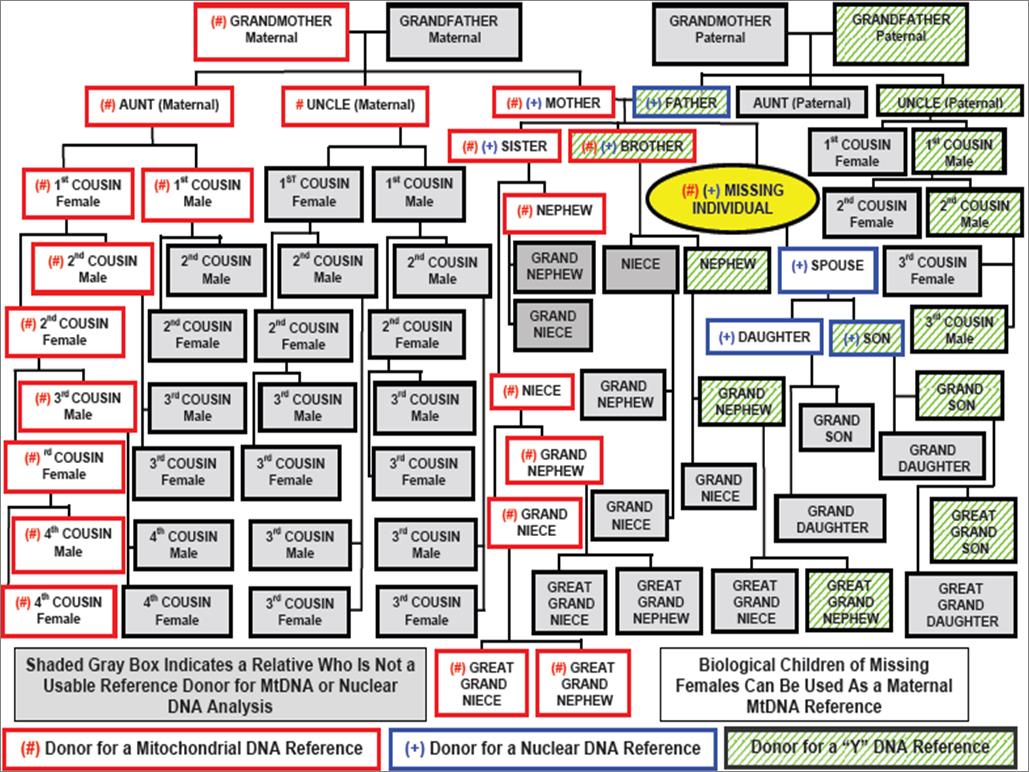
    On their web site’s “Contact Us” page, DPAA now has FAQs. The answer to one of those FAQs describes who can and cannot submit DNA samples useful in identifying recovered remains. The chart giving the answer can be viewed here. The text associated with the chart is short and can be viewed in DPAA’s FAQs.

    If your family lost someone in one of these conflicts and you qualify to submit a DNA sample, please arrange to submit one. By doing that you just might help identify the remains of a US service member who’s been repatriated but not yet been identified – as well as a relative of yours, however distant. Or you may help to identify remains to be recovered in the future.

    Everybody deserves a proper burial. That’s especially true for those who gave their all while serving this nation.

    ———-

    Author’s Note: DPAA apparently “slip-streamed” the entry for Air America employee George L. Ritter into their “Recently Accounted For” page listing sometime during the past 3 weeks.

    Given the history and mission of Air America in Southeast Asia, the announcement of Mr. Ritter’s accounting being made in a low-key, behind-the-scenes fashion simply seems . . . somehow apropos.

  • Weekend Open Thread

    Most readers probably know that between 1956 and 1960, the US conducted U2 overflights of the Soviet Union. Most also probably know that those overflights “ended” when Gary Powers’ ill-fated flight was shot down near Sverdlovsk on 1 May 1960.

    Yes, the “ended” above is in quotations for a reason. While Powers’ flight was the last acknowledged intentional US overflight of Soviet territory by a U2, it was not the last such overflight. At least one other overflight occurred – and it occurred at perhaps the worst possible time in human history.

    . . .

    The week of Monday, 22 October 1962, should need no introduction to either regular TAH readers or those with a knowledge of Cold War history. That week was the public part of the Cuban Missile Crisis – e.g., the week the US and USSR very nearly played a “game” called Global Thermonuclear War.

    During the Saturday of that week, Captain (later Vice Admiral) Vasili Alexandrovich Arkhipov of the Soviet Navy prevented another Soviet Naval officer from using a nuclear-armed torpedo against US warships. Also on that same day a U2 piloted by Maj. Rudy Anderson, USAF, was shot down while overflying Cuba on a recon mission, killing Maj. Anderson.

    But at the same time that Maj. Anderson’s aircraft was downed, another U2 mission was underway. And it wasn’t over Cuba. Rather, it was 5,000+ miles to the northwest.

    . . .

    Even during the Cuban Missile Crisis, U2s were operating elsewhere in the world. The USSR had resumed atmospheric nuclear testing in 1961, at Novaya Zemlaya. So in October 1962 the US was regularly sending sampling missions over the Arctic to obtain fallout samples from those tests in an operation called “Project Star Dust II”.

    The route of the mission scheduled for 27 October 1962 was simple. It was to take off from Eielson AFB, AK; fly north to the North Pole, obtaining fallout samples (if there were any); and return. The flight was a routine one, scheduled well in advance.

    The execution wasn’t exactly as planned.

    . . .

    The pilot of the sampling flight in question was Capt. Charles Maultsby, USAF. He would have preferred to have been flying missions over Cuba, but his current assignment was flying missions over the Arctic.

    Maultsby’s flight to the North Pole on 27 October 1962 went reasonably well. However, as he approached the North Pole he had to determine the correct south heading for his return (all directions from the North Pole are by definition south, but obviously most headings won’t result in a return to Eielson AFB).

    Further: at high northern latitudes, a compass isn’t particularly useful. So on such missions the U2 pilot had to use celestial navigation – e.g., star sightings via sextant. And as Maultsby made his early-morning (Alaska time) approach to the North Pole, the aurora was particularly strong.

    To make a long story short: Maultsby’s navigation was off. Instead of returning to Alaska, he flew west of Wrangel Island and ended up over far eastern Siberia’s Chukot Peninsula.

    SAC HQ was monitoring Maultsby’s flight. For whatever reason, the Soviets were not using strong encryption on their Siberian Air Defense network. The US had discovered this – and unknown to the Soviets the US was monitoring that network in virtually real time. But this fact was, obviously, a critically important secret. Radioing Maultsby a message to the effect that, “Um, guy, you are currently over the Soviet Union; turn due east” would disclose that secret – and was simply not going to happen.

    A second complicating factor was the fact that USAF procedures of the day mandated a change in ordnance on frontline US air defense interceptors when the US went to DEFCON 3. Specifically, the F-102’s based in Alaska at that point changed from conventional air-to-air missiles to ones having small nuclear warheads.

    Earlier during the week, we’d gone to DEFCON 3 – then DEFCON 2. So our Alaska-based interceptor aircraft were now armed with air-to-air missiles having nuclear warheads.

    The USSR wasn’t exactly thrilled at the fact that another US U-2 was flying over Soviet territory. They scrambled interceptors from two Siberian airfields on the Chukot Penisula – airfields near the towns of Pevek and Anadyr – in an unsuccessful attempt to intercept Maultsby’s U-2. In response, the US launched F-102s from the former Galena AFB in Alaska in the event Maultsby required air support during his return.

    . . .

    After penetrating some distance into eastern Siberia, Maultsby determined he was likely over the USSR. He was able to contact one of his mission’s support/search and rescue aircraft via radio; they advised Maultsby that it was sunrise over central Alaska and asked him if he could see the sunrise. Since he could not (Maultsby was several hundred miles west at the time), this information confirmed that he was indeed over the USSR and needed to head east. He did so.

    One problem: by this time, Maultsby no longer had enough fuel to reach Alaska under his own power. He’d taken off with 9 hours 40 minutes of fuel; his flight, now a substantially longer one, would take in excess of 10 hours. However, the U2 glides well – up to 250 miles when starting at high altitude. So with about 12 minutes fuel remaining, Maultsby cut his engines and glided until he was met by two US F-102s from Galena AFB over extreme western Alaska. They suggested to him a landing at a USAF radar station near Kotzebue (about 150 miles NNE of Nome).

    Maultsby successfully landed there. After being assisted from his cockpit by one of the radar site’s crew, to paraphrase the late Frank Zappa he then emulated the famous Huskies and immediately “made a bunch of yellow snow”. No word on whether he used the opportunity to write his initials – or his name – in said snow. (smile)

    Maultsby’s U2 flight was the longest duration U2 flight on record at the time. He’d flown for 10 hours and 25 minutes – on 9 hours 40 minutes worth of fuel. He’d also inadvertently overflown several hundred miles of Soviet territory, including flying within intercept range of two Soviet air bases. Only the fact that he was at a much higher altitude than Soviet interceptors of the day could reach saved him. (The fact that the Soviets had indeed twice tried to intercept him during his inadvertent Soviet overflight wasn’t made known to Maultsby until well after he’d landed.)

    Maultsby was not disciplined by the USAF for the mission gone awry. However, at least one other account of his flight (besides the ones linked below) exists and indicates he was never again allowed to fly polar sampling missions.

    Maultsby later flew 200+ combat missions in Vietnam, retiring from the USAF as a Colonel in the late 1970s. He passed away on 14 August 1998 in Tucson, AZ.

    . . .

    An account of Maultsby’s 27 October 1962 mission can be found in Michael Dobbs’ excellent book about the Cuban Missile Crisis One Minute to Midnight in chapters 8, 9, and 11. These can be found online here, here, and here. (Later chapters also give post-flight details, including an account of Maultsby’s personal briefing to the CINCSAC – Gen. Thomas Power – afterwards.) The graphic accompanying this article is from that source.

    A shorter account of Maultsby’s flight can also be found on the National Security Archive website here. Both of these accounts provide additional background and/or details not discussed above.

    As of 2008, the official USAF investigation into Maultsby’s flight remained classified. To my knowledge, it remains classified today and has never been released to the public. The information Dobbs used to prepare the graphic in his book was found in State Department files in the National Archives during his research for the book. An image of the map of Maultsby’s flight Dobbs found in the National Archives can be seen here.

    However, the official USAF history Maultsby’s unit (the 4080th Strategic Wing) for October 1962 has been released to the public in redacted form. It refers to Maultsby’s flight as having been “100 per cent successful”.

    I guess the official history is correct, technically speaking. Presumably “100 per cent successful” in this context means that Maultsby’s flight returned with samples usable by Project Star Dust II. The fact that the flight also involved an unauthorized overflight of the USSR on the absolute worst day of the Cuban Missile Crisis and could easily have sparked World War III is merely an “irrelevant minor detail”. (smile)

    FWIW: tomorrow will be the 56th anniversary of Maultsby’s Soviet overflight. Rest in peace, Colonel Maultsby.

    . . .

    OK, enough Cold War history. Enjoy the WOT, everyone – and the weekend.

  • Another Five Are Home

    DPAA has identified and accounted for the following formerly-missing US personnel.

    From World War II

    Bgmstr2c Lionel W. Lescault, US Navy, assigned to the crew of the USS Oklahoma, was lost at Pearl Harbor, HI, on 7 December 1941. He was accounted for on 16 October 2018.

    S1c John A. Karli, US Navy, assigned to the crew of the USS Oklahoma, was lost at Pearl Harbor, HI, on 7 December 1941. He was accounted for on 16 October 2018.

    S2c Charles C. Gomez, Jr., US Navy, assigned to the crew of the USS Oklahoma, was lost at Pearl Harbor, HI, on 7 December 1941. He was accounted for on 9 October 2018.

    Pfc Michael L. Salerno, USMC, assigned to Company K, 3rd Battalion, 2nd Marine Regiment, 2nd Marine Division, Fleet Marine Force, was lost on Tarawa on 20 November 1943. He was accounted for on 8 October 2018.

    From Korea

    None

    From Southeast Asia

    LT Richard C. Lannom, US Navy, assigned to Attack Squadron Three Five [ATKRON 35], USS Enterprise [CVA-65], was lost in Vietnam on 1 March 1968. He was accounted for on 9 October 2018.

    Welcome back, elder brothers-in-arms. Our apologies that your return took so long.

    Rest easy. You’re home now.

    . . .

    Over 72,000 US personnel remain unaccounted for from World War II; over 7,600 US personnel remain unaccounted for from the Korean War; over 1,500 remain unaccounted for in Southeast Asia (SEA); 126 remain unaccounted for from the Cold War; 5 remain unaccounted for from the Gulf Wars; and 1 individual remains unaccounted for from Operation Eldorado Canyon. Comparison of DNA from recovered remains against DNA from some (but not all) blood relatives can assist in making a positive ID for unidentified remains that have already been recovered, or which may be recovered in the future.

    On their web site’s “Contact Us” page, DPAA now has FAQs. The answer to one of those FAQs describes who can and cannot submit DNA samples useful in identifying recovered remains. The chart giving the answer can be viewed here. The text associated with the chart is short and can be viewed in DPAA’s FAQs.

    If your family lost someone in one of these conflicts and you qualify to submit a DNA sample, please arrange to submit one. By doing that you just might help identify the remains of a US service member who’s been repatriated but not yet been identified – as well as a relative of yours, however distant. Or you may help to identify remains to be recovered in the future.

    Everybody deserves a proper burial. That’s especially true for those who gave their all while serving this nation.

  • Weekend Open Thread

    Well, looks like it’s almost time to go on the road again. This one will be a short trip time-wise, though unlike the last this one was both expected and planned some time ago.

    So today’s WOT will be a relatively short one as well – at least the part I’m writing. (smile)

    Today’s (hopefully) amusing and amazing aviation anecdote comes to you courtesy of longtime TAH reader and commenter GDContractor. Original attribution for the text is to an individual named Andy Rawson.

    The story which follows references a video link and a photo. The referenced video link can be found here.

    I don’t have a link to the precise photo referenced in the text below, nor do I have a copy of the photo. However, links to photos of the two trainer aircraft referenced have been inserted into that text. The text is otherwise as I received it.

    For those interested, here’s a photo of the aircraft that’s the primary subject of this story, the English Electric Lightning F1:

    “OK. Airplane story time! Link to a video in comments that tells the whole story.

    So once upon a time, there was a British aircraft maintainer (he was a civilian at the time but was RAF prior service), named Wing Commander Taffy Holden. He commanded a service and replacement group staffed by civilians that they wanted to close down, and they had one trouble. One sick English Electric Lightning F1. After they fixed it and sent it off, the unit was to be disbanded.

    So they got a test pilot, who hadn’t been able to help them during the time he was available, and there were no more available for at least a week.

    So WC Holden had a bright idea. He had served as an engineer, but had been through basic flight training during his service in WW2. He had trained on that biplane in the picture there. DH 82 Tiger Moth, and the DHC 1 Chipmunk, a monoplane trainer. Both of these are, how shall we say, safe, calm, forgiving aircraft. He’s a pilot. They only wanted to taxi the aircraft to run tests on the electrical systems, which is where the problem was. So they dragged this supersonic beast out to a closed runway, he hopped in, and had a quick briefing on how to start the engines and work the throttles, because he couldn’t figure out how to start a jet, never having flown one.

    Because he was only going to taxi 30 -40 yards, the canopy was removed, and Holden wasn’t wearing a helmet.

    So he cranks it up, gets ready, and opens the throttles. He has some trouble with the brakes, so the plane doesn’t move, so he cranked it up a bit more. All the way through the stop to “reheat”, which is gated to keep it in afterburner. At this point he is sitting in a rocket that can climb to altitude almost vertically.

    So he shoots off down this closed runway, misses a truck, crosses an active runway, also missing a DH Comet taking off, and starts to run out of tarmac. So he has to take off. Which the aircraft wants to do at this point. Once he’s past the ground hazards, he remembers how to disable the afterburners, but he has no helmet, no radio, and no canopy. Oh, and the ejection seat is still safed, so it doesn’t work either. On his third try, he manages to get it down, only breaking the box that holds the drogue chute because he landed it like a taildragger, He managed to get it stopped with 100yd of runway left.

    Oddly enough, he isn’t charged or censured in any way, because the aircraft wasn’t seriously damaged. And he went from aircraft whose top speeds are like 120mph to one whose top speed was 1300+ MPH successfully with zero training.”

    WC Holden was one lucky man, indeed.

    Enjoy the WOT, everyone. And have a great weekend.

  • A Somewhat Different “Feel Good Story”

    As promised, here’s a different kind of “feel good story” for our readers. The money quote, with emphasis added:

    The United States returned to the top spot as the most competitive country in the world for the first time since 2008 after it made the second highest overall gain from the previous year’s ranking from the World Economic Forum.

    The year being considered was 2017.

    Gee. I wonder what might have caused that?

    You don’t think having reasonable adults vice naive, petulant children running things in DC could have had anything to do with it – do ya?

    (smile)

  • Another Two Return

    DPAA has identified and accounted for the following formerly-missing US personnel.

    From World War II

    CWO John A. Austin, US Navy, assigned to the crew of the USS Oklahoma, was lost at Pearl Harbor, HI, on 7 December 1941. He was accounted for on 5 October 2018.

    F1c Creighton H. Workman, US Navy, assigned to the crew of the USS Oklahoma, was lost at Pearl Harbor, HI, on 7 December 1941. He was accounted for on 5 October 2018.

    From Korea

    None

    From Southeast Asia

    None

    Welcome back, elder brothers-in-arms. Our apologies that your return took so long.

    Rest easy. You’re home now.

    . . .

    Over 72,000 US personnel remain unaccounted for from World War II; over 7,600 US personnel remain unaccounted for from the Korean War; over 1,500 remain unaccounted for in Southeast Asia (SEA); 126 remain unaccounted for from the Cold War; 5 remain unaccounted for from the Gulf Wars; and 1 individual remains unaccounted for from Operation Eldorado Canyon. Comparison of DNA from recovered remains against DNA from some (but not all) blood relatives can assist in making a positive ID for unidentified remains that have already been recovered, or which may be recovered in the future.

    On their web site’s “Contact Us” page, DPAA now has FAQs. The answer to one of those FAQs describes who can and cannot submit DNA samples useful in identifying recovered remains. The chart giving the answer can be viewed here. The text associated with the chart is short and can be viewed in DPAA’s FAQs.

    If your family lost someone in one of these conflicts and you qualify to submit a DNA sample, please arrange to submit one. By doing that you just might help identify the remains of a US service member who’s been repatriated but not yet been identified – as well as a relative of yours, however distant. Or you may help to identify remains to be recovered in the future.

    Everybody deserves a proper burial. That’s especially true for those who gave their all while serving this nation.

    —–

    Author’s Note: Cutoff for this week’s NLM article was Thursday evening due to unanticipated travel. It therefore does not include individuals publicized by DPAA as accounted for on 12 October 2018