Author: Hondo

  • Yer “Humpday” Funny: Gettin’ the Important Things Clean

    Provided with three preface comments:

    1. Use care when viewing. The clip is likely NSFW and inappropriate around prudes, clergy, or small children.
    2. I’d recommend you put down any liquids you might be drinking – and swallow anything you might be eating – before viewing this clip.
    3. Not responsible for sore sides or dirty looks from those around you due to raucous laughter.

    Without further ado: the infamous Axe Detailer infomercial. Enjoy.


    I have to hand it (no pun intended) to all the participants in that video  for being able to pull that off with a straight face.  (smile)


    Author’s Note: No, the video’s not a joke. It apparently was an actual infomercial-type ad by Axe for the product named back around 2010. It was reportedly banned (or maybe voluntarily pulled from TV by Axe) after complaints that it was too suggestive and/or sexist.

  • Gee. What a Surprise.

    Ever wondered about those nearly 900,000 “refugees” that Germany admitted last year?  You know, how they’re making ends meet?

    Well, we don’t have to wonder any more, courtesy of Fox News.

    Short version:  a sh!tload of them are receiving Germany’s equivalent of “welfare”.  Here’s the money quote from the above article.

    The Federal Employment Agency said 469,403 immigrants from asylum seekers’ eight most common countries of origin received benefits in June, a 93% increase from a year earlier. The number of Syrians tripled to 292,326 while the number of Iraqis rose by almost a quarter to 68,813.

    As the title above says:  gee, what a surprise.  Even Stevie Wonder could have seen that coming.

    What’s not a surprise is that the German public is getting kinda fed up with getting stuck with the bill – along with the increased crime caused by the refugee influx.

    The Fox article above includes a link to a Wall Street Journal article giving more details.  Unfortunately, you need to sign up to get access – and I routinely pass on doing that.  So I can’t give you any of those other details.

    Now, tell me again why we have some kind of “obligation” to do the same thing here?  Especially since we know that some number of those so-called “refugees” are in reality terrorist operatives using “refugee” status as cover for infiltration?

    Oh yeah, I remember now.  It’s because DC is currently run by a gang of naive idiots without the sense to pour p!ss out of a boot.

  • Common Leftist Economic Claims, Part III: Exposing the “Shrinking Middle Class/Growing Poor” Fables

    The left is always droning on and on about alleged “income inequity”.  That – plus the claim that those “evil conservative economic policies” are changing the US to become a society with a tiny minority of very rich and a host of extremely poor, with a disappearing middle class – seems to be among their “five pillars of faith”.

    In fact, one of our frequent commenters with a decidedly Leftist bent has even posted slides from that “Great Center of Economic Wisdom and Analysis” Mother Jones purporting to “prove” that is the case.

    I’m not going to debunk those “wonderful” Mother Jones slides individually; they’re simply not worth the time.  Suffice it to say that they are misleading.  My guess is that they were constructed using means (averages) vice median values for data.  As I noted in the previous article in this series, using mean values allows the data to be skewed greatly by a small number of huge “outliers”.  That’s particularly true when you’re talking distribution of wealth or income, where a few people with a huge income or net worth (think Bill Gates) can grossly inflate the overall average (mean) and obscure the reality of the situation.

    Well, longtime readers probably can see what’s coming.  I got curious, so I decided to look for some definitive numbers.  And, “Lo and behold!” – I found them.

    It was easy, actually.  They were in the same place I found some of the numbers for the previous article in this series.

    You see, it seems the US Census Bureau also collects data on US household income each year.  They also publish that data, adjusted for inflation using CPI-U-RS, annually – going back to 1967.  Further, the published data is conveniently “binned” into nine different household income categories, ranging from poverty (<$15,000 annual household income in real terms) to quite well off (>$200,000 annual real household income).

    So, yeah – I decided to look at that data and see if it agreed with the Left’s claims.  I mean, really – the data’s all there.  All you have to do is download it and analyze it for yourself.

    The results were interesting.  But first, a small sidebar.

    Just What Is the US “Middle Class”?

    Perhaps not surprisingly, there are actually multiple definitions for the US “middle class”.  The one we’re concerned with here is a definition based on household income – and such a definition indeed exists.  Pew Research – who usually has their organic fertilizer well consolidated and neatly stowed when it comes to economic research and analysis – defines the middle class as having a household income ranging from “two-thirds to two times the national median income for your household size”.  For 2014, that equated to a household income between $46,960 and $140,900.

    Frankly, IMO there are some problems with that definition other than the fact that it appears kinda arbitrary.  First:  that definition excludes the bulk of a number of occupations that have traditionally been considered “upper middle class” – doctors, dentists, and nurse-anesthetists  being examples.  All three of those professional occupations (and possibly some others) have median incomes above the upper end of that range.  So I’m going to modify the definition for middle class I use here a bit.

    The second problem is more practical:  the income breakout by categories provided by the Census Bureau data doesn’t line up with those Pew Research income limits for the Middle Class.  So as a first cut, for income classes I’m going to use the following definitions:

    • Low Income: <$35,000 annual real household income
    • Middle Class: $35,000 to $150,000 annual real household income
    • “Wealthy”: >$150,000 annual real household income

    Yes, the quotes around the class “Wealthy” are intentional.  With a lower limit of $150,000, this “Wealthy” category IMO includes a large portion of some occupations traditionally considered “upper middle class”.

    My definition here – like Pew Research’s – is a bit arbitrary.  Here’s my rationale for the above categories.  First, I want to capture at more of those traditional “upper middle class” occupations that would be excluded using Pew Research’s upper limit.  Second, I have no way of knowing the distribution within the Census Bureau’s $35k-$50k or $100k-$150k income “bins” – so I’m not going to attempt to split them.  And, finally, $50k real household income hardly seems to qualify as “low income” anyway.

    I’ll revisit these definitions later in the article.  But they’re as good a starting point as is practical, given the data to which I have access.

    The Data.

    The data, as noted above, was obtained from the US Census Bureau.  The specific source is noted at the end of the article.

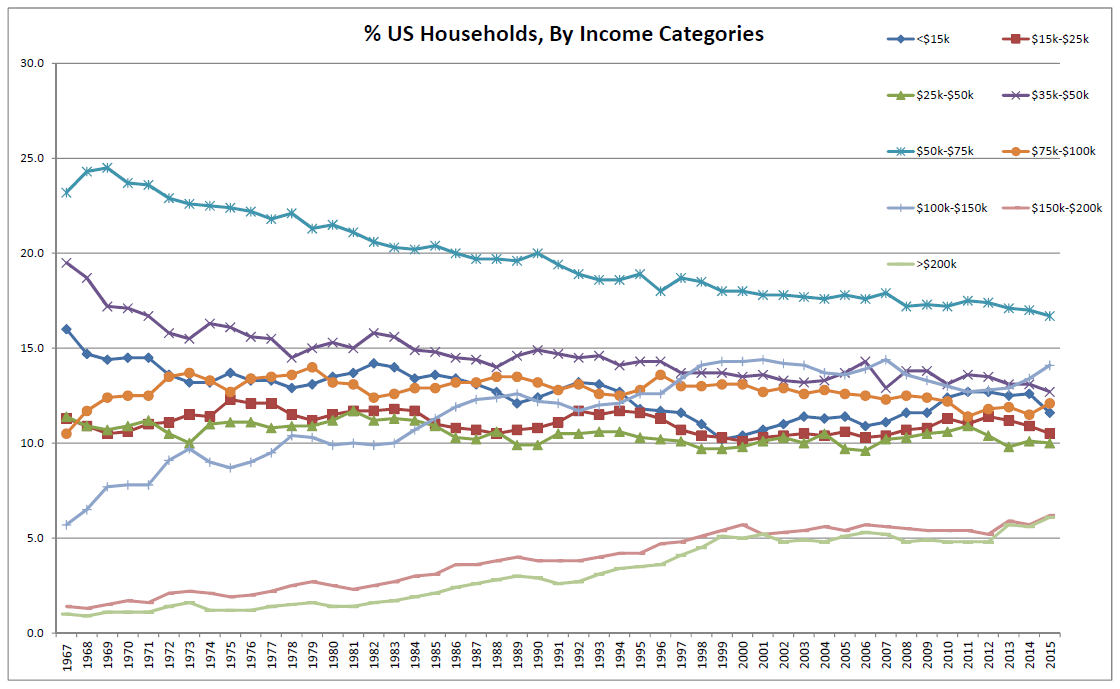
    The data shows the percentage of US households having real incomes in each of 9 categories for the period 1967-2015.  As was the case with the previous article in this series, the data has been adjusted for inflation, with 2015 as the base year, using the Bureau of Labor Statistics’ CPI-U-RS from 1977 on and the Census Bureau’s derived CPI-U-RS for the period 1967-1976.  For completeness, here’s a graph showing all 9 income categories.  Don’t worry if you can’t make heads or tails out of it – it’s far too busy to interpret easily.  I’m providing this chart for illustrative purposes and completeness only.
    A larger version of the same image may be viewed here.

    First-Cut Analysis

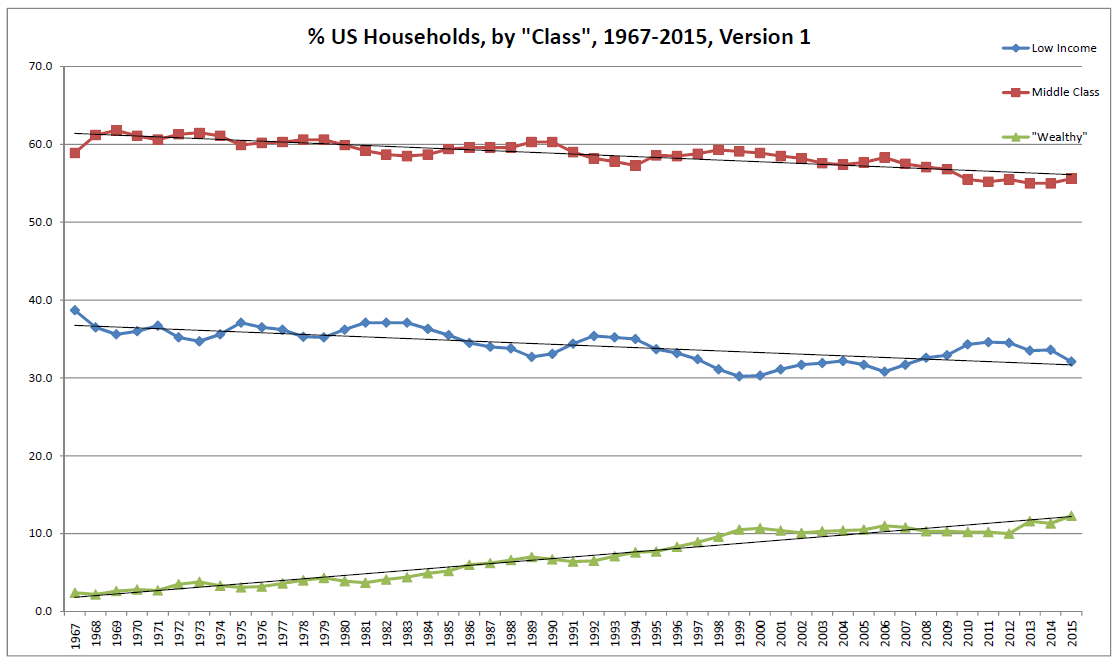
    OK, after “binning” the data into the three classes defined above, I prepared a second chart.  This chart is simpler – it shows the percentage of US households that, according to real annual household income, fit into each of those three class “bins” (Low Income, Middle Class, and “Wealthy”).  I’ve added trend lines to each of these data series to visually indicate the trend of change over time.
    A larger version of the same image may be viewed here.

    Hmm.  In 1967, 58.9% of US households were “middle class”.  And in 2015, the fraction of US households that were middle class was slightly smaller – but only slightly.  In 2015, the middle class comprised 55.6% of US households.  That is 3.3% less than in 1967.

    Looking at that, I’ll be damned if I can see a “disappearing” middle class.   Yeah, proportionally it’s slightly smaller.  But it’s not a helluva lot smaller.  And that’s over a period spanning nearly 50 freaking years.  At that rate, it will take something like another 800 years or so for the US middle class to vanish.  Doesn’t seem to be exactly the “major crisis” the Left keeps yapping about.

    So, where did those 3.3% of US households go?  If the Left is right, those “evil Reagan tax cuts” drove them to the Low Income category.  Is the Left correct?

    In a word:  no.  Or as we might have put it where I grew up:  “Oh HELL no!”

    In 1967, in terms of real household income 38.7% of US households were “Low Income” – e.g., real household incomes of $35,000 or less.  But in 2015, only 32.1% of US households were in that same Low Income category in real terms.  That’s 6.6% fewer US households than in 1967.

    Don’t forget, the middle class shrank half that much between 1967 and 2015 also.  That means almost 10% fewer US households today are Low Income and Middle Class today than in 1967.

    So, what the hell?  Where did nearly 10% of US households go?

    The answer is simple.  They became “Wealthy”.

    In 1967, the fraction of US households with a real income of >$150,000 (and which thus were “Wealthy”) was indeed tiny.  In 1967, only 2.4% of US households – or roughly 1 household out of 42 – had a real household income of $150,000 or more.

    Today?  Well, the percentage of US households that “Wealthy” by that criteria is 12.3% – or roughly 1 US household in 8.  THAT is where the “missing” poor and middle class went.  They freaking got wealthy.

    Second Pass:  Reworking the Categories.

    OK, maybe those categories were “bad”.  So let’s try a more detailed look.  Let’s “re-bin” everyone, using the following categories.  Maybe that will help us see what’s happening.

    • Poverty: <$15,000 annual real household income
    • Working Poor: $15,000 to $35,000 annual real household income
    • Lower Middle Class: $35,000 to $50,000 annual real household income
    • Middle Class: $50,000 to $100,000 annual real household income
    • Upper Middle Class: $100,000 to $150,000 annual real household income  (I’d argue $200,000 would be a better upper limit here, in order to include most medical professionals and other occupations traditionally held to be members of the upper middle class having real household annual incomes above $150,000.  But here, to stay reasonably close to Pew Research’s definition I’ll continue to use an upper cutoff of $150,000 annual real household income.)
    • “Wealthy”: >$150,000 annual real household income

    As before, the quotes around “Wealthy” are intentional – for the same reason previously stated.

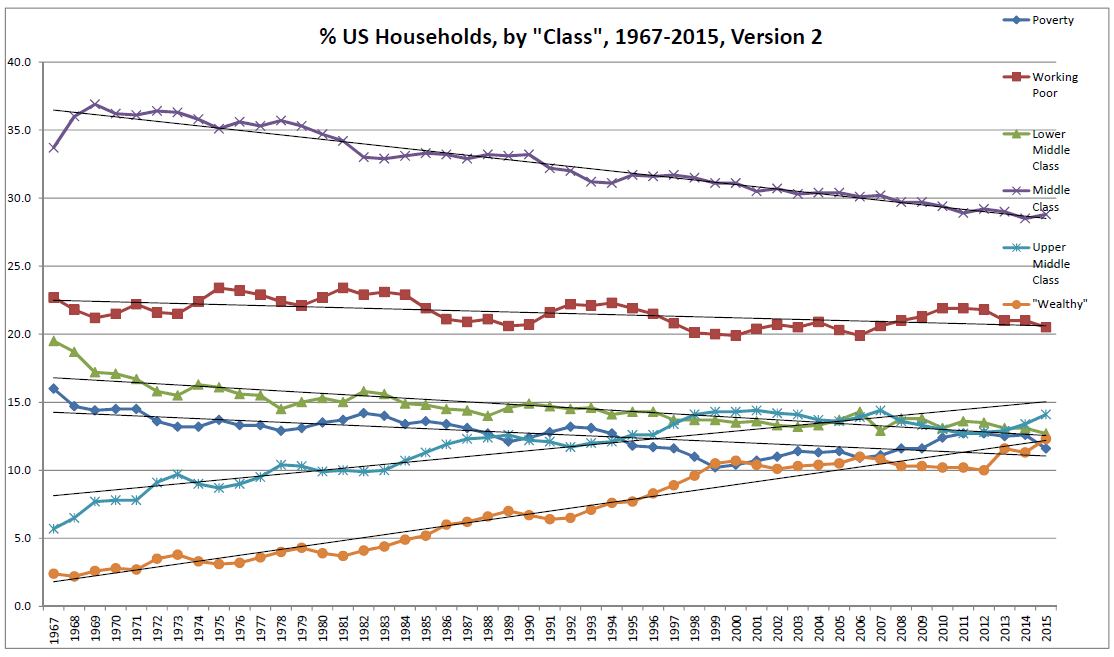
    So, what does that look like in graphical form?  Here you go – again, with trend lines.
    A larger version of the same image may be viewed here.

    Yep – pretty much the same as before.  Here, we see that every income category below the upper middle class has gotten proportionally smaller.  In contrast, the Upper Middle Class and the “Wealthy” have each grown – hugely.

    Conclusions.

    The Left’s contention that the US “middle class is shrinking” has a tiny grain of truth – but that grain of truth is wrapped with so much Leftist propaganda and bullsh!t that it obscures reality.  The “middle class” is indeed shrinking – EXTREMELY slowly.  Statistically speaking, 3.3% of the US population has moved out of the middle class in the last 50 years.  At that rate, as noted above it would take the US middle class over 800 years to disappear entirely.

    What the left WON’T tell you is the reason why those households have moved out of the middle class.  No, those leaving the middle class haven’t become impoverished by those “evil” conservative policies, statistically speaking.  Rather, they’ve become enriched instead.  Statistically speaking, they left the middle class because they became wealthy.

    Why do I say that?  I say that because the Low Income category is also shrinking.

    In fact, the fraction of Low Income US households is shrinking twice as fast annually, percentage-wise, as the middle class.  Where did they go?  Again:  since the Middle Class is also shrinking, there’s only one place they could have gone.  Statistically speaking, they also got wealthy – or at least, wealthier.  Today, 6.6% fewer US households are “Low Income” in real terms than was the case in 1967.

    The bottom line:  in 1967, in real terms 2.4% of US households were “wealthy” in terms of real household income.  In 2015, that fraction was 12.3%.  Over that roughly 50 year period, nearly 10% of American households left the ranks of the “poor” and “middle class” – and became “wealthy”.

    The same is generally true if one looks at the more detailed classes defined in the second “binning” above.  There, collectively a net 18.4% – or nearly 1 out every 5.4 American households – moved out of the classes of Poverty, Working Poor, Lower Middle Class, and Middle Class.  They moved from there to either the “Upper Middle Class” (real household income between $100,000 and $150,000 annually) or the “Wealthy” (>$200,000) – with the net influx split almost evenly between the latter two categories.

    Last time I checked, having a larger household income in real terms was indeed a “good thing”.  And becoming “Wealthy” was called “The American Dream”.

    In summary:  yeah, the US “middle class” is shrinking – at the rate of around 0.067% per year.  But the US Low Income “class” is also shrinking – and it’s shrinking at twice the rate.  And those two groups are shrinking because members of each are becoming wealthy.

    Yes, it’s true that a handful of Americans are filthy rich.  There are probably more of those today than in the past.

    And that’s also absolutely, positively freaking irrelevant.

    Those getting filthy rich are not getting filthy rich because the poor and middle class are “getting screwed”.  Rather, while some are becoming filthy rich, many of the poor and middle class are also becoming wealthy right alongside them.  In 50 years, nearly 10% of American households have moved from the “low income” and “middle class” categories to the “wealthy” category in real terms.

    In short, the Left is misleading or outright lying to us yet again. Is anyone surprised?

    Here, for the Left the actual, hard, documented economic data that’s freely available truly is an “inconvenient truth”.

    . . .

    Data used in this article was obtained from

    http://www2.census.gov/programs-surveys/demo/tables/p60/256/table3.xls (Data used is for all races with one of the two entries for 1988 omitted.  The dual entries for that year are apparently due to two different methods of calculation used, and using both is impractical.  Regardless, they’re pretty damn close to each other, so omitting either makes effectively little or not difference.)

    And yes, Poodle – unlike your previous false claim, the data used above IS inflation-adjusted data – AKA “real” income.  That’s exactly what the annotation “Income in 2015 CPI-U-RS adjusted dollars” in the description of the data in the original source means.  Have someone ‘splain that to you if you don’t “get it”.


    Author’s note:  I also “ran the numbers” for the 3 income category case  – Low Income, Middle Class, and “Wealthy”- with the Middle Class defined as having an upper limit of $200,000 in real household income.  This would be necessary to capture many traditional members of the “upper middle class”, such as doctors and dentists who as groups generally have household incomes in excess of $150,000 in real terms. 

    In that case, the US middle class didn’t shrink appreciably at all between 1967 and today – it actually increased slightly instead.  However, the Low Income fraction (real household income of less than $35,000 annually) still shrank by 6.6% – and the fraction of US households classified as “Wealthy” (real household income greater than $200,000 annually)  grew by nearly that much (5.1%). 
  • Another Comes Home

    DPAA has identified and accounted for the following formerly-missing US soldier.

    From Korea

    • PFC William W. Cowan, M Company, 3rd Battalion, 38th Infantry Regiment, 2nd Infantry Division, US Army, was lost on 12 February 1951 in South Korea. He was accounted for on 23 September 2016.

    Welcome back, elder brother-in-arms. Our apologies that your return took so long.

    Rest in peace. You’re home now.

    . . .

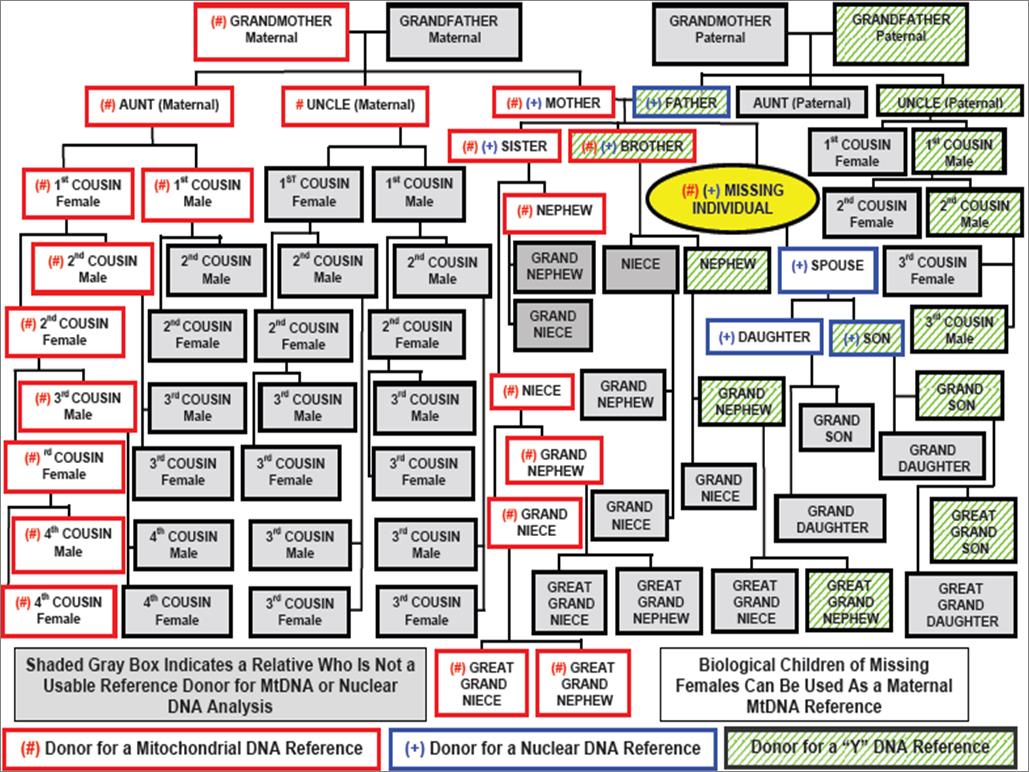
    Over 73,000 US personnel remain unaccounted for from World War II; over 7,800 US personnel remain unaccounted for from the Korean War; and over 1,600 remain unaccounted for in Southeast Asia (SEA). Comparison of DNA from recovered remains against DNA from some (but not all) blood relatives can assist in making a positive ID for unidentified remains that have already been recovered, or which may be recovered in the future.

    On their web site’s “Contact Us” page, DPAA now has FAQs. The answer to one of those FAQs describes who can and cannot submit DNA samples useful in identifying recovered remains. The chart giving the answer can be viewed here. The text associated with the chart is short and can be viewed in DPAA’s FAQs.

    If your family lost someone in one of these conflicts and you qualify to submit a DNA sample, please arrange to submit one. By doing that you just might help identify the remains of a US service member who’s been repatriated but not yet been identified – as well as a relative of yours, however distant. Or you may help to identify remains to be recovered in the future.

    Everybody deserves a proper burial. That’s especially true for those who gave their all while serving this nation.

  • Somewhere, The Wienermobile – and TSO – are Crying

    Richard D. Trentlage died on 21 September 2016.  He died of congestive heart failure.

    Mr. Trentlage was 87.  He’d lived a full life.

    You may not recognize his name.  But I’ll guarantee you know his most famous work:


    Yep, he’s the guy who wrote the “Oscar Meyer Wiener” jingle.

    Trentlage wrote other advertising jingles, too – some of which were used in national ad campaigns. But one he wrote for Oscar Meyer is by far his most famous.

    Fox has a short obit on the man; the NYT has a longer one.  The Wikipedia Article on the man is also a good read. Any of them IMO are worth the the few minutes it will take to read.

    Rest in peace, Mr. Trentlage. And thanks for giving us a piece of Americana.


    Author’s Note: in case anyone is wondering about the TSO reference, check out this link.  (smile)

  • Common Leftist Economic Claims, Part II: Refuting the “Supply Side” Canard

    To continue from yesterday’s article:  in a previous article here at TAH, one of our frequent commenters made this unsupported claim:

    Additionally, inflation adjusted income is negatively correlated with tax cuts for the the top tax brackets.

    Presumably, the individual meant “increasing inflation adjusted income”.   I’ll make that assumption, because otherwise the statement doesn’t make much sense.

    The same commenter also posed this question.

    When in the history of human society has wealth ever flowed DOWN in any meaningful way?

    Essentially, these two items are a restatement of the old Leftist claim that “supply side economics doesn’t work”.

    Well, let’s look at that.   Luckily, data shedding light on the answer to that question is readily available.  That is, it’s readily available if you (1) actually know what to look for, (2) are willing to do some simple calculations using common software, and (3) are willing to believe your own eyes.

    And unlike our commenter above, I’ll provide a graphic that actually is relevant to the matter under discussion.  (smile)

    Data.

    The US Census Bureau collects tons of data.  One of the items they collect – and regularly publish – is data concerning US median household real (e.g., inflation-adjusted) income.

    Historical data regarding the top Federal income tax rate is also available from numerous sources.  I located one that contained data for the same period.

    Tables can be hard to interpret.  Most people have a much easier time grasping what’s going on if the numbers can be presented meaningfully in graphical format.  Luckily, common software (spreadsheets) today provide an easy way to do exactly that.

    So, I did two things.  I obtained the pertinent data for each item (top income tax rate and median US real household income) for the period 1967-2015.  I then used common spreadsheet software to compare this data graphically.  Let’s take a look at what the data shows.

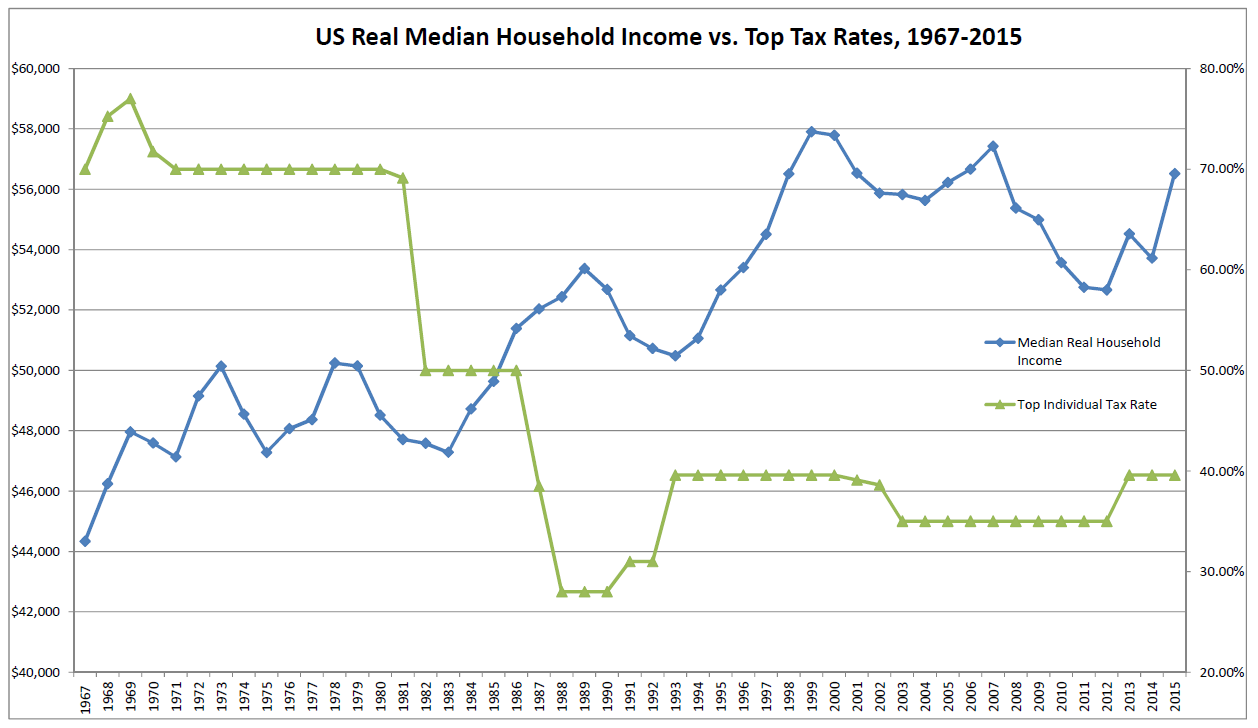
    Here’s a graph that plots US median household income, in real terms (e.g., after having been adjusted for inflation using the Bureau of Labor Statistics’ CPI-U-RS from 1977 on and the Census Bureau’s derived CPI-U-RS for the period 1967-1976) and the top marginal individual Federal income tax rate for the period 1967-2015.  Data sources are indicated at the end of this article.


    A larger version of the same image may be viewed here.

    Important Concepts .

    I’d like to emphasize a three key points before continuing.

    First, the chart above shows income in REAL terms – that is, after having been adjusted for inflation using the Census Bureau’s version of CPI-U-RS.  Thus figures from different years can indeed be validly compared.

    Second, the chart used median household income – not average (mean).  The median is defined as the midpoint of a given data set; half of the values in the data set  fall above that value, and half fall below.  It is NOT the average (mean).  Its use is significant because the mean of a data set can be grossly distorted by a small number of “outlier” data points at the extreme end of the spectrum.

    Don’t believe me?  Let’s look at the mean (average) and median of a data set consisting of a large set of data with two huge outliers. Specifically, let’s look at a data set consisting of a thousand and one values, the first 999 being the integers from 1 to 999  – and the other two each equal to ten million.  For this example data set, the mean is 20,479.02; in contrast, the median is 501.  Therefore, for that data set the median is far more generally descriptive of the data than the mean, which has been grossly skewed by two outliers.

    Income data is subject to similar skewing; one person who makes a killing in the market (e.g., several $M) or in real estate speculation in a given year can skew an entire town’s average (mean) household income for that year, but won’t markedly affect the median.  Thus, using the median vice the mean is a better choice.

    Third: an increasing median over time for a data set indicates that values of the individual data elements are in general getting larger.  (Remember:  median means half are larger and half are smaller.)  A rising median real income is thus indicative of a general increase in purchasing power across the board. – or a situation where virtually everyone is getting better off, economically speaking.

    Observations.

    Inspecting the above chart yields some interesting results.

    1. From 1967 to 1980, the top US tax rate was 70% or higher (in 1981, it was just below 70% – 69.12%, to be precise.) That’s not quite the absurd post-World War II confiscatory top tax rates of 90+% in effect until the early 1960s, but it’s still very high.  During this period, using the “eyeball” method the US median household income appears to have oscillated around a trend line of around (in real terms) $48,500.  If there was any trend at all for an increase with time, it was barely increasing.  It may have been decreasing slowly instead.
    2. In 1982, the top tax rate dropped to 50%. A year later, the median US real household income began rising.  It remained generally rising, with the exception of the Gulf Crisis period and its immediate aftermath (1990-1993), until 1999.
    3. The US tax rate dropped again in 1987, to below 40% (38.5%). It has remained below 40% ever since.
    4. The temporary downturn in median US real household income from 1990-1993 coincides with both the buildup to and the Gulf War itself, along with two rises in the maximum US income tax rate. The first increase was by over 10%, to 31%, in 1991; the second was by over 27%, to 39.6%, in 1993.
    5. The end of the rise in median US real household income coincides with the “dot.com bubble burst” that occurred at about that time. This was exacerbated by the events of 9/11 and the war years following.
    6. In spite of the “dot.com bubble burst”, 9/11, and protracted war in Southwest and Central Asia, in 2004 median US real household income began to rise again. This occurred shortly after a reduction of approximately 11.6% in the top US income tax rate over the period 2001-2003 – from 39.6% to 35%.
    7. The collapse in 2007 of the US real estate “bubble”, attributable IMO largely to shortsighted and unsound lending policies mandated by the Clintoon administration, and the resulting follow-on Wall Street financial crisis of 2008 ended the short-term rise in median US real household income. The median US household real income has yet to recover to 2007 levels.
    8. The top US income tax rate was raised again in 2013, by roughly 13%, to 39.6%. Leading economic indicators indicate that US economic growth over the 12-month period ending in August 2016 appears to have been a paltry 1.1% – well under that generally accepted as required to sustain a rising standard of living.  That’s troubling.
    9. At worst, the US median real household income appears to have reached a new stable level, albeit at a significantly higher stable level than before.  At best, the end of the current recession will return the US to continued real median household growth.

    Analysis.

    In reviewing the above the following becomes quite evident.

    • The top income tax rate has been at or below 50% every year since 1982. Prior to 1981, it was 70% or higher. (The top tax rate in 1981 was 69+%, but below 70%.)  It’s been below 40% every year since 1987.
    • Prior to 1982, the median US real household income seems to have been relatively stagnant, oscillating around a trend line with value of around $48,500.
    • Starting in 1983, the median US real household income began general rise lasting 16 years. Unfortunately, major perturbations caused by the burst of the “dot.com bubble”, 9/11, and the 2007-2008 financial crises ended this expansion.  Household income in real time appear since 1999 to have reached a new stability, a trend line in the neighborhood of $55,000 (and perhaps significantly more) after 1999.
    • Alternately, the 2007-8 financial crisis and policies since that date may still be depressing real household income growth. US employment is still grossly depressed (see the current US labor participation rate) vis-à-vis 2007 levels, so the latter is indeed a distinct possibility.
    • Between the low point of 1982 and today, median US real household income has increased by more than 19.5%. Every year since 1984 has had a higher median US real household income than the pre-1982 “eyeball” trend line of $48,500.
    • Since we’re dealing with median real US household income, the fact that the median has risen since the implementation of supply-side income tax cuts in 1982 implies that far more than half of US households are indeed better off today than they were prior to 1982.  Indeed, it is reasonable to conclude that virtually everyone who is able (or willing) to work – and who isn’t a total jerk – is almost certainly better off to some degree.  Only those who are unwilling or unable to perform gainful work (or unable to keep a good job due to personality or other issues) are likely no better off.
    • Time lags in response to changes are the norm for any large dynamic system. The US economy is nothing if not a large, complex system.  This explains, at least in part, the usual one to two year lag seen between tax cuts and tax cuts.

    And, finally, we have

    • Since the top Federal income tax bracket only affects those who have incomes that make them “wealthy”, that means that the “wealthy” received the bulk of the tax cuts. But guess what?  Over time, it certainly looks like virtually everyone ended up with a bigger real household income anyway.  So regardless of who got the benefit first, in relatively short order everyone benefited.  And those benefits appear to be permanent gains.

    Conclusions.

    When the top US income tax rate was cut substantially in 1982, this was an implementation of supply-side economics through tax policy.  After a short lag (about 1 year) US real household incomes – which had been stagnant in the long term, and had been in a multi-year decline during the years immediately before 1982 – began rising.  And if/when they stabilized some 17 or so years later (if indeed they’ve stabilized), real US household incomes stabilized at a substantially higher level than the previous norm.  The new level was roughly 20% higher, minimum, that the apparent previous norm; the new median may resume growth to even higher levels if the US median real household income is indeed still temporarily depressed by the 2007-2008 financial crises and resulting recession.  A resumption of real growth is indeed possible.  Finally, deviations from growth since 1982 appear to have an external cause unrelated to tax policies (Gulf War, “dot.com bubble”, 9/11, and 2007-2008 economic issues).

    In short:  yes, supply-side economics does work.  And in particular, the Reagan-era tax cuts do appear to have materially benefited everyone  – not just the rich.  In other words:  the benefits of those tax cuts “trickled down”, to everyone’s benefit.

    The data above shows that quite clearly – unless you’re wearing ideological blinders, of course.

    Assuming they’re seaworthy in the first place, a rising tide really does lift all boats.

    . . .

    That’s all for today.  The next article will address the Left’s misrepresentation that “wealth distribution is inequitable”, and “the Reagan era tax cuts are making the rich richer and the rest of the US poorer”.


    Author’s Note:  Data used in this article was obtained from the following sources.

    http://www2.census.gov/programs-surveys/demo/tables/p60/256/table3.xls (data used is for all races with one of the entries for 1988 omitted).

    http://taxfoundation.org/article/us-federal-individual-income-tax-rates-history-1913-2013-nominal-and-inflation-adjusted-brackets

  • Common Leftist Economic Claims, Part I: Exposing the Ignorance. Or Maybe the Dishonesty.

    In a comment to a previous article here at TAH, one of our regular commenters made the following statement.

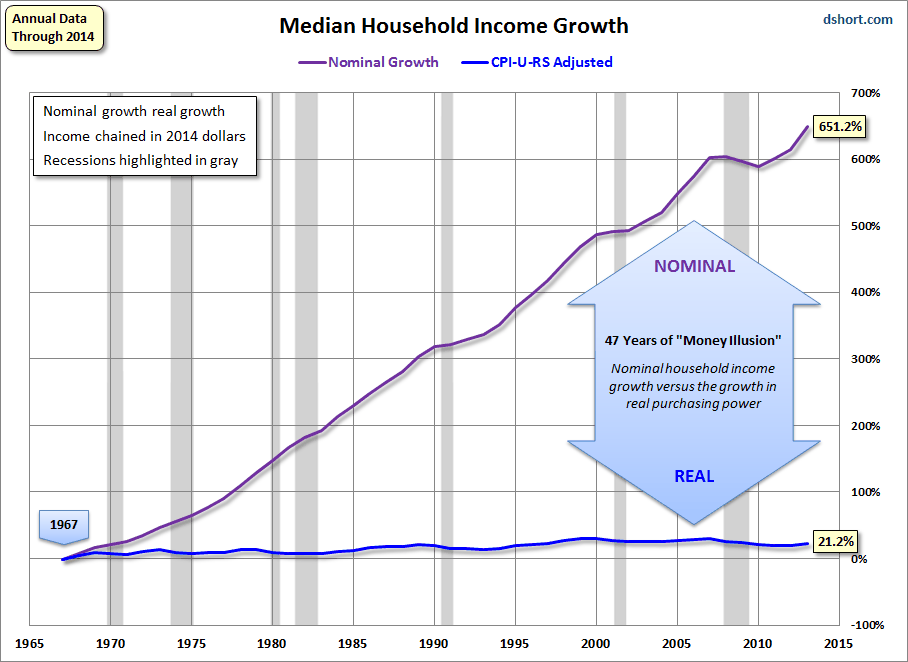
    Here is a purchasing power chart showing Reagan’s tax cuts did not flow down in actual purchasing power.

    http://www.advisorperspectives.com/images/content_image/data/f1/f1bddfd60a7085c654daea1353d98626.gif

    I’ve pointed out much what follows to the individual via a reply in those same comments.  Since there was no response or acknowledgement, my working assumption is that he actually believes what he said above.

    I bring this up here because it’s indicative of a common behavior of those on the political Left.  Often, they don’t know a damn thing about the subject about which they’re pontificating.  They merely parrot whatever blatant bullsh!t or “buzzword du jour” their superiors in the      Politboro      Progressive hierarchy give them.

    And while doing so, some of them act like arrogant, insufferable, “superior” a-holes, looking down their noses at everyone else.  In reality, virtually all of them they have little if any reason to think they’re superior, and no justification whatsoever for acting arrogant.

    So I’ll use this case as an example – and I’ll explain how the chart above is being misused to support a specious  claim, either out of ignorance or by design.  I’ll let you decide which it was.

    Here’s the figure in question.  Remember, it was supposed to prove the Reagan-era tax cuts “didn’t work”.


    The claim is that the above chart is a “purchasing power chart showing Reagan’s tax cuts did not flow down in actual purchasing power.”  That claim about the Reagan era tax cuts – like many made by those on the Left – is specious, but that’s not the issue here.  The issue is that the chart doesn’t support the claim whatsoever.

    There are multiple problems with trying to use the chart above for that purpose.  In fact, it fails to do so so badly that one wonders if the person making the claim was joking, was ignorant, or was trying to “pull a fast one”.

    Firstthe chart above doesn’t address the Reagan era tax cuts.  They’re not depicted on the chart in any way – so the chart is silent about them.  It neither supports nor undercuts any claims about the Reagan era tax cuts.

    Therefore, claiming that the chart above “shows the Reagan tax cuts didn’t work” (or words to that effect) is, to be charitable, simply not accurate.  To be less kind:  it’s evidence of either a gross error, gross ignorance,  or an attempt to deliberately mislead.  Or maybe of an outright lie.

    Second:  to anyone who has even a smattering of knowledge about finances and inflation the actual purpose of the chart is quite evident – and that purpose is unrelated to the Reagan era tax cuts.  Two terms on the chart make the chart’s purpose crystal clear:  the terms “nominal” and “real”, used in the context of discussing money and time.

    The upper line on the chart is “nominal US median household income”.  In the context of money and time, the term “nominal” has only one reasonable meaning:  “current year dollars”.   That is, dollars that are NOT indexed for inflation.

    However, anyone who’s not a bona fide idiot knows that inflation reduces the purchasing power of money over time; a dollar in 1980 is simply not worth the same as a dollar today (in terms of purchasing power, a dollar in 1980 was worth substantially more).  Therefore, to compare incomes from different years a correction for inflation is required.

    Other than the chart’s axes, the only other line on the chart is “real US median household income”.  In the context of money and time, the term “real” means “indexed for inflation”; there isn’t any other reasonable interpretation.  In fact, the chart even specifies what measure was used to adjust for inflation to obtain real dollars, albeit not the source:  CPI-U-RS.  That is the emerging preferred index for correcting for data, and is generally regarded as an improvement over CPI-U.

    The purpose of the chart is thus clear to anyone who (a) understands even the basics of finance and inflation, (b) actually read it, and (c) isn’t wearing ideological blinders.  It’s intended to show the effect of inflation on actual purchasing power.  It’s not intended to show anything else.

    In particular, the chart is not intended to say anything whatsoever about Reagan, taxes, or the effectiveness (or lack thereof) of Reagan-era tax cuts.  Saying that it does is at best a truly foolish error, and at worst a deliberate falsehood.

    The Left does things like that quite often – e.g., claims one thing, then uses invalid arguments, bad data, irrelevant examples, or outright lies to support their claims.  They apparently do so hoping that no one will catch on and call them on it.  Hell, I don’t think many of them even have the background (or smarts) to realize they’re doing so.  They’re simply Polly Parrot, regurgitating the “party line” they’ve been fed.  That may or may not be the case here; decide for yourself.

    Third:  the chart also illustrates a potential shortcoming in using data presented in graphical form.  The chart above indeed compares different variables – but it does so using a scale that obscures relevant changes in one of the variables being plotted.  For the intended purposes of the chart, that’s not a “biggie”; the scale used shows the discrepancy between nominal dollars and actual purchasing power, and the fact that the details present on the lower data plot aren’t apparent is irrelevant in that context.  But the scale used indeed makes examining the data presented on the “real US median household income” line in detail impossible. There’s simply not enough definition on the lower line to see what’s going on.

    That lack of definition issue also makes it impossible to use the above chart together with other data to assess the effectiveness of the Reagan-era tax cuts.  That’s true because there’s so little definition for the line depicting real income that inferring the actual data point values with anything approaching accuracy is impossible; the necessary detail simply can’t be seen in that chart.  That’s a third reason why the chart can’t be used to say anything about the Reagan era tax cuts.

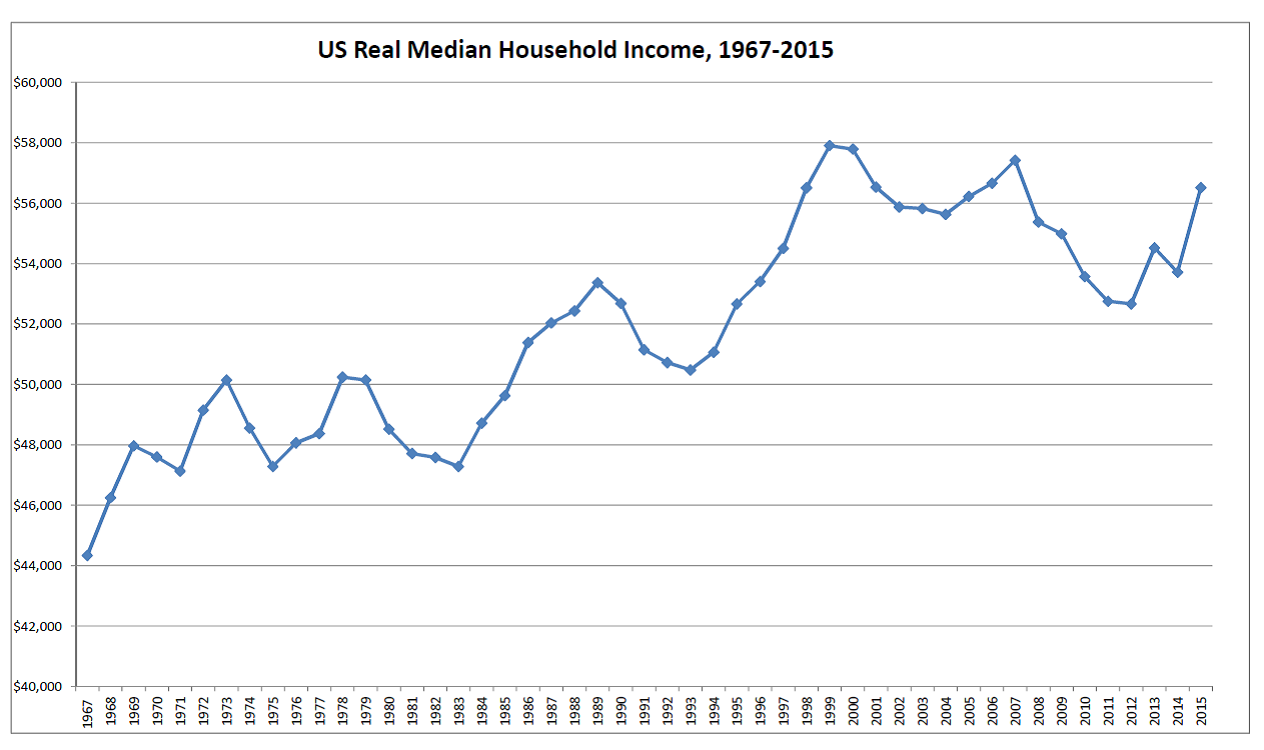
    For comparison, here’s virtually the same data (it continues for an additional year or two), presented alone, from a known source (US Census Bureau).  It shows the detail obscured by the scale used on the other graph:


    A larger version of the same image may be viewed here.

    Clearly, this second version does provide enough information to allow visual analysis.  Those details cannot be seen on the original chart.

    I could probably go on, but this is likely enough to prove my point.  Very obviously, claiming that the first chart proves the Reagan era tax cuts were ineffective is simply . . . ridiculous.  It’s either a gross error, or it’s a deliberate lie.  Take your pick.

    . . .

    In the same comment that started this article, links were provided to charts prepared by that “fountain of economic insight and analysis” Mother Jones purporting to support other Leftist claims.  Still other claims were made that are specious at best if not outright falsehoods.  Those other charts and claims will be the subject of the next 2 articles in this series.


  • A Few More “Private” Email Facts Come to Light

    Over the past week, we’ve seen a few new items of interest come to light concerning the Clintoon “Private Email” story.  Here they are.

    •  The day after the House Select Committee on Benghazi and the Department of State reached an agreement wherein State would provide the Committee copies of Clintoon’s email, the administrator of her private, unauthorized and poorly secured email server apparently asked for technical help on Reddit.  What kind of technical help?  Well, in the guy’s own words, “I need to strip out a VIP’s (VERY VIP) email address from a bunch of archived email . . . .”

    •  Afterwards, Clintoon ordered a change in her email retention policy on that private email server, shortening it dramatically.  That change was requested in December 2014 – but wasn’t implemented until March 2015.  The same guy also apparently asked Reddit for advice on how to do that, too.  (See link in previous “bullet” for source.)

    •  At least one employee of Platte River Networks – who hosted Clintoon’s unauthorized and unsecured email system used to conduct official government business – referred in writing to the requested change in retention policy (to “automatically delete after 60 days”) as the “Hilary [sic] coverup [sic] operation”.  The individual later claimed to the FBI that they’d been “joking” in that email.   (Personally, I’m not buying that for a minute.  I might buy “prophetic” or “being brutally honest”.)

    •  The POTUS was apparently a regular communicant with Clintoon at her “private” email address while she was SECSTATE.  (Citing “Presidential communications privilege”, the Federal government has refused to make these emails public.)  This is in spite of the fact that the POTUS in March 2015 publicly denied any knowledge her use of such a server (and email address) prior to the media revealing its existence.

    One of Clintoon’s longtime aides reputedly possessed a thumbdrive containing an archive of Clintoon’s emails, which she said was “something she happened to have laying around the house.”  When the FBI requested she produce it, she was “unable to find it” – purportedly after searching “several times”. (See first link in previous “bullet” for source.

    •  Multiple officials at the Department of State knew of Clintoon’s use of a private email server to conduct official government business in 2009 and 2010 – and had serious concerns about whether mandatory records retention policies were in use for emails originating on or received by that server.  These officials requested that Bryan Pagliano, the former Clintoon campaign aid who set up and maintained this server, to pass along their concern to Clintoon’s “inner circle”.  Pagliano in turn advised the FBI of these concerns by multiple Department of State officials when he himself was later investigated.

    •  In fact, there are so many irregularities in the FBI’s investigation of Clintoon’s email that some are now claiming that the entire investigation was nothing but a sham from day one.  (The case made in the linked article is a persuasive, though circumstantial, one.)

    Yep.  Just another week’s worth of . . . “unusual” revelations concerning Clintoon email, with a bit of stuff about possible politically-motivated FBI malfeasance thrown in.  Nothing to see here, people; move along.

    Sheesh.  You or I would be in jail by now.