Author: Hondo

  • Border Security “Overemphasized”? Hardly.

    Many people claim that the US is wasting money on border security operations.  In fact, some go so far as to say that we should have open borders, advocating an utterly ridiculous and nonexistent “right to migrate” – and thus don’t need to control our border at all.

    Others say the threat from terrorism is “overemphasized”.  In fact, some people openly proclaim both of these (no need for border security and the threat from terrorism being overemphasized) to be true.

    Well, “Riddle me this, Batman”:  just how many encounters were there in the US with known and suspected terrorists during the one-year period ending 20 July 2016?

    If you guessed more than 7,700  – or an average of more than 21 every day  – give yourself a gold star.

    I’m not joking. 

    I’m normally a bit hesitant to use Breitbart as a primary source.  But here, the author at Breitbart seems to have gotten access to bona fide documentation of his claims – documentation, as in an official briefing prepared by the FBI’s Terrorist Screening Center.  The 7,700+ figure comes from the FBI briefing.

    No, all of those known/suspected terrorists weren’t radical Islamists.  And yes, some of the reports were doubtless false alarms.

    But in the one state for which the FBI gave detailed figures, over half were assessed to be Islamic radicals.  And even if only 10% of the reports nationwide are accurate, that still means we have somewhere over 700 terrorists running around loose.  Recent news (the San Bernardino massacre, the Pulse nightclub shooting, the NYC bombings, and possibly the WA mall shooting) certainly proves the number isn’t zero.

    And if you’re wondering how this ties to border security:  from looking over the sketchy data available, it certainly appears that a helluva lot of the foreign terrorists currently in the US likely came into the country by crossing the US border illegally.  It doesn’t take a rocket scientist to see that preventing such illegal crossings makes getting terrorists into the US significantly more difficult.

    The biggest issue with US border security is not that it’s a waste of time.  Rather, the biggest problem is that we’re still in denial.  We’re still not taking it seriously enough.

    And I’m wondering how many more attacks – and dead US citizens – it will take until we do.

  • Another Five Return

    DPAA has identified and accounted for the following formerly-missing US military personnel.

    From World War II

    • 1st Lt Ben B. Barnes, 361st Fighter Squadron, 356th Fighter Group, US Army Air Forces, US Army, was lost on 5 December 1944 in Germany. He was accounted for on 17 September 2016.

    From Korea

    • PFC Everett E. Johnson, F Company, 2nd Battalion, 8th Cavalry Regiment, 1st Cavalry Division, US Army, was lost on 3 September 1950 in South Korea. He was accounted for on 19 September 2016.

    • CPL William H. Smith, E Company, 2nd Battalion, 35th Infantry Regiment, 25th Infantry Division, US Army, was lost on 28 November 1950 in North Korea. He was accounted for on 12 September 2016.

    • CPL Roy C. Fink, B Company, 1st Battalion, 32nd Infantry Regiment, 7th Infantry Division, US Army, was lost on 2 December 1950 in North Korea. He was accounted for on 23 September 2016.

    • PFC William V. Giovanniello, Company F, 35th Infantry Regiment, 25th Infantry Division, US Army, was lost on 25 April 1951 in South Korea. He was accounted for on 19 September 2016.

    Welcome back, elder brothers-in-arms. Our apologies that your return took so long.

    You’re home now; rest in peace.

    . . .

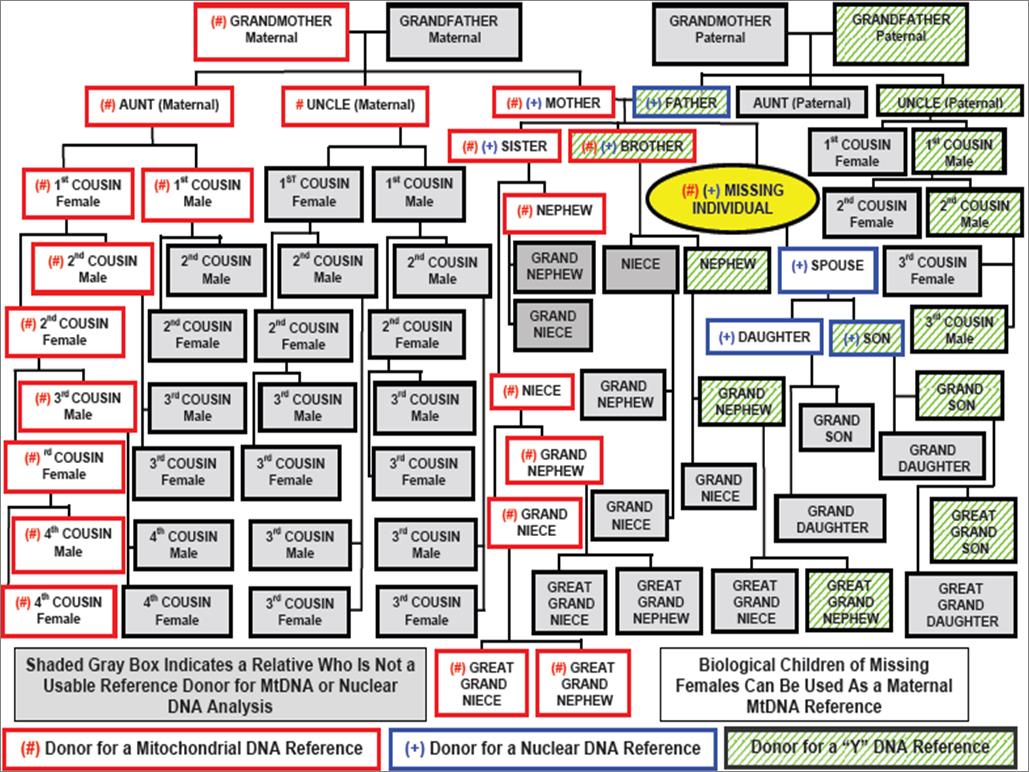
    Over 73,000 US personnel remain unaccounted for from World War II; over 7,800 US personnel remain unaccounted for from the Korean War; and over 1,600 remain unaccounted for in Southeast Asia (SEA). Comparison of DNA from recovered remains against DNA from some (but not all) blood relatives can assist in making a positive ID for unidentified remains that have already been recovered, or which may be recovered in the future.

    On their web site’s “Contact Us” page, DPAA now has FAQs. The answer to one of those FAQs describes who can and cannot submit DNA samples useful in identifying recovered remains. The chart giving the answer can be viewed here. The text associated with the chart is short and can be viewed in DPAA’s FAQs.

    If your family lost someone in one of these conflicts and you qualify to submit a DNA sample, please arrange to submit one. By doing that you just might help identify the remains of a US service member who’s been repatriated but not yet been identified – as well as a relative of yours, however distant. Or you may help to identify remains to be recovered in the future.

    Everybody deserves a proper burial. That’s especially true for those who gave their all while serving this nation.


    Author’s Notes:
    1. On their “Recently Accounted For” page, DPAA does not give a date of loss for CPL William H. Smith, US Army. However, the press release associated with his accounting – which
    may be read here – indicates he was reported as MIA on 28 November 1950.
    2. As of 23 September 2016, DPAA
    had announced that CPL Fink had been accounted for. However, as of that date his name had yet to appear on their “Recently Accounted For” page.

  • “Thoroughly vetting” refugees? Hardly.

    From an internal DHS memo concerning issues with processing applications for refugee status:

    “Refugee fraud is easy to commit, yet not easy to investigate,” the undated memo says.

    The memo said there are clear instances where “bad actors … have exploited this program,” gaining a foothold in the U.S. through bogus refugee claims.

    Gee – thanks, Captain Obvious.  No one would ever have guessed that might be the case!

    But that’s not even the “money quote”.  That would be this one (emphasis added):

    The U.S. has relaxed requirements for refugees to prove they are who they say they are, and at times may rely solely on testimony. That makes it easier for bogus applicants to conspire to get approved, according to the department memo, which was obtained by the House Judiciary and Oversight committees.

    Yeah, you’re reading that correctly.  Sometimes DHS simply takes people’s word for who they are and why they’re trying to get into the US if they’re claiming to be “refugees”.

    The memo’s warnings were, of course, ignored by senior DHS officials – or perhaps never made it to them.  One DHS senior official has claimed “never to have seen it”.

    The Washington Times has a good article today discussing the subject.  It’s IMO worth a read, even if it will p!ss you off.


  • Social Security’s Finances: Follow Up on a Question

    A few days ago, I wrote an article discussing Social Security and its finances.  In the comments, one of TAH’s regular readers (ex-OS2) asked two questions – one of which stumped me royally.

    So I got curious, and decided to poke around a bit and see if I could find an answer.

    While I didn’t find the precise answer, I did find the answer to a couple of similar and related questions.  And the questions seemed to be ones that might be of general interest, so I decided to post the answers here.

    The question I couldn’t answer was, “What fraction of Disability payments are made to those who never contributed?”  That in turn raises a bigger question:  “What fraction of Social Security recipients overall (Disability, Old Age, Survivors) fall into the ‘never contributed’ category?”

    Yes, that’s indeed possible.  Social Security pays benefits to spouses, survivors, and dependents under many circumstances.  Sometimes those beneficiaries in fact never have paid FICA taxes themselves.  But they still qualify based on the worker’s earnings history.

    As I surmised might be the case, Social Security doesn’t make it particularly easy to find this information, and I can’t say with that I found the precise answer to either the question concerning disability or the larger question for Social Security overall.  But I do think I found enough information to answer a closely-related question:  “How many people are receiving benefits based on someone else’s earnings history, and how much do those benefits total?”

    It turns out that Social Security does publish one report monthly that gives useable data here:  their monthly “snapshot” report.  The latest one I could find was for July 2016.  Apparently it takes a bit of time to get the necessary data, because August’s report doesn’t yet seem ready.

    Here are the pertinent numbers in table form.  The snapshot for July 2016 can be downloaded, in PDF format, here.

    July 2016 – Social Security Benefits Paid, Summary  Number of Beneficiaries (x 1,000) Percent of Beneficiaries  Benefits Paid (x $1M) Percent of Benefits Paid Average Monthly Benefit
    Grand Total 60,505 100.0% $74,854 100.0% $1,237
    Old Age/Survivors – Total 49,841 82.4% $63,890 85.4% $1,282
    Retirement Benefits – Total 43,831 72.4% $57,167 76.4% $1,304
    Paid to
         Retired Workers 40,817 67.5% $55,086 73.6% $1,350
         Spouses of Retired Workers 2,369 3.9% $1,660 2.2% $701
         Children of Retired Workers 645 1.1% $421 0.6% $652
    Survivor Benefits – Total 6,010 9.9% $6,722 9.0% $1,119
    Paid to
         Children of deceased workers 1,852 3.1% $1,542 2.1% $833
         Widowed mothers/fathers 134 0.2% $126 0.2% $943
         Nondisabled widow(er)s 3,763 6.2% $4,866 6.5% $1,293
         Disabled widow(er)s 260 0.4% $186 0.2% $717
         Parents of deceased workers 1 <0.002% $1 0.0% $1,142
    Disability Benefits – Total 10,664 17.6% $10,965 14.6% $1,028
    Paid to
         Disabled workers 8,861 14.6% $10,335 13.8% $1,166
         Spouses of deceased workers 138 0.2% $44 0.1% $323
         Children of deceased workers 1,666 2.8% $585 0.8% $351


    In looking at the table above, it’s pretty apparent that some of those individuals receiving benefits are receiving those benefits based on another individual’s Social Security record.  For disability, that is benefits paid to spouses and children.  For Old age And Survivors, that would be those benefits paid to spouses and children of retired workers.  By definition, it also includes all forms of survivor’s benefits that Social Security pays regarding deceased retirees.  All of these categories of persons are eligible to receive benefits from Social Security based on the worker’s earnings history under the proper circumstances.

    Doing the math, I came up with an approximate answer to the question for disability.  Social Security paid disability benefits to roughly 10,664,000 persons in July 2016.  Of those, 1,804,000 – or a bit more than 1 in 6 – were NOT disabled workers; the vast majority of that number (1,666,000) were children.  It’s a virtual certainly that they never paid a dime in FICA taxes.  The remaining 138,000 were disability benefits paid by Social Security to selected spouses of disabled workers; these are paid based on the worker’s qualification to receive disability benefits, and thus were due to the disabled worker’s earnings record.  However, it’s possible that some of these spouses indeed worked and paid FICA taxes at some point in their lives – so I can’t say with certainty that they “never paid into” Social Security.

    In dollar terms, these disability payments to spouses and children appear quite modest.  They represent only about 5.7% of Social Security’s total disability outlays.

    The situation is somewhat different for Social Security retirement and survivor benefits.  These payments are both more numerous and proportionally more costly than payments made to children and spouses of disabled workers.

    Spouses and children of retired workers receiving benefits from Social Security on the basis of the retired workers earnings histories totaled 3,041,000; benefits were also paid to 6,010,000 survivors of deceased workers.  The total of these categories – 9,024,000 – represents 20.6% of those receiving Old Age and Survivor’s benefits from Social Security – or just over 1 in 5.  These payments constitute approximately 15.4% of all Social Security Old Age and Survivors benefits paid.

    Summing both categories (Disability and Old Age/Survivors), it turns out that a bit less than 18% (17.9%) of those receiving benefits from Social Security are receiving benefits on the basis of another individual’s work history.  Those benefits represent 12.6% of all Social Security benefits paid.

    A caveat:  many of these spouses receiving benefits on the basis of a spousal work history indeed may have paid FICA taxes themselves.  A person can qualify for Social Security based on both their own work history and that of their spouse.  They’re allowed to choose to receive whichever benefit that is more advantageous financially.  So in many cases, the individuals would be entitled to a benefit – but a smaller one – based on their own work history.

    I hope someone besides me finds this information interesting or of use.
  • “Governor Moonbeam” Strikes Again

    This time, he’s fighting “climate change”.

    How, you ask?  He’s just pushed through a new law allowing regulation of short-lived “dangerous pollutants”.  In the “Granola State” of California, a whole slew of such emissions are now subject to regulation.

    Those “dangerous pollutants” now regulated by California now include methane emissions – from dairy farms.  Under a newly-passed CA law, those dairy farm methane emissions must be reduced by 40% over the next 17 years.

    I’m dead serious.  CA is now legally regulating cattle farts.

    Elsie the Cow had no comment, other than to burp.  No word on whether or not that subjects her owner to a fine.

    Yet.

  • Immigration Fraud? DHS: “Not necessarily.”

    We already knew that DHS has some real problems managing immigration.  Just look at some of the issues found with in connection with the foreign-born spouse involved in the San Bernardino shooting (here and here and here and here), along with issues relating to Syrian “refugee” immigration (here and here and here and here).

    But you’d think they could get at least the “common stuff” right. Like run-of-the-mill, everyday immigration.

    Unfortunately, you’d be wrong.  From a recent news report (emphasis added):

    The U.S. government has mistakenly granted citizenship to at least 858 immigrants from countries of concern to national security or with high rates of immigration fraud who had pending deportation orders, according to an internal Homeland Security audit released Monday.

    The Homeland Security Department’s inspector general found that the immigrants used different names or birth dates to apply for citizenship with U.S. Citizenship and Immigration Services and such discrepancies weren’t caught because their fingerprints were missing from government databases.

    DHS said in an emailed statement that an initial review of these cases suggest that some of the individuals may have ultimately qualified for citizenship, and that the lack of digital fingerprint records does not necessarily mean they committed fraud.

    The report does not identify any of the immigrants by name, but Inspector General John Roth’s auditors said they were all from “special interest countries” — those that present a national security concern for the United States — or neighboring countries with high rates of immigration fraud. The report did not identify those countries.

    Yeah, no need to worry.  The DHS IG says that even though the individuals used an alias or other false data during application, that that “does not necessarily mean they committed fraud”.

    Really, Mr. IG?  Can I come visit the planet on which you’re living?

    So, ICE is going after these folks – right?  They’re being tracked down and prosecuted for fraud, then stripped of their ill-gotten US citizenship – right?

    Hardly.  Two have been.  Prosecutors declined to prosecute another 26.  32 remain under investigation by ICE; they’ve closed 90 investigations.  The status of the remaining, oh, 700+?  Damned if I know.

    Oh, and this might be just the tip of the iceberg with respect to the problem.  The DHS report that found the above issue indicates that digital fingerprints are missing from Federal databases for 315,000 immigrants having final deportation orders on file.  I’m guessing some of those either have or will “slip through the cracks” soon.

    Yahoo News has an article on the subject; it’s worth a read.  Don’t read it if you’re already angry or having a crappy day.

    Unfortunately, I’m guessing if you read it and weren’t already having a crappy day . . . you’ll be having one afterwards.

    Trump’s gotten a lot of grief on various issues, including immigration.  And I can’t say I necessarily like all of his positions or public statements.

    But his recent calls for increased scrutiny of those asking to immigrate to the US certainly seem to me to be on the mark.

  • “Nothing to See Here. Move Along”

    Looks like a couple of other “non-terrorist events” happened yesterday.

    Jonn’s already mentioned one of them – that “intentional” explosion in NYC, along with the discovery of a possible pressure-cooker bomb 4 streets north – that NYC’s mayor says isn’t related to either terrorism or the New Jersey bombing earlier that day.  So I’ll discuss the other.

    In Minnesota yesterday, a guy with a knife sliced and diced eight people at a shopping mall.  (All but one of his victims have been treated and released by medical authorities, and all are expected to survive.)  He was wearing a private security company uniform at the time of the attack.

    The incident ended when the low-life bastard perp was shot and killed by an off-duty cop from a different legal jurisdiction who by chance was in the mall at the time.  That off-duty cop was authorized to carry concealed, and was indeed carrying at the time of the incident.

    The low-life bastard reportedly asked at least one of his victims if they were Muslim.  He was also reportedly heard referencing Allah during his attack.

    Local authorities have so far “declined to call the attacks an act of terrorism, saying the suspect’s motive isn’t known yet.”   Gee, that seems mighty . . . nice of them.  I guess that means there’s no reason to be concerned.

    “Nothing to see here, sheeple.  Move along.”

    Yeah, I’m thinking my leg feels wet again.  And it hasn’t been raining.

  • Five Return from Korea

    DPAA has identified and accounted for the following formerly-missing US military personnel.

    From Korea

    • CPL Wayne Minard, C Company, 1st Battalion, 9th Infantry Regiment, 2nd Infantry Division, US Army, was lost on 26 November 1950 in North Korea. He was accounted for on 7 September 2016.

    • CPL David T. Nordin, Jr., K Company, 3rd Battalion, 35th Infantry Regiment, 25th Infantry Division, US Army, was lost on 28 November 1950 in North Korea. He was accounted for on 6 September 2016.

    • CPL Joseph Trepasso, L Company, 3rd Battalion, 31st Infantry Regiment, 7th Infantry Division, US Army, was lost on 1 December 1950 in North Korea. He was accounted for on 18 May 2016.

    • SFC Louis M. Baxter, Headquarters Battery, 57th Field Artillery Battalion, 31st Regimental Combat Team, 7th Infantry Division, US Army, was lost on 6 December 1950 in North Korea. He was accounted for on 6 September 2016.

    • PFC Kenneth R. Miller, K Company, 3rd Battalion, 19th Infantry Regiment, 24th Infantry Division, US Army, was lost on 23 April 1951 in North Korea. He was accounted for on 12 September 2016.

    Welcome back, elder brothers-in-arms. Our apologies that your return took so long.

    You’re home now. Rest in peace.

    . . .

    Over 73,000 US personnel remain unaccounted for from World War II; over 7,800 US personnel remain unaccounted for from the Korean War; and over 1,600 remain unaccounted for in Southeast Asia (SEA). Comparison of DNA from recovered remains against DNA from some (but not all) blood relatives can assist in making a positive ID for unidentified remains that have already been recovered, or which may be recovered in the future.

    On their web site’s “Contact Us” page, DPAA now has FAQs. The answer to one of those FAQs describes who can and cannot submit DNA samples useful in identifying recovered remains. The chart giving the answer can be viewed here. The text associated with the chart is short and can be viewed in DPAA’s FAQs.

    If your family lost someone in one of these conflicts and you qualify to submit a DNA sample, please arrange to submit one. By doing that you just might help identify the remains of a US service member who’s been repatriated but not yet been identified – as well as a relative of yours, however distant. Or you may help to identify remains to be recovered in the future.

    Everybody deserves a proper burial. That’s especially true for those who gave their all while serving this nation.