Author: AW1Ed

  • One of the greatest Coast Guard rescues to be celebrated

    Coast Guard

    The Navy Times reports that, beginning Aug. 13, the historical association is planning five days of events to commemorate the 100th anniversary of the Mirlo rescue — one of the most daring in Coast Guard history.

    Mirlo, a British tanker loaded with gasoline was torpedoed seven miles off the shore from Chicamacomico, North Carolina. The badly needed fuel was headed for England in support of it’s forces in Europe during WW-1.

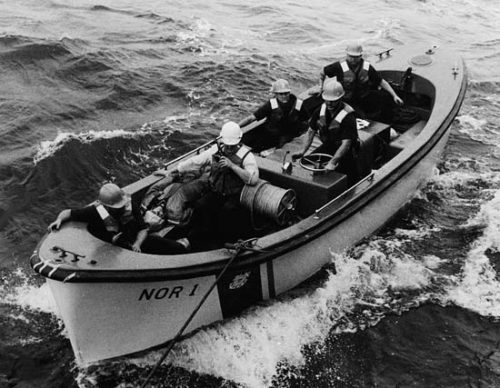
    The six-man U.S. Coast Guard lifesaving crew in Rodanthe led by Capt. John Allen Midgette Jr. pulled the surf boat from its shed to begin what would be a seven-hour rescue.

    “We call that boat the seventh hero,” said Ralph Buxton, a board member with the Chicamacomico Historical Association, pointing to the 26-foot wooden vessel that still sits at the Chicamacomico Life-Saving Station. “It performed perfectly that day.”

    Beginning Aug. 13, the historical association is planning five days of events to commemorate the 100th anniversary of the Mirlo rescue — one of the most daring in Coast Guard history.

    In earlier years, the crew had to row to foundering ships. But on that day in 1918, they turned to a boat with the latest 12-horsepower motor, Buxton said.

    “That made a huge difference,” he said. “The motorized surf boats were state-of-the-art technology then.”

    surf boat

    The crew launched it into 15-foot waves coming one set after another. It took four tries to get past the massive breakers.

    “That was like a semitruck coming at you at 30 miles an hour and another one coming just eight seconds after that,” said Carl Smith, retired Coast Guard officer and a board member of the historical association.

    The crew motored toward the tanker, now split in two from multiple explosions. The water was on fire with burning fuel. Midgette and his men maneuvered through flames as the heat charred the paint on the boat and singed the men’s hair.

    One lifeboat and the captain’s gig were launched with several tanker crew members aboard. A second lifeboat overturned, leaving men hanging on in the burning waters.

    Midgette first brought those men aboard his boat and then helped bring the other boats closer to shore. The surf boat safely unloaded its cargo of survivors, then made three more trips to get the others in the boats beyond the breakers. The crew rescued 42 of 51 aboard the Mirlo.

    Midgette later recorded in the log, “Crew very tired.”

    Always Prepared- Semper Paratus is the official motto of the US Coast Guard. The unofficial motto is, “You have to go out, but you don’t have to come back.” It’s as true today as it was in 1918.

  • Naked British Army captain destroys toilet in harrowing bathroom escape

    brit loo bamage

    Some things you just can’t make up, other things need little explanation. In this case, I believe there’s a lesson to be had.

    Military Times Link

    Toilet humor is a time-honored tradition of military personnel around the globe, passed down from generation to generation by exceptional orators, inscriptions on barracks walls as treasured as the Dead Sea Scrolls or through meticulously sketched art in far-flung porta-johns, the likes of which are rivaled only by Michelangelo’s Sistine Chapel.

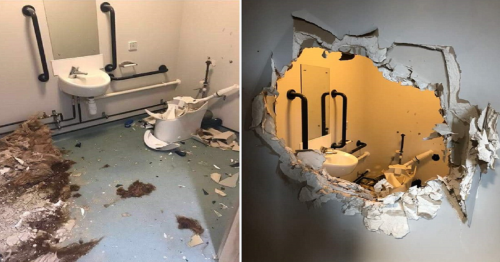
    This past week, military annals of lavatory amusement received a noteworthy addition when a British Army captain, in a state of awe-inspiring intoxication following a formal ceremony, was stripped naked by his troops after he fell asleep and locked in a barracks bathroom for six hours to contemplate the meaning of life.

    What the captain’s subordinates didn’t expect, however, was that the prank victim, once roused from the dead, would reveal himself to be the second coming of Harry Houdini mixed with a dash of Tasmanian Devil.

    “When he woke up he started banging on the door, screaming at the blokes to let him out,” a source told the Daily Mail. “They replied they’d only let him out if he gave them a pay rise.”

    Unwilling to budge on matters of pay, the explosive ordnance disposal officer who refused to dispose of his explosive temper began unleashing hell on the porcelain-filled confines, ripping the toilet and steel handrails from their foundation to bash his way to sweet deliverance, the report said.

    Drunk, naked and angry are no way to be, Captain, so never pass out in the enlisted barracks.

  • Navy helicopter crewman killed in North Island accident

    hh60 seahawk

    The Navy Times reports the sad news of a helicopter crewman killed last week in a fuel tank accident at Naval Air Station North Island in California.

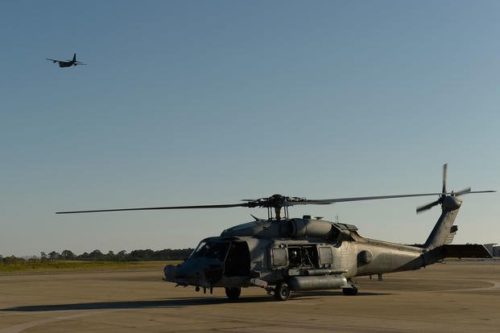
    Naval Helicopter Aircrewman 1st Class Jonathan Richard Clement was declared dead on July 31 at the UC San Diego Medical Center in Hillcrest, a day after an auxiliary fuel tank detached from an HH-60H Seahawk helicopter and struck him and a fellow petty officer.

    The other sailor was treated and released from the hospital after suffering what officials at Naval Air Forces described as “minor injuries.”

    Both sailors were assigned to the “Firehawks” of North Island-based Helicopter Sea Combat Squadron 85.

    The Naval Safety Center reported the mishap on the morning of Aug. 6, indicating only that the helicopter crew had been conducting “hot seat” training at the sprawling air base when the accident occurred.

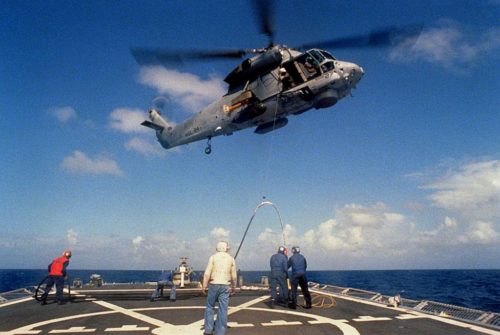
    There but for the grace of God, go I. Hot crew swaps and hot refueling were a routine event back in my Helo days. If the ship was so configured, we didn’t even land for gas, a HIFR (Helo In-Flight Refueling) was performed.

    hifr

    Fair winds and following seas, AW1 Clement. Training can be just as dangerous as combat.

  • NASA names nine ‘American hero’ astronauts for SpaceX, Boeing missions

    astro 9
    After a long hiatus (thanks for nothing, Barry) the US will be back in the space game, with US crews launching from US territory, on US made spacecraft. Nine Astronauts have been identified to crew the upcoming missions for flight testing (near and dear to my heart) with missions in mind to the International Space Station and beyond.

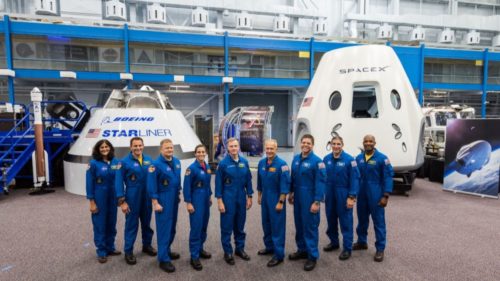
    Fox News reports that NASA has announced the nine astronauts that will crew the test flights, and first missions of the SpaceX ‘Crew Dragon’ and Boeing CST-100 ‘Starliner’ spacecraft.

    Crew for the Starliner test flight are NASA astronauts Eric Boe and Nicole Aunapu-Mann and Boeing astronaut Chris Ferguson. NASA astronauts Bob Behnken and Doug Hurley have been selected to take part in the Crew Dragon test flight.

    The first Boeing mission to the International Space Station will be crewed by NASA astronauts Josh Cassada and Suni Williams. The initial SpaceX mission to the ISS will be crewed by NASA astronauts Victor Glover and Mike Hopkins.

    “This is the stuff of dreams,” said Glover, during an event at NASA’s Johnson Space Center in Houston Friday.

    “Having an opportunity to introduce you to these American heroes is unique,” said NASA Adminstrator Jim Bridenstine.

    “This is just the beginning of daring missions that this country is embarking upon,” said Mark Geyer, director of Johnson Space Center, during the event. “It’s an exciting time for human spaceflight and an exciting time for our nation.”

    The space agency has partnered with Boeing and SpaceX to develop the Starliner spacecraft to launch atop a United Launch Alliance Atlas V rocket and the Crew Dragon launching atop the Falcon 9 rocket, respectively.

    In a statement released Thursday, NASA and its Commercial Crew partners revealed more details of the effort to carry astronauts from the U.S. to the International Space Station. Since the retirement of the space shuttle in 2011, the U.S. has been relying on Russian Soyuz rockets, launched from Kazakhstan, to get astronauts to the ISS.

    Boeing plans to do an uncrewed flight test of its CST-100 Starliner later this year or early next year. John Mulholland, vice president and program manager for Boeing’s Commercial Crew effort, explained that the earliest the company can “confidently” do a manned flight test will be in mid-2019. “Our commitment has always been to provide NASA and those crews the highest level of mission assurance,” he said in the statement.

    “SpaceX is targeting November 2018 for Crew Dragon’s first demonstration mission and April 2019 for Crew Dragon’s second demonstration mission, which will carry two NASA astronauts to and from the International Space Station,” said Benji Reed, director of Crew Mission Management at SpaceX, in the statement.

    The first test flight for SpaceX and Boeing will be known as Demo-1 and Orbital Flight Test, respectively. “Each test flight will provide data on the performance of the rockets, spacecraft, ground systems, and operations to ensure the systems are safe to fly astronauts,” explained NASA in the statement.

    Crew for each flight will include at least a flight commander and a pilot.

    Boeing’s CST-100 Starliner will be launched from Space Launch Complex 41 at Cape Canaveral Air Force Station in Florida. The Crew Dragon spacecraft will launch from Launch Complex 39A at NASA’s Kennedy Space Center.

    Most of us here I would think remember the Apollo missions to the moon, and certainly the Space Shuttle program cancelled by the SCoaMF. I remember watching the landing of one of the first shuttle missions from the Lava Lounge onboard NAS Sigonella- to a standing ovation and wild cheers from all present. Finally the US is back, and headed soon enough to Mars. Amazing times.

  • Winston Churchill: 10 little-known facts

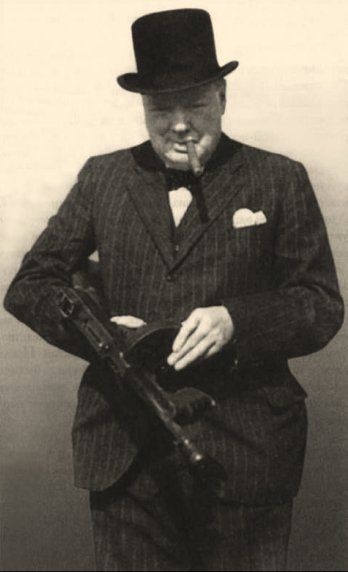
    wc and gun

    Thought I’d join ex-OS2, Hondo, 2/17 AC, and Combat Historian and post up a little history. I’ve been a big fan of Winston, read several of his books, and chuckled at his anecdotes. I mean, who can resist the famous exchange between himself and Nancy Astor,

    “If you were my husband, sir, I’d give you a dose of poison!”
    “If I were your husband,” said he, “I’d take it!”

    Here’s 10 facts about him, brought to us by Military History. Winston Churchill, the emblematic British wartime leader is instantly recognizable by his cigar, bowler hat, trench coat, and imposing scowl.

    Sir Winston Leonard Spencer Churchill was known for his domineering presence, sharp wit, and uncompromising resilience in the face of adversity, when lesser men would falter. His epic speeches, often paraphrased and parodied, rival Shakespeare and Dickens in their cultural resonance in popular perceptions of Britishness exported across the globe. Often a difficult man, his razor-sharp tongue would frequently get him into trouble, particularly amongst political rivals and the opposite sex.

    His role in supporting innovative technological military solutions, including the development of the tank and his recognition of the importance of aerial warfare, are well documented by commentators and historians alike.
    Perhaps less well known are his American ancestry, his animated primate impressions and his prolific artistic output.

    Military History Monthly examines ten obscure Churchill facts, which may shed some light on the twentieth-century figure.

    1. British Bulldog?
    Churchill, the ‘British Bulldog’ – and symbol of all things British – is in fact half-American. Churchill’s English roots are undisputed; indeed, his paternal ancestry, courtesy of his father Lord Randolph Churchill, can be traced back to the illustrious Dukes of Marlborough. However, his American heritage is equally impressive. His mother, Jennie Jerome, was the daughter of the American millionaire Leonard Jerome.

    As The Times has noted, his paternal grandmother was a relative of George Washington.

    According to one source, his family tree can be linked to George Herbert Walker Bush and son. Further cementing his American ties, Churchill was the first individual ever to be acknowledged as an Honorary Citizen of the United States.

    Incidentally, the Churchill family motto is Fiel Pero Desdichado, meaning ‘Faithful but unfortunate’. Whilst seemingly an unusual choice of mantra, Winston appears to have bucked the trend of misfortune.

    2. Impeccable timing – in life and death
    One of Churchill’s most revered traits – at various stages, both a blessing and a curse – was a determination, bordering on stubbornness, to operate on his own terms. Whilst no doubt a coincidence, it would appear this applied to entrances and exits.

    Churchill was born prematurely in a cloakroom at Blenheim Palace, where his expectant mother was attending a party. She was unable to reach a bedroom in time, before labour commenced. He died on the exact same day as his father (only 70 years later) at the age of 90, in January 1965.

    3. Churchill the Artist
    Churchill was a prolific painter, producing nearly 600 works throughout his lifetime. Sarah Thomas of Sotheby’s has commented “Churchill took up painting very late… He found relief from all the pressures of his work in his painting.”

    In December 2006, one piece, ‘View of Tinherir’ from 1951, sold at auction for a record £612,800. According to Thomas, however, it took him a while to master his trade: “His work does vary in quality… A lot of his paintings are pretty poor and amateur and full of splodges.”

    4. Prisoner of War
    In 1899, Churchill escaped a prisoner of war camp whilst a correspondent in South Africa, during the Boer War. The bounty on his head was 25 pounds. He returned home a hero, perhaps a taster of what was to come for the young Churchill.

    5. Churchill the Historian
    Winnie was a gifted writer, novelist and historian; in his lifetime, he published volume upon volume of works on the history of England and Europe, including A History of the English Speaking Peoples and, not least, his six-part epic collection, The Second World War.

    His literary merit was officially recognized when he won the Nobel Prize for Literature in 1953 “for his historical and biographical presentations and for the scintillating oratory in which he has stood forth as a defender of human values.” Incidentally, he is still the only British Prime Minister to have won the prize.

    6. Gorilla Warfare
    According to his nephew, John Spencer Churchill, Winston did a good gorilla impression. In his 1961 book, Crowded Canvas, John writes “Few people can say they have seen the ex-First Lord of the Admiralty, crouching in the branches of an oak, baring his teeth and pounding his chest.”

    7. Man of the Half-Century
    Churchill eclipsed Hitler by being named Time Magazine’s ‘Man of the Year’, not once but twice, in 1940 and again in 1949. The title is granted to men (and also women, since Wallis Simpson in 1936) who have significantly influenced the course of history. On his second time receiving the accolade, he was named ‘Man of the Half-Century’.

    8. Churchill the Statesman
    Churchill served under an impressive six monarchs: Queen Victoria, King Edward VII, King George V, King Edward VIII, King George VI and Queen Elizabeth II. Whilst serving his country, he held at least nine different offices.

    9. School of Thought
    As a schoolboy, Winston Churchill did not shine academically; he would often find himself in the bottom half of classes and examinations; his rebellious streak ending in numerous beatings. Few would have predicted a successful career in politics, least of all his headmaster at Harrow, who punished the young boy for destroying his beloved straw hat.

    Realizing university was not an option, and recognizing Winston’s childhood love for toy soldiers, Churchill’s father decided to send him to Sandhurst Military Academy. It would, however, take three attempts before Winston passed the entrance examination.

    10. Pillow Talk
    Churchill was known to enjoy a siesta, a habit he adopted following his time in Cuba with Spanish forces in 1895. In later life, far from simply aiding his recuperation, Churchill’s bed often acted as his preferred location to discuss matters of great state importance.

    Senior military advisors Sir Hastings Ismay and General Alan Brooke would invariably be summoned bedside, for a private audience with the Prime Minister. Reports claim a bespoke breakfast table to fit his bed was commissioned especially to accommodate his unusual conferences.

    So there we are, 10 facts about Sir Winston not widely known. Hope ya’ll enjoyed this little diversion on a lazy Sunday afternoon. I did posting it.
  • Sea Story Page

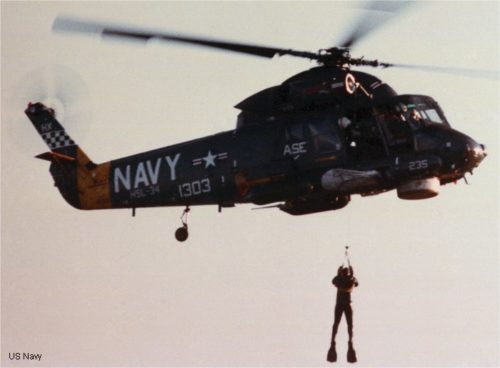
    h2 hoist

    As Ex-PH2 alluded to in her “Knock Yourselves Out” post, TAH is akin to a watering hole where Vets meet and greet, and swap fables known in the Navy as “Sea Stories.” I’m certain the nautically challenged services have similar. A fairy tale starts with “Once upon a time” but a Sea Story always begins with, “Now this ain’t no shit.” So post up your favorite Sea Story or their equivalent. Here’s one of mine.

    Now this ain’t no shit…
    So there AWANEd was, onboard Naval Air Station Jacksonville, FLA (NAS JAX, or just JAX) on Day 2 of Rescue Swimmer School. The same morning PT regimen was conducted, including the Hospital Run, and we broke for lunch. (Day one was pretty brutal, and we lost about 30% of the class right off the bat, exactly as the instructors planned).

    Much different choices for chow today among the now wiser remaining SAR candidates, I had soup and a salad, because we were hitting the pool for the first time.

    It was called a Practical Evaluation, where the instructors would see if any of us could actually swim. Which is kind of key to become a Helicopter Rescue Swimmer.

    An aside, passing SAR School was really not an option for me, as we were told if failed, our next stop would be ship’s company as a non-rate, meaning get familiar with deck grinders and paint brushes, or aircraft chocks and tie-down chains, depending. You can pick the ship’s color as long as its haze gray; they’ll pick the number. Neither option charmed me much.

    So, after chow we mustered at the pool in our shorts and tee shirts, now stenciled with a number and name. No fins or dive mask allowed. The swimming pool, OK, training tank, was 50 yards in length and 12 feet down, everywhere. No splishy splashy shallow end. 12 lanes were described by dark tiles. The eval itself was one lap (up and back, 100 yards) of breast stroke, side stroke, and elementary back stroke, where your hands never break the water’s surface, easy.

    I had been on swim teams since I was 8 years old, and raced for our high school’s team. We got to State level, but were crushed by a team of mutants who I swear had webbed toes and gills. Really cute young ladies, though, which had a big input on my swim team participation.

    Anyway, my turn in the tank. This is a timed event, too, so just finishing doesn’t mean you pass. It means you MIGHT get another shot.

    I jumped in, and started, making good time with the breast stroke (I used to race the 100 and 200 meter breast events) the went to the side stroke, which was easy, but nothing I’d spent a lot of time doing in the past, and then the elementary back stroke, sort of a breast stroke, flipped. Boring. I was well ahead of the clock. Then it hit me, I could impress the instructors with my swimming expertise by finishing the last 50 yards doing the butterfly, a fast double overarm stroke with a dolphin kick. So I did.

    What a bad mistake.

    “What the F do we have here? Mark F-ing Spitz??!!”
    “Why are you F-ing up MY Navy practical eval, AWANED? Are you a F-ing commie??!!”
    “I think Mark F-ing Spitz here needs to meet the Blue Baby!”

    Oops.

    I had managed to single myself out for special attention by the instructor cadre, not a good thing. I got the Blue Baby.

    The Blue Baby is a 10 pound dumbbell weight, and cannot get wet. Doesn’t sound like much, until you have to swim with it. I was “awarded” 100 yards with the Blue Baby, and a ridiculously short time to complete the swim. I opted for the now not so boring elementary back stroke, and completed the 100 yards well passed the allotted, impossible time.

    So, up on the deck for some extra PT because I didn’t meet the Blue Baby time, and repeat the Practical Evaluation, because I “contaminated” the first one with an unapproved swim stroke. I didn’t opt for the butterfly finale, this time. And I did pass just fine. Lesson learned.

    The rest of the class were kept busy with push-ups and flutter kicks and what not while I swam. They weren’t especially happy with me, but the instructors would have found another reason to PT them.
    It was going to be a long eight weeks.

    And guess what my nick name was for the duration.

    F’n Mark Spitz.

  • The lone dog tag recovered from North Korea had a name

    home bound

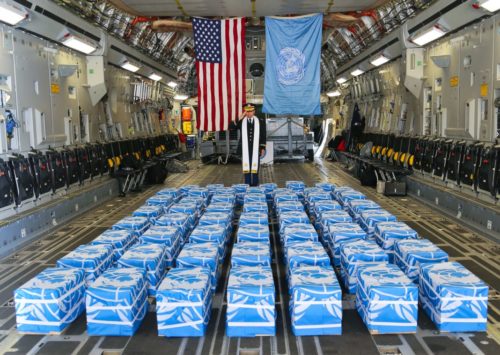
    After a solemn ceremony at Hickam, the hard work begins in identifying the remains. One family is a step nearer to closure, with the discovery of a single dog tag among the relics that the North Koreans returned with the remains.

    The Military Times reports the military has contacted the family of a service member missing from the Korean War. whose dog tag was found among the 55 cases of war remains repatriated to the U.S. on Thursday.

    His family will be presented that tag in Arlington, Va., next week as they arrive with hundreds of others for an annual meeting on the efforts to find their missing family members.

    The dog tag was among the cases of human bones and a limited number of artifacts, such as boots, buttons and buckles that North Korea said came from the village of SinHung-Ri, location of the 1950 Battle of Chosin Reservoir, said John Byrd, chief scientist for the Defense POW/MIA Accounting Agency.

    More than 3,000 U.S. Marines and soldiers perished at Chosin, and more than 12,000 were wounded in one of costliest battles of the war. Byrd said the North Koreans said the bones came from the eastern side of the village, which leads him to believe they are likely Army remains.

    More than 5,300 U.S. remains are still missing in North Korea.

    Byrd, who participated in previous remains transfers from North Korea before those exchanges were suspended in 2005, rode on the C-17 into Wonson, North Korea, last Friday. There on the ground, he was greeted by North Korean officers who showed him the contents of the boxes. Byrd said he performed a cursory review of bones to verify they were human.

    “That was confirmed in Wonson before we actually loaded the boxes onto the C-17,” Byrd said.

    The article in it’s entirety can be found here:

    Military Times Link

    A promising gesture in relations with North Korea, but the path ahead is still in question.

  • ISIS Flees Taliban Onslaught, Surrenders To Afghan Forces

    Isis

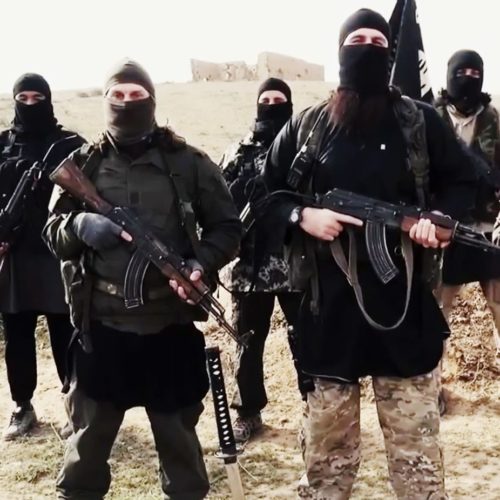
    Asymmetrical Warfare sometimes makes for strange bedfellows, especially in the Middle East, where alliance can be had for a price and blue on green attacks occur. Case in point, Afghanistan, Operation Freedom’s Sentinel where the US, supported by UK and Canada, invaded in October 2007. This coalition grew to include over 40 countries, with the aim to dismantle al-Qaeda and deny the Taliban safe harbor there. Then ISIS arrived.

    Stars and Stripes reports The allied coalition’s battle against the Islamic State in Afghanistan received a boost from another enemy Wednesday, when Taliban guerrillas drove ISIS fighters out of northern Jawzjan province.

    More than 150 ISIS fighters surrendered to Afghan government forces after the Taliban launched an offensive against them, officials said. U.S. forces have also been conducting airstrikes against ISIS in the area for months.

    “These people were surrounded by the Taliban for several days, but last night they managed to break free and surrender to government forces,” Faqir Mohammad Jawzjani, Jawzjan’s police chief, told Stars and Stripes on Wednesday.

    The surrender is a major setback for ISIS in Afghanistan, known as ISIS-Khorasan Province. The group emerged in the country’s east about four years ago and recently appeared to be growing stronger in the north.

    In this case, the enemy of my enemy is still my enemy. Read the entire article at: Stars and Stripes Link