Author: AW1Ed

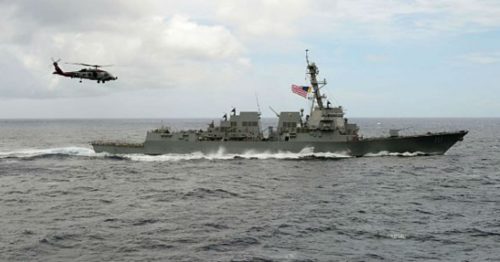
  • Navy fires XO of San Diego-based destroyer

    decatur
    Navy Times Link

    Another one falls to the sin of “Loss of Confidence” to lead. The article does not mention a specific event, so perhaps he was in over his head as XO. At any rate, now is a good time for him to update his resume.

    The executive officer of the warship Decatur was fired last week, Navy officials confirmed.

    Cmdr. Blandino A. Villanueva was relieved Wednesday “due to a loss of confidence in ability to lead,” according to U.S. Surface Force Pacific spokesman Cmdr. Patrick Evans.

    Evans declined to provide details about why the officer was relieved but indicated it was not tied to any specific event.

    Villanueva had been the second-in-command aboard the San Diego-based destroyer since February, Evans said.

    He has been temporarily reassigned to the Coronado-based SURFPAC staff.

    Villanueva did not respond to a phone message or requests for comment submitted through official channels by Navy Times.

    Originally from Honolulu, Villanueva is the son of Navy mess specialist from the Philippines. He was commissioned through Officer Candidate School in 1998, two years after graduating from San Diego State University.

    Villanueva served as executive officer of the guided-missile destroyer Gridley and in SURFPAC’s aviation department in recent years, according to Navy personnel records and his command bio website.

    Villanueva has received two Meritorious Service Medals, three Navy and Marine Corps Commendation Medals, two Navy and Marine Corps Achievement Medals and an Army Achievement Medal during his career, according to military records.

    Lt. Cmdr. Molly Lawton, a Decatur department head, has assumed temporary XO duties until a permanent relief arrives, Evans said.

    The San Diego Union-Tribune first reported Villanueva’s firing.

  • Civilian Contractor Awarded Medal of Valor After He and Another Fought Off Taliban

    seabolt
    Breitbart News Link
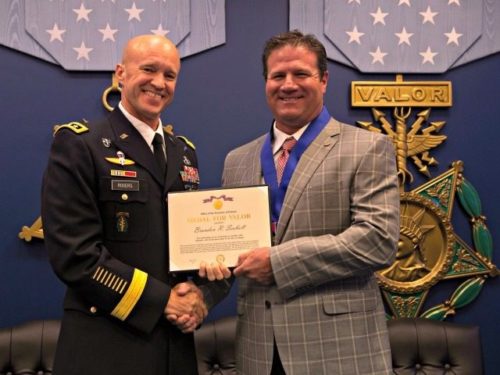
    Brandon Ray Seabolt was awarded the Medal of Valor, the highest award the Pentagon can bestow on a civilian, for his actions in Afghanistan on 17 December 2015. Seabolt is a former Green Beret with 22 years of service. Currently he is a contractor with the Pentagon’s Defense Threat Reduction Agency (DTRA), where he is a counter-improvised-explosive device (IED) expert.

    “We’re out with the Special Forces guys every night, and when they go out, we go out with them. Our main job is to advise on counter-IED to try to keep them out of trouble, so we’re out with them all the time,” he said.

    The night of the firefight, the team was out on a raid looking for the shadow governor of Helmand Province. They didn’t find him.

    HALL OF HEROES, Pentagon — Brandon Ray Seabolt, 53, said as soon as the team of U.S. and Afghan commandos stepped into the courtyard of a compound that December 17, 2015 night in Helmand, Afghanistan, he knew something was wrong.

    There was an open door in front of them. “There’s never an open door” in Afghanistan, he said.

    He grabbed the Army Green Beret in front of him, Mike, and pulled him to the side. At that instant, automatic machine gun fire opened up, hitting the line of Afghan and U.S. commandos who had entered the compound behind them.

    Seabolt began firing his weapon at the open door, laying down suppressive fire, as Mike began dragging those wounded out of the compound. There were nine hit.

    “I just knew we needed to get the wounded guys out so I just told Mike, ‘Hey keep working on those, I’ll keep them pinned down and focused on me.’”

    That went on for a long time, Seabolt said. But it wasn’t until the last guy was dragged out and he was alone that he got a little nervous.

    “They picked up their fire a good bit and I thought, ‘Well, this could get ugly here.’ But then Mike came back literally a couple minutes later and I heard him engaging again, and so I knew that we would be alright at that point.”

    But it was not over yet. The two devised a plan of attack. Seabolt stepped out from cover and sacrificed his own safety to to distract the enemy, as Mike snuck up close enough to the open door to throw a grenade inside.
    He and Mike then killed the five enemy fighters who ran out.

    That night, two Afghan commandos were killed, and two U.S. Special Forces soldiers, four Afghan commandos, and one Afghan interpreter wounded. Those wounded would survive.

    Mike would be awarded the Silver Star for his actions, but until now, little was known about Seabolt’s role.

    Last week at a ceremony in the Pentagon, Seabolt was awarded the Medal of Valor — the highest award the Pentagon can give a civilian for bravery.

    Only 17 have been awarded the medal, which was created after Sept. 11, 2001, to recognize private citizens who have sacrificed their safety for others.

    “Ray, after receiving accurate and sustained and enemy direct fire at close range, engaged, suppressed and eliminated multiple insurgents who were barricaded in a fortified fighting position in order to ensure his own safety and the safety of those on his team,” said Army Lt. Gen. Darsie Rogers, deputy director of DTRA and former commander of Special Operations Command.

    “Ray exposed himself from his position of cover to provide effective fire on the insurgent position, as a soldier assaulted the position and hurled two fragmentary grenades.

    The insurgents continued to fight, but as they exited the building they were met with … well-aimed effective fire by Ray, which resulted in neutralization of five enemy insurgents,” he said.

    “For a short period of time, Ray was the sole remaining member of that fighting position, and single-handedly fended off an insurgent onslaught until his fellow soldier returned.

    Ray’s quick thinking, his determination, and great nerves are why we are so proud of him today.”

    As a civilian, Seabolt has built a reputation among the tight-knit Special Forces community.

    “Ray is famous for going out on almost every operation he can in the south. Everybody knows Ray,” said Michael “Tony” Dunne, 45, a fellow former Army Green Beret who was also recently recognized for his courage under fire in a separate incident in Afghanistan.

    Seabolt is going back to Afghanistan soon, where he continues to go on missions to save more lives. He knows there is always the chance of another firefight.

    “There’s always the possibility. When you’re around a bunch of SF guys, you’re bound to get into trouble, so — ,” he said wryly.
  • Marine ID’d as service member who went overboard near Philippines

    uss essex

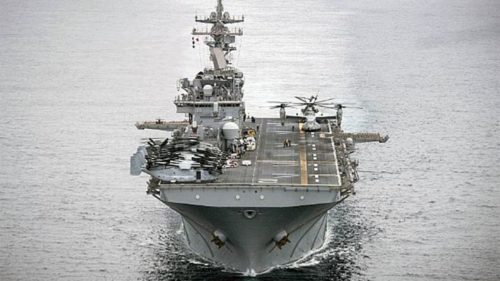
    Fox News reports the Camp Pendleton-based Marine who fell overboard from an amphibious assault ship off the Philippines, has been identified by military officials as Cpl. Jonathan Currier, a native of New Hampshire.

    He was declared dead Friday after five days of efforts to find him or recover his body were unsuccessful.

    Currier went overboard from the amphibious USS Essex around 9:40 a.m. Aug. 9 while the aircraft was conducting routine operations off the coast of the Philippines, the report said.

    Capt. Diann Rosenfield said Currier was with the 13th Marine Expeditionary Unit stationed at Camp Pendleton near San Diego, according to a news release.

    “Our hearts go out to the Currier family,” commanding officer Col. Chandler Nelms said. “Cpl. Currier’s loss is felt by our entire ARG/MEU family, and he will not be forgotten.”

    According to the release, Currier enlisted in the Marine Corps in August 2015 and graduated from Marine Corps Recruit Depot, Paris Island, several months later.

    At the time of Currier’s disappearance, he had been deployed with Marine Medium Tiltrotor Squadron 166 Reinforced, 13th MEU, aboard the Essex.

    The search for Currier, assisted by the U.S. Navy, the U.S. Embassy in the Philippines, and the Philippine Coast Guard, spanned 13,000 square nautical miles, the Marine Corps Times reported.

    “All of our Marines and Sailors demonstrated a tremendous resilinence and put forth an extraordinary effort over the past five days,” Nelms said. “Our thoughts and prayers have been and will continue to be with our Marine’s family during this difficult time.”

    Officials are currently investigated the circumstances surrounding the incident, the press release said. No official photo of Currier was provided.

    Another grim reminder that training can be just as hazardous as war. Fair winds and following seas, Cpl. Currier. Condolences to his family, friends, and shipmates.

    Eternal Father, grant, we pray

    To all Marines, both night and day

    The courage, honor, strength, and skill

    Their land to serve, Thy law fulfill

    Be Thou the shield forevermore

    From every peril to the Corps.

    Amen.

  • Trump is rolling back restraints on US cyberwarfare

    cyber war

    Wall Street Journal Link

    President Donald Trump has removed restraints on how and when the US can launch cyberattacks on its adversaries — and it could make attacks on other countries more likely.

    Trump signed an order earlier this week overturning a series of Obama-era rules, which defined a lengthy process of inter-agency approval before the US could launch cyber-offensives, people familiar with the matter told The Wall Street Journal.

    The Journal said one administration official briefed on the decision described the change as an “offensive step forward.” The change is meant to support military operations and deter foreign interference in US elections.

    The Trump administration is under pressure to show it is taking threats of foreign interference seriously in light of mounting evidence that Russia meddled in the 2016 US election.

    The Obama-era rules, known as Presidential Policy Directive 20, meant agencies that wanted to launch a cyberattack had to gain approval from groups across the federal government. This was to ensure that existing defense operations were not harmed by the launch of a new attack, but added levels of bureaucracy, slowing effective response time.

    The new policy applies to the Defense Department as well as other federal agencies, an administration official told The Journal. The person declined to say which other agencies would be affected.

    Sources did not tell The Journal which rules were replacing the Obama-era directive, citing the classified nature of the process; as The Journal pointed out, the Obama-era rules were classified as well and were made public only in the 2013 Edward Snowden leaks.

    More Obama era group-think bypassed, allowing rapid deployment of cyber warfare assets to attack against near real time adversaries.

  • U.S. Navy Wreckage from WWII Discovered Off Coast of Alaska

    Abner Read

    Popular Mechanics reports wreckage from a U.S. Navy destroyer badly damaged by a sea mine was discovered last month by a government-funded scientific team.

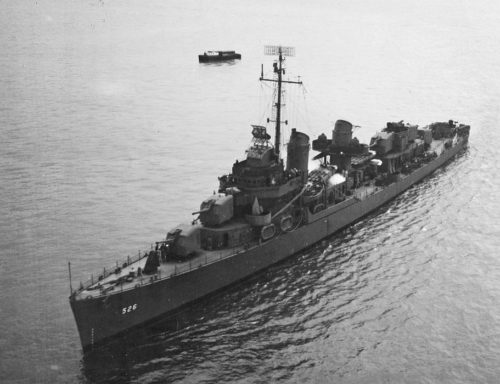
    USS Abner Read nearly sank during the Aleutians campaign in World War II, as US and Allied forces fought to eject Japanese troops occupying the remote islands of Attu and Kiska.

    The destroyer was towed, repaired and continued to serve in the Pacific for the remainder of the war, but the stern and those who were berthed or stationed there were lost to the sea.

    In the early months of America’s participation in World War II, Imperial Japanese forces occupied the islands of Attu and Kiska in the Aleutian islands chain. The operation was meant to distract the Americans from the central and south Pacific theaters but was not part of a larger invasion of Alaska.

    Built in the naval shipyards of San Francisco, the USS Abner Read joined the Pacific Fleet and was sent to participate in the Aleutians campaign.

    On the night of August 8th, 1943 while participating in an anti-submarine operation off Kiska, Read struck a sea mine at the stern of the ship.

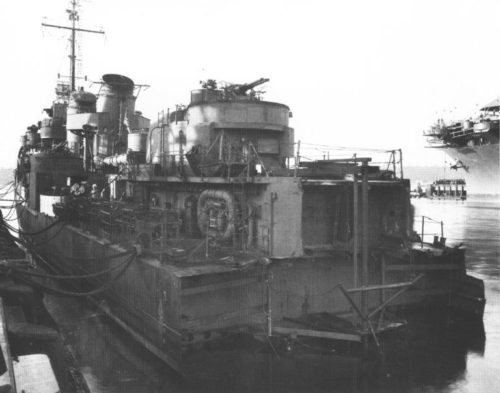
    The rear 75 feet of the 376 foot long ship was blown off, including rudder and propellers. The section quickly sank, and only herculean damage control efforts saved the rest of the ship and crew.

    Seventy one men were killed in the mine attack.

    read damage
    Damaged stern USS Abner Read

    On July 17th, 2018 a team funded by the National Ocean and Atmospheric Administration rediscovered the stern section in 290 feet of water, still off the coast of Kiska. The team consisted of scientists from the Scripps Institution of Oceanography at the University of California San Diego and the University of Delaware.

    The team discovered the wreckage after a multibeam sonar on the research ship Norseman II identified a “promising target.” A remotely operated vehicle (ROV) was sent to the target location to investigate.

    The team was quickly convinced they had found the stern of the Abner Read. Expedition leader Eric Terrill later said, “We could clearly see the broken stern, the gun and rudder control, all consistent with the historical documents.”

    The wreckage qualifies for U.S. government protection per the Federal government’s Sunken Military Act. The act states that the “Navy’s sunken military craft remain property of the U.S. regardless of their location or the passage of time and may not be disturbed without the permission from the U.S. Navy.”

    This is in order to protect the graves, unexploded ordnance, or hazardous materials within the wreckage.

    As for USS Abner Read, it was towed back to Bremerton, Washington where a new stern was attached. The ship rejoined the fleet but was sunk in 1944 off the island of Samar, the victim of a Japanese bomber attack.

    The ship’s stern section is now a final resting place, a tomb for the 71.

  • Coast Guard for the Save

    coast guard

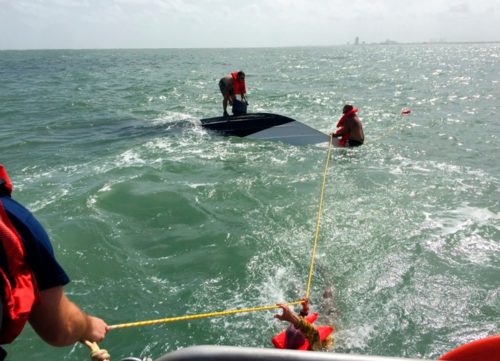
    The Navy Times reports the Coast Guard rescued three boaters found clinging to the hull of their capsized 24-foot vessel off Texas.

    All three men were unharmed in Monday afternoon’s incident shortly after leaving Galveston.

    Officials received a mayday call from a man saying his recreational boat was taking on water near the Galveston jetties.

    Petty Officer Edward Wargo in Houston says Coast Guard personnel arrived and provided life jackets to the boaters, plus a line to the capsized vessel.

    All three men were transferred to the Coast Guard vessel and transported to shore.

    Officials aren’t sure why the boat began sinking. Wargo says the partly submerged boat was anchored Tuesday and a salvage company was expected to remove the vessel.

    So much fail on the part of the boaters; these guys were lucky the Coast Guard was nearby to provide assistance. No life jackets aboard, and one wonders how the emergency was called in- I’m betting a cell phone. Well maintained vessels don’t just take on water, either. At least the salvage will be expensive, so there is that.

    Well done Coast Guard, and maybe these fellows learned a lesson.

  • Saving the World- Airman helps save lives of three families caught in fire

    tsgt clearyThe Air Force Times reports Tech Sgt. Michael Cleary, while home on leave, rushed into multiple burning buildings to awaken residents and usher them out of danger.

    While visiting his hometown of Manteca, California, on July 14, he smelled smoke and noticed ash drifting through the air. Shortly afterward, he saw flames coming over some houses, according to an Air Force press release.

    The blaze was spreading through the entire neighborhood, engulfing trees and cars. Recognizing the danger to the residential area, he jumped from his vehicle and ran to the scene of the fire.

    “My first thought was to see if anyone needed help, so I ran up to the first house. where the tenants were still inside sleeping, woke them up and helped them exit,” Cleary said in the release.

    The fire was spreading rapidly, though, and Cleary saw two other homes nearby that were in immediate danger, so he ran to alert those residents as well.

    Carin Rhodes, a tenant of one of the properties, heard Cleary shouting just outside, “Hey! Hey! There’s a fire in your backyard!”

    “I rushed to a window where I could see that there were three Modesto ash trees on fire,” Rhodes said. “I could feel the searing heat through the window. As I ran to the front door, I could still hear the yelling man alerting my neighbors. I watched this man go from house to house alerting the neighborhood without hesitation. All the while, I was completely amazed at how quickly he reacted to everything and how fluid he was.”

    After alerting the neighborhood, Cleary grabbed a water hose and began trying to prevent the spread of flames before the local fire department arrived.

    The Air Force said he risked his physical safety and health by exposing himself to the flames and smoke.

    “I had a cough for the next two days, but it was all worth it knowing that I played a small part in preventing three families from possibly losing their homes,” Cleary said.

    With a half-hour, Cleary and the Manteca Fire Department had not only cleared the residents from the three burning homes but also extinguished the flames.

    Cleary credited his Air Force training for helping him respond quickly.

    As an aircraft maintenance professional, Cleary is routinely trained in fire safety, especially in fire prevention and how to slow or stop the spread of aircraft-related blazes when they occur.

    “That training helped me remain calm throughout the situation,” Cleary said. “The whole process felt instinctual; [I needed] to prevent the spread of fire the best I could.”

    Bravo Zulu, Tech Sgt. Michael Cleary, damn well done.

  • Exoskeleton helps spinal cord and stroke victims walk again

    exo suit

    Fox News Link

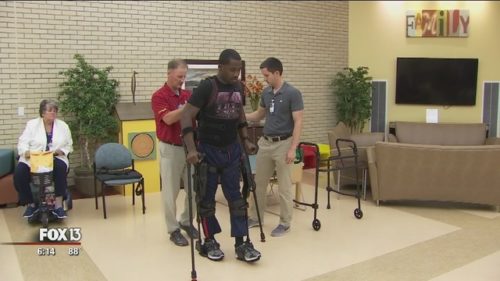
    31-year-old Laquan Taylor was told he would never walk again. But with the help of an exoskeleton suit donated by SoldierStrong, he is getting his sense of independence back.

    Most of us take it for granted, but when a paralyzed veteran stood up and walked today, it was like a miracle had changed his world.

    Laquan Taylor was shot numerous times by a carjacker.

    “I was in a vegetative state. I was told I would never walk again,” said the 31-year-old Navy veteran.

    But he’s proving them wrong with the use of new technology: An exoskeleton suit.
    “It allows me to stand. It gives me the sense of confidence again without falling or having issues,” he explained.

    With some help from his physical therapist, Taylor stood and walked across a room at the James A. Haley Veterans Hospital in Tampa.

    The Ekso GT exoskeleton was donated to the hospital by SoldierStrong, a group that had already donated 16 exoskeletons across the country at a cost of more than $100,000 each.

    “I’ve seen this a hundred times now and every time is special. You see the smile on their face, their eyes light up,” said Chris Meek, co-founder of SoldierStrong.
    Dr. Kevin White, a spinal cord injury specialist, says he expects the devices will become cheaper.

    “This is going to be commonplace in a short period of time. As years go by this technology gets better and better.”

    He says the exoskeleton donated today can help people with full or partial paralysis. It’s FDA approved for both spinal cord injuries and stroke.

    LaQuan says the exoskeleton has accelerated his therapy and improved his outlook. “It gives you your sense of independence back.”

    SoldierStrong has partnered with some of America’s most advanced medical technology companies to make their devices accessible to returning veterans. The SoldierStrong SoldierSuit is comprised of several state-of-the-art rehabilitation and powered prosthetic technologies that address a variety of combat and non-combat related disabilities. Read more about them here:

    Soldier Strong Link