Author: AW1Ed

  • U.S. Remains Returned By North Korea Could Take Days Or Decades To Identify

    returned

    I’ll simply post the article in its entirety. There is really nothing more to say except, Welcome Home.

    Reuters Link

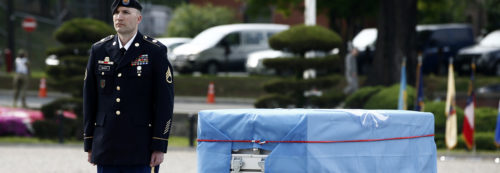
    WASHINGTON – When the remains of Americans handed over by North Korea arrive in Hawaii on Wednesday, the U.S. military will begin a painstaking identification process that experts said could take from three days to two decades to complete.
    The 55 boxes, draped in the blue and white flag of the United Nations, are each small enough to be carried in one person’s arms.

    They bear not only the remains thought to be of missing servicemen from the 1950-53 Korean War, but also a message of good faith made by North Korean leader Kim Jong Un at his summit with U.S. President Donald Trump in June.

    The remains within each box may not be those of a single person and are likely fragments of bones, said Paul Cole, an expert on recovery of soldiers missing in action and prisoners of war, who worked as a visiting scientific fellow at Hawaii’s Central Identification Laboratory where the boxes will land.

    The commingling of remains reflects the violent impacts to which human beings are subjected in war.

    At the laboratory, work will be done to determine if the remains are human. Then experts will count the bones and come up with a minimum number of individuals that could be in the shipment.

    Each bone, or fragment, offers a clue. The femur indicates height, the pelvis age, the face and skull national origin. The clavicle and teeth offer some of the best comparison to the personnel file the Department of Defense keeps of missing servicemen, said Cole, author of the book “POW/MIA Accounting: Searching for America’s Missing Servicemen in the Soviet Union.”

    Six Decades Of Waiting
    When bones meet the size requirement, the lab will cut and send a piece to the Armed Forces DNA Identification Laboratory, where it will be analyzed and compared to family reference samples.

    If the bone is too small, DNA analysis cannot be done. Federal law prohibits the destruction of evidence in testing, and DNA analysis destroys the bone, said Cole.
    Those kinds of challenges can drag out the process by many years.

    “Problems such as inability to get DNA from bones and lack of a DNA reference sample from the family can be major stumbling blocks,” said Chuck Prichard, director of public affairs for the Defense POW/MIA Personnel Accounting Agency, the U.S. military’s main unit for finding and identifying missing members.

    The identification process does not prove the bones belong to one person, but rather that they could not belong to anybody else, Cole said. Sometimes all families receive are fragments small enough to fit in the palm of a hand.

    Still, the mission is loaded with expectations and political weight.

    Trump last week thanked Kim for keeping the promise he made as part of their talks about North Korea’s denuclearization.

    “And I’m sure that he will continue to fulfill that promise as they search and search and search,” said Trump, who has sent Vice President Mike Pence to Hawaii to receive the remains.

    The U.S. State Department said this month it would resume joint field activities to search for the remains of Americans missing from the war. A total of 5,300 American servicemen are believed to have been lost in what is now North Korea.

    Gail Embery first found out when she was about 10 years old that her father, Sergeant Coleman Edwards, had gone missing in Korea. She is hopeful that her father’s remains are among those arriving on Wednesday.

    “I always knew that I would have to find my father. I always knew it in my heart,” Embery said. “I’m 73 now, and I am still looking.”

    Reporting by Daphne Psaledakis in Washington; Additional reporting by Phil Stewart; Editing by Mary Milliken and James Dalgleish

  • ISIS claims attack on cyclists in Tajikistan

    jihad

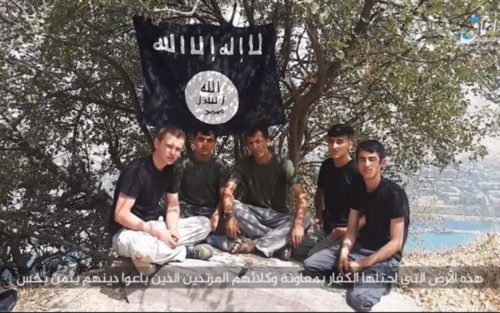
    CBS News reports The Islamic State of Iraq and Syria (ISIS) has claimed responsibility for an attack in Tajikistan that left four cycle tourists, including two Americans, dead over the weekend. The terror group released a video purportedly showing the five men who carried out the attack, pledging allegiance to its leader Abu Bakr al-Baghdadi.

    A Daewoo sedan plowed into the group of seven foreign bicyclists about 60 miles south of the Tajik capital, Dushanbe, on Sunday, according to local police. The people in the vehicle then “exited the car and stabbed the cyclists with knives,” the U.S. Embassy in Tajikistan said in a statement Monday.

    Four of the cyclists died and three others, including a woman from Switzerland, were injured, Tajik officials said.

    Two of the victims were American, one was Swiss, and another was from the Netherlands, both foreign and Tajik officials said. Tajik President Emomali Rahmon sent the leaders of each country a telegram expressing condolences Monday.

    United States Charge dAffaires in Tajikistan, Kevin Covert, met people at the American embassy in Dushanbe who came to pay their tributes to the victims of the attack.

    Of all the places in the world, they pick Tajikistan for a cycling vacation. If they wanted a thrill seeker adventure vacation, should have visited Chicago or Baltimore.

  • Citizen Comes to Aid of Officer

    police line

    Not a true “Feel Good” story, but a nice start to a Saturday morning. A citizen comes to the aid of a Provo, Utah, police officer, as a Body Cam shows, by apprehending and body slamming the suspect on concrete.

    Breitbart News gives us the video, which begins by showing an officer walking around at a gas station checking vehicle occupants in search for a suspect in a gray shirt.

    He talks to one individual, concludes he is not the suspect, then turns to see the suspect walking across the parking lot.

    The officer approaches the suspect and asks if he is alright, citing a call that the suspect had allegedly been walking around asking for water.

    The suspect quickly becomes agitated and allegedly reaches for something on the officer’s belt, then resists arrest when the officer grabs his arm.

    The officer and the suspect grapple before the suspect breaks free and runs. The officer gives chase and a citizen intervenes:

    Cop Cam

    Nice open field tackle, and thanks from the officer.

  • Report: Chinese Are ‘Awed’ by Trump’s ‘Skill as a Strategist and Tactician’

    us china

    Financial Times reporter Mark Leonard finds that on a recent trip to China, many top officials and intellectuals in China were “awed” by President Donald Trump’s “skill as a strategist and tactician,” and said “that Mr Trump is the US first president for more than 40 years to bash China on three fronts simultaneously: trade, military and ideology.”

    The Chinese see Trump as rejecting the idea that U.S. leaders should be managing the relative decline of the U.S. They think Mr Trump feels he is presiding over the relative decline of his great nation. It is not that the current order does not benefit the US. The problem is that it benefits others more in relative terms. To make things worse the US is investing billions of dollars and a fair amount of blood in supporting the very alliances and international institutions that are constraining America and facilitating China’s rise.

    In Chinese eyes, Mr Trump’s response is a form of “creative destruction”. He is systematically destroying the existing institutions — from the World Trade Organization and the North American Free Trade Agreement to Nato and the Iran nuclear deal — as a first step towards renegotiating the world order on terms more favourable to Washington.

    Once the order is destroyed, the Chinese elite believes, Mr Trump will move to stage two: renegotiating America’s relationship with other powers. Because the US is still the most powerful country in the world, it will be able to negotiate with other countries from a position of strength if it deals with them one at a time rather than through multilateral institutions that empower the weak at the expense of the strong.

    Leonard goes on to say that while China is taking a tough stance in its conflict with the U.S. now, “many Chinese” think that their leaders should rethink the strategy. Instead of confronting the U.S. and seeking to build an anti-U.S. coalition, China should “prepare the ground for a new grand bargain with the US based on Chinese retrenchment.”

    Tired of winning yet?

  • Another Navy Officer Faces Court-Martial After Fitzgerald Collision

    fitz damage

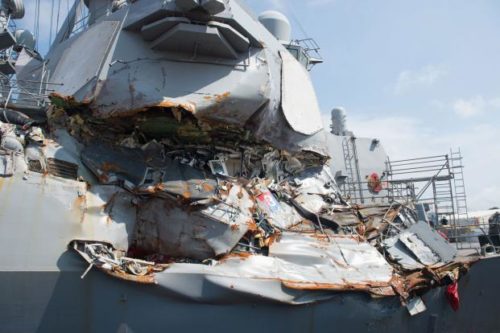
    Military Times reports a second officer who served aboard USS Fitzgerald during a fatal 2017 accident that left seven sailors dead, is headed to a general court-martial. Lt. Natalie Combs, the guided-missile destroyer Fitzgerald’s former Tactical Action Officer (TAO), has been charged with dereliction of duty through neglect resulting in death and improper hazarding of a vessel.

    “She did not enter a plea during her arraignment Monday at Washington Navy Yard, but may opt to do so at a later time,” said Patty Babb, a spokeswoman for the Office of the Judge Advocate General of the Navy.

    According to her charge sheet, Combs had a duty to communicate safe speed and maneuvering recommendations to the Officer of the Deck (OOD) and impose efficient watchstanding principles. On the night of June 17, 2017, the lieutenant “negligently failed to comply” with her commanding officer’s orders and regulation manuals, the charges allege. That dereliction of duty resulted in the deaths of seven sailors when the destroyer collided with a container ship off the coast of Japan, the charge sheet states.

    Her court-martial is set for Feb. 25.

    “Charges against the accused are only allegations; the accused is presumed innocent until proven guilty,” Lt. Christina Sears, a Navy spokeswoman at the Pentagon, said in a statement.

    Combs is the second Fitz officer to be formally charged this month following the fatal collision. Cmdr. Bryce Benson, the ship’s former commanding officer, has also been referred to a general court-martial after he was charged with violating the same two articles of the Uniform Code of Military Justice as Combs: 92 and 110.

    Benson pleaded not guilty to the charges during his July 10 arraignment.

    In a shockingly similar case, the commander of USS John S. McCain when it collided with a commercial tanker last year in the Straits of Singapore, pleaded guilty to dereliction of duty and acknowledged his role in the deaths of 10 sailors. Cmdr. Alfredo Sanchez, as part an agreement, will retire from Naval Service. If so sentenced, he could face a letter of reprimand and forfeiture of a portion of his pay for three months.

    Since I have nothing productive to add, I’ll just stop here.

  • Pentagon Slashes GI Bill Transfer Eligibility Window

    dod logo

    Military Times reports new changes in service member’s ability to transfer GI Bill benefits to dependents, and they’re not for the better. The goal, Pentagon officials stated, is to shift the benefit to focus on retention.

    “After a thorough review of the policy, we saw a need to focus on retention in a time of increased growth of the armed forces,” Stephanie Miller, director of accessions policy in the Office of the Secretary of Defense, said in a statement. “This change continues to allow career service members that earned this benefit to share it with their family members while they continue to serve.”

    Troops with 16 or more years of service will no longer be permitted to transfer their Post-9/11 GI Bill benefits to a spouse or child starting next year, Defense Department officials announced Thursday.

    Currently, troops who serve a minimum of six years and commit to serving an additional four years are eligible to transfer the education benefit to their dependents. Some who agree to the four years but are barred from completing it, such as troops who are injured and medically discharged, are permitted to keep the transfer. Others who start the process after getting injured can request a waiver so the transfer can go through.

    But starting 12 July 2019, service members need to begin the benefit transfer process between six and 16 years of service, the new policy update states.

    Another benefit cut to focus on retention? Sorry, that doesn’t pass the smell check. Hat tip to IDC SARC, who mentioned this in the Cohen Purple Heart post where it caught my eye.

  • Trump’s SCOTUS Pick

    SCOTUS

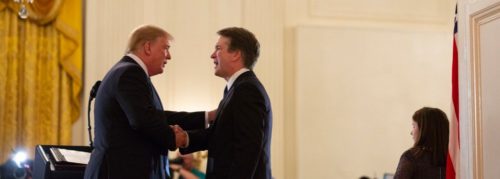
    Previously I posted about President Trump’s short list of SCOTUS candidates, a brief bio and a list of education and experiences for each. All were excellent candidates; any of the three is fully qualified and able to assume the duties as a Supreme Court justice. But what breaks out the nominee? I’d say a record of his/her decisions and written opinions are the benchmark upon which a nominee gets the nod.

    Here’s a brief bio, and a list of Kavanaugh’s standout findings.

    A native of the Washington, D.C. area, Judge Kavanaugh attended Yale University, graduating cum laude from its college and then earning a degree from its law school while serving as notes editor of the Yale Law Journal. Judge Kavanaugh then clerked at both the Third and Ninth Circuits, served as a fellow with the solicitor general of the United States, Kenneth Starr, and clerked for Supreme Court Justice Anthony Kennedy.

    Judge Kavanaugh returned to work for Ken Starr, playing key roles in the Independent Counsel’s investigation of President Bill Clinton before joining a prominent D.C. law firm. He then served in a variety of senior roles for President George W. Bush, who then nominated him to the D.C. Circuit Court where he has served since 2006. A committed textualist and originalist, Judge Kavanaugh has described his deep belief in “a neutral, impartial judiciary that decides cases based on settled principles without regard to policy preferences or political allegiances….”

    In his 12 years as a judge, Kavanaugh has issued approximately 300 opinions and delivered numerous speeches and legal arguments. Among them is his dissenting opinion on a pivotal gun ban in 2001.

    Second Amendment
    In Heller v. District of Columbia, the D.C. Circuit Court upheld the District’s ordinance banning most semi-automatic rifles. But in that case, Kavanaugh wrote the dissenting opinion, arguing the Supreme Court had already decided handguns – “the vast majority of which today are semi-automatic” – are constitutionally protected under the Second Amendment.

    Abortion
    Although he has not expressed outright opposition to abortion, liberals have already warned of the end of Roe v. Wade, the landmark Supreme Court decision that legalized abortion, should Kavanaugh be confirmed.

    Kavanaugh did, however, issue a dissent in a 2017 case involving an illegal immigrant who wished to be released from custody in order to obtain an abortion. While the court eventually allowed her to have the procedure, Kavanaugh said the majority opinion was “radically inconsistent with 40 years of Supreme Court precedent.”

    He argued if the government helped the 17-year-old obtain an abortion, then it ignores its “permissible interest in favoring fetal life, protecting the best interests of a minor and refraining from facilitating abortion.”

    Obama Care
    Kavanaugh’s role in an ObamaCare decision had some conservatives on edge prior to his official nomination. Kavanaugh ultimately dissented in Seven-Sky v. Holder, a challenge to the Affordable Care Act.

    However, in his dissent, Kavanaugh did acknowledge the Affordable Care Act’s “individual mandate provision” could fit “comfortably within Congress’ Taxing Clause power.” Conservative health care expert Christopher Jacobs argued Kavanaugh “cultivated a theory” that paved the way for Chief Justice John Roberts to uphold the individual mandate requiring people to purchase health insurance in 2012.

    Religious Rights
    In 2015, Kavanaugh sided with organizations that argued ObamaCare’s contraceptive coverage mandate infringed upon their religious rights.

    “When the Government forces someone to take an action contrary to his or her sincere religious belief (here, submitting the form) or else suffer a financial penalty (which here is huge), the Government has substantially burdened the individual’s exercise of religion,” Kavanaugh wrote in the dissenting opinion in Priests for Life v. HHS.

    Clinton Impeachment
    Kavanaugh worked with Kenneth Starr in the 1990s, co-writing the independent counsel’s report laying out the legal framework supporting then-President Bill Clinton’s impeachment. He said Clinton should be impeached because he misled the public and lied to his staff, according to The New York Times.

    But in 2009, citing his role with the investigation into Clinton, Kavanaugh expressed his opinion that presidents should not have to deal with criminal investigations or civil lawsuits while in office.

    Writing for the Minnesota Law Review, Kavanaugh said, “I think we grossly underestimate how difficult the job [of U.S. president] is.” Because of that, he said he believes “[it’s] vital that the President be able to focus on his never-ending tasks with as few distractions as possible.”

    In over 300 findings, Kavanaugh has displayed a staunch support of the Constitution as it was originally written, curtailed government overreach, and applied the law and not opinion. No wonder the Dems are howling.

  • Then There Were Three

    3 for SCOTUS

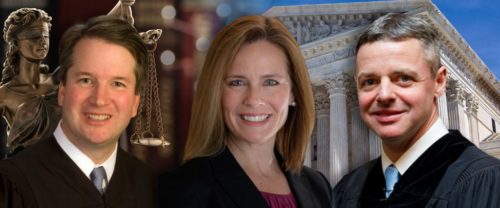
    Numerous sites (Fox News Politico and USA Today) are reporting President Trump has winnowed the field of potential Supreme Court judges down to three candidates. Conventional wisdom doesn’t bat 1000, but I’ll work with what I have. Who are these people, and what are their backgrounds? I did some digging- here’s what I found. Sorry for the length, but I did edit out much that wasn’t really relevant.

    Brett Kavanaugh (born February 12, 1965)

    After graduating from Georgetown Prep, Kavanaugh attended Yale University and graduated with a B.A. cum laude in 1987. He then attended the Yale Law School, and graduated with a J.D. in 1990. At Yale Law, he served as Notes Editor of the Yale Law Journal.

    Kavanaugh clerked for Supreme Court Justice Anthony Kennedy, as well as Judge Alex Kozinski of the Ninth Circuit and Judge Walter Stapleton of the Third Circuit. Prior to his Supreme Court clerkship, Kavanaugh earned a one-year fellowship in the Office of the Solicitor General of the United States, Kenneth Starr, during which he worked on the Whitewater investigation.

    Kavanaugh was later a partner at the law firm of Kirkland & Ellis, where his practice focused on appellate matters. Kavanaugh also served as an Associate Counsel in the Office of Independent Counsel, where he handled a number of the novel constitutional and legal issues presented during that investigation and was a principal author of the Starr Report to Congress on the Monica Lewinsky-Bill Clinton and Vincent Foster investigation.

    President George W. Bush first nominated Kavanaugh to the D.C. Circuit on July 25, 2003, to a vacancy created by Judge Laurence H. Silberman, who took senior status in November 2000. Kavanaugh’s nomination was stalled in the Senate for nearly three years. Democratic Senators accused him of being too partisan, with Senator Dick Durbin calling him the “Forrest Gump of Republican politics.” The Senate Judiciary Committee recommended confirmation on a 10–8 party-line vote on May 11, 2006, and Kavanaugh was thereafter confirmed by the U.S. Senate on May 26, 2006 by a vote of 57–36. On June 1, 2006, he was sworn in by Justice Anthony Kennedy, for whom he had previously clerked, during a special Rose Garden ceremony at the White House.

    Raymond Kethledge (born December 11, 1966)

    Kethledge graduated from Birmingham Groves High School in the Birmingham Public School District. He attended the University of Michigan, graduating in 1989 with a Bachelor of Arts degree in history. He then attended the University of Michigan Law School, graduating magna cum laude (and second in his class) with a Juris Doctor in 1993.

    After graduating, Kethledge clerked for Sixth Circuit Judge Ralph B. Guy Jr. in 1994 in Ann Arbor, Michigan. After finishing his clerkship, he served as judiciary counsel to Michigan Senator Spencer Abraham from 1995 to 1997. Following that, Kethledge clerked for United States Supreme Court Justice Anthony Kennedy in 1997.

    After completing his Supreme Court clerkship, Kethledge returned to Michigan in 1998 to join the law firm of Honigman, Miller, Schwartz & Cohn, where he became a partner. In 2001, he joined Ford Motor Company as in-house counsel in the company’s Detroit headquarters. He later joined Feeney, Kellett, Wienner & Bush as a partner. In 2003, Kethledge co-founded a boutique litigation firm, now known as Bush, Seyferth & Paige, with its office in Troy, Michigan. In addition to his duties as a federal judge, Kethledge teaches a course at the University of Michigan Law School called “Fundamentals of Appellate Practice,” which focuses on the elements of good legal writing.

    Kethledge was first nominated to the Sixth Circuit by President George W. Bush on June 28, 2006, to replace Judge James L. Ryan. From November 2001 to March 2006, Henry Saad had been nominated to the seat, but he had been filibustered by the Senate Democrats and later withdrew. Kethledge’s nomination lapsed when the 109th Congress adjourned in December 2006. Bush again nominated Kethledge on March 19, 2007. However, his nomination stalled for over a year due to opposition from Michigan’s two Democratic Senators, Carl Levin and Debbie Stabenow.

    On June 24, 2008, he was confirmed by voice vote, almost exactly two years after his original nomination. He received his commission on July 7, 2008. Kethledge was the eighth judge nominated to the Sixth Circuit by Bush and confirmed by the United States Senate.

    Commentators have noted that Kethledge has “broadly criticized judicial deference and specifically criticized deference to federal agencies under Chevron” and “has set himself apart as a dedicated defender of the Constitution’s structural protections.”

    Amy Coney Barrett (born January 28, 1972)

    Barrett graduated from St. Mary’s Dominican High School in New Orleans in 1990. In 1994, Barrett graduated magna cum laude with a Bachelor of Arts in English literature from Rhodes College, where she was a Phi Beta Kappa member. In 1997, she graduated from the Notre Dame Law School with a Juris Doctor, where she was executive editor of the Notre Dame Law Review.

    After graduation, Barrett served as a law clerk to Judge Laurence Silberman of the United States Court of Appeals for the District of Columbia Circuit. She then spent a year as clerk to Associate Justice Antonin Scalia of the Supreme Court of the United States from 1998–99. From 1999 to 2002, she practiced law at Miller, Cassidy, Larroca & Lewin in Washington, D.C.

    In 2002, she began teaching at the Notre Dame Law School, where she was named a Professor of Law in 2010, and, from 2014–17, held the Diane and M.O. Miller Research Chair of Law. Barrett continues to teach as a sitting judge.

    She is a member of the conservative Federalist Society.

    On May 8, 2017, President Donald Trump nominated Barrett to serve as a United States Circuit Judge of the United States Court of Appeals for the Seventh Circuit, to the seat vacated by Judge John Daniel Tinder, who took senior status on February 18, 2015. A hearing on her nomination before the Senate Judiciary Committee was held on September 6, 2017.

    During Barrett’s hearing, U.S. Senator Dianne Feinstein questioned Barrett about whether her Catholic faith would influence her decision-making on the court. Feinstein, concerned about whether Barrett would uphold Roe v. Wade given her Catholic beliefs, stated “the dogma lives loudly within you, and that is a concern.” The subject of Feinstein and other Democrats’ concern was a 1998 article by Barrett where she argued that Catholic judges should in some cases recuse themselves from death penalty cases because of their moral objections to the death penalty. During her hearing, Barrett said: “It is never appropriate for a judge to impose that judge’s personal convictions, whether they arise from faith or anywhere else, on the law.”

    On October 5, 2017, the Senate Judiciary Committee voted on a party-line basis of 11–9 to recommend Barrett and report her nomination to the full Senate. On October 30, 2017 the Senate invoked cloture by a vote of 54–42. The Senate confirmed her with a vote of 55–43 on October 31, 2017. She received her commission on November 2, 2017.

    Three eminently qualified candidates for a seat on the Supreme Court; glad I’m not the one who must choose. Even though the finalist has yet to be named, the Dems are already throwing stones. This fight will be beyond ugly; I can’t see how the Dems could possibly succeed, other than look like spoiled, screaming children who can’t have their way.

    (Ex, listed by DOB, nothing else. Having spent a tour behind the podium, I do prefer those with teaching in their resume)