Category: Real Soldiers

  • SPC Michael Mechaca; saving the world one person at a time

    Zedechek send us the story of Army Specialist Michael Mechaca who happened to be on the scene at DC’s Metro Center subway station when a man in a wheelchair toppled over the edge of the platform onto the tracks;

    NBC4 has the surveillance video, which shows a man go off the platform onto the tracks around 8 a.m. Almost immediately, four men jumped onto the tracks to pull the man to safety. The first bystander to jump was Army Spc. Michael Mechaca, who told NBC4 he was just doing the “courteous thing.”

  • Perhaps “The Greatest Hero America Never Knew”

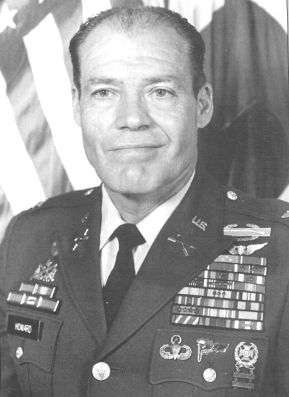
    COL Robert L. Howard, US Army
    July 11, 1939 – December 23, 2009
     

    Ask many Americans who Audie Murphy or Sergeant York or George Patton – or many other famous American military figures are – and you’ll likely get at least a fair number who know who you’re talking about. But ask them if they know who Robert Howard was, and I’d guess 95% or more would give you a blank look – or would say “He was some soldier, right?”.

    That’s a damn shame. The man deserves far better than that.

    (more…)

  • July 4th, 1953, The Bridge to Pork Chop Hill

    MCPO NYC USN (Ret.) sends us a story written by Capt. James A. Brettell, the commander of Company A 13th Engineer Bn. of his experiences on the 4th of July 60 years ago;

    On July 6, the Chinese, launched their last attack of the Korean War at Pork Chop Hill under the cover of darkness and the rains. It was ferocious and unrelenting. The 17th infantry suffered heavy casualties in the initial onslaught.

    Pre-arranged counter attack plans were implemented immediately. Each of these plans included use of “A” Company supporting engineers. A squad of engineers were assigned to each company of the 17th and regularly practiced counter attack procedures. The engineer troops had pre-arranged basic loads of ammunition, satchel charges, bangalore torpedoes. mines, radios and rations that each individual carried with him for use in the counter attack.

    You should read the rest.

  • One Hundred Fifty Years Ago Today: Hell and High Water

    Note:  this is a republication of an article from several months ago.  Today, it’s apropos. Although actions continued at Culp’s Hill and Cemetery Hill on 3 July, this was indeed the main action of the day.

    ___________

    Gettysburg.

    To any American with even a rudimentary knowledge of military history, that word speaks volumes. The battle itself, its historical impact, the heroism, the second-guessing . . . . all of these are legendary. Literally hundreds of books have been written concerning various aspects of the battle and its aftermath.

    Yet certain parts of the battle remain under-appreciated today. That’s true even of some that are well-known.

    In fact, that’s true for one of the great acts of heroism which occurred at Gettysburg. IMO, it’s one of the greatest acts of collective heroism in military history – ranking with Gideon’s Band, the Spartans at Themopylae, and the Charge of the Light Brigade. Yet it is an action for which none of the participants received any substantial personal recognition other than after-the-fact praise. The human cost was extreme. And it remains controversial even today.

    But that’s to be expected. Any military operation involving 52+% casualties should be expected to have both heroic and controversial aspects. That’s especially true when it involves roughly 12,500 men.

    I’m referring to Pickett’s Charge.

    (more…)

  • One Hundred Fifty Years Ago Today: Gettysburg, Day 2

    The Battle of Gettysburg continued today in 1863.  Union and Confederate forces continued to arrive overnight and during the morning of 2 July.  Forces were positioned for and prepared for battle during that time.  For many reasons, Lee’s second day attacks did not begin until relatively late in the afternoon.

    Many of the engagements today and their locations are well-known:  the Devil’s Den, the Wheatfield, the Peach Orchard, Little Round Top, Culp’s Hill, and Cemetery Hill (significant fighting at the latter two would continue into day 3).  Other sources describe these actions well.  Suffice it to say that the valor displayed during all engagements was extraordinary.

    One point of comparison is worth noting.  Antietam is often referred to as the bloodiest single day in US military history.  In terms of casualties, that is correct; close to 23,000 Americans were killed or wounded in one day at Antietam.  But Gettysburg’s second day appears to have seen more intense combat, albeit for a shorter duration.

    Action at Antietam lasted roughly 12 hours.  In contrast, the Gettysburg battlefield was largely quiet until approximately 4 PM – and fighting had ended by 10 PM.  In that six-hour period, it is estimated that roughly 16,800 Americans were killed or wounded.

    Take a moment today to remember the heroism, the sacrifice – and those lost – one hundred fifty years ago today at Gettysburg.  That’s worth remembering.

  • 150 Years Ago Today: Gettysburg

    Today is the 150th anniversary of the beginning of the Battle of Gettysburg.

    The battle would rage for three days.  It is generally regarded as one of the turning points in the US Civil War.  Indeed, many historians regard it as the turning point after which Confederate independence was no longer possible.

    Gettysburg was a classic meeting engagement; it was never intended to be fought at all.  It was enabled by the absence of much of the Confederate cavalry from Lee’s Army of Northern Virginia, whose commander – “Jeb” Stuart – had gone on his famous but foolish “ride around the Union army”.   This act deprived Lee of reconnaissance assets that would have alerted him to the close presence of the enemy.

    The battle began when Confederate troops of Harry Heth’s division approached Gettysburg (according to Heth’s memoirs, looking for supplies – particularly shoes).  They were discovered by Union cavalry under John Buford screening the Chambersburg Pike northwest of Gettysburg.  Buford recognized the critical value of the high ground south Gettysburg (Cemetery Ridge), and – with no support and no guidance – on his own initiative decisively deployed his troops to delay the Confederate advance.

    This act, which could easily have destroyed his command, was in retrospect likely the event that both ensured the battle and the Union’s victory.  Union troops under John Reynolds, Abner Doubleday, and Oliver Howard arrived in time to relieve Buford and prevent the destruction of his command (a very near thing) – and to fight a delaying action keeping Cemetery Ridge in Union hands.

    Reynolds was killed by a Confederate sharpshooter shortly after arriving. He would be among the first of many to die during the battle.

    Units from both sides arrived piecemeal during the day, and went into battle as they did.  Confederate forces seized Gettysburg and the high ground east of town – Seminary Ridge.  But the Union held possession of the critical ground at Cemetery Ridge at the end of the day.

    Confederate forces would never possess Cemetery Ridge.  Lee would nearly break his army attempting to seize it from them.

    Lee failed.  With that failure, in the opinion of many historians the Confederacy’s chances of independence also failed.

    Wickipedia’s article on the Battle of Gettysburg is actually a rather good overview of the battle’s events.  If you have some time today and need or want a refresher, it’s worthwhile – as are the articles describing Day 1, Day 2, and other specific actions occurring as part of the battle (Little Round Top, Cemetery Hill, Culp’s Hill, Pickett’s Charge, Third Day Cavalry Battles ) in more detail.

    And while you’re reading it – or otherwise going about your daily business – also take a moment to remember the heroism and sacrifice that occurred 150 years ago today over the three day period beginning at about 7:30 AM.
  • Marine Osprey pilots awarded DFCs

    The Stars & Stripes reports that Marines MAJ Michael Hutchings and CPT David Haake are the first Osprey pilots to earn the Distinguished Flying Cross for their actions over Afghanistan on June 27, 2012;

    Hutchings led his section in flying a reconnaissance raid force into an enemy area, according to his award citation. When he was flying in the second wave of the force, his Osprey was hit by rocket-propelled grenades and medium machine-gun fire, causing extensive damage to critical flight control systems, the citation reads.

    Yet Hutchings was able to land and unload the remaining recon Marines and fly his crew safely back to their base at Camp Bastion. Once back, according to the citation, Hutchings “quickly reassessed the extraction plan” and returned to the site of the battle to bring the recon Marines home.

    Haake also flew Marines into the firefight, according to his award citation.

    Their commander, MG Robert Hedelund, said that it was just Marines taking care of Marines and Hutchings, in a manner characteristic of real heroes, said “I couldn’t have done anything without my Marines”.

  • Glen Coffee from the NFL to Fryar Drop Zone

    Glen Coffee

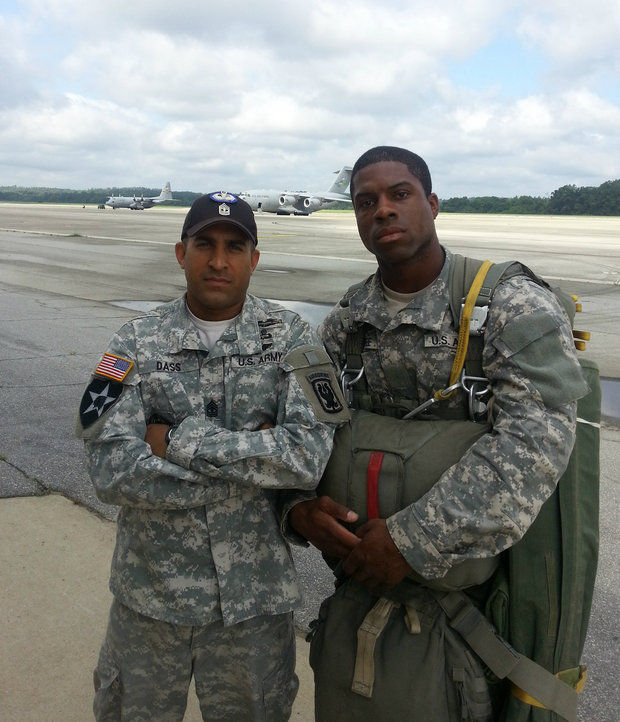
    Preston and Andy sent us links to the story of Glen Coffee, the former 49ers running back for whom the NFL didn’t give him thrills – so he joined the Army. He is slated to graduate from the Army’s Basic Airborne Course today on his way to Fort Bragg and Special Forces training;

    “I’ve always considered myself a warrior, somebody who would fight for what he believed in,” Coffee told AL.com. “It hit me like, ‘What do you think the military does and what do you think the military is full of? Warriors. All of a sudden, I had this respect for the military and I just realized that there is no America without the men and women who serve this country.

    “I figured that if I’m able, the Lord’s blessed me with an able body while I’m young, to get out there and get dirty.”

    Welcome and good luck, Glen.