Category: Navy

  • I Finally Broke the Code!

    You folks in the Navy think you’re so damn smart.  You encrypt your enlisted rank abbreviations so that no one knows what rank you are!

    But that won’t work any more.   I’ve finally done it.  I’ve found the decryption key!  Here it is!

    Yes, I’m being facetious above.  But I – and I’m sure many others – find Naval enlisted rank/rate abbreviations confusing as hell.   Being from another service (Army), I’ve never been able to make much sense of them.

    The linked document is what appears to be a relatively complete listing of Naval rank abbreviations – archaic and current – I found on a website belonging to the VA’s National Cemetery Administration.  I certainly will find it useful.

    I’m sure I’m not alone in being “lost” on this subject,  so I thought I’d post it here also.  Hopefully some others will find it useful as well.


    (Edited to add:  a shorter version of the current Navy enlisted rank/rate abbreviations,along with an explanation of the method to construct them, can be found here.  Hat tip to TAH reader CBSenior for this second list.)


  • 10 camouflaged patterns is nine too many

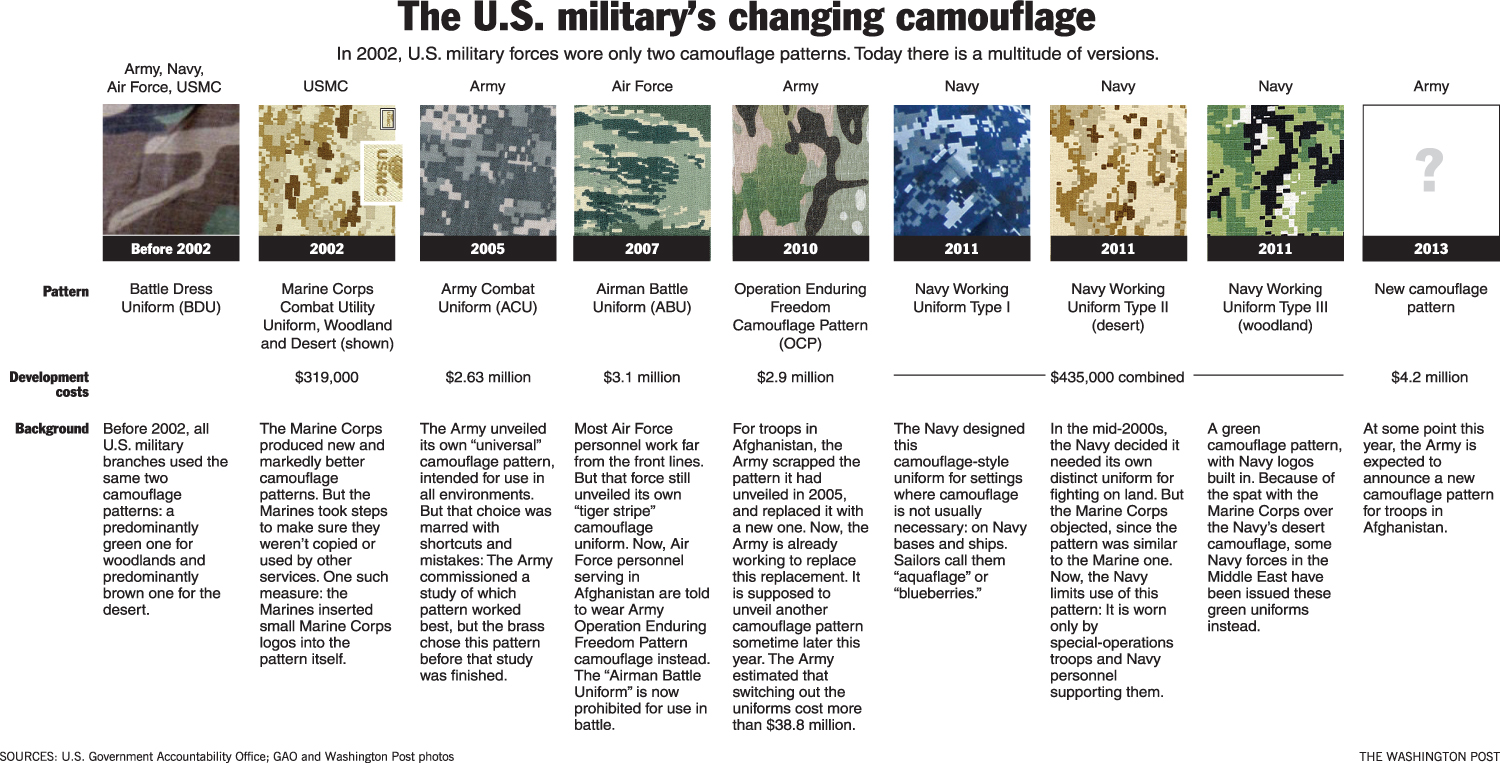
    When I left the military in 1994, there was one camouflaged pattern for all of the services – the “woodland” pattern, and we also had a desert uniform for people who were living in the desert. But as the Washington Post reports, the Pentagon has ten different patterns that it’s paying for with tax payer dollars;

    Today, there is one camouflage pattern just for Marines in the desert. There is another just for Navy personnel in the desert. The Army has its own “universal” camouflage pattern, which is designed to work anywhere. It also has another one just for Afghanistan, where the first one doesn’t work.

    Even the Air Force has its own unique camouflage, used in a new Airman Battle Uniform. But it has flaws. So in Afghanistan, airmen are told not to wear it in battle.

    In just 11 years, two kinds of camouflage have turned into 10. And a simple aspect of the U.S. government has emerged as a complicated and expensive case study in federal duplication.

    Somehow, people think that their uniform is an essential part of fighting wars. It really isn’t. Especially if you look at the Navy’s and Air Force’s uniforms which don’t hide anyone from anything. The Stars & Stripes has a chart which tracks the uniform changes over the last few years;

    The U.S. military's changing camouflage

    The Pentagon has spent billions of dollars going through the motions of picking “the best” pattern for their purposes and then changing their minds. But it’s all so much mental masturbation, since most of the wars we fought, the troops didn’t wear any camouflaged pattern and they still won the actual battles. The services are like a bunch of teenagers fretting over what cool new clothes they want to wear for the first day of school. But in the end, troops’ uniforms in combat all end up the same color – whatever color the dirt is in their particular area of operations. So all of that exercise that the pogues at Natick Labs go through has no real impact on the battlefield, but their jobs are secure for the next billion-dollar “back-to-school” shopping spree.

  • Navy Lt. Michelle Lea: Saving the world one person at a time

    IslandPacket.com tells the story of Navy Lt. Michelle Lea, a physician assistant, on her way to work when she came across the scene of an accident in which a hulking garbage truck had T-boned a pickup truck;

    The pickup driver, the lone occupant, was thrown to the passenger side on impact. The truck’s heavily tinted windows prevented a clear view of the interior. Lea climbed quickly into the truck’s bed and looked through the rear window.

    The driver was unconscious and struggling to breathe.

    Lea pushed the upper half of her body through the small window and began performing a “jaw thrust” — a maneuver designed to open the man’s airways without destabilizing his spine.

    It worked.

    He started breathing.

    Paramedics soon arrived and took the injured driver to Beaufort Memorial Hospital.

    The man, whose identity has not been released, survived and continues to recover.

    The Navy Public Affairs Office reports;

    “My first thought was that there was no way the driver was alive,” said Lea. “The garbage truck was completely sitting on top of the driver’s seat.”

    Doing what she was trained to do, Lea immediately performed a jaw thrust, which improved the accident victim’s breathing. Soon after, the victim began to regain consciousness, becoming combative and disoriented. Lea stabilized his cervical spine as best she could and remained with the patient until emergency medical personnel arrived on scene.

    “Lt. Lea is an exemplary naval officer and an outstanding physician assistant,” said Capt. Joan Queen, the commanding officer of Naval Hospital Beaufort, who presented Lea with her award. “Her actions upon arriving at the scene of an accident show that she is not only a dedicated health care provider, but an asset to the command, the Navy, and even the local community.”

  • Navy Corpsman Receives Silver Star

    HM1 Benny Flores – a Navy Corpsman – was awarded the Silver Star today at Camp Pendleton, CA.  The award was for heroism HM1 Flores displayed while deployed with USMC elements in Afghanistan last year.

    HM1 Flores’ heroic actions occurred in Zaranj, Nimruz province.  During April 2012, a vehicle in which he and other Allied forces were traveling was hit by a suicide bomber.  HM1 Flores rendered immediate medical assistance to the wounded of that attack and during the resulting 20-minute firefight afterwards.  During these actions, HM1 Flores exposed himself repeatedly to enemy fire in order to render assistance to friendly casualties.  At least 4 times he left a covered position in order to render assistance to and/or recover US and other friendly casualties in exposed locations.

    Well done, HM1 Flores.  Well deserved kudos.

  • Navy takes nine months to drop hammer on Ward

    You probably remember when we wrote about Navy Cmdr. Michael Ward II, who fell in extramarital love on line, pretended to be a SEAL with his new girlfriend, got a submarine command and then pretended to die to get rid of his new girlfriend. Then his girlfriend showed up for his funeral, which, of course, didn’t happen which made her turn him in to NCIS, the Navy guys, not the TV show (although, I think they did that one already).

    Well, that was back in August, and now it’s April, and the Navy has decided that Ward should be honorably discharged, says the Washington Times;

    Cmdr. Ward asked to remain in the service during the hearing, and his lawyers argued that despite his mistakes, the case came down to personal misconduct that should not destroy what had been a highly distinguished career. But attorneys for the government countered that Cmdr. Ward discredited the Navy and that his removal put a strain on the fleet because officers had to be shuffled around to cover his removal.

    “This is not a case of lapsed judgment; this is case of no judgment,” said NavyLt. Griffin Farris, acting as prosecutor at the hearing.

    […]

    Still, the Navy shouldn’t throw away his talent and training, said high-ranking officers with whom Cmdr. Ward has served. They said he made an awful mistake and that he was a fast-rising, hard-working officer.

    In other words, he sucks up to superiors at light-speed and he has a purty mouth.

    He should have been allowed to retire nine months ago and saved the tax payers his full pay, if this is as tough as they’re going to be on him. Of course, this is just a recommendation from the board, and Ward’s commander can accept their recommendation or not, but I suspect, if the Navy is like the Army, he’ll retire at full pension and you’ll probably see him on a roster of contractors within the allotted time that officers are allowed to do that. If his wife doesn’t smother him in his sleep first.

  • Forty-Four Years: In Memoriam

    We call the period between the end of World War II and the end of the Soviet Union the “Cold War”.  And in truth, it wasn’t an all-out, no-holds-barred global fight like World War II.

    But it wasn’t always particularly “cold”, either.

    The US and USSR (through allies) engaged in numerous wars by proxy throughout that period.  Korea, French Indochina, the Hukbalapap Rebellion in the Philippines, Quemoy/Matsu, the Arab-Israeli Wars, Vietnam, Indonesia, Malaysia, the Congo, Angola, Afghanistan, Grenada – the number of proxy conflicts, as well as casualties, were extensive.

    Even disregarding proxy wars, direct hostile fire incidents involving US and/or either Soviet or Soviet-client forces were not unknown.  Some such incidents are reasonably well-known:  the 1968 seizure of the USS Pueblo; the murder of MAJ Arthur Nicholson in East Germany in 1985; the 1976 Panmunjom Ax Murder Incident; the 1983 downing of KAL-007.  But our collective memory for many if not most such incidents has faded to the point that most are remembered only dimly, if at all.

    Such Cold War hostile fire incidents were far more common than most people realize.  The Defense POW/Missing Personnel Office maintains a list of 126 US personnel still unaccounted for due to 14 Cold War aircraft losses.  Two of these incidents (and 18 of the personnel still unaccounted for) were apparently not due to hostile action – but the other twelve aircraft and 108 personnel were indeed lost due to hostile fire.  And these 14 incidents are nowhere near a complete list of even Cold War aerial hostile fire incidents; it records only those where US personnel are still missing and formally unaccounted for.  A more comprehensive list of such Cold War aerial hostile fire incidents may be found here.  There were also numerous other hostile incidents on ground and at sea.

    Perhaps the deadliest single Cold War hostile fire incident involving US forces is today virtually unknown.  Like the USS Pueblo, it was the result of hostile action by a Soviet client – North Korea – and involved the US Navy.  But unlike the USS Pueblo, no US survivors returned.

    The 44th anniversary of that incident occurs shortly before midnight EDT tonight.

    (more…)

  • 50 Years Ago

    null

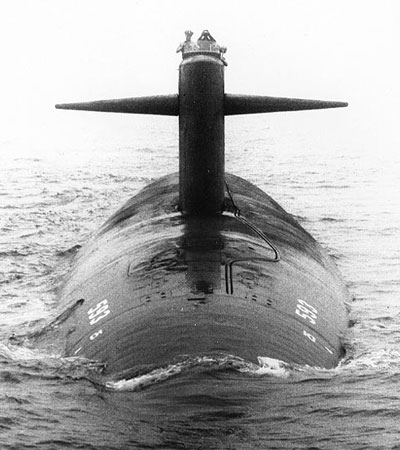
    50 years ago today, USS THRESHER (SSN-593) departed on her ill-fated voyage after having undocked and completed an overhaul period at Portsmouth Naval Shipyard. She transited to a point about 200 miles off Cape Cod with 129 crew and civilian shipyard engineers and technicians, and commenced a series of dive tests to verify her work in the shipyard. She successfully completed a series of tests on 9 April and remained submerged overnight.

    On the morning of 10 April, THRESHER commenced another series of dive tests. The approximate timeline of that fateful day is as follows:

    07:47 Thresher begins its descent to the test depth of 1,000 ft (300 m).

    07:52 Thresher levels off at 400 ft (120 m), contacts the surface, and the crew inspects the ship for leaks. None are found.

    08:09 Commander Harvey reports reaching half the test depth.

    08:25 Thresher reaches 1,000 ft (300 m).

    09:02 Thresher is cruising at just a few knots (subs normally moved slowly and cautiously at great depths, lest a sudden jam of the diving planes send the ship below test depth in a matter of seconds.) The boat is descending in slow circles, and announces to Skylark she is turning to “Corpen [course] 090.” At this point, transmission quality from Thresher begins to noticeably degrade, possibly as a result of thermoclines.

    09:09 It is believed a brazed pipe-joint ruptures in the engine room. The crew would have attempted to stop the leak; at the same time, the engine room would be filling with a cloud of mist. Under the circumstances, Commander Harvey’s likely decision would have been to order full speed, full rise on the fairwater planes, and blowing main ballast in order to surface. The pressurized air rapidly expanding in the pipes cools down, condensing moisture and depositing it on strainers installed in the system to protect the moving parts of the valves; in only a few seconds the moisture freezes, clogging the strainers and blocking the air flow, halting the effort to blow ballast. Water leaking from the broken pipe most likely causes short circuits leading to an automatic shutdown of the ship’s reactor, causing a loss of propulsion. The logical action at this point would have been for Harvey to order propulsion shifted to a battery-powered backup system. As soon as the flooding was contained, the engine room crew would have begun to restart the reactor, an operation that would be expected to take at least 7 minutes.

    09:12 Skylark pages Thresher on the underwater telephone: “Gertrude check, K [over].” With no immediate response (although Skylark is still unaware of the conditions aboard Thresher), the signal “K” is repeated twice.

    09:13 Harvey reports status via underwater telephone. The transmission is garbled, though some words are recognizable: “[We are] experiencing minor difficulty, have positive up-angle, attempting to blow.” The submarine, growing heavier from water flooding the engine room, continues its descent, probably tail-first. Another attempt to empty the ballast tanks is performed, again failing due to the formation of ice. Officers on Skylark could hear the hiss of compressed air over the loudspeaker at this point.

    09:14 Skylark acknowledges with a brisk, “Roger, out,” awaiting further updates from the SSN. A follow-up message, “No contacts in area,” is sent to reassure Thresher she can surface quickly, without fear of collision, if required.

    09:15 Skylark queries Thresher about her intentions: “My course 270 degrees. Interrogative range and bearing from you.” There is no response, and Skylark’s captain, Lieutenant Commander Hecker, sends his own gertrude message to the submarine, “Are you in control?”

    09:16 Skylark picks up a garbled transmission from Thresher, transcribed in the ship’s log as “900 N.” [The meaning of this message is unclear, and was not discussed at the enquiry; it may have indicated the submarine’s depth and course, or it may have referred to a Navy “event number” (1000 indicating loss of submarine), with the “N” signifying a negative response to the query from Skylark, “Are you in control?”]

    09:17 A second transmission is received, with the partially recognizable phrase “exceeding test depth….” The leak from the broken pipe grows with increased pressure.

    09:18 Skylark detects a high-energy low-frequency noise with characteristics of an implosion.

    09:20 Skylark continues to page Thresher, repeatedly calling for a radio check, a smoke bomb, or some other indication of the boat’s condition.

    11:04 Skylark attempts to transmit a message to COMSUBLANT (Commander, Submarines, Atlantic Fleet): “Unable to communicate with Thresher since 0917R. Have been calling by UQC voice and CW, QHB, CW every minute. Explosive signals every 10 minutes with no success. Last transmission received was garbled. Indicated Thresher was approaching test depth…. Conducting expanding search.” Radio problems meant that COMSUBLANT did not receive and respond to this message until 12:45. Hecker initiated “Event SUBMISS [loss of a submarine]” procedures at 11:21, and continued to repeatedly hail Thresher until after 17:00.

    Recent reports suggest that the last transmission from THRESHER at 0917 might have meant that the boat was 900 feet greater than her designed test depth of 1300 feet, or 2200 feet. It’s estimated that she imploded in less than a tenth of a second at a depth of 2400 feet, nearly double her test depth and greater than her design crush depth of 2000 feet.

    The loss of the boat was due to several factors:
    –Joints subjected to sea pressure were often silver-brazed joints, which were susceptible to leaking.
    –The scram (shutdown) of the reactor also caused the main steam stops to close, preventing use of residual steam being produced to be used for propulsion.
    –In the EMBT (Emergency Main Ballast Tank) blow system, 4500 psi air is taken from tanks located inside the ballast tanks, through “knocker valves” and into the main ballast tanks themselves. Prior to underway, THRESHER used “shore air” to pressurize their EMBT cylinders. This air had very high moisture content. When the emergency blow was conducted, this air was redirected through piping as small as one inch in diameter, and the reduction in pressure and lowering of temperature caused the moisture to freeze and plug the EMBT piping, preventing more air from getting into the main ballast tanks.

    What was learned from the loss of THRESHER was put to use in what is called the SUBSAFE system. Welds replaced brazed joints. New procedures allowed propulsion to be maintained even in the event of a plant shutdown. More robust piping for the EMBT systems, and many other changes were implemented. From 1915 through 1963, 16 submarines were lost due to non-combat conditions. Since THRESHER, only one has been lost: USS SCORPION (SSN-589), which was not a SUBSAFE boat and whose cause for her loss has never been conclusively determined.

    Another reminder for submariners that “There is no such thing as peacetime underway” and the inherent hazards of the sea.

    USS Thresher’s name was retired, but she was never struck from the commissioning list. She remains “on eternal patrol.”

    Sailors rest your oars.
  • I Think I Finally “Get It”!

    Why the Navy seems so odd to everyone else, that is.

    It’s simple.  They think and look at the world differently.

    Here’s an example.  In any sane world, room 5D22 generally is next to (or maybe across the hall from) room 5D23.

    On a ship – or in a building laid out by a Navy contractor – it’s often completely on the other side of the ship or building.  That’s called the “even/odd rule”.

    Also, decks above the main deck are levels, not decks – even though they’re decks.  Decks including and below the main deck – those are decks.  And the main deck may or may not be big one that’s open to the air (it’s not on a carrier).  And so on.

    Once you realize that, why the Navy seems “different” to everyone else all starts to kinda make sense.

    You nautical types are kinda weird, but we love you anyway. (smile)