Category: Navy

  • A Promise Kept

    Two days ago, a US Korean War veteran landed in Pyongyang, Korea.  His name is Thomas Hudner.

    Hudner was a Naval aviator during the Korean War.  On 4 December 1950, his wingman – Jesse Brown – was shot down near the Chosin Reservoir.

    Hudner located the crash site, and noted his wingman was still alive. He then crash-landed his own aircraft near the remains of Brown’s plane.  He attempted to save his wingman.

    Sadly, Brown was severely injured – possibly fatally.  And in any case, Hudner was unable to free him, even after air-rescue arrived.

    Hudner stayed with his wingman until he’d lost consciousness.  The he departed with search and rescue.

    Brown’s last words to Hudner were a whispered, “If I don’t make it, please tell Daisy I love her.”  (Daisy was Brown’s wife.)  Hudner agreed. 

    Hudner’s last words to Brown were, “We’ll come back for you.”

    Hudner indeed kept the first promise: he sought out and told Mrs. Daisy Brown her late husband’s final words. And although it’s taken over 62 years, he’s now kept both promises.

    Hudner is in Pyongyang with a JPAC search party. They have secured permission to search for Ensign Jesse Brown’s body near the Chosin Reservoir in North Korea.

    . . .

    For the record: ENS Jesse L. Brown was the first African-American Naval Aviator. He was also the first US Navy officer killed in Korea. Obviously, that means that LT(JG) Thomas Hudner was white.

    Doug Sterner’s excellent site “Home of Heroes” has a wonderful article that gives much more background on LT(JG) Hudner and ENS Brown. Go there and read it; it’s definitely worth your time. Keep a kleenex or two handy.

    Doug’s article is entitled “No Man Should Die Alone”. I probably don’t need to explain what that means to anyone reading this site.

    For his actions that day, ENS Jesse Brown was awarded the Distinguished Flying Cross. Sadly, it also came with a posthumous Purple Heart.

    For his actions that day, LT(JG) Thomas Hudner was later awarded the Medal of Honor.
  • Drone fails in third landing attempt

    130710-N-LE576-002

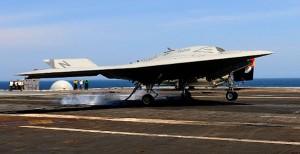
    I’m digging through my inbox but I don’t see any emails from the Navy Office of Information about this one; the Stars & Stripes reports in a Virginian-Pilot article, that the Navy’s drone failed on it’s third attempt at landing on a carrier;

    After two successful autonomous tailhook landings on the George H.W. Bush on Wednesday, the craft took off for a third attempt. During that flight, one of the three computers used for navigation on the prototype X-47B failed, Rear Adm. Mat Winter told reporters during a conference call Thursday.

    The other two computers recognized the failure, and the craft responded the way it was programmed to, he said. It alerted the mission operator, who directed the craft to the nearest landing site on shore, on Wallops Island.

    Well, at least, they should be glad that it worked the way it should- it recognized the problem and reported it to the controller. That’s something, right?

  • Navy’s first drone carrier landings

    George H.W. Bush is conducting training operations in the Atlantic Ocean.

    The Navy’s Office of Information sent us pictures and videos of the first carrier landing of a drone on the USS George HW Bush yesterday. Here’s a video of the first and second landings;

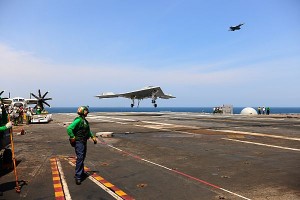
    USS GEORGE H. W. BUSH, At Sea (NNS) — The X-47B Unmanned Combat Air System (UCAS) demonstrator completed its first carrier-based arrested landing on board USS George H.W. Bush (CVN 77) off the coast of Virginia July 10.

    “It isn’t very often you get a glimpse of the future. Today, those of us aboard USS George H.W. Bush got that chance as we witnessed the X-47B make its first ever arrested landing aboard an aircraft carrier,” said Secretary of the Navy Ray Mabus. “The operational unmanned aircraft soon to be developed have the opportunity to radically change the way presence and combat power are delivered from our aircraft carriers.”

    Today’s demonstration was the first time a tailless, unmanned autonomous aircraft landed on a modern aircraft carrier.

    This test marks an historic event for naval aviation that Navy leaders believe will impact the way the Navy integrates manned and unmanned aircraft on the carrier flight deck in the future.

    George H.W. Bush is conducting training operations in the Atlantic Ocean.

    “Today we witnessed the capstone moment for the Navy UCAS program as the team flawlessly performed integrated carrier operations aboard USS George H.W. Bush with the X-47B aircraft,” said Capt. Jaime Engdahl, Navy UCAS Program Manager. “Our precision landing performance, advanced autonomous flight controls and digital carrier air traffic control environment are a testament to the innovation and technical excellence of the Navy and Northrop Grumman team.”

    The July 10 landing was the final part of three at-sea test periods for X-47B during the last eight months, culminating a decade of Navy unmanned integration efforts that show the Navy’s readiness to move forward with unmanned carrier aviation says Rear Adm. Mat Winter, who oversees the Program Executive Office for Unmanned Aviation and Strike Weapons in Patuxent River, Md.

    “This demonstration has enabled us to merge industry and government technologies together which will enable the U.S. Navy to pursue future unmanned aviation carrier capabilities,” said Winter, who witnessed the historic landing. “The government engineering and testing team in partnership with our Northrop Grumman team members have matured the technologies in this X-47B system to position us for today’s event, which marks a milestone in naval aviation.”

    During today’s testing, the X-47B completed the 35-minute transit from Pax River to the carrier and caught the 3 wire with the aircraft’s tailhook. The arrested landing effectively brought the aircraft from approximately 145 knots to stop in less than 350 feet.

    Shortly after the initial landing, the aircraft was launched off the ship using the carrier’s catapult. The X-47B then proceeded to execute one more arrested landing.

    “We have been using the same [carrier] landing technology for more than 50 years now and the idea that we can take a large UAV and operate in that environment is fascinating,” said Capt. Jaime Engdahl, Navy UCAS program manager. “When I think about all of the hours and all of the work-ups the team put into executing this event, I had no doubt the air vehicle was going to do exactly what it was supposed to do.”

    “Across the entire spectrum of military operations, an integrated force of manned and unmanned platforms is the future,” said Secretary of the Navy (SECNAV) Ray Mabus. “The X-47B’s autonomous arrested landing aboard USS George H.W. Bush shows how the Navy and Marine Corps are riding the bow wave of technological advances to create this 21st century force.”

    The X-47B spent several weeks aboard aircraft carriers in recent months. The Navy UCAS program successfully completed CVN deck operations aboard USS Harry S. Truman (CVN 75) in December 2012 and aboard Bush in May. During the May underway period, the X-47B completed its first-ever catapult launch. Since May, the integrated test team conducted a number of shore-based arrestments at Pax River in preparation for the demonstration aboard the ship.

    “We have learned a lot from our flight deck operations, our shore-based flight test and extensive modeling and simulation,” Engdahl added. “Our team has executed all major program objectives and developed the concept of operations and demonstrated technologies for a future unmanned carrier-based aircraft capability. [Today] we have proven we can seamlessly integrate unmanned systems into the carrier environment.”

    “We have certainly come a long way in the 102 years since Eugene Ely made the first arrested landing aboard an aircraft carrier. Naval aviators have always been at the forefront of operational and tactical innovation, and today was no exception,” said Mabus. “People make unmanned aviation possible and it is people who will provide the fresh thinking and new ideas so crucial to successes like the X-47B program and the unmanned aircraft of the future.”

    The Navy will continue to update this story as more information from today’s demonstration is made available.

    For more information on USS George H.W. Bush follow the ship’s fan page on Facebook at http://www.facebook.com/USSGeorgeHWBush.

  • A Forgotten Hero Remembered

    In 1892, Luke M. Griswold died.  He was buried in Oak Grove Cemetery, Springfield, MA.

    Griswold had been a sailor.  He had been in the US Navy, and had served in the Civil War. 

    Griswold was far from common, however.  He was a Medal of Honor recipient. 

    Sadly, he was also a forgotten Medal of Honor recipient.  His grave was a common and plain one.  Indeed, there was not even a headstone marking his life and passing.  Instead, only a stone with the engraved number “297” marked his resting place.

    For over 120 years, that was the situation.  And that’s how things would have probably stayed.  Except . . . one man found that unacceptable.

    Some years ago, J. Donald Morfe of Baltimore, MD – an Army veteran – learned that the final resting places for many Medal of Honor recipients were not marked with proper headstones.  He found this troubling.

    Since learning of that sad situation Morfe, working together with other volunteers, has convinced various government or private organizations to fund proper headstones for many these heretofore unmarked heroes.  They’ve arranged markers for 220 so far.  Griswold’s was the latest.

    Some might ask, “Why this is important?” 

    The answer is simple:  “Poor is the Nation that has no Heroes, but beggared is the Nation that has, and forgets them.”

    Kudos, Mr. Morfe.  Many thanks.

  • Navy Gets Two Right

    The Navy has caught flack recently regarding naming its ships.  But recently the Navy announced names for two new ships that are IMO apropos.  One will be named after a former SECNAV; the other, after a MoH recipient.

    DDG-117 will be named for Mr. Paul Ignatius.  Mr. Ignatius was a Navy Lieutenant during World War II.  He served as Assistant Secretary of Defense (Installations and Logistics) and as Secretary of the Navy during the LBJ administration.

    The next destroyer to be built will be named after the late Senator Daniel Inouye.  As a member of the US Army’s 442nd Regimental Combat Team (RCT), then SGT Inouye received a battlefield commission for his actions during the 442nd RCTs breakthrough to rescue World War II’s “Lost Battalion” (1st Batalion, 141st Infantry, 36th Infantry Division) in the Vosage Mountains of France in late October 1944.  He was later awarded the Distinguished Service Cross for gallantry in action at San Terenzo, Italy, on 21 April 1945.  Senator Inouye’s DSC, along with decorations of 19 other members of the 442nd RCT, were later upgraded to the Medal of Honor.  At the time of his death in December 2012, Senator Inouye was the second-longest serving Senator in US history.

    I can’t argue with naming a ship after a Navy Veteran who later became SECNAV.  And even if he wasn’t Navy, IMO any former MoH recipient is a fitting choice as a namesake for a US Navy ship.

    Kudos to the SECNAV for getting these two right.

  • 45 Years Ago Today

    May 22, 1968 marks the date of the loss of USS SCORPION (SSN-589) the only other time in the nuclear era in which a submarine was lost, coming just over five years from the loss of USS THRESHER (SSN-593). SCORPION was returning from a Mediterranean deployment to her homeport of Norfolk, VA. Her loss, unlike that of the THRESHER, was not immediately noted–only when she failed to return from deployment and declared lost with all 99 on board on June 5th, 1968.

    Her wreckage was discovered later that year due to the work of Dr. John Craven and others from the Navy’s Special Projects Division and SOSUS groups. What is certain is that an explosion or catastrophic failure of some sort cause her to go down in 10,000 feet of water a few hundred miles off the Azores. What has not, nor will it likely ever be conclusively determined, is what caused that explosion. Theories have been suggested that it was anything from a battery fire, to a “hot run” torpedo and detonation, to an encounter with a Soviet submarine.

    What is certain is this–the sea is a very demanding environment, and a very unforgiving one.

    Sailors, rest your oars.

  • The Herndon Climb; May 20, 2013

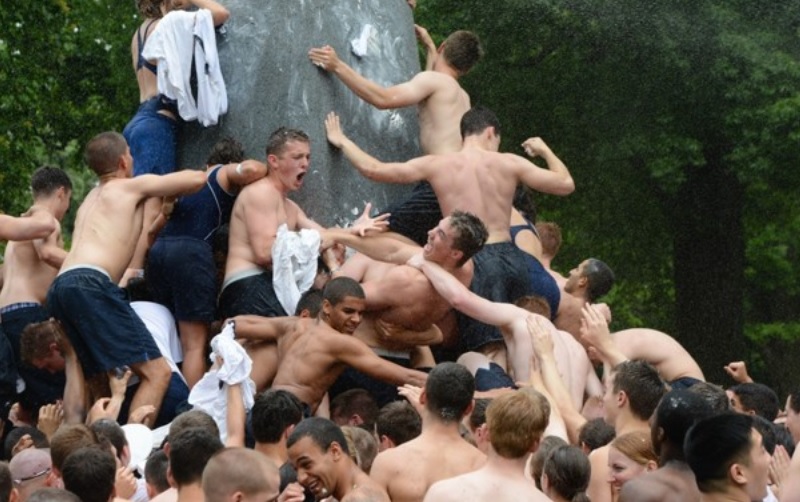
    From the Washington Post. The Navy only looks ghey;

    Herndon Climb

    The greased Herndon Monument is pictured before the event. The plebes climb to the top of the lard-covered, 21-foot-high statue and remove the “dixie cup” hat at the top, replacing it with an upperclassman’s hat. After completing this, the freshmen are called “fourth-class midshipmen.” This class completed the task in 1 hour, 32 minutes and 43 seconds. The hat was placed by Patrick Lien from Orlando.

  • UAV Launch from USS GHW Bush (CVN77)

    GHW Bush UAV launch

    VTWoody and the Navy PAO sent us some information on the unmanned aerial vehicle launch from the deck of the USS George HW Bush today;

    GHW Bush UAV Launch 1

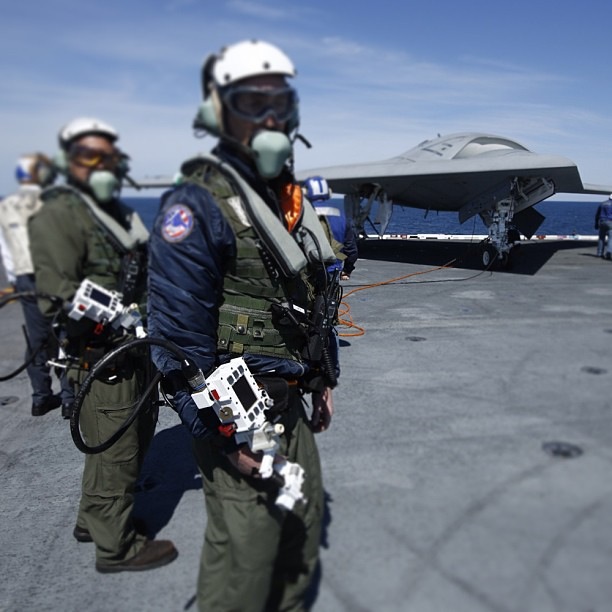
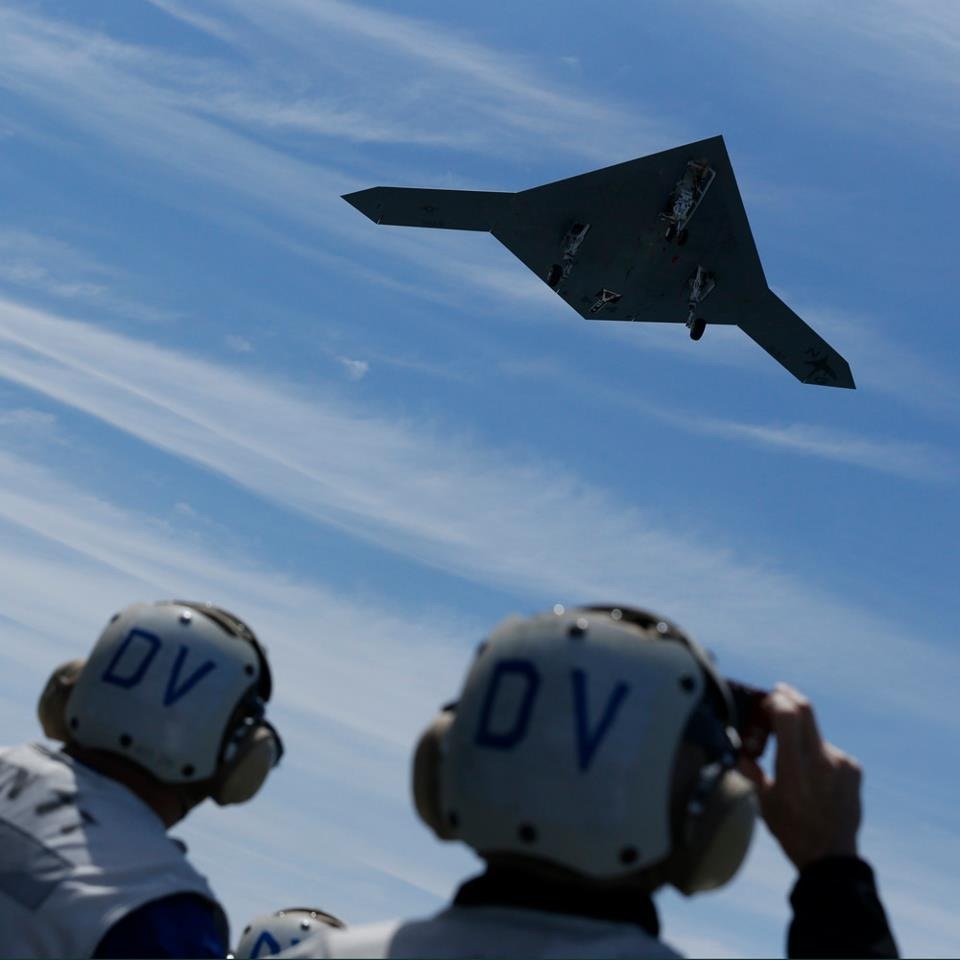
    USS GEORGE H.W. BUSH, at sea — The X-47B Unmanned Combat Air System demonstrator (UCAS-D) completed its first ever carrier-based catapult launch from USS George H.W. Bush (CVN 77) off the coast of Virginia today.

    “Today we saw a small, but significant pixel in the future picture of our Navy as we begin integration of unmanned systems into arguably the most complex warfighting environment that exists today: the flight deck of a nuclear-powered aircraft carrier,” said Vice Adm. David Buss, commander, Naval Air Forces, the Navy’s “Air Boss”.

    The unmanned aircraft launched from the deck of George H.W. Bush at 11:18 a.m. It executed several planned low approaches to the carrier and safely transited across the Chesapeake Bay to land at Naval Air Station Patuxent River, Md., after a 65-minute flight.

    Buss called the launch a “watershed event” in naval aviation and said he expects that decades from now, a future “Air Boss” will have a picture of the X-47B launching from Bush behind his or her desk just as he has a picture of aviation pioneer Eugene Ely’s first-ever landing on the deck of a ship in 1911 behind his desk today.

    Completing another important first for the UCAS-D program, the team demonstrated the ability to precisely navigate the X-47B within the controlled airspace around an aircraft carrier at sea and seamlessly pass control of the air vehicle from a “mission operator” aboard the carrier to one located in the Mission Test Control Center at NAS Patuxent River for landing.

    “The flight today demonstrated that the X-47B is capable of operation from a carrier, hand-off from one mission control station to another, flight through the national airspace, and recovery at another location without degradation in safety or precision,” said Matt Funk, lead test engineer for the Navy UCAS program.

    Videos of the launch and landing below the jump
    (more…)