Category: Military issues

  • No Nork War Just Yet

    Here’s more news about Norkiland, including a reference at the end to the solar storms generated by a large sunspot (a cluster?) going on right now.

    https://www.cnbc.com/2017/09/08/north-koreas-next-missile-launch-could-come-saturday-as-it-plays-chicken-with-us.html

    The article references changing the angle of the missile’s guidance system to a flatter trajectory to hit a specific target. Guam was his last threat (here) which means that he’s still peeved at not getting quite enough attention, and it’s all out fault.

    It’s mostly rehashing what was on the news last night, but since Irma is more of an attention hog than the Cheeseslayer, the reports on Noriland’s chief Numbnuts were slim.

    However, Pres. Trump did indicate that while warfare is a possibility, it will be a sad day if it does come to that. http://www.reuters.com/article/us-northkorea-missiles-system/trump-sad-day-for-north-korea-if-u-s-takes-military-action-idUSKCN1BI07P?feedType=RSS&feedName=topNews

    Here’s a reminder from a couple of days ago that Kim Cheese does have some big boomers.  From 09-06-2017 – a Google Earth shot of landslides at Nork nuke test site: http://www.bbc.com/news/world-asia-41170940

    And in case anyone thinks it was just another possible false flag, this is the USGS’s seismic report of an explosion in that area, followed by a 6.3M quake on 9-4-2017:

    https://earthquake.usgs.gov/earthquakes/eventpage/us2000aert#executive

    Well, really, if ND:tBF is that anxious about getting attention, he needs to lawyer up, hire a disbarred sloppy attorney from Florida to represent him and sue Pres. Trump because he’s not getting enough attention from us. They have similar personalities and Fatty Kim da T’ird has a lot of cash from his suspected theft of Bangla Desh’s $81 million deposit account in the New Yok  Federal Reserve Bank earlier this summer

  • A Slap In the Face

    On 9/3/2017, an emergency meeting of the UN Security Council was requested by he United States, Japan, France, the United Kingdom, and the Republic of Korea Request

    Here’s the press release:  https://usun.state.gov/remarks/7952

    This is a link to the transcript of Amb. Nikki Haley’s address at the Emergency UN Security Council Briefing on 9/4/2017:   https://usun.state.gov/remarks/7953

    You must read it before you react.  She is not mincing words in this address at all.  To quote her final sentence: “Twenty-four years of half measures and failed talks is enough. Thank you.”

    Here is a transcript of her additional remarks https://usun.state.gov/remarks/7954

    Ambassador Nikki Haley

    U.S. Permanent Representative to the United Nations

    U.S. Mission to the United Nations

    New York City

    September 4, 2017

    AS DELIVERED

    Mr. President, due to the urgency of the situation with the nuclear test, as well as the announcement by North Korea that they are planning for another ICBM test, we want to urge the Council to move very quickly on this.

    I think that North Korea basically has slapped everyone in the face in the international community that has asked them to stop, so the United States will be circulating a resolution that we want to negotiate this week and vote on on Monday. So just wanted to let the members know.

    I know that some are going to Addis, but we wanted to make sure that we will do that on Monday when we can get those negotiations finished. Thank you.

    ” slapped everyone in the face” is not mincing words at all.

    Fatty Kim da T’ird is itching for a fight. As Amb. Haley says, he wants a war. That much is as clear as a bell.  Anyone who thinks that, because I point and snicker at him, I don’t take him seriously, is badly mistaken.

    I grew up under the constant implied threat of nuclear war with Red China and the Soviet Union. Our house was barely 10 miles from ground zero in a target city, with a heavy equipment factory, a grain processing plant, an electronics factory, a tire factory and a sizable railyard.  Those are still in place today, as well as an additional grain processing plant. Both of these companies process corn and soybeans for the fuels industry. In addition to these, the  hospital where my mother worked is now a major medical teaching hospital, and the university that I graduated from has expanded its curriculum exponentially into current events, as well as adding two new master’s degree programs some time back.

    Any large city was a target city, whether it was New York, Chicago, Los Angeles, San Diego, or Washington, DC, and whether or not it was near a military base. Pensacola, FL, was and still is home to Navy tech schools and ships, and a naval aviation training command.  It was a target city then and still is today.

    I think it’s far past time we got (Vlad Putin) Russia and (Xi Jinping) China, along with Japan, France, Israel and South Korea, into the White House for another kitchen table conference. And maybe it’s time someone put the screws to Iran, once and for all.  Vlad Putin (smooches) has stated that sanctions do not work on North Korea.  http://www.express.co.uk/news/world/850109/north-korea-news-latest-war-usa-trump-nuclear-bomb-missile-test-launch-south

    I miss the Cold War more than I thought I would.

  • And the Beat Goes On….

    Russia is nervous about the Norks? So it seems. It appears, per this Reuters article, that Russia’s somewhat doveish approach to Norkiland is not doing so well. The Russian government is continuing trade with the Norks, but in a more moderated way.  https://www.reuters.com/article/us-russia-northkorea-trade-idUSKCN1B81BO

    According to Galushka’s statement, the Russian government is sticking to the guidelines of its trade agreement with North Korea. But there is an alternative side to this, from HuffPo, which deserves a view. And once in a while, HuffPo publishes something worth looking at.

    We can all view the contrasts between the two Koreas, North and South, in this series of photos by the tourist, who followed a strictly guided tour a year ago in Norkiland. It’s worth a few minutes of your time to see the contrast between the two, if you want to watch his video. His first image, of the contrast between the two Koreas at dusk, is indicative of the rest of the images he provides.

    http://www.huffingtonpost.com/entry/north-korea-photos_us_59a07221e4b06d67e3377f37

    There are also, from South Korea’s NIS agency, indications that the Norks are going to engage in a 6th nuclear test at Punggye-ri. I don’t know how accurate CNN’s article is, but the link is here: http://www.cnn.com/2017/08/28/asia/north-korea-missile-test/index.html

    Stock your pantry shelves.

  • We Gonna Show You!!

    It’s the usual stuff with Norkiland: we gonna bump up missiles, we gonna launch ‘em at you, we gonna show you we Da Big Cheeses. We gonna bomb Guam!!!

    So the threats toward Guam didn’t work. Guam went about its day-to-day business. Guamaians got interviewed by reporters who may have never heard of that US island territory until the week before last week. We did discover, however, that Guam has a lot of cuisine involving Spam and that they’re happy to be a territory of the U.S. They welcome tourists and want our business. I still don’t know why that birdbrained blowhard hasn’t threatened the Marianas, but maybe his maps are outdated??

    Yesterday (Aug. 25), he decided to up the scare tactics, by running his own drills.

    10.10am: Kim Jong-un prepares to invade South Korean Islands (Express.co.uk article:  http://www.express.co.uk/news/world/846077/North-Korea-v-USA-latest-news-live-updates-Kim-Jong-un-launch-missiles)

    “Kim Jong-un is preparing his soldiers to take over a South Korean island, North Korea’s state propaganda has revealed. In a series of simulated drills, warplanes and missile launchers bombarded a mocked-up war zone. Simulated attacks on South Korea’s border islands of Baengnyeong and Yeonpyeong saw paratroopers leap from planes while others swept into position on dinghies. The DPRK state media said Kim “expressed great satisfaction” with the exercises.”

    He did launch three missiles yesterday. One of them exploded and the other two fell into the Sea of Japan. The Japanese indicated they knew and weren’t worried about it.

    Before that, he was making a nuisance of himself with his stated intentions to sell missiles and nukes to Syria and Iran.

    That pesky solar eclipse took up a lot of room on the news, so ND:tBF went on another tantrum binge, threatening this and that, and finally settled on selling his deadly stuff to Syria and Iran.  Ah, but wait! There’s more, isn’t there?  He was already doing that, wasn’t he?  http://www.express.co.uk/news/world/844704/North-Korea-news-United-States-sanctions-sell-weapons-Syria-Iran-Donald-Trump-World-War-3

    Well, the South is taking him seriously. They’re running drills on everything, which is not really new. They’re just broadcasting it more. I believe the Chinese still have troops at the Nork-China border, as a buttress against potential swarms of refugees fleeing the North. If the North did test an H-bomb in June, as Fatty Kim da T’ird has bragged, he’s pushing his agenda harder and harder. There was a seismic event in June located in northwestern Norkiland, registered at 5.1M. That’s either a massive quake over there, or he really did let off a big one.

    Per the 2nd and earlier article, he does intend to sell his products to Syria and Iran. I thought Iran was posting along nicely with its own nuke missile program, or was that just another hysterical, partial-truth report from the Clowndog News Network? While Norkiland is under UN sanctions to not do what they’re doing, they just keep on keeping on, moseying on down the trail to the launch button. He needs money, which he isn’t getting from China right now, to work on his hard-driving nuclear missile program.

    Ms. Emily Landau, from the Institute for National Security Studies, says ‘it’s all about money’, in regard to Fatty Kim da T’ird’s posturing. From the 2nd Express article: “Emily Landau, a senior research fellow and head of arms control program at the Institute for National Security Studies, warned Mr. Trump’s sanctions could force North Korea to sell its weapons if it is required to raise funds.”  Okay, but, Emily, weren’t the Norks and their Secret Squirrel Cage hackers the chief suspects behind the Wannacry virus a few weeks ago?  https://www.wired.com/2017/05/wannacry-ransomware-link-suspected-north-korean-hackers/

    (I know, I know: those guys cashed in their chips.) And weren’t they the chief suspects in the theft of hu-u-u-u-uge sums of cash from the Federal Reserve Bank in New York City? She does admit that he will sell his weapons to anyone who will pay the price.

    I’ve got an extra $5 this month. Does anyone think he’d sell me a nuke missile for my home defense system? Anyone? Bueller?


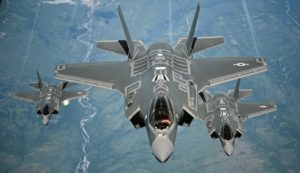
  • Some F-35 Acquisition Projections

    A few days ago, Poetrooper wrote an article concerning foreign sales for the F-35.  In preparing comments to that article, I did a bit of research on the aircraft’s financials.

    The information I found was, to put it mildly, troubling.  So I decided I’d do a bit of “what-if” gaming to see what happens if reality intrudes on DoD’s plans with respect to the F-35.

    The basic financials for the F-35 program are not pretty.  Neither are the “what ifs”.  In fact, both are damned scary.

    So I decided to write this article.  I’ve tried to keep it as simple as possible, while still being as accurate as I can within the time I have available to chase facts.

    And no, PT – you’re not gonna like this article.

    . . .

    This article is structured into three parts.  The first part is a description of some the information I’ve found to date regarding F-35 financials, adjusted to 2017 dollars as necessary.  The second part is a “quick and dirty” analysis of what happens to the F-35’s unit and overall costs under several scenarios.  The third part is my attempt to put things in perspective – to answer the “So what?” question regarding the F-35.

    The article’s a bit long as it is.  So I’m not planning on presenting the details of my calculations in this article.  If there’s demand, I can edit the article to include a link to a “prettied-up” version of the spreadsheet I used to make the calculations.

    . . .

    Part I – Current F-35 Financials

    Wikipedia gives the following information regarding the F-35 program financials, as of 2015.  Though the immediate source is Wikipedia, their source was official program documentation from the F-35 PMO; I’ll thus take it as legit.

    • RDT&E Costs (2015):  $55.1 billion
    • MILCON:  $4.8 billion
    • Procurement:  $319.1 billion

    Now, this isn’t the breakout we need for projections – we need Development Cost and Procurement Cost instead.  And we shouldn’t simply use the RDT&E amount above as
    “Development Cost” without first determining whether or not that’s even close to correct.  Some portion of the RDT&E costs will be spent during production for follow-up testing, and some portion of the procurement costs will have been spent during development.

    However, since those portions in question will each likely be small, we probably won’t be too far off if we assume they balance each other.  So if we consider the RDT&E funding to be the F-35’s development cost and the combination of MILCON and Procurement funding the F-35’s Procurement Cost, we shouldn’t be too far off.  (The MILCON costs likely will go to setting up production and maintenance facilities associated with the aircraft, so they should fall under the Production Cost umbrella)  Hey – this is a “quick and dirty” estimate; it’s not a detailed budget projection.

    If we do that, that gives us the following starting point numbers:

    • Est Development Cost (2015):  $55.1 billion
    • Est Procurement Cost (2015):  $323.9 billion
    • Total Est Program Acquisition Cost (2015):  $379 billion

    Now, that’s in 2015 dollars (duh).  Converting to 2017 dollars ($1.00 in Jun 2015 had the purchasing power of $1.03 in Jun 2017, per the BLS CPI calculator), based on those Wikipedia numbers we get the following:

    • Est Development Cost (2015, in 2017 dollars):  $56.753 billion
    • Est Procurement Cost (2015, in 2017 dollars):  $333.617 billion
    • Total Est Program Acquisition Cost (2015, in 2017 dollars):  $390.37 billion

    However, it turns out those 2015 costs are no longer current.  The F-35 PMO publicly indicated last month that updated financials for the F-35 are now available.  Those new numbers indicate that the F-35’s Program Acquisition Cost has gone up to $406.5 billion in terms of 2017 dollars.

    That’s an increase, in terms of 2017 dollars, of $16.13 billion since 2015.  Since the F-35 PMO said that increase is split between RDT&E, MILCON, and Procurement funding, I’m going to assume the proportions of each in the increase are the same as they were in 2015. (They might not be in the same proportions, but since I don’t know one way or another that assumption seems reasonable.)  That yields the following

    • Updated Est Development Cost (2017):  $59.098 billion
    • Updated Est Procurement Cost (2017):  $347.402 billion
    • Updated Total Est Program Acquisition Cost (2017):  $406.5 billion

    Again:  these financial numbers probably aren’t exactly correct, but they’re probably close enough to do reasonable “what if” games to see what happens to program and unit costs if Congress or DoD decides to start reducing quantities.  Any errors should be reasonably small.

    The same Bloomberg article that gave the revised program costs seems to indicate a total planned production for the F-35 of 2,456 aircraft.  This yields an average Program Acquisition Unit Cost for the F-35 of $165.5 million – or over twice that of the F/A-18E/F.  And knowing the total number of F-35s projected to be produced is also the final piece of information we need to do reasonable “what if” games.

    What Happens If Quantities Are Reduced?

    Ok, the above are all based on the assumption that 2,456 F-35s will be produced.  So, what happens if the numbers to be built get cut?  Based on past DoD procurement history over the last 2 decades, we know that’s pretty damned likely.

    In broad terms, we already have a good idea of what should happen.  The overall Program Acquisition Cost will drop – but the unit cost will rise.  But by how much in each case?

    To figure that, we need to make some assumptions about the average flyaway cost of the F-35.  And we have the info to make some reasonable guesses about that, though we don’t have the details.

    The F-35 is expected to enter production in FY2018.  The PM has indicated he is confident he can make his flyaway cost target of about $85 million each for the F-35 in 2019 and (presumably) beyond.

    We don’t know what the add-ons to the flyaway cost will be needed to yield procurement cost will be.  But I can’t see them being more than about 5% of flyaway cost, so I’ll use that as a worst-case figure.

    Further, the flyaway cost tends to drop over time as I’ve discussed in an earlier article.  So the average flyaway cost of the last 1500 or so F-35s to be produced (231 have already been built) will likely be less than the 2019 figure.  How much less?  Dunno.

    Further, the F-35B and C models cost more.  I don’t have current figures for the flyaway costs of the B and C models, but most to be produced are the A model – so I’m going to assume it all comes out to a single figure “in the wash”.

    So for this part, I’m going to use 3 assumptions for flyaway cost of the items cut:  $85m average (the target cost for FY2019), $75M average (assumes the flyaway cost goes down substantially before we start cutting quantities), and $65M average (since that’s a nearly 25% reduction, this IMO essentially assumes the proverbial “. . . and a miracle occurs”).  I’m also going to assume the estimated Program Acquisition Cost of $406.5 billion is dead on target.

    Case 1:  Constant Flyaway Cost from FY2019 On

    This scenario is probably not terribly reasonable, as production costs tend to go down over time and I’m guessing the PMO is probably counting on that.  Nonetheless, it gives a good starting point.  That starting point is:

    • Program Acquisition Cost:  $406.5 billion
    • Total Produced:  2,456
    • Unit Acquisition Cost:  $165.5 million

    But what happens if either Congress or DoD cuts production?  After all:  recent history says that’s rather likely.

    Specifically, what happens if DoD or Congress says, “Nope – can’t afford those last 1,000.  Airforce, Navy, USMC:  you guys figure out how to split the 1,456 we actually will buy.”

    Now, as noted above the unit cost for the F-35B and C models is higher, so the mix will affect the overall average.  But I’m not going to attempt to deal with those complications on a quick-look analysis like this article.

    Anyway, here’s the impact, assuming a “salami-slice” cut (everyone gets an equal % reduction), based on an average flyaway cost of $85M per F-35 cut:

    • Program Acquisition Cost, 1456 total aircraft:  $317.25 billion
    • Unit Acquisition Cost:  $217.891 million

    Yep – the overall program’s acquisition cost goes down by $89+ billion.  But while the Program Acquisition Cost goes down, the unit cost for the aircraft goes up by $52+ million.  Why?  Because that $59+ billion in development costs (and the MILCON) are now spread over fewer items.

    So, what happens if we only end up producing, say, 1000?  Here ya go:

    • Program Acquisition Cost, 1000 total aircraft:  $276.552 billion
    • Unit Acquisition Cost:  $276.552 million

    Yep, the trend continues.  Program cost went down more – this time by nearly $130 billion.  But the unit cost for the bird has now grown by over $100M with respect to the original plan.

    Those numbers were ugly enough (in terms of unit cost) that I didn’t bother to run the 750 or 500 total production scenarios.

    And believe it or not, it gets worse.

    Case 2:  Flyaway Cost Reduced Moderately During Production

    I regard this as the most reasonable scenario.  Here, I project that we learn enough during the first 1000 F-35s produced that we can reduce the average flyaway cost from that point forward to $75M per aircraft.  I’m guessing I’m guessing the PMO is probably counting on something along those lines, though maybe not that exact amount.  I’m also assuming here that the $406.5 billion Program Acquisition Cost figure from the PMO released last month remains accurate.

    Here, there’s no impact if all 2,456 are built.  In that case, unit and total costs remain the same – $165.5M and $406.5B, respectively.

    But that’s not the case if DoD or Congress says, “Nope – can’t afford all of that.  Reduce the number produced.”  For a reduction to 1456 total aircraft, here’s what we get.

    • Program Acquisition Cost, 1456 total aircraft:  $327.75 billion
    • Unit Acquisition Cost:  $225.103 million

    Huh?  Wait a minute.  Both the program’s Acquisition Cost and the Unit Cost went UP with respect to the previous case?

    Yes, they did.  We removed the 1000 lowest-cost items produced – which cost less each than in the previous case.  Since we assume the total program cost of $406.5 billion is unchanged, that means the costs under this scenario were perforce proportionally more “front-loaded”.  The net effect is that we saved less overall (and ended up with an even higher unit cost to boot) by cutting the same number of items.

    It’s even uglier if production is cut to 1000 total:

    • Program Acquisition Cost, 1000 total aircraft:  $291.840 billion
    • Unit Acquisition Cost:  $291.84 million

    Under this scenario, we’re approaching a unit cost of $300M per aircraft.

    Case 3:  Flyaway Cost Reduced Substantially During Production

    I regard this as the least reasonable scenario.  Here, I project that we learn enough during production of the first 1000 F-35s that we could reduce the average flyaway cost from that point forward to $65M per aircraft, but that the $406.5 billion Program Acquisition Cost figure from the PMO released last month and remains accurate.  I don’t think we’ll see this happen, but you never know.

    As before, there’s no impact if all 2,456 are built.  In that case, unit and total costs remain the same as in the other two cases.

    Now, what happens if DoD or Congress says, “Nope – can’t afford that.  Reduce the number produced.”  For a reduction to 1456 total aircraft, here’s what we get.

    • Program Acquisition Cost, 1456 total aircraft:  $338.35 billion
    • Unit Acquisition Cost:  $232.314+ million

    Just like before, both Program Acquisition Cost and the Unit Cost went UP with respect to the previous case.  As before, we removed the 1000 lowest-cost items produced – but this time, what we removed cost even less than before.  So what we saw before in terms of rising program and unit costs got more extreme.

    It’s even uglier under this case if production is cut to 1000 total:

    • Program Acquisition Cost, 1000 total aircraft:  $307.128 billion
    • Unit Acquisition Cost:  $307.128 million

    There ya go.  Under this scenario, we now have a single-seat fighter aircraft that cost Uncle Sam $300+M each.  Isn’t that just dandy?

    Some Perspective, AKA the “So What?”

    So, what does all this mean?  Well, I’ve got a couple of thoughts along those lines.

    First:  the F-35 has been termed the most expensive weapon system ever.  That’s accurate.  We’re talking $406.5 billion just to buy it.  Operating and maintaining over its anticipated life span it will cost nearly 3x that (current estimate is somewhere around $1.1 trillion).

    To put that in perspective, I’ve seen various estimates for the cost of procuring a carrier battle group (CBG) – including both ships and aircraft – ranging from $20 billion to $40 billion.  Assuming a CBG procurement cost of $30 billion on average (CBGs vary in size, and $30 billion is the midpoint of the range), that means we’re planning to spend enough on the F-35 alone to replace all 10 existing Navy carrier battle groups – plus buy 3 additional CBGs, and still have $16.5 billion left over.

    Even at the higher end of estimated CBG cost ($40 billion), we’re still talking enough to replace all 10 Navy CBGs.  And that still leaves $6.5 billion to “play with”.

    That matters because we’ll need other new things too over the next 3 decades.  Obviously, F-35 is hardly the only new weapons system we need to develop during the next couple of decades.  Hell, it’s hardly the only new aircraft the USAF will need over the next 25+ years – which is how long the F-35 is projected to be in production (until 2044).  But if we’re going to spend $400+ billion on it . . . where do we get the $$$ for the others?

    The F-35 may end up being a great aircraft.  Or it might not be.  But it doesn’t matter how damn good it is if we can’t afford to procure enough of them to do the job – or if buying it means the rest of DoD is left Bravo Delta due to lack of money to train/operate/maintain, or due to obsolete equipment because we can’t afford to buy anything else new.

    I just don’t see how we can afford it.  Not if we’re going to have enough funding left to buy the other new stuff we need, plus train/operate/maintain.

    Second:  consider what this could do in terms of forcing leadership to be more risk-adverse.  (Arguably, we’re already too risk-adverse as it is.)  Let’s say the unit cost of a F-35 ends up being around $200M after all is said and done.  That could very easily happen if quantities procured fall significantly short of what’s projected today, and it’s my guess that it indeed will.  Remember:  best-case, they’re going to cost around $165M each anyway – and that’s only if we build all 2,450+ of them that are currently planned.  Build fewer, and the unit cost goes up.

    A typical squadron has between 12 and 24 aircraft.  Let’s say the average is 18.  That means a squadron commander now “owns” aircraft worth $3.6 billion dollars.  A wing commander will own probably 3 or 4 times that much in terms of aircraft cost.  Wow, that’s gonna look great on their OERs!

    Well, it certainly will – unless something happens to one of those aircraft due to an accident, bad maintenance, or even wartime losses. Then . . . who’s gonna be blamed?

    Now I’m not an aviator.  But last time I checked, the entire chain-of-command sometimes felt the pain of one dumbass decision (or honest mistake) by a relatively junior troop.  How’s that gonna play out for the chain-of-command when some wannabe sh!t-hot young and inexperienced fighter jock crashes a $200M aircraft by doing something foolish or reckless?  Or cuts a maneuver too close, and gets into a midair – and takes out $400M worth of Uncle Sam’s property?  Or when a maintainer misses something, and $200M ends up a “smoking hole” as a result?

    My guess is that it will be seriously bad news for both his squadron and wing commanders – hell, I think something like that already is bad news for the entire chain-of-command.  But I’d guess it will be far worse for the chain-of-command than it is today when the financial loss of such an incident is $200M (or $400M or more).  And I’m guessing that because of this possibility, a risk-adverse attitude (“Don’t take any chances with your equipment!”) will filter down to their subordinates, too – including their maintainers, who will find themselves being even more “under the gun” regarding aircraft maintenance than they are today.

    That’s not necessarily a good thing.  We don’t need timid or risk-adverse military leaders leading troops in combat any more than we need reckless fools doing the same.  Either can be a prescription for disaster.

    . . .

    As I said, I’m no aviator.  I could be wrong above.  But it seems to me that this bird is simply not affordable – even it ever it works as proponents claim it will “real soon now” in all respects.  And based on what I’ve seen to date, I’m damned pessimistic about it ever working “100% as advertised”.

    I think we need to cut our losses here, and go back to the drawing board.

    Any weapon system has to be affordable enough to buy in the first place – and to risk losing it while training or in combat.  Otherwise, it’s nothing but a wet dream made real for developers and manufacturers that’s of little military utility.

    I just don’t think we can afford this one – no matter how good it eventually may be.  It’s not the only new system DoD will need over the next 25 years.


    (Addendum:  for what it’s worth, assuming we’ve spent roughly 85% of the development cost of the F-35, or about $50 billion, so farper this Wikipedia article it appears that we’ve already spent roughly $96 billion on developing and procuring the F-35 through 2016.  [Spending for the F-35 for 2017 doesn’t seem to be available there.]  For production to date of 231 F-35s of all types, that works out to an average unit acquisition cost of around $415.4 million as of this year.

    And costs for the system continue to rise above projections as time goes by.)
  • Some More Thoughts on Weapons Systems Costs and Their Uses

    The other day, I published an article describing the 8 distinct (and different) costs DoD defines for weapons systems under development.  While I touched on the utility of some of them briefly, I didn’t really say much regarding how each of those costs can be used.

    They’re not meaningless bookkeeping exercises.  Each is useful – even if some are more useful than others.

    Today, I’ll discuss the uses of those 8 costs.  For ease of following along, I’ll follow the order used in my first article.  You can find that prior article here.

    Development Cost.

    It might seem as if examining development costs would be rather pointless.  And in truth, they are in general “sunk costs”.  Once they’re incurred, there’s no way to recover them.  Even if they program is cancelled, that money is gone. So why would we care about it?

    However, other than the obvious fact that the US taxpayer foots that bill, knowing a system’s development cost is useful in other ways.  The amount of development cost can be (and often is) an indicator of two things.  First, a high development cost in anything but a space system generally indicates one of three things:  (a) a program that is using “bleeding edge” technology, or is developing new technology altogether; (b) a program that is having difficulty and is having to “re-do” things, or (c) both.  Second, it often indicates that the system being produced may be a bit problematic – at least initially.

    A case in point is the B2.  It had a huge development cost – $29+B out of a total program cost of around $45B, though in fairness it’s production was curtailed by political action.  It indeed developed serious new technology (curved surface stealth) and made use of other highly advanced (for the day) technologies.   It also had a somewhat extended and troubled development, and is also reputedly somewhat difficult and expensive to maintain.  Draw your own conclusions regarding whether the those are related.

    Flyaway Cost.

    The flyaway cost (or sailaway or rollaway cost, if instead you’re talking about ships or ground systems) is actually a quite useful cost.  However, it’s not useful in perhaps quite the way you might think.

    For starters:  the flyaway cost does not give you the full cost to DoD of the system.  It doesn’t include development costs essential equipment that is required but not part of the system itself; initial spares; or a few other things.  So the flyaway cost isn’t the answer to the question, “How much did (or will) that (whatever) cost Uncle Sam?”

    Further, flyaway cost changes over time.  This is because as more of an item are produced production line efficiency improves.  The workforce gets more efficient; procedures get streamlined and improved, with “kinks” getting worked out; the management team gets more experience at managing the process; and the same all occurs with suppliers of components.  It’s not unusual to see the last of a particular weapon system produced have a far lower flyaway cost than the first.

    So, how is it useful?  It’s useful for projections.  Since the flyaway cost is the cost of producing one item, for systems near end of production the current flyaway cost is effectively the marginal cost of producing one more item than originally planned – or the savings associated with producing one less.  It can be used to answer such questions as, “How much would another 50 (whatevers) cost?” or “How much would cutting production by 25 save Uncle Sam?”  Decision-makers sometimes need to know this.

    Weapon System Cost and Procurement Cost.

    Weapons System Cost is simply Flyaway Cost plus the cost of other items (e.g., prime movers, system-unique test equipment and special tools, associated radios) that were not developed as part of the system under development, but which are nonetheless needed for its normal operation.  Procurement Cost adds to that initial spares and a couple of other things.  As such, the uses of these two costs – and the pitfalls associated with each – are effectively the same as for the Flyaway Cost.  Indeed, the Procurement Cost is actually what you want if you’re going to do accurate “what if” drills regarding changing numbers produced.

    Program Acquisition Cost.

    The Program Acquisition Cost is probably the most useful cost for answering the question, “How much will (or did) that (whatever) cost Uncle Sam to develop and field?”  This cost is the sum of Development Cost and Procurement Cost.  As such, it represents virtually everything DoD actually spends to develop a system and deploy it to the field.  So if that’s what someone wants to know the total cost to field a particular system – or wants to know how much each copy cost Uncle Sam to buy – that number is essential.

    What it does NOT include is the cost of actually operating the system.  So while it tells you how much $$$ is needed (or was spent) to buy it, it doesn’t tell you squat about how much you’ll spend to use the system for 10 or 20 or 30 (or more) years.

    For anything but a space system, Total Program Cost is generally only somewhere between 20% and 40% of the total cost of owning and operating the system.  So while you hear a lot about it for weapons being developed, it’s not even really the “biggie” in terms of overall $$$.

    Operations and Support Cost.

    Operations and Support Cost is what it costs to actually use the system after it’s fielded – e.g., fuel, maintenance, spare parts (other than initial spares), operator salaries, etc . . . .  While system developers determine these costs, their programs aren’t the one to pay for them – units operating the systems do.  So “Big Army”/HQAF/DoNavy/HQ USMC and their subordinate HQs are the ones who care about these.

    You have to know these costs in order to calculate future budget requests.  And as the bureaucrat from DC put it to the test pilots in the movie The Right Stuff:  “Funding. That’s what makes your ships go up . . . . No bucks, no Buck Rodgers.”

    Disposal Cost.

    Since this is the cost of demilitarizing and disposing of a system being retired, anyone involved in that activity needs to know this cost.  And while it’s usually a relatively small cost with respect to the overall system’s Life-Cycle Cost (next), it can still be substantial in absolute terms.

    It’s also an area that you really don’t want to neglect if you’re responsible for same.  Ask the folks who formerly worked at Edgewood Arsenal how not having enough funding to properly dispose of stuff worked out for them.

    Life-Cycle Cost.

    This is the total cost of ownership of the system – including buying, selling, and disposing of it when it’s no longer needed.  This is of keen interest to high-level policy makers in DoD who manage DoD’s budget and requests for funding.

    . . .

    That’s all for today.  In the next few days, I’ll take a bit more of an in-depth look at what we know about the F-35’s program costs  and production.  I’ll also do a bit of “what if” to project what might happen if (as is virtually certain to occur based on recent past history) the number currently planned to be produced is reduced due to lack of funding.

  • Cost Confusion

    This article was inspired by thoughts brought to mind by Poetrooper’s F35 article yesterday.

    . . .

    Here’s a conversation you might hear somewhere inside the DC Beltway:

    Congressional Staffer:  “So tell me, Mr. Program Manager – just what will one of those systems you’re developing for DoD cost?   Senator Whositz wants to know.”

    Program Manager:  “Well, that depends.  What cost does he want?”

    Congressional Staffer:  “C’mon, bud – don’t play games.  What will each of the systems cost?”

    Program Manager:  “I’m not playing games.  What cost does he want?”

    Congressional Staffer:  “Are you trying to get Congress to cut your program’s budget?”

    Introduction.

    The above might sound like an Abbot and Costello comedy routine – but it’s not.  When it comes to weapons systems, a question seemingly as simple as “How much will it cost?” can be hard to answer – because DoD, in it’s “infinite wisdom”, has defined at least eight distinct costs associated with a defense system under development.  Each means something different, and each is calculated differently.  And several (but not all of them) can be used, along with the total projected number of systems to be produced, to come up with a valid “unit cost” for the system by dividing the cost in question by the number of systems to be produced.

    And, yes – which one is quoted to the press often depends on politics and desired “spin”.

    The purpose of this article is to give an overview of the ways costs for DoD systems are calculated.  Just as importantly, it will also indicate what is – and what is not – included in each cost.

    To help understanding, I’ll try to relate these costs to something we all presumably know all too well:  the cost of owning a car.

    Obligatory warning:  the subject matter can be a bit soporific.  Might want to grab a caffeinated beverage or two before reading further.  (smile)

    . . .

    The eight costs DoD defines for a system under development are the Development Cost; the Flyaway/Rollaway/Sailaway Cost; the Weapon System Cost; the Procurement Cost; the Program Acquisition Cost; the Operations and Support Cost; the Disposal Cost; and the Life Cycle Cost.   All of these except Disposal Cost have been around for a while – since at least the release of DoD 5000.4-M in December 1992, and perhaps before.  The Disposal Cost is a relative newcomer.

    So, what do these costs mean, and how are they calculated? Glad you asked.

    1.  Development Cost.

    Development cost is pretty simple.  It’s essentially the cost of virtually all activities needed to develop a new weapon system from Day 1 up to the point of production.  This includes research and development (R&D); design and engineering activities; much if not the vast majority of the system’s test activities; extensive modeling and simulation (or model development), if required; development of new technology or materials, if required; construction of prototypes and test articles/systems; and other activities.  In short, it’s what you gotta do before you set up the production line to make sure the system “works” (the quotes are intentional).

    Development cost may be relatively small for a system using mature technology.  For one that was/is using “bleeding edge” technology (like the B-2), it can end up being a huge part of the total cost of getting the system to the field – particularly if the number of intended systems is cut dramatically after the program has begun.  (I’ll have more to say on that in a sidebar near the end of this article.)

    To reference this to buying a car, it’s what Chevrolet (or Honda or BMW or Hyundai) spends to design the model you bought.  The buyers of new cars pay this.  You’ll probably never know how much of the purchase price it was for your car.

    2. Flyaway/Rollaway/Sailaway Cost.

    This is generally the most-favorable (e.g., lowest) cost for the system.  It is the cost of producing the system, including the costs associated with setting up and running the production line.  No spares, no essential associated equipment, no personnel to operate it or maintain it, no supplies or fuel.  Just the end item.

    This cost will tend to go down over time.  The more systems are produced, the more widely the cost of setting up the production line gets distributed – and the more proficient the workforce tends to be at producing the item.  Both a current and an average flyaway/rollaway/sailaway cost can be calculated.  The current one is almost always the most favorable (lowest).

    For buying a car, this equates to most – but not all – of what you paid for the vehicle.  No insurance, no maintenance, no associated tools or other equipment you need – just part of the cost of the car.  (Part of what you pay is actually the manufacturer recovering some of their development costs and the dealer’s overhead, but for commercial items this isn’t information that’s typically readily available to the consumer.)

    3.  Weapon System Cost.

    This cost is defined as the cost of the system, plus any required equipment needed to make it fully functional.  For example:  if the system requires an already-existing generator or a prime mover (truck or track) or radio to make it fully mission capable – or if it requires special test equipment or tools that aren’t already in the system – then those costs get added to the “flyaway” cost to produce the Weapon System Cost.

    For buying a car, there isn’t any real hardware equivalent – unless maybe you were foolish enough to buy a Volt or some other fully electric vehicle that required you to install a charging station in your garage.  In that case, the cost of the charging station would be added.  However, mandatory charges such as taxes, title fees, and required insurance could arguably be added here – though these IMO better fit into the “Operations and Support Cost” category.

    4.  Procurement Cost.

    The procurement cost for an item takes the Weapon System Cost and adds a few things:  initial spares and (for ships) often also includes outfitting and post-delivery costs.  If memory serves, it also includes costs associated with initial training and transportation of the system to the field users; however, I’ve been away from the “game” for a bit, and no longer have access to some of my former references.   I could be wrong about those latter two items.

    If you tend to keep a spare set of plugs and filters on-hand, adding the cost of the first set of each you’d have to buy for a newly-purchased car might be an analog to the added costs here.  If you had to travel to pick up your new car and stay overnight, those costs could also be considered an “add-on” here – as could the charges for “dealer prep” and “transportation”.

    5.  Program Acquisition Cost.

    Program Acquisition Cost is the sum of Development Cost and Procurement Cost.  As such, it’s one of the overall figures that actually is meaningful.  Taking this figure, and dividing it by the projected number of such systems to be produced, gives a meaningful answer to the question, “How much will each of these systems cost?”

    Unfortunately, this is why reducing the numbers to be produced often causes the overall unit cost of a system to skyrocket.  If a system’s Development Cost was $1 billion, that adds $1,000,000 to the cost of each system if you plan to produce 1,000 of them ($1B/1,000 = $1M).  If the number produced is cut to 20, that means each system now gets ($1B/20) = $50,000,000 added to its unit cost.

    [Sidebar:  This is precisely why the B-2 ended up being a $2 billion aircraft.  Original plans for the B-2 called for 132 aircraft to be produced.  When this ended up being cut to 21, a huge development cost of substantially over $29 billion was “split” among only 21 aircraft – yielding a Procurement Acquisition Unit Cost for the B-2 of roughly $2.13 billion EACH ($44.75B / 21).  The flyaway cost for the B-2 was a bit over 1/3 of that, and would have continued to drop as more were produced.  However, even in that case IMO its average cost likely would have still been somewhere well above $500M each.]

    For the automobile example, this is much of what you paid for the car, with the other adds noted above for initial spare parts, tag, tax, title, etc . . . .  As noted above, the development costs are hidden in the sticker price of the car; you’ll pay a pro-rata portion of them regardless, but you’ll probably never know how that was broken down.

    6.  Operating and Support Costs.

    Operating and Support costs are simple in concept.  They’re what it costs to operate the system after it’s deployed.  This includes operator salaries; fuel and lubricants; maintenance; post-deployent engineering upgrades and fixes; spare parts other than initial spares, and all other costs associated with normal operations and maintenance.

    For most systems other than space systems, this is actually the single biggest cost category – anywhere from 50+% to 80% a typical military system’s life cycle cost, with somewhere around 2/3 being typical for non-software systems.  Space systems are the “outlier” here – they have much lower operating and support costs (and consequently higher development and procurement costs) than other military systems.  That’s generally because servicing a space system in orbit is still somewhat problematic.  (smile)

    Since they are paid out of O&M funds (or, for military salaries, the military personnel appropriation), you virtually never hear about these costs when systems under development are discussed.  That’s too bad, because they’re typically the lion’s share of the cost of any weapon system.

    An automotive analog is the recurring cost of license plates/insurance/oil/gas/filters/tires/brakes/other maintenance and repair that the vehicle requires post-purchase.  Drive a lot – or buy a lemon – and these costs are likely to exceed the purchase cost of the vehicle within a few years.

    7.  Disposal Cost.

    Although it seems as if we do, we really don’t keep military systems around forever.  Eventually they get retired.  But you can’t just haul them off to the local dump at end of life.

    Demilitarizing a former weapons system isn’t free.  The cost may be low (“SGT Jones – go check to see that none of the troops stuffed anything sensitive or classified in the glovebox or under the seats of that deuce-and-a-half we’re sending to PDO or left any personal gear there.”).  Or it may be high (think prepping a ship for sinking as an artificial reef – which is why many end up sold to shipbreakers for scrapping).  It may actually result in a gain for Uncle Sam – e.g., the proceeds of selling a former military vehicle at auction.  But it’s only coincidentally zero, so it’s a cost to be considered.

    For an automotive example, think selling that old clunker in the driveway –  or having to pay someone to tow it away.

    Life Cycle Cost.

    This is the true “whole enchilada” with respect to a DoD system.  It’s the total cost of buying, owning, using, and disposing of a system from Day One to the day the system is completely “washed out” of DoD’s inventory.  It’s the sum of Program Acquisition Cost, Operations and Support Cost, and Disposal Cost.  Counter-intuitively, it’s also not one you hear that much about.

    For an automobile, this is every penny you ever spent on that car.  Every last cent.  And for a privately owned auto, that neglects the value of your time, business use of car possibly excepted.

    . . .

    So What?

    So, how are these used?  Well, as one DoD organization frequently puts it:  “That depends.”  (smile)

    A PM trying to defending their program will generally try to make it seem as efficiently run and as low cost as possible.  That means they’ll likely focus any public statements on their system’s flyaway/rollaway/sailaway cost – typically the smallest of the costs – and will downplay others.  His or her position will be that, “Future improvements will keep those other costs under control, and we believe we’ll be able to lower them over time.”

    Conversely, a system critic will focus on making the system appear costly.  Life Cycle Cost will be something he or she is VERY interested in determining. Barring that, they’ll focus on either Operations and Support or Program Acquisition Costs.  The latter is generally available.

    Finally, when it comes to the unit cost of a particular system the number of items produced can matter A LOT.  Cut the numbers produced on a system with only minor Development Cost and there’s not a big effect.  Cut the numbers to be produced on a system with a huge R&D cost, and you could well triple the cost of the system.  That’s pretty much what happened on the B-2.

    In any event, a meaningful number for the real unit cost of developing a military system under development can be obtained from two pieces of information:  the Program Acquisition Cost and the total estimated number of systems to be produced.  Using those two, a “best case” overall projected average unit cost for the system in question can be calculated.  I say “best case” because reducing the number to be produced virtually always raises the overall unit cost of any system – the development cost gets spread among fewer units, and you see less production line improvement due to workforce learning.

    This is why I’m VERY concerned with the F-35. Per info I found yesterday while considering Poetrooper’s article about the F-35, the Program Acquisition Cost for the F-35 is currently estimated at approximately $406.5 billion.  The total number to be produced is currently estimated at 2,456.That yields a “best case” unit cost for the F-35 of $165+ million each.  That’s twice that of the F/A-18E/F.

    Reduce the number to be produced – either through Congress cutting the budget or foreign customers deciding that it’s simply too damn expensive – and we could conceivably see a unit cost of 2 or 3 times that.  Add to that the fact that it simply can’t adequately replace the A-10, and, well . . . the term “white elephant” comes to mind.

    Yes, that could indeed happen.  It already did once with the B-2.

    A weapon system that is too expensive to buy in sufficient quantity, or is too expensive to use, is worse than not having one at all.  It won’t do the job – and the money wasted on such a white elephant could easily have been used to buy something useful instead.

    . . .

    Well, I hope this helps.  Might have a detail or two wrong above (I have been away from that for a few years now), but I’m pretty sure it’s in general correct.


    References:

    https://dap.dau.mil/acquipedia/Pages/Default.aspx

    https://biotech.law.lsu.edu/blaw/dodd/corres/pdf/50004m_1292/p50004m.pdf

    https://dap.dau.mil/aap/pages/qdetails.aspx?cgiSubjectAreaID=8&cgiQuestionID=108656

  • Falling short is no reason to lie.

    I often think of those with whom I have served.  Too many men, better than I, fell short of completing their tour.  Injured in training, a family hardship, disease, and so much more.  Through no fault of their own, they fell short of their mark and returned home to no applause.   There are others of course, who made a bad choice and were sent out the gate with cause.  What becomes of those men who live with remorse and have to go on about their lives?

    Too often we find them reinventing past lives with badges and patches and pins…oh my.   But there are great men, better than I, who fell short of the finish line.  Do they live with remorse of what went awry, or do they stand up and hold their head high?

    To those who have served and think they fell short and never appear on our site, hold your head high you are a brother of mine, regardless of what you might think.  We should recognize those who fell short of their mark and silently live with remorse.

    There is no reason for that,  if they went on with life and did not embellish… that which they  knew was a lie.  They did more than most, and too many times, it could have been I who fell short… and went on to live with remorse.

    “There is no person so severely punished, as those who subject themselves to the whip of their own remorse.”
    Seneca the Younger

    Adam Driver – Wikipedia

    Shortly after the September 11 attacks, Adam Driver joined the United States Marine Corps and was assigned to Weapons Company, 1st Battalion, 1st Marines as an 81mm mortar man. He served for two years and eight months with no deployments before breaking his sternum while mountain biking. He was medically discharged before his unit deployed to Iraq for the Iraq War.

    Semper Fi