Category: Military issues

  • USMC considers no first enlistment Grunts.

    USMC considers no first enlistment Grunts.

    This kind of thing was toyed with back in the early 80’s.  Some people think Marines that are at least on their second enlistment are better killers.  Marine Corps Times reports:

    Older. Wiser. More seasoned. Deadlier.

    There’s a controversial idea taking root at the ­Pentagon: That Marines should wait an enlistment before joining the infantry, coming into traditional rifle squads only after getting some experience in another career field.  It would be a profound change that would make Marine infantry units older, but potentially stacked with additional skill sets.

    It would also further blur the line between ­conventional infantry Marine and special operator, as they’d be plucked from the same pool.

    I got plucked from the pool…we just worded it a bit different.

    Whether the 18-year-old grunt Marine model can continue to compete on the future battlefield is a question being scrutinized at the top levels of the Defense Department and among top officials close to Defense Secretary Jim Mattis, who is himself a former Marine infantry commander.

    One such man leading the charge is a retired general who chairs Mattis’ Pentagon task force focused on boosting lethality of grunts.

    “The optimal age for a close-combat soldier, the ­balance is … mid to late 20s,” retired Army Maj. Gen. Robert Scales told Marine Corps Times.

    That’s probably about right, I started at 17.  Most are done with their first marriage by their second enlistment, their pay goes out in allotments and the Driftwood has them  on the banned list, death doesn’t scare them anymore.  Some of us even have a stripe or two left.

    Today’s grunts have increasingly taken up the mantle of special operations missions where small detachments of Marines have deployed to advise and train foreign military units in remote and hostile ­environments — missions that require mature ­operators and problem solvers.

    Oh, they mean like Marines have always been doing.  I can tell them from experience, maturity comes on pretty fast when you’re on the chopper flying into a country you can not pronounce in the middle of the night.

    “Significant focus is being placed on the human dimension,” Marine spokeswoman Capt. Karoline Foote told Marine Corps Times. “We are evaluating and implementing improvements in how we recruit, train and retain our infantry Marines.”

    Ahh, I have read that kind of stuff before.  It’s one of those “say nothing in 20 words or more” things.

    “The way JSOC [Joint Special Operations Command] operates is a telling point,” he explained.

    Aaaaaaand there we have it.  People who have no idea what an EGA is, trying to dictate the manner in which Marines are to kill people.

    One option the Corps could consider is saving a large portion of infantry slots for a second enlistment. A benefit to this would be the added ­experience and skill sets carried over by Marines hailing from other support billets and functions into ground combat units.

    Infantry squads could potentially be stacked with Marines with experience in intelligence, electronic warfare, engineering or communications.

    WTF?  Ok, so I have to prance up to a platoon with Sgt (electronic warfare)  and tell every one he is the skulling coach.  Get the F*** outta here with that s***.  The average 19 year old LCpl will break his ass.  All I am trying to say is Combat Arms Marines can be a bit brutal…age got nuttin to do with it.

    “With 16 years of infantry background, I learned 80 percent of my ground pounding in my first four years,” one Marine combat instructor told ­Marine Corps Times. “And as the war has kind of slipped away from us, the majority of the seasoned fighters have moved on because with no war they feel cheated.”

    Bingo, all we are asking is Give War a Chance.   People, we have to keep our heads about us until this peace craze blows over.  They go on and on but you will have to follow the link because they start quoting General Neller and it gives me gas.   I have led Marines into the unknown, never questioned the maturity of a singly one of them.

    FOLLOW LINK HERE


  • Defense Department modifies “Deploy or get out” policy

    Military Times is reporting the new changes to the Defense Department’s “Deploy or get out instruction” .

    Service members wounded in combat will be exempt from the Defense Department’s new policy to be deployable in 12 months or face separation from the military, the Pentagon announced this week.

    The policy tweak came after criticism that DoD was going to remove personnel who were only in non-deployable status because of their combat injuries, when the overall goal of the program was to target the thousands of military personnel who for fitness, health or other administrative reasons have not been deployable. The initiative is part of Defense Secretary Jim Mattis’ effort to improve the lethality and readiness of the services.

    “Service members whose injuries were the result of hostile action, meet the criteria for awarding of the Purple Heart, and whose injuries were not the result of their own misconduct” are approved for retention, DoD said in its July 30 policy.

    The DoD Instruction is available HERE in its entirety.   They list the exceptions as follows:

    1. Combat wounded. “These are service members whose injuries were the result of hostile action, meet the criteria for awarding of the Purple Heart, and whose injuries were not the result of their own misconduct.” The policy goes on to say that “disapproval of retention for non-deployable combat wounded service members, who wish to be retained and whose reason for non-deployability is a direct result of their combat wounds, may not be delegated.”

    2. Pregnant and post-partum service members. Females are exempt for pregnancy-related health conditions during pregnancy through the post-partum period. Under the policy, pregnancy is considered a temporary non-deployable status, and the duration of that status after childbirth is left to the individual service secretaries.

    3. Case-by-case exemptions. The service secretaries may grant exemptions on a case-by-case basis if the service member is filling in a specific position critical to the service.

    4. Soon-to-retire. The service secretaries may grant exemptions for active duty service members who are three years away from regular retirement, or reserve component personnel who have accumulated 17 years of reserve service.

    So now people can stay in the military without deploying just because they are missing a few body parts.   And, am I the only one that sees the injustice in merely being pregnant as some kind of excuse for not deploying?  It all seems a bit soft, why I can remember when…

  • PEOPLE ON THE RISE TO COUNTER MIKEY WEINSTEIN

    We have written about Mikey Weinstein and his militant bullying via the legal system for years.  It now seems the effort to stand up to the likes of Mikey and the Military Religious Freedom Foundation is on the rise.   Mikey and his ilk are anything but supportive of religious freedom in the  military.  The ACLJ has begun to push back.  There is a great article over at  christianfighterpilot.com.

    One would hope most military leaders were aware of Mikey Weinstein and his disdain for Christian service members by now (guidance on dealing with Weinstein was published by the Air Force nearly a decade ago), yet there remain some who are blissfully ignorant — and who could therefore use some mentorship from their senior leaders. Then, of course, there are those in the military chain of command who support Weinstein’s bigotry; they could use a bit of “focused” leadership attention, as well.

    The systemic problem with the MRFF has everything to do with Mikey Weinstein.  I firmly believe he is little more than a charlatan who found a niche to get some people whipped up into enough of  an emotional fervor to throw money in his direction.  Even Seth Andrews of thethinkingatheist, who attacked me for trying to bring some balance to his discussion on religion in the military, has recently dimmed his view of Mikey.  He now states that Mikey is no longer his “cup of tea” and how he is a bit too much “in your face”.

    All hucksters like Weinstein paint themselves as the protagonist defending their flock from a generally fictitious and hysterically inflated evil.   It is about time the military and veteran community at large begin to push back.  Jesse Duplantis, the televangelist, says God wants him to have a new jet airplane but at least he is  honest about what he is going to do with  the money.  The bulk of what the MRFF collects goes to Mikey insofar as I can tell.

    Most of our regular readers know I am an ardent Atheist.  However, I will stand shoulder to shoulder with anyone who is having their right to free religious expression trod upon by the likes Mikey Weinstein.  Being an American requires its citizens to stand and defend the right of their neighbor to prose on about that which they themselves have spent a lifetime in opposition.   The notion that I, as an Atheist, have been burdened in anyway by being exposed to the religious expression of others is ludicrous.  I bow my head during public prayer and stand silent out of respect for my brothers with whom I serve.   The vast majority of those I served with were Christians and the finest men I have ever known.

    I have come to believe Mikey Weinstein has crafted his cause to do nothing more than stuff his own pockets by bilking the gullible out  of money.  He and the MRFF do not represent the interests of veterans be they Christian, Muslim, Jew or Atheist.

  • “I thought you were bigger”

    A story by  Brendan O’Byrne first published in The War Horse

    This article is well written, I hope you find it worth a read.

    A small line of people formed in front of the stage. Some of them offered a handshake or a thank you, a few wanted to tell me a story about their own experience, and others asked a question or two.

    Light blue specks of splattered paint polka-dotted her faded jeans. She wore a light-colored fleece and thick-framed reading glasses. She had aged kindly. The corners of her eyes and mouth wrinkled to show years of smiles and laughter. It seemed like some of those small lines were damp. Gray streaks highlighted her black hair.

    She carried a copy of “War,” by Sebastian Junger, with my face on the cover staring out at nothing. She’d tucked the book under her arm to keep both her hands free to grasp mine.

    “I just wanted to thank you for your service and your honesty up there on stage today,” she said as she took my hand with both of hers while maintaining direct eye contact. She wore a small, sad smile and didn’t blink. “The fighting you boys did for … us … .” Her voice trailed off as she tried to find words. “Well, no one should have to go through what you and your friends did.”

    It humbled me into awkwardness for my experience to be honored by my elders. I quickly thanked her as I studied my dress shoes. I may have even told her it wasn’t so bad out there, just to make her feel better. I was aware that she was old enough to have possibly said the same words 50 years earlier to an entirely different group of returning veterans, maybe even to the man standing beside her.

    “It would be an honor if you could sign this,” she said, releasing my hands and untucking the copy of Battle Company 2-503rd’s story.

    She made small talk about my speech and said she’d watched the documentary, “Restrepo,” as I signed my name underneath the big block letters of WAR.

    “I have to admit, from the movie, I thought you’d be bigger,” she added.

    I finished signing the book and handed it back while thinking of how to respond. Her kind eyes told me no harm was intended. It was just an observation, yet I wanted to defend myself.

    I wanted to tell her that the bigger the guy, the bigger the target. I wanted to tell her how the men who could walk like goats through the Hindu Kush mountains with 100 pounds on their backs were shorter than her, which I guessed to be just a few inches over five feet. I bit my tongue when I began to tell her that “Restrepo” wasn’t a movie and there were no actors cast for the part.

    My emotions in check, I told her that most of the men I had served with were no bigger than me. I added, politely, that the legendary Spartans averaged five-foot-six.”

    With more people in line behind her, we said our quick goodbyes.

    But her observation bugged me the rest of the day, and I couldn’t understand why. It bugged me so much that I began my next speech by asking the audience, “By a show of hands, who thought I would be bigger?”

    Between the chuckles, dozens of hands raised. I laughed with them.

    Around this time, 2013, I was speaking regularly around the country about my combat deployment and the journey back home to a range of people: veterans, college students, mental health professionals, and anyone else who would listen.

    After the encounter with the woman, I began each speech with that question and received the same response.

    At the end of each speech, the little line formed with the same kind of questions and the same kind of praise, “Your friends and you are our country’s heroes.” Or something very similar.

    The almost universal reactions, observations, and questions from the audiences exposed a misconception in our country about veterans, and more broadly, about how we define “hero.” It wasn’t just the audiences that were confused about veterans and heroes. I was, too.

    I had strong mixed emotions about what service to my country meant to me. I served six years in the Army, and in May 2007, I deployed with the 173rd Airborne Brigade to the Korengal Valley, Afghanistan, for 15 months. I lived those long, hard months with my own well-being and needs second to those of the group. That is the mentality in combat; it is always “we.”

    I was and am proud that I served honorably.

    Yet, at the end of our deployment when a Bronze Star was given to all the men who had served the full 15 months, to all the men I had fought alongside for 15 months, I was given a lesser award. An Army Commendation Medal. There was no explanation why. I have repeatedly asked my former leaders for a reason, but the closest thing to an answer cast blame on Army bureaucracy.

    I didn’t care about the award itself, I cared about what the award represented: the Army recognizing the sacrifices and honoring the job we did. I was there doing the same job and sacrificing the same as everyone else, but when the Army recognized me with a lesser award, it effectively told me that my service wasn’t equal to theirs.

    It shattered my idea of what my service meant to me and to the Army I’d fought for. I felt betrayed, making my last few months of service more miserable than any war could.

    I left the military in December 2008 with an honorable discharge and a lot of questions about what my service meant to me, the Army, and my country. It helped me to see that the crowds I spoke to were filled with a lot of the same kind of questions.

    A couple of years after finding out I was too small to be me, I was living on the eastern edge of the U.S.A. in Provincetown, Cape Cod. The small coastal town, as old as America’s story, was port for the Mayflower before the ship continued west to mainland Plymouth, Massachusetts.

    Nowadays, visitors come to Provincetown by road rather than by sea. Provincetown is at the end of the 60-mile-long island, which draws two distinct types of people to the small town by the sea: ones who are incredibly lost or ones who have made the choice to be at the terminal point of a 60-mile island.

    I was both as I dealt with a failed marriage, coped with the death of my father who’d died a year after my return from war, and tried to get a handle on a crippling alcohol problem, all while trying to find meaning in my now peaceful life. With combat’s constant deadly threat, to be alive and keep each other alive is meaning enough. Without that pressure, meaning became harder to define.

    While living in Provincetown and dealing with those issues, I continued to search how best to honor my military service, which had become harder to do as I struggled to reconcile being called a hero by the public, knowing what the Army thought of my service. I didn’t know who was right or if they were both wrong.

    I was living illegally inside of an old, bare building that had been a ship-refitting wharf until a bunch of returning World War I veterans who wanted to make art and hang out with each other bought it and turned it into an artist club.

    They’d hardly changed the inside of the building, besides adding a huge fireplace, some long dinner tables, and a pool and billiards table. Nearly 100 years later when I lived there, the walls still hadn’t been insulated.

    During the winter, it became so cold in the building that the top layer of the toilet water froze; I kept a stick next to the toilet to break the ice in order to go to the bathroom. I was given a studio with free room and board in return for taking care of the place and cleaning up the weekly dinner that had been eaten every Saturday since 1916.

    I slept in the studio’s loft on a worn mattress. From my window, I had a view of the harbor and the boats moored in it. I tried to create beautiful things from chunks of wood and stone; I sculpted the moored boats, figures of nude women, and primitive wooden clubs. It is the most healing place I have ever lived.

    I also spent a lot of time on my leaky 25-foot fiberglass sailboat, The Irish Mist. When I lay in the boat’s damp cabin bed, rolling on the protected harbor’s swells, I felt so far from the country I had fought for and the questions about my service and honor, and so far from the feeling that my country and I didn’t know what the word hero actually meant.

    My Provincetown P.O. box had a surprise waiting in early 2015, when the town was dead and there was hardly any news at all besides the howling winds of approaching nor’easters.

    The letter was from Cape Cod’s American Red Cross. Eight years separated the last time I had received a Red Cross message. The previous message found me at the tail end of a fighting season in the Korengal in October 2007, informing me that my younger sister was seriously hurt and that I needed to come home to possibly say my goodbye.

    Eight years later, a dread washed over me as I opened the letter in the post office lobby. Luckily, the envelope contained no threat of possible goodbyes; rather, it shocked me to find a note congratulating me that I would be honored by Cape Cod’s Red Cross as a “Local Veteran Hero.”

    I received the news with trepidation.

    Before I could accept it, I needed to know what they were giving me the award for. If it was for my military service, I didn’t want it. Not that it wouldn’t have been an honor; it would’ve been. But it would have come from the wrong people. The Army should have honored and recognized my service to the country. I hadn’t reconciled those mixed feelings when the Red Cross letter came in the mail, but by that point I no longer wanted any award for the violence of war.

    The Red Cross award started unraveling years of confusion for me about why being called a hero for my service hurt instead of feeling good. That woman with the book tucked under her arm, and all the ones who followed her, the audiences, and the country in general had a perception of me and my service. They thought I should be bigger, and they thought what I did overseas had made me a hero. On the other side of the spectrum was the Army, to whom I was just another number.

    But to the local Red Cross, and my community, I was more. Through phone calls and emails with a Red Cross representative, I was relieved to learn they didn’t want to honor my military service directly. Instead, they wanted to honor my honest speeches about war and homecoming, the volunteer work I’d done with returning veterans, and the peace I worked toward in myself and my community.

    The award helped me clarify what a real veteran hero looks like and what it takes to become one. Serving honorably during combat, I’ve come to believe, is only the beginning. The next step starts when you return home, bringing with you the lessons you learned. In war, I learned that the most human thing we can do is put our own needs, wants, and ego second to the community we live in.

    The fallen in war have learned combat’s most profound lesson, and their deathly silence demands that we learn the cost of war. The living have valuable lessons about war’s toll as well, though, and I’ve hardly been asked about mine.

    It finally clicked as I was writing my speech for the award ceremony that I hadn’t served the Army; I had served my country, the United States of America. To honor my own contribution, I’ve started taking my own advice and reminding myself that my service isn’t over yet. What I have learned is that I don’t want to be recognized and honored only for my contribution in war.

    We veterans have so much more to give and teach our country than just what we did overseas.

    To honor our service, civilians who haven’t served need to ask what we’ve learned, and veterans need to speak.

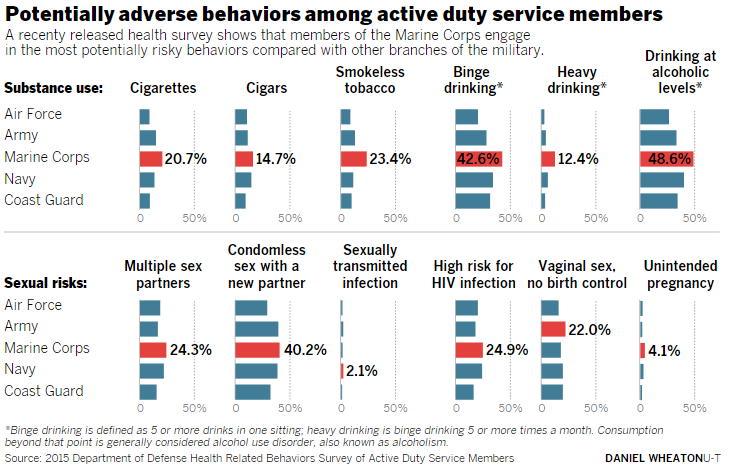
  • Marines lead all services in binge drinking, sex partners

    Marines lead all services in binge drinking, sex partners

    I realize this might be shocking news to some, but I don’t make this stuff up.  The Rand Corp Study has some very interesting findings.  It seems the Marines have continued their dominion of the Debauchery Ball with only half of the Marine Corps drinking at alcoholic levels.  I take exception to part of the study, they need to define Binge in military terms.

    The Corps lost to the Navy for the highest overall percentage of LGBT personnel and of gay or bisexual men serving, but the Marine Corps recovered with the highest percentage of lesbian or bisexual women serving.  Nearly half of service members reported aggressive behavior in the past month, and the other half were probably in the Air Force.  In addition, 8.4 percent reported aggressive behavior five or more times in the past month which is consistent with the percentage of service members in the Corps and Rangers.  The Army just needs to step up their game in general.  I call BS on the Coast Guard numbers across the board.  It was my experience that Coast Guardettes were, well, they really looked good in uniform.  When it comes to multiple sex partners I can attest to several Guardettes being more than capable and they deserve to be recognized.

    Some stereotypes are founded in factual data…just sayin.  We need to conduct some studies of  ‘You People’ here at TAH.  Maybe we can provide these folks with meaningful data.  Anyway, read the entire study yourself and come to some more appropriate conclusions if you dare.


  • Pentagon Slashes GI Bill Transfer Eligibility Window

    dod logo

    Military Times reports new changes in service member’s ability to transfer GI Bill benefits to dependents, and they’re not for the better. The goal, Pentagon officials stated, is to shift the benefit to focus on retention.

    “After a thorough review of the policy, we saw a need to focus on retention in a time of increased growth of the armed forces,” Stephanie Miller, director of accessions policy in the Office of the Secretary of Defense, said in a statement. “This change continues to allow career service members that earned this benefit to share it with their family members while they continue to serve.”

    Troops with 16 or more years of service will no longer be permitted to transfer their Post-9/11 GI Bill benefits to a spouse or child starting next year, Defense Department officials announced Thursday.

    Currently, troops who serve a minimum of six years and commit to serving an additional four years are eligible to transfer the education benefit to their dependents. Some who agree to the four years but are barred from completing it, such as troops who are injured and medically discharged, are permitted to keep the transfer. Others who start the process after getting injured can request a waiver so the transfer can go through.

    But starting 12 July 2019, service members need to begin the benefit transfer process between six and 16 years of service, the new policy update states.

    Another benefit cut to focus on retention? Sorry, that doesn’t pass the smell check. Hat tip to IDC SARC, who mentioned this in the Cohen Purple Heart post where it caught my eye.

  • New Pentagon rule bans ‘offensive jokes’ and harassing behavior.

    Mattis

    Military Times reports on Thursday the Pentagon released Department of Defense Instruction 1020.03, “Harassment Prevention and Response in the Armed Forces.” The new instruction establishes guidance to the services’ to prevent all types of harassment, ranging from offensive jokes to sexual harassment.

    Defense Secretary Jim Mattis, known for his own use of colorful language to inspire the troops, said a new Pentagon policy targeting offensive language and behavior should not be interpreted as a draconian end to military camaraderie.

    “You have to adapt to your times,” Mattis said. “There’s a rough, good humor among soldiers. We all know that. But I have never seen rough good humor countenance or in any way frame something that’s disgusting, repellent or something like that.”

    According to the instruction, “harassment may include offensive jokes, epithets, ridicule or mockery, insults or put-downs,” as well as physical threats or racially-tinged interactions that “creates an intimidating, hostile, or offensive environment.”

    I’m of a mixed mind about this. One person’s harassment is another’s vivid learning experience. Times change- I get that- and we all can agree there is no place in the military for sexual harassment. But I can see this becoming a sop for some puppy’s hurt feelings when receiving some well-deserved stick-and-rudder from a superior. Thoughts?

  • In Case Anyone Wondered . . .

    Former President George W. Bush was – and, presumably, still is – rather liked by most serving in the military.  Many hardcore liberals can’t seem to understand why.

    This article might help partially explain the reason why.  Then again, understanding the explanation might well be beyond many of them.

    Well done, Sir. I’m proud to have served while you were CINC.