Category: Military issues

  • Why the troops aren’t pleased with the President

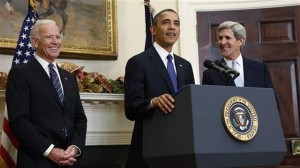
    obama_kerry_biden

    The Washington Post seems a little upset at their polling data about how the troops aren’t very pleased with the President’s performance. According to Real Clear Politics, the Post’s poll says that 32% of folks who served in Iraq or Afghanistan approve of the job Obama is doing, compared with 65% who approved of George W. Bush’s performance. So the Post’s Jennifer Rubin, one of those conservatives (question mark) at the Post addresses what Obama can do to to improve his numbers;

    We don’t know why their view of Obama is comparatively so negative. Maybe they believe his budget choices reflect that they are a lower priority than, say, universal pre-school. Perhaps, they see in his rush to remove all troops from Iraq, and possibly adopt the “zero option” for Afghanistan as well, that he lacks the will the retain the benefits they sacrificed to win. It could be that his wishy-washy approach to Syria or his unwillingness to deter aggressors like Vladimir Putin concerns them and makes the potential for hostilities even greater. Or it could be that, like my colleague Jackson Diehl, they understand that the president via his secretary of state “thanks to a profound misreading of the realities on the ground — was enabling the bad guys.”

    Or, maybe, he shits on the troops at every turn. He has kept a bumbling moron on as the Secretary of Veterans Affairs. Maybe folks in the military believed him when he said he wanted the war in Afghanistan to be “won” and every chance that he ever had to “win”, he squandered the chance in favor of political expedience. Maybe it’s because he’s weakened our place in the world so badly that we’re a laughing stock. maybe because they know at some point, his inability to accept that American Exceptionalism was what kept us safe.

    Maybe the military is tired of holding his umbrella.

    I do agree with Rubin one her last point;

    And finally, it is time to install a respected and capable secretary of defense with a competent national security team to exclude political hacks from national security decision-making and to become realistic about the state of the world.

    Hagel is a buffoon who likes to make the politically-correct decision, rather than the effective decision. John Kerry is living out his dream from 1971, projecting his own worldview as our foreign policy. Joe Biden is a clown. Period. Between the three, the words “United States” are a global punchline. And toss the Joint Chiefs in that clown car, too.

    The troops don’t like being pawns, they don’t like to be told that their tattoos make them ineffective, while Congress and the Administration cuts their training and their pay. They don’t like making sacrifices while the whole rest of the country doesn’t have to be uncomfortable one whit. Through the wars, they already saw that, so why is this administration so willing to let it happen to them again? Let, Hell, they’re mandating that the troops will suffer while admitting that illegal aliens deserve more from the government.

    They understand sacrifice and service, maybe that’s why they don’t approve of the jet-setting President and his family.

    Thanks to Chief Tango for the links.
  • Pollard to Be Freed?

    CNN is reporting that’s a possibility.

    I’d best shut the hell up now before I say something I’ll later regret.

  • Hagel supports tobacco ban

    This is not my shocked face. Secretary of Defense Chuck Hagel supports a ban on tobacco products at military bases. Just because. From Stars & Stripes;

    “I don’t know if there’s anybody in America who still thinks that tobacco is good for you,” Hagel told reporters at the Pentagon in response to a question about the Navy review. “We don’t allow smoking in any of our government buildings. Restaurants, states, [and] municipalities have pretty clear regulations on this. I think in reviewing any options that we have as to whether we in the military through commissaries [or] PXs sell or continue to sell tobacco is something we need to look at. And we are looking at it. And I think we owe it to our people.”

    Hagel said that the financial and human costs of tobacco use need to be taken into account. The secretary said that dealing with tobacco-related health issues costs the Defense Department more than a billion dollars a year.

    The healthcare costs of tobacco use isn’t among the active force because it takes years for tobacco use to affect a person. It’s not like a twenty year old who runs five miles every morning is going to develop one of these health problems that everyone is so worried about all of a sudden. It’s like the First Lady pronouncements against mess hall chow. Everybody wants to be seen as doing something to shape the military into a big social experiment.

    I guess they figure that won’t affect retention either – knowing that you can die for your country with a bullet, but you can’t get that last smoke that’s so popular in the movies. So they’re against smoking, tattoos, and winning wars. Looks like they have their priorities straight.

  • AF Instructor sentenced for trainee abuse

    Annamarie Ellis

    ChipNASA sends a link from Military.com in regards to Staff Sergeant Annamarie Ellis, a basic training instructor at Lackland Air Force Base who was sentenced Friday for trainee abuse;

    Her punishment also included dropping her rank to airman basic and a bad-conduct discharge. She was taken to a lockup at Joint Base San Antonio-Lackland.

    The San Antonio Express-News reports Ellis pleaded guilty earlier to three charges, including the maltreatment of recruits, and 24 allegations of misconduct. She had faced a maximum prison sentence of 43 years.

    Who knew that they were abusive to trainees in the Air Force? Well, I’m glad they got this one because abuse isn’t training. Since she was looking at 43 years, I guess she’s pretty happy today.

  • Sage Santangelo; the double standard at Marine Infantry Officer Course

    Enlisted-Women-Infantryjpeg

    Sage Santangelo, a Marine Corps lieutenant and one of the first few women to have participated in the Marine Corps’ Infantry Officer Course writes in the Washington Post about why she thinks she failed her attempt. the main reason, she thinks, is because it was the first time that she had to do something at the male level of fitness;

    I absolutely agree that we shouldn’t reduce qualifications. For Marine infantry officers, mistakes mean risking the lives of the troops you are charged to protect. But I believe that I could pass, and that other women could pass, if the standards for men and women were equal from the beginning of their time with the Marines, if endurance and strength training started earlier than the current practice for people interested in going into the infantry, and if women were allowed a second try, as men are.

    […]

    The Basic School, where I reported after graduating from Bowdoin College in 2012, has long been co-ed. But physical double standards persist. In the Physical Fitness Test, for example, a male perfect score is achieved by an 18-minute three-mile run, 20 pull-ups and 100 sit-ups in two minutes. A female perfect score is a 21-minute three-mile run, a 70-second flexed-arm hang and 100 sit-ups in two minutes. There was a move to shift from arm hangs to pull-ups for women last year. Yet 55 percent of female recruits were unable to meet the minimum of three, and the plan was put on hold.

    I guess what she’s saying is that women, if they’re to be expected to meet men’s standards in physical endurance and fitness, the entire force should train to the same standard from the beginning, something I can’t disagree with at all. But then she complains that she wasn’t afforded a second shot at the course.

    I also would have liked to have had the opportunity to try the course again. The Marine leadership has said it doesn’t want female lieutenants taking the course multiple times, at least until combat positions are available to women, because it doesn’t want to delay the rest of their training. Yet many of the men who failed alongside me in January are back at Quantico, training to retake the course in April.

    Well, in the Marine Corps’ defense, I’d guess that because this is a test phase for the program that will only ultimately end in a report on the Secretary of Defense’s desk, and since the Marine Corps doesn’t want to chew it’s fat twice, the report should mirror the results of first time participants, since those are the people that the Marine Corps wants to graduate most. It might not be fair to LT Santangelo personally, it’s fair for the test phase.

    She also complains that there is little time for perspective infantry students to prepare themselves physically for the course. I wonder, then, why are there any infantry officers in the Marine Corps. Some make through despite the challenges the lieutenant has cited, and many of those made it through the first time.

    While I agree with her that fitness standards should be universal irrespective of sex – a female clerk should be at the same level of fitness as a male clerk – even though she only had a month between her basic course and her infantry course, that was still time enough to prepare for the infantry course. It’s a time management thing.

    Like I said, any accommodation for women in this phase would skew the results for the study, and although it doesn’t seem fair for the women taking their shots at IOC now, in the end, it will give a more accurate picture of the overall program in the end. She says that she doesn’t want the standards lowered for the Course, and this is the best way to make sure that doesn’t happen.

  • You Get What You Pay For

    The effects of Defense wide cuts is far reaching. As this US News Article discusses.

    “We’re an 11-carrier Navy in a 15-carrier world.” Army General Martin Dempsey said.

    According to Marine General John Kelly, his command is, “unable to get after 74 percent of suspected maritime drug smuggling.”

    Our budgets are being cut so tight that we are unable to accomplish the ever increasing global missions that we are being tasked to accomplish. This is an ultimate consequence of the success of our military and the generations that came before. They have established a sense of security within our borders that fosters the idea that we no longer need the military. That is a nice idea, and 9/11 should have been a reminder of that, but as a nation we have a short term memory.

    There will come a point when we as a nation are again reminded that the world is not a friendly place and we can’t solve problems by throwing money at them. Well, throwing money at other people, while failing to invest in ourselves, our infrastructure and our ability to defend it. The issues in Crimea are highlighting the failure of that thought process, and I hope that we won’t have to solve that problem with physical intervention. Stalin, however, does seem to be trying the west/America’s patience, just to see what he can get away with.

    At the rate we are going, however, with more budget cuts, we won’t have much left to fight with. Our military will be poorly equipped, understaffed and under trained. Hopefully, our enemies will just be happy that we keep developing new iPhones and still make great movies, and just leave us to our own devices.


  • The Economics of Veteran Unemployment

    Veteran unemployment rates are 9.2% for those serving after 9/11. That statistic is from the Bureau of Labor Statistics as of February 2014. Last year at the same time it was 9.4%. Comparatively, the unemployment rate for non-veterans is 6.9%, and was 7.9% the previous year. For veterans of other eras, their unemployment rate is 6.3% and was 6.9%.
    It is a startling statistic–as well as deeply disturbing. Why do our veterans leave the military, only to find themselves less employable than their civilian counterparts, especially our newest generation?
    The problem was glaringly obvious to me when I returned home from my third tour to Afghanistan and I found myself working at a food court serving pizza. I was happy for the opportunity and glad that someone was willing to hire me. I worked hard and tried to reduce the impact of my National Guard obligations on them as best I could–even if it was just a cashier position. But it burned. Six months prior I was managing repair and installation projects for cellular and data networks. I was a Staff Sergeant during my drill weekends, managing a platoon of combat medics, who supported a cavalry squadron. And then I took off my uniform, grabbed my visor and apron and always made sure to ask if the customer wanted a caesar salad with their order.
    My situation wasn’t unique, and it wasn’t until I connected two very important lessons that either the veterans need to accept or civilian employers need to educate themselves about. (Sadly, my guess is that capitalism will win and Veterans will need to accept their fate.) First, was when a friend, who had never served and had worked in the civilian market in an executive position, made this casually ignorant comment about military leadership. “Your experience doesn’t translate. You just tell your guys what to do and they do it. Things don’t work like that in the civilian world.”
    I wish. I wish it were that easy, but he didn’t know any better.
    Second, was when I was studying my Labor Economics textbook. It discussed the amount of experience that a person gains while working in a position, and how that experience makes them more valuable. This experience is only applicable to that position, however.
    That is the problem. That is the barrier that we can’t overcome: the combination of the belief that our experience doesn’t translate, and the simple fact that we don’t have experience in the civilian market. Many of our skills can be translated, but a civilian employer doesn’t know which ones. In addition, we are simply entry level employees in the eyes of those organizations seeking qualified applicants. There is no doubt that we have gained skills and experience, but rarely in the fields of employment we are attempting to gain access to, which is why so many of us must behave like someone freshly entering the market, with no job skills, because that is what we are–at least in the eyes of the hiring managers.
    The hard part for us is that we know we do have skills, the kind of skills that civilian employers are demanding. I can see it, as I push through college. I’m forced to take classes dedicated to speaking in front of a group, writing professional correspondence, and simply working in a team. That was three separate courses–summarized, two 100 level courses, and a 400 level course. Taking these courses, is to simply prove to my future civilian employer that I am capable of functioning and communicating in a professional environment. All of these were things I learned in the military: teaching classes to my peers and subordinates, briefing my superiors, and working in a team.
    Many of the issues have to do with our pride. Every veteran I know complains about attending college with these “kids.” It is a perfectly understandable frustration. We now operate under completely different frames of reference than most of America. Why should we have to stand in line with all these kids, people who didn’t serve, and be treated as their equals? We shouldn’t, but then again, in the eyes of the greater capitalist machine–those firms that would hire us–we are viewed simply for what production value we can offer. The hiring manager as a human being appreciates and perhaps, even sympathizes with our plight, but they have a job to do, and that job is to hire as many qualified applicants as they can for the lowest cost.
    To do this, they have pre-established requirements that an applicant must meet, simple easy to assess criteria to determine what our production value is to the hiring firm. Veterans are not easily assessed. We don’t have the same certifications, and our experience doesn’t translate well onto paper to fill in their check boxes. As a result, we aren’t hired.
    Why doesn’t the military simply support us with these civilian certifications? We do the same jobs right? Two reasons: cost and retention. Many certifications require training that goes beyond the scope of the job that the military requires of the veterans. Why would they train us, so that we could leave? Training is expensive, and it would be a waste of taxpayer money to train us then let us go. It sucks, but it is reality.
    So there we are: the veterans of foreign wars, combat proven individuals capable of thinking critically and performing under the kind of stress that the civilian market can’t reproduce. This, my generation of veterans, is the same experience as those veterans who came before us. But none of that matters. What we need to do is gain the credentials which the civilian market has established to ease the burden on their hiring managers. Then, once we have entered those positions, we, as human beings, can be evaluated more closely. Our productivity can be measured and our experience can be really put to the test against our civilian counterparts. That is where we will show the value of our experience and our productive capabilities.

  • Pentagon’s lies to Congress

    ROS sends us a link to Military.com in which they report to Congress that the troops are willing to give up their pay and benefits if it means they can train and have better equipment. At least, that’s what I think it says, because I can’t quite read around the ads that Military.com places right over the text that I’m trying to read.

    Vice Adm. William F. Moran, chief of naval personnel and deputy chief of naval operations, told lawmakers that sailors he has met with over the past six months have spoken more about “the quality of the service” they’re able to do than anything other topic.

    The view was shared by other officials, including Sheryl E. Murray, assistant deputy commandant for manpower and reserve affairs for the Marine Corps.

    “I would emphasize our Marines do enjoy a good quality of life. Our Marines love being in the Marine Corps family,” she said. “Most of all, they want the right equipment. … They want to be trained, and they want to be ready. That is the overriding desire.”

    Personnel officials from the Army, Navy, Marine Corps, Air Force and the Department of Defense met with the House Armed Services’ Military Personnel subcommittee to talk about cuts to pay and benefits the Pentagon is proposing for its upcoming budget.

    These include a smaller pay raise — 1 percent raise, an average 5 percent reduction in housing allowances, and higher health care fees for some retirees.

    You know, when I served, I used to think the same thing – that my pay was low, but my training was expensive, so I weighed the two against each other, and figured that if I lived to retire, that was payment enough. But since I got out, I see how dependents of the welfare system, and employees at other agencies in the Executive Department aren’t willing to make the same sacrifice, always demanding more and complaining to the media how they need more.

    So the troops continue to sacrifice, the majority of the cuts are to personnel costs in the Pentagon. But those cuts don’t intrude on the largesse and comfort for those at the top. The job of the top brass is to take care of their troops, not to make it easier on the consciences of Congress while they slash troops’ compensation, so that those fat cats with stars on their shoulders can cling to the perks of their offices.

    I think the troops would agree with what the Pentagon sockpuppets are telling Congress if the cuts to pay and compensation were across the board in the Executive Department. But this is me not holding my breath.