Category: Military issues

  • Here’s One Guy You Won’t Hear Complaining About Body Armor

    Lots of soldiers complain about their body armor.  And it is indeed uncomfortable, and rather heavy.

    Still:  I don’t think you’ll ever hear SGT Timothy Gilboe, ME ARNG, complain about it.  Why not?  Read this article from the Army Times to find out.

    Three additional comments:

    • Cojones muy grande, SGT Gilboe.  Kudos.
    • Kudos to you, PEO Solider.  Your equipment certainly worked as designed that day.
    • Finally, kudos also to whoever came up with the policy of offering the soldiers affected the item that saved their life as a souvenir.  I wish we saw more such common-sense in DoD.
  • To Support Our Patriots–Privatize the Military

    It occurred to me in the last blog I put together, “Why So Few Choose to Serve,” that the government has a distinct advantage over American patriots, and because we have a Sergeant Major of the Marine Corps talking about why marines should be paid less. The reason for this is that the US government, and ultimately most world governments, have what is called a monopsony. A monopsony is where there is only one buyer in the market. American patriots want to serve their country–or in this situation, sell their labor. However, there is only one buyer of that labor, putting the Patriot at a distinct disadvantage. What is one simple way to reduce the problems caused by this? Bring more buyers into the market by privatizing the military.

    Do I completely believe in privatization of the military? No, but for the sake of healthy debate, I’m going to argue that it is to the benefit of the American patriot to privatize the military because it will allow them to be properly compensated for their service.

    I am going to start out with some very simple assumptions:

    1. The government is the only purchaser of a patriot’s labor.
    2. The only motivation for patriots to supply their labor is to serve their country. No other form of compensation, initially, affects their decision to serve.
    3. The wage provided by the government is unrelated to services provided or productivity of the patriot.

    I have also chosen for the simplicity of this conversation to ignore the following:

    1. The efficiency benefits of a privatized military.
    2. The potential evils of allowing greed driven decisions to be attached to military power.

    With these assumptions in place, we can look at the ways that the government takes advantage of the patriot. The first being wage. Wage is the collection of all financial benefits paid: paycheck, insurance, and retirement benefits.  The Government, employing laborers who are only motivated by patriotism, can set the wage wherever they desire, which is why pay is considered to be so low. In a situation like this, the only factor driving the decision for what to pay a patriot would be a minimum livable wage. There are also pay raises to account for changes in family structure, but not because of a caring for the patriots’ families. It’s merely because, without these pay increases the patriots would no longer be able to supply their labor.  If the military wanted you to have a family, they would have issued you one, hopefully in better condition than the gear I have already been issued.

    The additional wage requirements for patriots with families,, and the cost of more mature patriots, is one of the many reasons that recruitment targets the younger patriots with the glitz and glamour of the job, not the wage, as in other civilian fields of employment. Young people join for the experience and the opportunities, not the financial return, or as it applied to me at seventeen years old, I wanted to blow shit up.

    Now, with these wages intentionally kept low, this is a method of controlling enlistment numbers for more senior individuals–those with the additional responsibilities that a person gains while they get older and are no longer able to remain within the military because the cost to maintain their household requirements no longer matches with the pay and benefits they receive from the military. This leaves only those who are willing to sacrifice pay to continue to provide service to their country.

    I was told by my Battalion Commander, “The Marine Corps gives you everything money can’t buy.” Fellow service members have also looked down upon me when I pointed out that one of the driving factors to remain within the military is my educational benefits.  The culture of the military pushes out those mercenary thoughts, while promoting patriotic service for its own sake.

    Why would a privatized military support the patriot? By providing the patriot, who is willing to supply their labor, regardless of wage, additional options as for whom to provide their labor. For example, Company A and Company B have both been contracted out to perform military operations to support America. The missions being equal, and the pay being the only difference, the patriot will have the option to choose the higher paying company.

    Is this mentality mercenary, yes, but it is a means of compensating our patriots with more than a slap on the ass and a thank you for your service.

    Now, the final question remains: Why do patriots deserve a higher pay? In the civilian market, a person is paid based upon the services they provide. A factory line worker is paid an hourly wage based upon their value to the company. If only ten widgets are created an hour by that worker, then their impact is ten widgets per hour. If a musician puts on a concert for twenty thousand people, their impact is the entertainment of twenty thousand people.

    The patriot provides security, either through defensive or offensive operations, to three hundred and seventeen million people, producing a collective GDP of $16.8 trillion against violent threats. That responsibility is spread among the 2.3 million patriots who have decided to serve. That is the impact of the patriot’s service.

    The American patriot is going to provide their service regardless of their pay, but with such a high level of impact, why not compensate them in a similar manner as we do so many others? By allowing the patriot the option to provide their patriotic service to the highest paying organization, we recognize their impact upon our nation.

  • NATO beefs up forces near Ukraine

    NATO beefs up forces near Ukraine

    In the Stars & Stripes, it’s reported that NATO is letting the world know that after weeks of diddling, they’re deploying more forces to the area around the eastern Ukraine.

    “We will have more planes in the air, more ships on the water, and more readiness on the land,” NATO Secretary-General Anders Fogh Rasmussen told reporters after a meeting of the North Atlantic Council.

    Among the measures to be taken include an intensification of NATO air policing missions over the Baltic region and more allied ships bound for the Baltic Sea, eastern Mediterranean and other regions as required, Rasmussen said. However, he made no mention of sending additional ships to the Black Sea, where Russia has the bulk of its fleet.

    The good news is that they’re leaning forward with staff, too, so there will be enough cooks to ruin the broth. My only question is what exactl are they deploying, since the Pentagon, in another Stars & Stripes link claims that, because of sequestration, they can no longer guarantee our national security;

    “If sequestration-level cuts persist, our forces will assume substantial additional risks in certain missions and will continue to face significant readiness and modernization challenges,” the report said.

    “Overall, sequester-level cuts would result in a military that is too small to fully meet the requirements of our strategy, thereby significantly increasing national security risks both in the short- and long-term,” according to a Pentagon statement that accompanied the report’s release.

    So, I’m sure the news of NATO taking this seriously has Vlad shaking in his boots. NBC News, in a link sent by Pinto Nag, reports that the Russians have rolled about 40,000 troops to it’s border with Ukraine, I wonder how many NATO will send. The Ukrainians are gearing up for an operation they’re calling “anti-terrorist” and they aren’t giving NBC full access with their cameras;

  • More Twists and Turns in the Ukraine

    As Alice said:  “Curiouser and curiouser!”

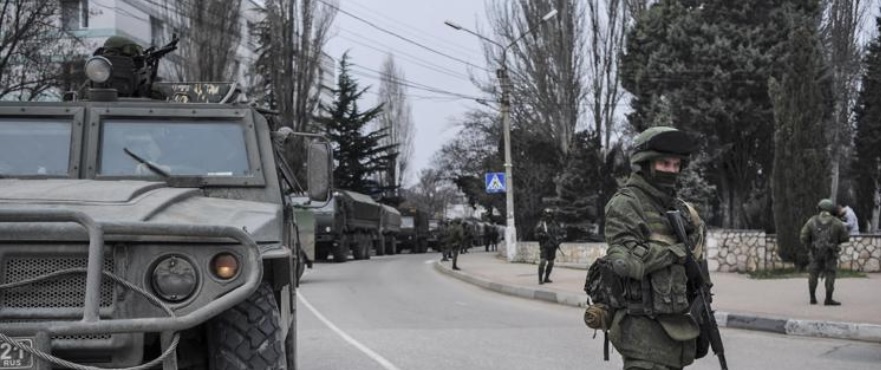
    Fox News is reporting that a small column of armored vehicles sporting a Russian flag and troops in camouflage uniforms has been spotted in the eastern Ukrainian city of Slovyansk.   At least some of the troops claim to be members of the Ukrainian 25th Airborne Brigade that had decided to change sides.

    The Ukrainian defense ministry was reportedly contacted, but declined comment.  But there have been other reports of some Ukrainian forces switching sides in the recent troubles.

    Pro-Russian protestors were also reported to have taken over the mayor’s office in the regional capital of Donetsk.

    I certainly hope cool heads prevail here.  Otherwise, this could indeed turn ugly – quickly.


  • The case for US troops in Ukraine

    Chief Tango sends us a link from the Washington Post written by James Jeffrey, a former ambassador for the Clinton and Obama Administrations who thinks that NATO ad the UN haven’t been fierce enough in the face of aggression in the Ukraine, so he figures that we need to put boots on the ground;

    The best way to send Putin a tough message and possibly deflect a Russian campaign against more vulnerable NATO states is to back up our commitment to the sanctity of NATO territory with ground troops, the only military deployment that can make such commitments unequivocal. To its credit, the administration has dispatched fighter aircraft to Poland and the Baltic states to reinforce NATO fighter patrols and exercises. But these deployments, like ships temporarily in the Black Sea, have inherent weaknesses as political signals. They cannot hold terrain — the ultimate arbiter of any military calculus — and can be easily withdrawn if trouble brews. Troops, even limited in number, send a much more powerful message. More difficult to rapidly withdraw once deployed, they can make the point that the United States is serious about defending NATO’s eastern borders.

    Yeah, no. We’ve gone past the point of sending a “powerful message”. That time was five years ago. Putin’s biggest fear is a missile shield in eastern Europe. Everyone on the planet knows that. Putting some Joe Rucksack in the western Ukraine as a minor speed bump on Vlad’s way to the Adriatic Sea will do nothing except make the US look weaker. the last I heard, the US pulled it’s last tanks from Europe last year. I guess that didn’t send a message to Putin, did it? And when you talk about “boots on the ground” you must mean tank treads on the ground, too. So which armored division are we going to reactivate to face the tank-heavy Russians, or would that be too strong of the message?

    These navel-gazing egg heads would make me laugh if they weren’t giving dangerous advice without a thought to the consequences and without considering the resources we’ll have left when the liberals get done slashing the shit out of the Pentagon. The troops aren’t mannequins to propped up in front of Russian divisions to scare them off – they won’t be scared off. The Russians don’t scare with piddly-assed think tank mental masturbation.

  • Tension Ratchets Up in the Eastern Ukraine

    It appears that the situation in the eastern Ukraine is getting quite tense.

    The current acting president of the Ukraine, Oleksandr Turchynov, has announced the beginning of what he termed “anti-terrorist” operations at various locations in the eastern Ukraine.  Those targeted by Ukrainian forces in these operations appear to be Ukrainian militias with pro-Russian sympathies that have occupied Ukrainian government facilities.

    The Ukraine government alleges Russia is behind the unrest in the eastern Ukraine.   Dissidents in the eastern Ukraine are indeed demanding closer ties to Russia and flying the Russian flag at “liberated” facilities, so the allegation is plausible.

    However, the eastern Ukraine has historically tended to look north to Moscow vice west to Europe, and has far closer ties to Moscow than does the western Ukraine.  It is also the portion of the Ukraine that most strongly supported the former Russian-leaning Ukrainian President Viktor Yanukovych, who was ousted by pro-Western demonstrations earlier this year.  There thus may well be a large element of local discontent in the eastern Ukraine with pro-Western policies being dictated by the current Kiev government.

    At least two have died in the eastern Ukrainian unrest so far.  The Russian Prime Minister Dmitry Medvedev has called the Ukraine “on the brink of civil war”.  Russia has thousands of troops near the eastern borders of the Ukraine.

    The Ukrainian government has asked for the deployment of UN Peacekeeping troops in the eastern Ukraine.  However, with Russia holding veto power over UN Security Council resolutions, the prospect of that happening is almost certainly essentially nil.

    It looks like this could indeed get ugly if someone guesses wrong.  Hopefully we (the US) will have the good sense to stay the hell out of this, militarily.

  • Insanity over Bundy Ranch standoff

    Insanity over Bundy Ranch standoff

    bundy ranch

    I know, I haven’t written about this subject, that being the standoff of the ranch family Bundy in Nevada. Mostly because I didn’t understand the whole thing until yesterday, but then I’m focused on military issues and the grazing laws and the Bureau of Land Management don’t concern me now that I left my civilian job. Anyway, a whole bunch of people were headed to the Bundy ranch and BLM backed off concerned about public safety Fox News reports.

    Bureau of Land Management Chief Neil Kornze announced an abrupt halt to the weeklong roundup just hours before the release.

    “Based on information about conditions on the ground and in consultation with law enforcement, we have made a decision to conclude the cattle gather because of our serious concerns about the safety of employees and members of the public,” Kornze said in a statement.

    Hundreds of states’ rights protesters, including militia members, showed up at corrals outside Mesquite to demand the animals’ return to rancher Cliven Bundy. Some protesters were armed with handguns and rifles at the corrals and at an earlier nearby rally.

    So BLM is going to take the issue up in court, like they should have done in the first damn place, instead of showing us why they need to scarf up all of the ammo in the market place.

    But here is why I’m finally addressing the issue; some of my conservative so-called “friends” on Facebook were asking why the military wasn’t getting involved to protect the protesters from the BLM thugs. So my question is “WTF is wrong with you?” Since when is it the military’s job to protect private citizens individually from other government agencies? When has it ever happened in American history. Yes, yes, I know, they’re supposed to protect and defend the Constitution from all enemies foreign and domestic, but do you understand what it is you’re expecting the military to do and do you understand the precedent it would set if generals ordered the troops to stand against the BLM?

    What exactly did you expect them to do? Take over the Bureau of Land Management offices in DC? Roll out tanks from the nearest post to Nevada? Do you really expect them to accomplish all of that without orders from their commander-in-chief (who by the way would never order them to do that any-damn-way).

    Sometimes conservatives are as stupid as the liberals – because they get emotional about something, the military should act now to make them feel better about themselves. Of course, their questions about the military not defending the Bundy’s and their fans is supposed to prove that military has no problem rounding up Americans on Obama’s orders. It was to prove that the folks in the military are automatons who slavishly follow whatever orders they are given. Mental masturbation completely vacant of any reason.

    I blame the fact that some conservatives are a bunch of Rand & Ron Paul huggers these days.

  • Les Parraines d’Épinal

    There are many towns in the French province of Lorraine.  One of those towns – about 40 miles SSE of Nancy – is called Épinal.

    During both World Wars, Épinal was occupied by Germany.  In World War II it was liberated by forces of the US 7th Army on 23 September 1944.

    War has many costs; some of those costs are measured in terms of lives.  Thus, not long after its liberation a wartime cemetery was established near Épinal.  By the end of the war over 6,000 German dead were buried there – along with over 7,750 Americans.

    The cemetery remains today, as the Épinal American Cemetery and Memorial.  It is the final resting place for 5,255 American war dead.

    Shortly after the cemetery began operations, the mayor of Épinal asked members of his town to “adopt” American graves in the cemetery as a way of thanking their liberators.  Those adopting graves would tend them, and bring them flowers from time to time.

    That tradition has continued until the present, continuously.  Sometimes the caretaker duty is performed by the same person for life.  At least one local resident has been doing exactly that for one of the Épinal graves for 68 years.

    The practice is called parrainage – literally, “sponsorship”.  Here, it refers to the adoption of a US grave for care.  Those adopting a grave refer to themselves as “godfathers” for that grave:  les parraines.

    . . .

    Most have never heard of les parraines d’Épinal.  And I probably would never have heard of them either.  Except . . . .

    I ran across a news article the other day.  The headline caught my attention, and I read it.

    It seems that one of the grave caretakers in Épinal – M. Joel Houot – wanted to know more about the individual buried in the grave for which he cared.   He sought assistance.

    Houot was able to determine that the soldier was from Wisconsin.  So last fall, Houot found the e-mail address of a Professor of History at the University of Wisconsin – Dr. Mary Louise Roberts – and e-mailed her, requesting her assistance.

    Call it fate, luck, or whatever – the hand of God, if you like.  But it turns out that Professor Roberts had written professionally about World War II, and teaches a popular undergraduate course on the subject.  She was teaching her World War II course last fall.

    Roberts thought helping M. Houot would make an excellent extra credit project for one of her students.  So one day, she told the class about the request, and asked for a volunteer for an extra-credit project.

    Forty-three hands went up.  The entire class volunteered.

    Roberts then corresponded with M. Houot.  She asked for additional names of soldiers from Wisconsin who might be buried at Épinal.

    Two weeks later, a list of 30 names of Wisconsin natives buried at Épinal arrived from the current director of parrainage at Épinal, Mme. Jocelyne Papelard-Brescia.  Roberts’ students were able to find good information on 25 of the individuals.

    The class’ research was called, simply, The Épinal Project.  It is introduced here; the full project may be viewed here.  It documents the class’ work; IMO, it’s worth a look.

    . . .

    In the great scheme of things, perhaps all of this is “small stuff”.  And yet . . . IMO it matters.

    I think for most soldiers the greatest fear isn’t death or disability.  Rather, that greatest fear is the fear of being abandoned  – and forgotten – after they’re lost.  Indeed, I believe that’s why the US military goes to such great lengths to account for each and every missing Soldier/Sailor/Airman/Marine, to rescue those captured – and to recover each and every set of remains that can possibly be recovered, so that they can receive a proper burial.

    Les parrianes d’Épinal prevented that fate for the US war dead buried at Épinal American Cemetery and Memorial.  They made sure these US war dead were not abandoned, not forgotten.  Dr. Roberts’ and her class provided faces and history for some of those honored dead.  They enhanced the legacy – the memory – of those fallen.

    Each of those is a “good thing”, and is indeed worthwhile.

    As a nation and a society, from a US perspective the French certainly have their faults.  But regardless of their faults, the French do indeed have a sense of honor, and of gratitude.

    If you doubt that, visit Épinal.

    . . .

    À chacun des parrianes d’Épinal – Merci, mes amis. Merci beaucoup.