Category: Historical

  • Twenty-two years ago tonight

    This is republished from two years ago;

    Twenty years ago, 1st Battalion, 41st Infantry attached to the Third Brigade of the 1st Infantry Division (from the Third Brigade of the 2d Armored Division (Forward)), was the only US unit in Iraq. We were fifteen clicks from the Saudi border, screening for the sweep east of Schwartzkopf’s “Hail Mary” strategy. For two days we had been watched by Iraqis and had a little contact. with some reconnaissance elements. However on February 17th, my gunner spotted 5 T-55s about 1500 meters in front of our defilade position and I called for indirect fire. The first response came from an Apache unit. The pilot ignored his instruments and fired the wrong grid coordinate, directly to my west, striking two vehicles in our own Scout platoon anchoring our far west flank.

    COB6 was the platoon leader of the platoon between my platoon and the Scout elements. Despite the orders of our company commander (a phrase that I use in several other stories involving COB6 and our commander), COB6 pulled his vehicle off the line and rushed to the burning vehicles (An M3 and and an M113 from the GSR unit). COB6 and his crew pulled the broken bodies from the vehicles with burning ammunition exploding around him and shielded the injured Scouts with his own body. Two of those scouts were dead, but three others owe their lives to COB6 and his crew.

    Needless to say we stopped calling for Apaches and after slamming two TOWs into a berm about a hundred meters in front of us, we used artillery fire. My first ever call for indirect fire in total darkness. The following morning, M1s found the T-55s 5000 meters north of the spot my gunner had spotted them.

    These are the names of the members of 1/41 we lost throughout the war;

    Tony R. Applegate
    David R. Crumby
    Manuel M. Davila
    Anthony W. Kidd
    David W. Kramer
    Jeffery T. Middleton
    James C. Murray, Jr.
    Robert D. Talley

    Talley and Middleton were killed that night.

    We had the highest casualty rate of any other infantry unit in the war, I say it’s because both sides were shooting at us.

    And, oh, yeah, my granddaughter celebrates her 22d birthday today, too.
  • The Butterfly Effect

    A bit over 45 years ago – on 23 January 1968 – the USS Pueblo was seized in international waters by North Korean forces.   It was only the second US Navy ship to be captured by enemy forces since the War of 1812 (the river gunboat USS Wake was captured by Japanese forces on 8 December 1941).  It remains on the roster of US Navy ships today.

    During the seizure of the USS Pueblo, one crewman – Fireman Duane Hodges – was killed by North Korean gunfire.  The rest of the crew was captured alive.

    The crew was held prisoner for 11 months in North Korea.  Conditions were abysmal, and they were indeed abused and tortured by their North Korean captors.  Calling this “a year in hell” isn’t much of an exaggeration.  Some of the accounts here are disturbing; read them when you can afford to get disturbed – and angry.

    (more…)

  • “Remember the Maine. To Hell with Spain”

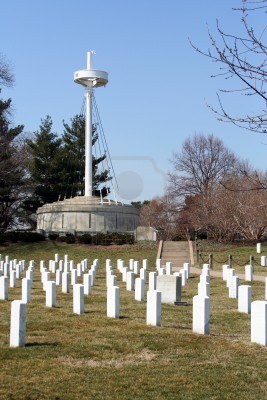
    1727273-uss-maine-mast-at-arlington-national-cemetery

    On this day in 1898, 266 sailors lost their lives in Havana Harbor, Cuba when a huge explosion ripped the armored cruiser USS Maine (ACR-1)apart and sent her to the bottom of the bay. She was stationed there to protect American interests during the Cuban revolution against Spain. Speculation is that it was an accidental fire in the powder magazine that had ripped the ship asunder. But at the time, most Americans thought it was Spanish saboteurs who had done the deed. Regardless, “Remember the Maine. To Hell with Spain” became the rallying call for war against Spain.

    The memorial at Arlington National Cemetery above is to the sailors who lost their lives and the base of the mast recovered from the Maine is inscribed with their names and accompanied by an anchor from the wreck.

    The Washington Post reports that the Monument to the Maine and her crew in Havana is being restored by the Cuban government after decades of neglect;

    The Maine monument was inaugurated in 1925 and bears the names of all 266 sailors. Two statues standing shoulder-to-shoulder at the base represent a maternal America guiding the maiden Cuba into independence.

    Words etched into the marble quote an 1898 U.S. congressional resolution recognizing Cuba’s right to be free, and the massive bronze eagle that long capped the monument faced due north in a symbol of Washington’s promise to return home after helping the island break from Spain.

    “To me it signifies a legacy of loyalty…friendship between two peoples,” said Julio Dominguez Santos, the monument’s night watchman of 17 years.

  • 158 years of John Moses Browning

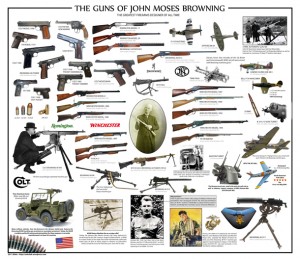
    guns-of-john-browning-small

    COB6 writes to remind us that today is the birthday of the fellow he calls “the most deadly American in history” John Moses Browning. He was born on this day in 1855 in Ogden, Utah and went on to design some of the most dependable weapons in our inventory. The son of a gunsmith, he patented his first breech-loading rifle in 1875.

    Ultimately, John Moses Browning’s inventions helped revolutionize the firearms industry in America with some of the country’s most commercially successful guns – including the lever-action repeating rifle, semi-automatic shotgun, .22 caliber rifle, the Browning 1919 .30 caliber and M2 .50 caliber machine guns (MGs), and the Browning Automatic Rifle (BAR).

    He also designed the M1911 .45 caliber semi-automatic pistol which remains in service today in some sectors – I don’t know any gun owners who don’t have a 1911. I have two. The Marines just bought 12,000 more for their special operations troops.

    Browning died in 1926, but lives on in our gun cases.

  • The One Classified Medal of Honor

    One of the most common lies a false claimant to military honors or decorations will tell people is, “My medal is classified; that’s why there aren’t any records of it.”

    Yes, that’s complete bullshit.  Medals and decorations are not classified, nor are their citations.  And there are always records of legitimate awards and decorations.

    But there actually was a classified Medal of Honor, once – some 60+ years ago.  Or, more precisely:  the fact that the Medal of Honor had been awarded to a particular individual was classified.   And that singular example was declassified after a period of a bit over 2 years.

    (more…)

  • A Morning to Remember

    Live long enough, and you’ll see some interesting things.  If you’re lucky enough, it’s possible you’ll see or be a part of something truly memorable and unusual.  Maybe even something historic.

    During my lifetime, I’ve been that fortunate twice.  The first time was when I was lucky enough to be in Korea when Reagan visited the DMZ, and to provide support for that mission (though I didn’t get to see the actual speech).   I’ll always feel honored to have been there.

    The second time occurred some 24 years later.  And it was, perhaps, even more memorable than the first.

    January 11, 2008 dawned in Baghdad.  Just another brutal, muddy, nasty, cold day – right?

    Yes, I did say cold.  Although Baghdad and surrounding area indeed gets hellish hot during the summer, during the winter it also gets colder than you might think.  Baghdad’s at about the same latitude as Columbus, GA, or Dallas/Fort Worth, TX –  and like those cities, it’s inland.  So it does get pretty cool in the winter; today’s high and low there are predicted to be 59 F and 34 F, respectively.

    Frost was not common, but was also not unknown.   And the winter of 2007-2008 was reputedly the coldest in at least a decade.

    Baghdad gets most of its rain during the winter, too.  And when that little bit of rain hits the finely-powdered silt making up the soil in the Tigris/Euphrates valley system, the result is . . . different.  Think wet, sticky paste.  Slippery, medium yellow-brown paste.

    I think I gained an inch or so in height every time I went outside that winter when things were wet.  (smile)

    But January 11, 2008 was different.  The sky was steel-grey, and it was still.  Things simply felt different than normal.  Something was up.  And around sunrise, we found out what it was.

    It began to snow.  Big, wet flakes.

    It didn’t snow much – just a dusting on exposed items and surfaces; most of it melted on contact.  And what little stuck didn’t stay around for long at all.

    But it snowed.  In Baghdad.

    Those who’ve never lived in a hot, desert climate can’t really appreciate the impact of a low desert snowfall.  It is a truly magnificent sight – if for no other reason than because they’re generally exceptionally rare.  It’s like seeing a horizon-to-horizon double-rainbow.  Yes, they can happen.  But they’re rare enough that not very many people ever get to see one.

    Snow was indeed a rare thing in Baghdad. One source said it had been over 60 years since the last snowfall in the area.  Others said it had been over a century.

    I don’t know which is correct.  And, frankly, I don’t care.  I only know I was lucky enough to see it in person.

    Snow.  In Baghdad.

    And, for what it’s worth:  during the snowfall, reportedly things were rather quiet in the city.

  • Alfie ‘Bill’ Fripp, last of the “Great Escape” passes

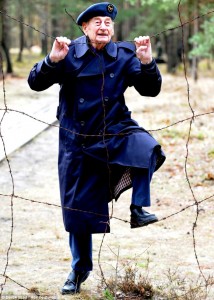
    Alfie Fripp

    Toothless Dawg sends us the news that Alfie ‘Bill’ Fripp, the last living member of the Stalag Luft III World War Two “Great Escape” has passed on at the ripe age of 98. Alfie didn’t actually take part in the escape made famous by the star-studded movie, but it was his job to assemble the equipment they needed to make history;

    One of Alfie’s official jobs was to marshal Red Cross aid parcels, a lifeline for prisoners.

    His unofficial job was to filter out the parcels coded to identify secret contents such as valves for radios or maps.

    He was relocated from Stalag Luft III less than two months before the Great Escape, but equipment from those parcels almost certainly contributed to the operation.

    To his eternal regret, however, his friend Mike Casey would be among 50 escapees slaughtered on Hitler’s orders when they were eventually recaptured.