Category: Historical

  • V-E Day

    We wrote a post yesterday about V-E Day, but our buddy, Denise Williams at the Plainfield Patch writes a much better article;

    Here in the US, from a total population of just over 132 million, 16.1 million served in WWll. Think about that number for a moment and realize that in a population of 132 million, approximately one quarter will be adult males. That means that nearly one half of all adult men here in the US served in WWll.

    The US casualty count of 416,800 means more than one fourth of those who went off to war never came home. This war was truly global in scale, yet intimate as it involved nearly every family in this country.

    You should go read the whole thing.

  • VE Day; 68 years later

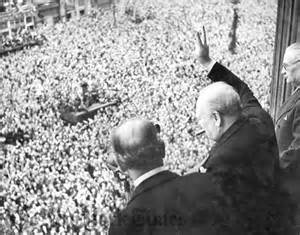
    VE Day 1945 London

    ROS writes to remind us that today is VE Day. That on May 8, 1945, the Allies declared themselves victorious in Europe. The day that European fascism died. The surrender was signed in Reins France on May 7th and in Berlin on May 8th, by the German government then headed by president Karl Donitz. From the Gaston Gazette;

    Liberation finally had come to the death camps and their unimaginable horrors. Evil had been defined by the atrocities that took place within their barbed-wire fences.

    Freedom rang across Europe — and across America, people joined in the rejoicing.

    In a month of military anniversaries and recognition of those who gave their lives in America’s wars, VE Day can easily become lost.

    The nation takes a holiday to observe Memorial Day.

    D-Day lives on in movies, the history books for far too many of succeeding generations.

    But the day that marks such a costly military – and important moral — victory passes by quietly.

    By the way, it was also Harry Truman’s 61st birthday.

  • 68 Years Ago

    “At 0001 hrs BDST 7 May 1945 the mission of this Allied force was accomplished.  signed Eisenhower.”

    In case you don’t recognize it:  the above bold text was the message sent by GA Dwight D. Eisenhower, Commander, AEF, to GA George C. Marshall, CSA, on the surrender of Nazi Germany. The image is the document of unconditional surrender on the part of the German High Command.

    After more than 5 years and 8 months, World War II had effectively ended in Europe.  It would continue in the Pacific for another 3 1/2 months.

    Happy VE Day, all.

  • 38 Years Ago Today

    Can’t believe I forgot this. Saigon fell 38 years ago today.

    Trivia note: though this is perhaps the most well-known and iconic photo of of US evacuation operations that occurred that day, the photo is neither the roof of the US Embassy nor a US military aircraft. The photo is of an Air America helicopter evacuating CIA Station Saigon personnel from a Saigon apartment complex where they were housed. UPI “got it wrong” when they originally captioned the photo 38 years ago.

    The US evacuation of Saigon (Operation Frequent Wind) is worth reading about if you have the time. Some really riveting stories there – including those of the only 2 RVANF O-1 “Bird Dog” landings on a US carrier.

    Hat tip to TAH reader John Robert Mallernee for the reminder.

  • “. . . but if they mean to have a war, let it begin here.”

    An astute TAH reader (Roger in Republic) reminded me today that today also marks a second important military anniversary.

    Two hundred thirty-eight years ago today – at approximately 0500 – the opening shots of the American Revolution were fired at Lexington, MA.  Action quickly followed at Concord.

    The skirmish at Lexington was a debacle for the American Revolutionary force.  At Concord, however, British forces made a serious tactical error at North Bridge, found themselves outnumbered, and broke.

    British forces shortly afterwards retreated to Boston, suffering many casualties on the way – particularly at skirmishes at Bloody Angle and Menotomy.

    Lexington/Concord is generally accorded a victory for the Colonial forces. The American Revolution would last for nearly a decade (until the 1783 Treaty of Paris), and would ultimately result in our present United States.

  • 70 Years Ago Today: The Warsaw Ghetto Uprising

    Today marks the anniversary of a generally little-known battle of World War II.  On this day in 1943, the Warsaw Ghetto Uprising began.

    The uprising was a desperate attempt by the Jewish residents of the Warsaw Ghetto to avoid deportation to the Treblinka Extermination Camp.  It was supported to various extents by other Communist and non-Communist Polish resistance forces.

    The Polish Jews forced into the Ghetto were abysmally badly armed and supplied.  Nonetheless, they decided it was better to fight – and very likely die on their feet – than be led away to slaughter.

    From 19 April to 10 May, the residents of the Warsaw Ghetto battled Nazi forces.  Using fire as their most effective weapon, the Nazis prevailed.

    Prior to the uprising, the Warsaw Ghetto was approximately 1.3 square miles.  At the end, few buildings within the entire Ghetto were useable.  What was left were largely burned-out shells.  The Nazis razed those and built Warsaw Concentration Camp on the site.

    Approximately 13,000 are thought to have died during the Warsaw Ghetto uprising – 7,000 in the fighting, and 6,000 by being burned alive or via smoke inhalation.  After the fighting ceased, the remaining 50,000 residents were deported to Treblinka.  Most were murdered there.  

    However, the first group deported early during the uprising reportedly reorganized into resistance groups while at Treblinka.  Reputedly they also  played a pivotal role in the 2 August 1943 revolt and mass escape which occurred there.

    Spoczywaj w pokoju, mój starszy bracia broni. Szalom.
  • “With dynamite, my dear colleague.”

    We sometimes denigrate the French.  And in truth, they’ve not exactly been our country’s most constant ally since World War II.

    Nonetheless, the French have produced many distinguished military leaders.  This includes one many Americans likely have never heard of:  Lieutenant General Jean Ganeval.

    Then-Brigadier General Jean Ganeval was the Commandant (Military Governor) of the French Sector of Berlin throughout the Berlin Airlift.  (Like the rest of postwar Germany, Berlin was still under military occupation in 1948; and like the rest of Germany, Berlin was also divided into four occupation sectors:  British, US, French, and Soviet).  Ganeval’s authority within the French sector of Berlin was considerable, approaching that of a colonial governor or viceroy.

    Direct French participation in the Berlin Airlift proper was limited.   This was not due to politics or historical animosity; by 1948 France was involved in a war in Indochina they would ultimately lose, and the majority of the French Air Force’s transport assets were engaged in supporting that war.  France could supply its occupation troops in Berlin by air, but not much more.

    Nontheless, France – and Ganeval – played an essential role in the Berlin Airlift.

    (more…)

  • Forty-Four Years: In Memoriam

    We call the period between the end of World War II and the end of the Soviet Union the “Cold War”.  And in truth, it wasn’t an all-out, no-holds-barred global fight like World War II.

    But it wasn’t always particularly “cold”, either.

    The US and USSR (through allies) engaged in numerous wars by proxy throughout that period.  Korea, French Indochina, the Hukbalapap Rebellion in the Philippines, Quemoy/Matsu, the Arab-Israeli Wars, Vietnam, Indonesia, Malaysia, the Congo, Angola, Afghanistan, Grenada – the number of proxy conflicts, as well as casualties, were extensive.

    Even disregarding proxy wars, direct hostile fire incidents involving US and/or either Soviet or Soviet-client forces were not unknown.  Some such incidents are reasonably well-known:  the 1968 seizure of the USS Pueblo; the murder of MAJ Arthur Nicholson in East Germany in 1985; the 1976 Panmunjom Ax Murder Incident; the 1983 downing of KAL-007.  But our collective memory for many if not most such incidents has faded to the point that most are remembered only dimly, if at all.

    Such Cold War hostile fire incidents were far more common than most people realize.  The Defense POW/Missing Personnel Office maintains a list of 126 US personnel still unaccounted for due to 14 Cold War aircraft losses.  Two of these incidents (and 18 of the personnel still unaccounted for) were apparently not due to hostile action – but the other twelve aircraft and 108 personnel were indeed lost due to hostile fire.  And these 14 incidents are nowhere near a complete list of even Cold War aerial hostile fire incidents; it records only those where US personnel are still missing and formally unaccounted for.  A more comprehensive list of such Cold War aerial hostile fire incidents may be found here.  There were also numerous other hostile incidents on ground and at sea.

    Perhaps the deadliest single Cold War hostile fire incident involving US forces is today virtually unknown.  Like the USS Pueblo, it was the result of hostile action by a Soviet client – North Korea – and involved the US Navy.  But unlike the USS Pueblo, no US survivors returned.

    The 44th anniversary of that incident occurs shortly before midnight EDT tonight.

    (more…)