Category: Historical

  • 150 Years Ago Today: Gettysburg

    Today is the 150th anniversary of the beginning of the Battle of Gettysburg.

    The battle would rage for three days.  It is generally regarded as one of the turning points in the US Civil War.  Indeed, many historians regard it as the turning point after which Confederate independence was no longer possible.

    Gettysburg was a classic meeting engagement; it was never intended to be fought at all.  It was enabled by the absence of much of the Confederate cavalry from Lee’s Army of Northern Virginia, whose commander – “Jeb” Stuart – had gone on his famous but foolish “ride around the Union army”.   This act deprived Lee of reconnaissance assets that would have alerted him to the close presence of the enemy.

    The battle began when Confederate troops of Harry Heth’s division approached Gettysburg (according to Heth’s memoirs, looking for supplies – particularly shoes).  They were discovered by Union cavalry under John Buford screening the Chambersburg Pike northwest of Gettysburg.  Buford recognized the critical value of the high ground south Gettysburg (Cemetery Ridge), and – with no support and no guidance – on his own initiative decisively deployed his troops to delay the Confederate advance.

    This act, which could easily have destroyed his command, was in retrospect likely the event that both ensured the battle and the Union’s victory.  Union troops under John Reynolds, Abner Doubleday, and Oliver Howard arrived in time to relieve Buford and prevent the destruction of his command (a very near thing) – and to fight a delaying action keeping Cemetery Ridge in Union hands.

    Reynolds was killed by a Confederate sharpshooter shortly after arriving. He would be among the first of many to die during the battle.

    Units from both sides arrived piecemeal during the day, and went into battle as they did.  Confederate forces seized Gettysburg and the high ground east of town – Seminary Ridge.  But the Union held possession of the critical ground at Cemetery Ridge at the end of the day.

    Confederate forces would never possess Cemetery Ridge.  Lee would nearly break his army attempting to seize it from them.

    Lee failed.  With that failure, in the opinion of many historians the Confederacy’s chances of independence also failed.

    Wickipedia’s article on the Battle of Gettysburg is actually a rather good overview of the battle’s events.  If you have some time today and need or want a refresher, it’s worthwhile – as are the articles describing Day 1, Day 2, and other specific actions occurring as part of the battle (Little Round Top, Cemetery Hill, Culp’s Hill, Pickett’s Charge, Third Day Cavalry Battles ) in more detail.

    And while you’re reading it – or otherwise going about your daily business – also take a moment to remember the heroism and sacrifice that occurred 150 years ago today over the three day period beginning at about 7:30 AM.

  • Digging for Gold – in Berlin

    Military operations – overt and covert – come with risks.  But even covert military operations sometimes include too many ties to governments to be politically acceptable.  Hence, most intelligence services have “special” branches.

    The US is no different.  And during the Cold War, these “special branches” of our intelligence community did some truly interesting and high APF work.  Many such operations succeeded; some didn’t.

    The failures are the ones that we often hear about.  This is because they are often the ones exposed.  In contrast, the successful operations tend to stay secret for a rather long time.

    This article is about one such clandestine operation.  A few years ago, it was publicly acknowledged and information about it declassified.

    It occurred in Berlin during 1954-1956.  It was referred to as Operation Gold, and despite its early exposure is regarded as one of the most successful Cold War US covert operations.  It involved tunneling 450 meters into East Berlin – under one of the most heavily-guarded borders in the world – to tap telephone cables used by the Soviet military that were less than 2 meters (approx 6’ 6”) underground.


    Yes, the APF on this operation – particularly during the tunneling and tap placement – was indeed high.  Cojones muy grandes required.

    (more…)

  • Sixty-Three Years Ago Today

    On 25 June 1950 – at dawn – forces of the Korean People’s Army attacked South Korea. There had been skirmishes along the 38th parallel previously. However, this time the North Korean forces pushed south in an attempt to conquer South Korea and forcibly unify the peninsula under communist rule.

    Hostilities were to last 3 years, 1 month, and 3 days. The war would claim between 500,000 and 950,000 total KIA (both sides); in excess of 1,200,000 individuals would be WIA.

    The war technically has never ended. The agreement to stop fighting in July 1953 was an armistice, not a permanent settlement. A peace treaty formally ending the war has never been signed.

    Korea was the first “hot flare” of the Cold War – though not the last – and was also arguably the most intense. (Vietnam claimed more lives, but US combat operations there were spread over roughly 14 years vice 3.) It was the only Cold War conflict that saw large-scale direct combat between US and Soviet or Chinese forces. That experience was sobering for both sides, and was not repeated again during the Cold War.

    Korea is often called “the forgotten war”, though recently it has received more recognition. However, those who fought there – or who have served there – know vividly the war’s impact. It’s still felt today with each inane act of ND:tBF and the rest of North Korea’s leadership.

    The US was woefully unprepared when the Korean War began; we struggled mightily the first few weeks. It was very nearly a defeat for the US and the free world.

    If nothing else, that’s a lesson from the Korean War we should remember.

  • “Tear down this wall” Anniversary

    Twenty six years ago today, this happened;

  • “But we couldn’t live with ourselves.”

    Jonn posted a brief story the other day on the guilty plea entered by Robert Bales – the guy who claims he “snapped” after a night of unauthorized drinking, then went out and murdered 17 Afghan civilians in their homes.  Even now there appear to be those who would excuse Bales’ actions, either partially or completely.

    I’d like to offer a short counterexample.

    What Bales did was nothing but thuggery.  What the following three Soldiers did, on the other hand, was IMO the epitome of correct, professional conduct.

    During the first Gulf War a small US Special Forces team of  3 persons was conducting strategic reconnaissance.  They were well behind enemy lines.  Indeed, they were north of the Euphrates river and were less than 100 miles from Baghdad.  Their mission was to observe one of the major roadways between Baghdad and Iraq for signs of enemy activity in order to screen the western flank of the planned allied “left hook” through southern Iraq.

    They had secreted themselves in a dug-in, “spider-hole” hide site.  (We’d studied the Viet Cong’s use of such during the Vietnam war, and had learned much.)  The site was well camouflaged; observation was by a small periscope-like device raised through a small opening in the camouflaged door to the hide site, described as a “slit”.

    Unfortunately, no camouflage is absolutely perfect; children are both inquisitive and observant.  Early one morning a small Iraqi girl – a child no more than 7, per later estimates – was out and about and saw something she though unusual.  She went over to investigate.

    She found the slit in the hide site’s trap door – then lifted it open.  In short order, she was staring down the muzzle of three silencer-equipped pistols.

    The three US soldiers had a choice.  They could kill the little girl, hide the body, and continue their mission.  Or they could let the child go, attempt an extraction with their cover blown – and maybe not get home.

    They chose the latter option.  The child ran and got her father.  Her father informed nearby Iraqi forces of what his daughter had found.

    The site was soon surrounded by around 100 Iraqi troops.  Amazingly, the team was successfully extracted – although it turned out to be a truly harrowing and narrow escape under fire.

    The most junior member of the team was later asked why they didn’t kill the child to preserve their mission, and perhaps their own lives.  The title of this article gives his response.

    Like Bales, he was a US Army Staff Sergeant.

    The story above is not apocryphal.   Details may be found at pages 4 and 5 of this article.  It’s a short but incredible read.

    Those three soldiers knew the difference between cold-blooded murder and collateral damage.  They chose to be military professionals instead of murderers, even though they knew it might cost them their freedom – or their lives.

    In contrast, Bales chose cold-blooded murder.  For that, there’s no justification.

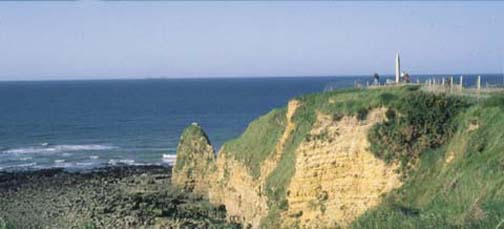
  • Pointe du Hoc

    Republished almost every year;

    a0139_small.gif

    Rangers Mission for D-Day, 6 June 1944

    The Ranger Group, attached to the 116th Infantry and commanded by Lt. Col. James E. Rudder, was given the mission to capture Pointe du Hoc and destroy the guns. The Ranger Group was made up of two battalions: the 2d Rangers, under direct command of Col. Rudder, and the 5th Rangers, under Lt. Col. Max F. Schneider. Three companies (D, E, and F) of the 2d Battalion (Task Force A) were to land from the sea at H-Hour and assault the cliff position at Pointe du Hoc. The main Ranger force (5th Battalion and Companies A and B of the 2d, comprising Task Force B) would wait off shore for a signal of success, then land at the Point. The Ranger Group would then move inland, cut the coastal highway connecting Grandcamp and Vierville, and await the arrival of the 116th Infantry from Vierville before pushing west toward Grandcamp and Maisy.

    dday_pointeduhoc_375.jpg

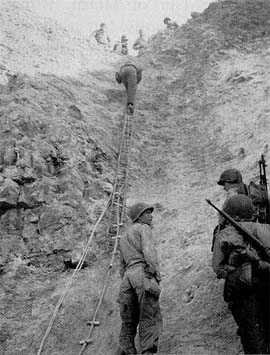
    One DUKW was hit and sunk by 20-mm fire from a cliff position near the Point. The nine surviving LCAs came in and managed to land in parallel on a 400-yard front on the east side of Point du Hoc, landing about 0705. Allied naval fire had been lifted since H-Hour, giving the Germans above the cliff time to recover. Scattered small-arms fire and automatic fire from a flanking machine-gun position hammered the LCAs, causing about fifteen casualties as the Rangers debarked on the heavily cratered strip of beach. The grapnel rockets were fired immediately on touchdown. Some of the water-soaked ropes failed to carry over the cliff, but only one craft failed to get at least one grapnel to the edge. In one or two cases, the demountable extension ladders were used. The DUKWs came in but could not get across the cratered beach, and from the water’s edge their extension ladders would not reach the top of the cliff.

    Despite all difficulties, the Rangers used the ropes and ladders to scramble up the cliff. The German defenders were shocked by the bombardment and improbable assault, but quickly responded by cutting as many ropes as they could. They rushed to the cliff edge and poured direct rifle and machine gun fire on the Rangers, augmented by grenades tossed down the slope. The Rangers never broke, continuing to climb amidst the fire as Ranger BAR men picked off any exposed Germans. The destroyer USS Satterlee (DD-626) observed the Rangers’ precarious position, closed to 1500 yards and took the cliff top under direct fire from all guns, a considerable assist at a crucial time.

    Within ten minutes of the landing the first Americans reached the top of the cliffs.

    rangers_pointe_du_hoc_700_01.jpg

    I may just watch “The Longest Day” tonight. “What does ‘bitte, bitte’ mean?”

  • D-Day; June 6, 1944

    The folks at the NRA & Brownells Life of Duty sent us this edited video produced by the Army in 1969 and mostly archival footage of the actual battle on the beaches of Normandy, France.

    June 6, 2013 marks the 69th anniversary of “Operation Overlord” – the D-Day invasion where more than 160,000 allied troops landed on a 50-mile stretch of French Coastline to fight Nazi Germany on the beaches of Normandy, France in 1944. The invasion led to the deaths of more than 9,000 allied forces, but the victory resulted in a significant turning point for Europe’s history. Today, we would like to honor the allied forces that participated in the invasion by sharing a film created by the U.S. Army in 1969. In this film, the drama and battle action of the landing at Normandy is portrayed along with the fierce combat that took place to overcome “Fortress Europe” (compliments of the National Archives).

    Embed Code –

    The Center for Military History tells the complete story of the battle.

  • Battle of Midway Anniversary

    midway

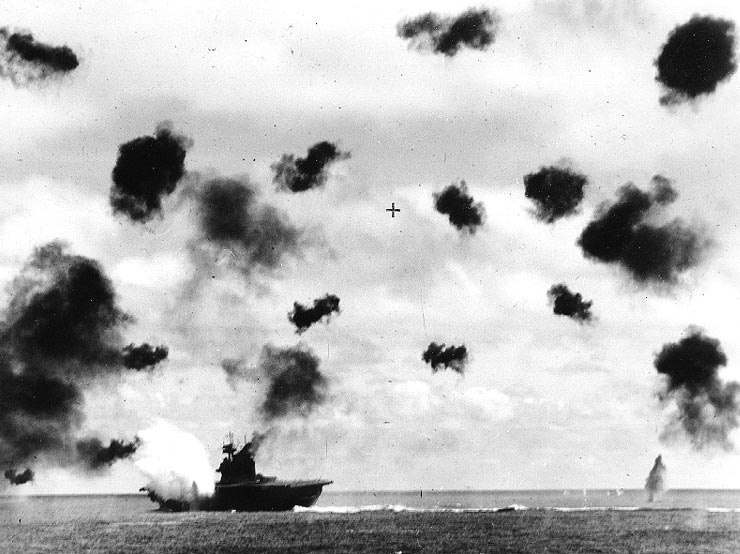
    509th Bob writes to remind us that today is the 71st Anniversary of the beginning of the Battle of Midway which lasted from June 4th – June 7th 1942. About six months after Pearl Harbor and seven weeks after the Doolittle Raid, the Japanese sought to extend their security perimeter a bit by taking Midway Island and drawing the Navy into an ambush. The US had, however broken the Japanese Naval codes and knew their plan and Nimitz was waiting for Yamamoto.

    When the smoke cleared, four Japanese carriers were at the bottom of the sea – the entire strength of the task force–Akagi, Kaga, Soryu, and Hiryu, with 322 aircraft and over five thousand sailors. The Japanese also lost the heavy cruiser Mikuma. American losses included 147 aircraft and more than three hundred seamen.

    Analysts often point to Japanese aircraft losses at Midway as eliminating the power of the Imperial Navy’s air arm, but in fact about two-thirds of air crews survived. More devastating was the loss of trained mechanics and aircraft ground crews who went down with the ships. Some historians see Midway as the turning point in the Pacific theater of the war, after which Americans rode straight to Tokyo; others view it as a cusp in the war, after which initiative hung in the balance, to swing toward the Allies in the Guadalcanal campaign. Either way, Midway ranks as a truly decisive battle.

    And it was a pretty exciting movie, convinced me that I didn’t want to join the Navy.