No, I’m not talking about the TAH commenter by that name – though based on her photo in the Member’s Gallery, she indeed qualifies. (smile) I’m talking about this lovely lady.


Valkyrie’s story is IMO worth telling. I’ll tell it briefly here.
. . .
No, I’m not talking about the TAH commenter by that name – though based on her photo in the Member’s Gallery, she indeed qualifies. (smile) I’m talking about this lovely lady.
Valkyrie’s story is IMO worth telling. I’ll tell it briefly here.
. . .
For those interested in aviation history, the CIA recently (2012) released a short history of the Lockheed “Archangel” program. It’s a bit over 50 pages, and focuses solely on the A-12.
The document is called Archangel: the CIA’s Supersonic A-12 Reconnaissance Aircraft. It was written by David Robarge, who in 2012 was the CIA’s Chief Historian.
It’s enjoyable reading. It can be found here in PDF format.
In case “A-12” doesn’t ring a bell: that was the airframe developed by Lockheed for the CIA as a successor for the U-2. It was later modified to produce the SR-71 for the USAF. (The SR-71 was a 2-seat plane; the A-12 was single-seat.)
Longtime TAH readers know I have a soft spot for history, and in particular that supporting the intel and military communities. Well, here’s another blurb on a bit of less-known aviation history.
Most of us know about Lockheed’s Skunk Works. Many know that the Skunk Works produced a number of pioneering high-performance aircraft for the US: the F-80, the F-104, the U-2, the A-12 (the design for which later was modified to become the SR-71), and the F-117. I’ve written a brief article about the U-2 and A-12 previously, and a somewhat longer one about the A-12.
However, between the U-2 and the A-12/SR-71 there was another Skunk Works project, It was the original successor to the U-2. Due to insurmountable issues, it was never produced.
The aircraft design was the CL-400. The project was code-named “Suntan”.
. . .
Several of you folks sent us a link to Buzzfeed‘s article by Benny Johnson about the Museum Support Center at Fort Belvoir and there’s nothing I can add to the series of photos.
Remember that ending scene out of Indiana Jones where the Ark of the Covenant is boxed up and wheeled through an endless government warehouse?
Did you know that that place actually exists?
It is located 30 minutes outside Washington, D.C., at Fort Belvoir in Virginia. The building itself is very nondescript…
Yeah, I’d like to get in there and just touch the weapons. Acres and acres of weapons. I never thought there’d be a place better than the armory at Williamsburg, but I was wrong.
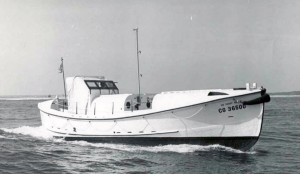
Eggs sends us a link to Fox News about an event that happened 62 years ago on February 18, 1952 when Petty Officer 1st Class Bernie Webber, Petty Officer 2nd Class Andy Fitzgerald, Seaman Ervin Maske and Seaman Richard Lively took off from the station at Chatham Harbor, Massachusetts in a 36-foot wooden boat to rescue the survivors of the SS Fort Mercer and SS Pendleton which had broken up off the coast. Their small wooden craft was built to carry 12 men, and there were 76 men clinging to the hulls of the two ships;
“The first wave they encountered was so big and so ferocious that it picked up their little life boat and tossed it into the air, slamming it back onto the sea.”
“They lost their compass. Their windshield was smashed. The glass was now embedded in the captain’s skin,” [Casey Sherman, co-author of “The Finest Hours”] said.
Other boats were headed for the scene as well, including five Coast Guard cutters. But it was the faster, smaller CG-36500 that would be the star of the effort, in which 70 of the stranded sailors were saved. Reaching the stern section of the Pendleton, the four found 33 men hanging on for their lives. They herded 32 of the men onto the boat. One man, identified as George “Tiny” Myers, died when the rescue boat collided with the Pendleton’s stern, pinning him between the two vessels.
The small craft returned to Chatham Station with 32 survivors, while other ships rescued the others, but according to the Fox News story, the Coasties never consider the rescue a success because they hadn’t saved “Tiny” Myers. CG-36500 has been restored to a museum and you can visit it in Orleans, Massachusetts.
On the night of 17-18 February 1864, military history was made.
On that date, the first ship was sunk by a submarine.
During the blockade of Charleston during the US Civil War, the CSS Hunley – a small, human-powered submarine (literally; its propeller was powered via a hand-crank) submerged. While submerged, it attacked the USS Housatonic with a spar torpedo.
The attack sank the USS Housatonic. However, the CSS Hunley also never returned to shore. It also sank in the aftermath of the attack.
The CSS Hunley’s sunken hull was located in 1995. It was raised in 2000.
Recent analysis indicates that the CSS Hunley may have been as close as approximately 20 feet away from their torpedo at time of detonation (they were originally thought to be much farther away). That may have been close enough to allow the shock to have knocked the ship’s crew unconscious, making it impossible for them to either return to shore or escape from the disabled craft.
May all 13 who lost their lives – 5 Union sailors from the USS Housatonic and entire 8-man crew of the CSS Hunley – in this historic event rest in peace.
This is republished from three years ago;
Twenty years ago, 1st Battalion, 41st Infantry attached to the Third Brigade of the 1st Infantry Division (from the Third Brigade of the 2d Armored Division (Forward)), was the only US unit in Iraq. We were fifteen clicks from the Saudi border, screening for the sweep east of Schwartzkopf’s “Hail Mary” strategy. For two days we had been watched by Iraqis and had a little contact. with some reconnaissance elements. However on February 17th, my gunner spotted 5 T-55s about 1500 meters in front of our defilade position and I called for indirect fire. The first response came from an Apache unit. The pilot ignored his instruments and fired the wrong grid coordinate, directly to my west, striking two vehicles in our own Scout platoon anchoring our far west flank.
COB6 was the platoon leader of the platoon between my platoon and the Scout elements. Despite the orders of our company commander (a phrase that I use in several other stories involving COB6 and our commander), COB6 pulled his vehicle off the line and rushed to the burning vehicles (An M3 and and an M113 from the GSR unit). COB6 and his crew pulled the broken bodies from the vehicles with burning ammunition exploding around him and shielded the injured Scouts with his own body. Two of those scouts were dead, but three others owe their lives to COB6 and his crew.
Needless to say we stopped calling for Apaches and after slamming two TOWs into a berm about a hundred meters in front of us, we used artillery fire. My first ever call for indirect fire in total darkness. The following morning, M1s found the T-55s 5000 meters north of the spot my gunner had spotted them.
These are the names of the members of 1/41 we lost throughout the war;
Tony R. Applegate
David R. Crumby
Manuel M. Davila
Anthony W. Kidd
David W. Kramer
Jeffery T. Middleton
James C. Murray, Jr.
Robert D. Talley
Talley and Middleton were killed that night.
We had the highest casualty rate of any other infantry unit in the war, I say it’s because both sides were shooting at us.
And, oh, yeah, my granddaughter celebrates her 23d birthday today, too.
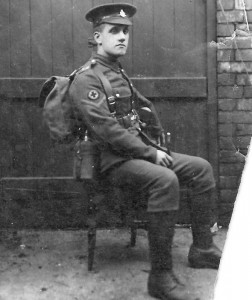
The UK Express reports that 82-year-old Denis Linfoot is transcribing his father’s diary about the years leading up to, and his participation in The Great War as a blog, each entry appearing 100 years after it was written;
Private Arthur Linfoot volunteered for the Royal Army Medical Corps when he was 25 in 1915 and kept a diary of his experiences in the trenches of France.
His diary, written in Pitman shorthand, chronicled January 1 1914 to December 31 1918 and have been decoded by his 82-year-old son Denis.
Mr Linfoot, from Canterbury in Kent, learnt the old form of shorthand so he could read his father’s diaries and spent months looking at the journals.
The blog is “The Diary of Arthur L. Linfoot | January 1914 – December 1918” and begins on January 1st, 1914.