Category: Pointless blather

  • Some Christmas Music

    Well, I’m “enjoying” participating in that annual ritual called “Holiday Travel” – and it’s now Christmas. So I decided to find and post what I thought was some appropriate Christmas music for our readers.

    Yeah, this was written by one of those stank-ass hippies from the 60s – albeit one who did have at least a little common sense (see the tune “Taxman”). And yeah, the chorus is unrealistic and Polyannaish in the extreme.

    Still: today it just seems apropos.


    Merry Christmas, all. Take care.

  • No Explanation Necessary

    DPAA doesn’t appear to have listed any new POW/MIA accountings this week. So instead of the normal “No Longer Missing” article, here’s a bit of music.

    This one’s from a group of now-middle-aged Irshmen. I’m thinking any of our male readers who’ve (1) loved someone and (2) are 35 or older can identify with this one.


    The lads certainly got that one right.

  • Yer Saturday Chuckle – Things You See While Traveling

    Yer Saturday Chuckle – Things You See While Traveling

    On a recent trip, I took a route I hadn’t taken in 20 years. Much of the route was pretty much the same as I remembered. But there was one recent change that caught my eye.

    Now, I happen to like roadside billboards. Yeah, some of them can be pretty garish and ugly. But they are a source of info when traveling by car. And some of them can even be fairly entertaining.

    Thanks to LBJ’s wife, Lady Bird, and our “nanny state” Congress back in the 1960s with it’s “wonderful” Highway Beautification Act, highway billboards are now somewhat the rarity. But a few do still exist; some billboards in existence when that “wonderful” law was passed and which meet certain criteria were grandfathered.

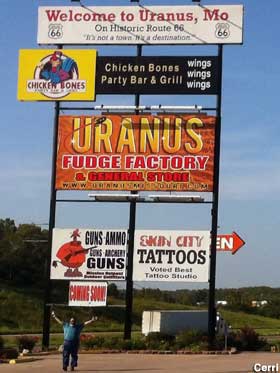
    Here’s the billboard that caught my eye:

    Yeah, you read that correctly. “The best fudge is found in Uranus” – the Uranus Fudge Factory in Uranus, MO, that is. (smile)

    Seems the place opened about 2 years ago, in 2015. Previously, according to RoadsideAmerica.com it was “Big Louie’s Burlesque Saloon”. So the place has more class today than it did in the past. (smile)

    In addition to selling fudge, the place is apparently a general store. There’s also a gun shop, a tattoo parlor, a “party bar and grill”, and some other novelty items.

    Here’s one of those “novelty items”. (Yeah, DB Bunghole – I’m throwing you a slow, straight “softball” here. Hop on it!) (smile)

    And since they’re in Missouri – heavily influenced by the Democratic Party since before the days of the Pendergast Machine – you know their labor force has a union:

    Your guess is as good as mine regarding how they ended up with Local #2. I’d have guessed Locals 1 and 2 would be in Greenwich Village and the Castro District.

    On that last trip, I didn’t have time to stop. But I might be back that way again early next year. And if so, I’m gonna have to stop and see the place. Maybe have some wings for dinner.

    Not sure I’ll try the fudge, though.  (smile)

  • The Road Goes On Forever (Continued)

    Well, not really. But this trip is indeed a longish one.

    US 70 – in the past called the “Broadway of America” – is still around, albeit no longer coast-to-coast (it now ends where it meets US 60 in Globe, Arizona). Still: parts of US 70 are indeed a drop-dead gorgeous drive.


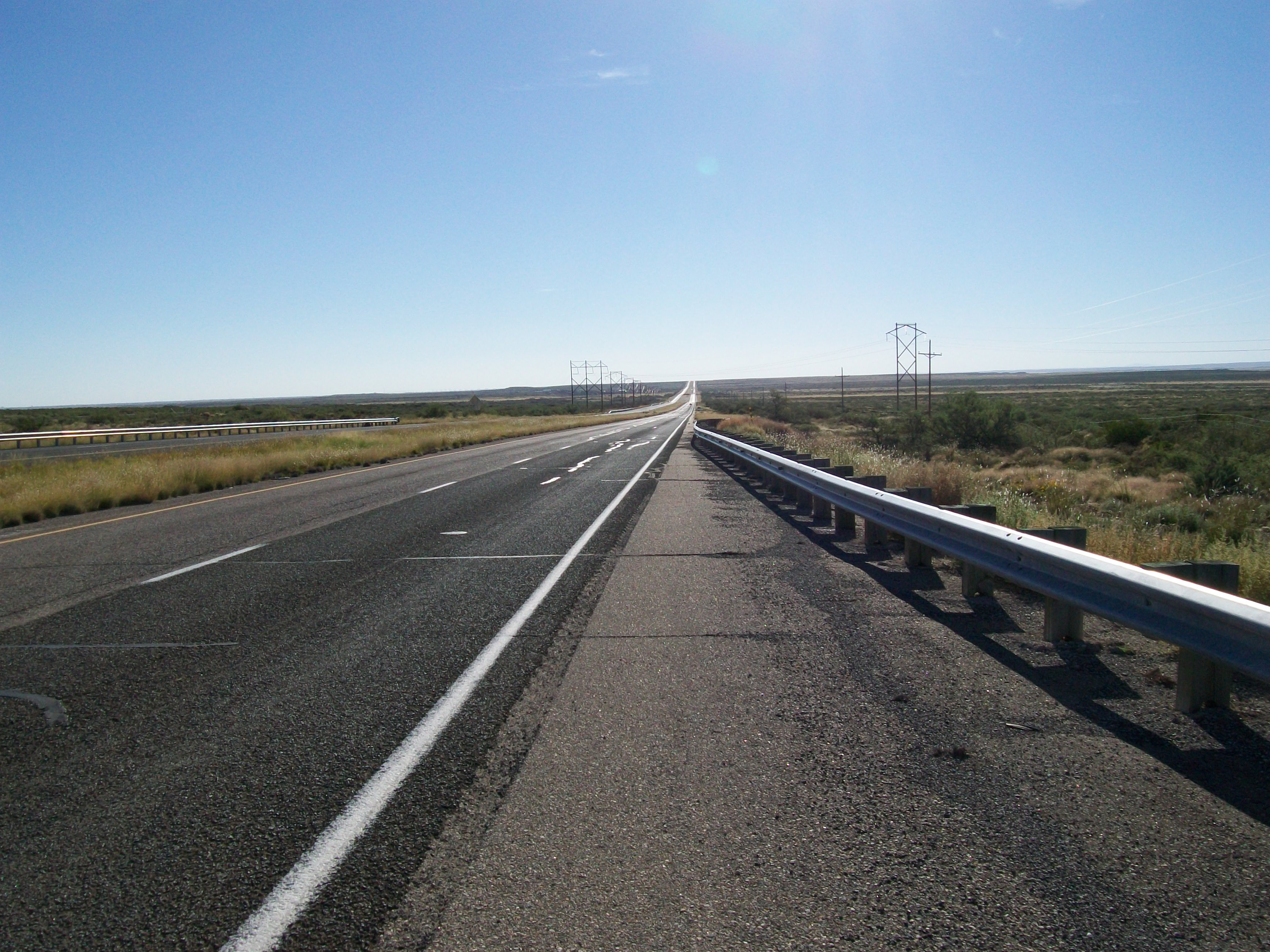
    US 70 is particularly scenic through New Mexico. The photo above was taken between Clovis and Roswell – and that’s probably the least scenic part of the road in the state.

    Much of the rest of the highway west of Roswell is incredibly beautiful. Since I don’t want anyone to accuse me of “stolen religion” (smile), I won’t claim this trip is a religious pilgrimage – even though the road does pass the entrance to The Inn of the Mountain Gods. (Sidebar: I’ve stopped there to see the place, but I’ve not yet stayed. It’s a gorgeous inn, at around 7000’ elevation in Ponderosa pine country. Staying there for a weekend or longer one day is on my “try to do this if you can” list.)

    One of the most beautiful stretches on US 70 in New Mexico is the Tularosa basin. The following just seemed apropos while crossing it after an early start. And traversing the Tularosa basin during a red-tinged sunrise while listening to this was . . . nice.


    Y’all take care. I’ll check in while traveling as circumstances and time permit.


    PS: Skippy, don’t say anything. (smile)

  • From the Road

    I’m back on the road again for a bit. So that means you all get lucky – articles from me may be somewhat limited for the next 2 or 3 weeks. (smile)

    Someone asked me if I’d be playing Willie Nelson’s “On the Road Again” during the trip. Probably not; I never was a huge Willie Nelson fan. My taste in music tends rock vice country.

    But this tune did hit the stereo already.  Kinda apropos, IMO.


    One problem: it was kinda hard to keep from pressing down a bit too much on the accelerator while that was playing. (smile)

    The band did some good work in the 1980s. For representative selection of their best work during that decade, give a listen to their 1990 hits album Standards. Several tracks there are excellent – especially tracks 11(“Sold Me Down the River”) and  12 (“Devolution Workin’ Man Blues”).

    Y’all take care.

  • “Helden”

    The late David Bowie was a musical icon.  He wrote some of the most creative and lasting popular music of the last several decades.

    This is about one of his works – one that I believe resonates particularly strongly with veterans of a certain part of the Cold War.  I know it certainly does with me.

    And I think I may have finally figured out why.

    Yep, you’re right – this is yet another verbal “walkabout” off the normal TAH “res”.   Better hit yer browser’s back button before it’s too late to escape yet another trip down the proverbial rabbit hole.  (smile)

    . . .

    The four years from 1972 to 1976 were hugely commercially and artistically successful period for Bowie.  But the personal cost was substantial.

    As a young man, Bowie had been advised to stay away from drugs – he was later to call this the best advice he’d ever received.  Yet like many of that era in the music business he ignored the advice.

    Ignoring that advice nearly killed him.

    Reputedly, his longtime assistant convinced him to leave the LA music and cocaine scene in the mid-1970s and get clean.  He did so – first moving to Paris, then to Switzerland, and finally settling in a small, shabby apartment in a working-class (and at the time, mostly Turkish) neighborhood near the Berlin Wall.  Doing this probably saved his life – though not his marriage.  He and his first wife divorced a few years later, in 1980.

    Here, Bowie regained control of his life and recovered.  And working with some of the musical luminaries of the day (e.g., Tom Visconti, Brian Eno, David Fripp, and others) he recorded three of his most critically acclaimed albums – Low, “Heroes”, and Lodger, collectively termed his “Berlin Trilogy”.  The album “Heroes” was the only one of these that was written and recorded entirely in Berlin.

    This background is IMO significant, because it affected the music Bowie produced during the period.  And that ties directly into why I think one of those songs resonates with those who served during that part of the Cold War.

    . . .

    OK, that’s the background about Bowie.  Now, some about the tune.

    The song in question is “Heroes” (the quotes are part of the title).  The music seems upbeat, with perhaps a bit of wistfulness added.  Though initially not particularly well-received, it’s become recognized as one of Bowie’s signature works – perhaps his finest.

    Live, it’s anthemic and stirring.  It appears to be a triumphant and joyful song – a musical reminder that one can “be all that you can be” if one seizes the day.

    That interpretation is IMO absolutely wrong.  The song isn’t about improving oneself or one’s state in life.  Rather, it’s about being caught in a no-win situation.

    And that – plus the timing – is why I believe the song resonates with those who served during and for a few years after the period in which the song was written.

    . . .

    On the surface, the song is about 2 lovers, told from the man’s perspective.  That much is obvious.  But the reality of the circumstances inspiring the song is hardly triumphant or inspiring.

    In truth, the surface impression is fairly on the mark.  An illicit love affair was the inspiration for the song.  Bowie wrote it after seeing, from his apartment’s window, the album’s producer embrace his mistress near the Berlin Wall.  (Bowie for years claimed it was an anonymous couple, until the man involved – Tom Visconti – publicly acknowledged the truth years later.  Bowie then confirmed Visconti’s account in 2003.)

    Bowie had been around the block enough by then to know how unlikely such a relationship was to last – he’d gone through many himself by that point.  So the song’s inspiration was something Bowie knew was almost certainly doomed to fail.

    Those two factors influence the original song’s lyrics, flow, and tone.  They’re also essential in understanding it.

    Bluntly put, IMO the song is about being in a relationship that’s doomed to fail.  And it captures that feeling, both musically and lyrically, exquisitely well.

    The original English-language version of the tune can be found here; an English-German version, released a few weeks afterwards, can be found here .  (The historical images accompanying the latter version are worth the time it takes to watch, though a few misguided Photoshopped images also appear in the mix.  Be forewarned:  the images will likely provoke various emotional reactions – among them nostalgia, sadness, anger, disgust, euphoria, and pride.)  Many live versions of the tune are also excellent (here is a representative sample).

    But for those who served in the US military during the mid/late 1970s and early 1980s, I believe there’s another reason behind the tune’s appeal.

    . . .

    IMO, in “Heroes” Bowie unintentionally captured something bigger than the song’s obvious storyline.  By accident or design Bowie captured the  mood of a short period of time – a time where Western civilization as we know it today could well have ended.

    The song was recorded at the depth of the Cold War.  It was recorded at the West’s Cold War nadir:  during the post-Vietnam period.

    That was a time, frankly, when it seemed the West might lose the Cold War.

    It was written and recorded in West Berlin – an enclave of the West 100 miles inside Communist East Germany.  A city that knew it was lost if the organic fertilizer ever indeed hit the rotary air movement device.  (smile)

    It was written while the Berlin Wall still existed as a de facto international border.

    The historical accounts do not exaggerate.  The Berlin Wall (and the rest of the IGB) was indeed monitored by  Grenztruppen der DDR (East German Border Troops, often inaccurately called “Volkspolezei” or “VoPo”) guards with orders to shoot those attempting escape.  Nearly 140 individuals died at the Berlin Wall between 1961 and 1989.

    So those “shots above our heads” Bowie was talking about . . . weren’t just figures of speech.  They were all too real.

    Korea along the DMZ wasn’t much different.  The APF there was damned high, too.  And there were periodic incidents there as well.

    Bottom line:  during the mid/late 1970s and early 1980s, that Soviet bear and its allies at the time seemed 10 feet tall.

    . . . 

    So here’s my theory about why the song affects me, and I’d guess many who served during the late 1970s and early 1980s.   Anyone who served in Europe then, or in Korea – or, well, pretty much anywhere  during the same period – at times felt much ­­like the song’s hypothetical “hero”.

    Why?  Simple.  Those of us anywhere near the IGB or Korean DMZ knew that if the balloon went up . . . we probably weren’t coming home.  We knew that many, and probably most if not all, of us were going to die in place doing what we could to stop the enemy.

    And we weren’t sure we could.

    So, yeah:  we understood what Bowie was saying, albeit maybe subconsciously.  Like the song’s protagonist we were putting on a brave face – most of the time.  We were whistling as we walked past the graveyard.

    But we knew the score, even if we didn’t often speak the truth plainly. We couldn’t deceive ourselves all of the time.

    We knew, deep down, if push came to shove . . . we were toast.  We just hoped we could buy enough time to preserve something worth saving before we bought the farm.

    None of us really wanted to end up in a position to be “heroes” – not even just for one day.  (smile)  We knew that often those in such a situation often didn’t come home.  But we also knew full well exactly that might happen.

    And as strange as it might seem . . . for the most part, we were OK with that.

    Thank God those days are past.

    . . .

    David Bowie passed away over a year ago.  And it’s a bit ironic to me that he was the one to so nearly perfectly capture the US military’s mood of that time frame.   His public persona was anything but military.

    Still  . . . he IMO he did capture that era and that feeling damn near perfectly.  So, wherever you are today, Mr. B:  an old Cold Warrior sends his thanks.

    IMO you certainly “got it right” with that one.
  • The “Disco Decade”? Yes – and No.

    Longtime readers know that Jonn tolerates an occasional “walkabout” from me on various and sundry subjects.  Well, consider yourself warned.  Here comes another.

    . . .

    The 1970s are considered by many  a “lost decade” in popular music.  And in truth, the 1970s did give us that abomination called “disco” – which IMO indeed royally polluted the popular music scene for much of the decade.  Derision for that is IMO deserved.

    Still, the decade wasn’t musically a total loss.  Besides those musicians who sold their souls for a quick buck in the disco/dance craze, many other artists were making some memorable music.

    Here’s some of what IMO is that decade’s better music – none of which is disco – at one song per year, along with a few comments on each.  I’ve intentionally omitted songs from that decade I’ve featured here in previous articles.  There’s plenty more from each year worth listening to.

    Without further ado:  yer 1970s non-disco popular musical sampler.

    . . .

    1970:  Mississippi Queen (Mountain)  – inspired when Corky Laing (later to become Mountain’s drummer) saw a Southern beauty wearing a near see-thru dress during a power failure at a gig on Nantucket Island – and pulled out all the stops (with a hour-long drum solo) to keep her dancing.  The song is one of two (along with BOC’s Don’t Fear the Reaper) responsible for making the cowbell a fixture in rock music.

    1971:  Riders on the Storm (Doors) – the Doors’ final recording, and the final Doors single released in Jim Morrison’s lifetime.  Hella good finale.

    1972:  Smoke on the Water (Deep Purple)  – the lyrics literally tell the story of a fire, stared by “some stupid with a flare gun”, at a Frank Zappa concert in Switzerland in Dec 1971.  The song’s intro is gripping – I still remember where I was the first time I heard it.

    1973:  Time (Pink Floyd) – from Dark Side of the Moon.  Perhaps the best (and my favorite) track on the album.

    1974:  Free Man in Paris (Joni Mitchell) – well before she became Don Juan’s Reckless Daughter, Joni was one helluva good singer/songwriter.  One of her best tunes.

    1975:  Rock and Roll All Nite (Kiss) – the lads could rock. From the live album that did a great deal to establish them as major stars.

    1976:  Lido Shuffle (Boz Scaggs) – an absolutely great tune from his greatest album, Silk Degrees.

    1977:  Margaritaville (Jimmy Buffett) – hard call between this and another great Buffett tune from the same year (and title tune of the album containing both), Changes in Attitudes, Changes in Latitudes.  Pretty sure most of us can identify with either tune.

    1978:  Sultans of Swing (Dire Straits) – from their debut album.  Introduced a guy named Mark Knopfler, who plays a fair guitar.  (smile)

    1979:  Hey Hey, My My (Into the Black) (Neil Young) – regardless of his politics, when he wanted to the man could flat-out rock.  One of his best.

    . . .

    OK, that’s all for today.  Time to head back to the ‘res.

  • For Our “Railhead” Readers

    . . . especially Ex-PH2 and API. The tune is self-explanatory – once you know a bit of baclground.

    The bit of background: like the US, Canada also made major efforts to build a transcontinental railroad. (The term “navvy” is British slang – adopted in Canadian English – for a railway laborer.) Their projects began in earnest with the establishment of Canada as a Confederation in 1867, and accelerated greatly with the entry of British Columbia into Canada in 1871.

    Indeed, one of the conditions of British Columbia’s entry into Canada in 1871 was completion of a transcontinental railroad within a decade. While they didn’t make that deadline, they came reasonably close.

    The Canadian transcontinental railroad was completed with the driving of the Last Spike at Cragellatchie, BC, on 7 November 1885. It’s approximately 1,600 km longer than the US transcontinental railroad.

    Lightfoot’s tune commemorates the building of this railroad, and the men who built it. It was commissioned for Canada’s Centennial in 1967 by the Canadian Broadcast Corporation; it aired in a special broadcast on 1 January 1967.

    Lightfoot has been called “a national treasure” by The Band’s primary songwriter Robbie Robertson (both are Canadian). Bob Dylan has been quoted as saying that whenever he hears a Lightfoot song he “wished it would last forever”.

    The man is indeed good. If you’ve forgotten just how good, you might want to give some of his work another listen.