Category: Big Army

  • The really important stuff

    The really important stuff

    Yeah, all of this talk about 4,000 troops going to fight Ebola in Africa, a few thousand more to fight back ISIS in Iraq and Syria, the troops involved in Somalia, the Pentagon hiking healthcare costs, and the White House trying to cut the troops’ pay raise…can we get back to the really important issues. Please.

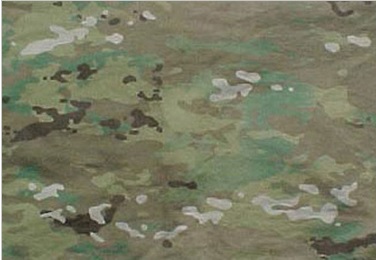
    Stuff like camouflage patterns;

    The U.S. Army will soon replace its digital, Universal Camouflage Pattern, but soldiers may still be wearing the service’s Afghanistan pattern for many years into the future.

    The Army’s recent decision to authorize the 75th Ranger Regiment to wear MultiCam in garrison has triggered questions about the pattern’s future as the service prepares to transition to its new Operational Camouflage Pattern in 2015.

    The new OCP is very similar to MultiCam, a pattern made by Crye Precision that the Army adopted for use in Afghanistan in 2010.

    It’s similar to MultiCam because Crye developed the pattern with the Army for its Objective Force Warrior program in 2002. He later made small adjustments to the pattern for trademark purposes and called it MultiCam.

    Yeah, I don’t even know what they’re talking about anymore, and I don’t think that they do either. Me? I know that “uniform” is supposed to mean that we’ll all look alike, but whichever group of stars and bars is leading this charge has lost sight of that simple concept. Whatever. The problem can solved by cutting the troops pay and throwing that money at stupid self-perpetuating projects like this.

  • Redefining “No direct Contact”

    As you may have read few things to Hondo’s post a day ago about the DOD stating that there will be a portion of the deploying force that will have direct interaction with the Ebola virus. The DOD gave the following statement that this does not mean interaction with actively infected patients.

    “In response to comments I made today about U.S. military personnel potentially coming in direct contact with Ebola infected individuals, specific to lab testing, I want to clarify my remarks. U.S. military personnel working in the labs are not interacting with patients, only samples. The testing labs are manned by highly skilled and trained personnel from the U.S. Naval Medical Research Center. These labs provide 24-hour turnaround results on samples received from area clinics and healthcare providers, with the capability to process up to 100 samples per day.”

    Yet back in September the White House website published a article that stated that 65 Commissioned Officers who will be utilized to provide treatment of infected healthcare workers.

    The United States Public Health Service Commissioned Corps is preparing to deploy 65 Commissioned Corps officers to Liberia to manage and staff a previously announced Department of Defense (DoD) hospital to care for healthcare workers who become ill. The deployment roster will consist of administrators, clinicians, and support staff.

    I start to worry when Commanders make the following statements about Ebola.

    The fear and uneasiness for soldiers and their families is something brigade commander Colonel Heath Roscoe understands, but he feels the soldier’s education, training, and preparation will be enough to fight Ebola as well as any fear.

    “I feel my soldiers are well trained,” said Roscoe. “There will be apprehension, but the more I read about (Ebola) the more comfortable I become about going over there.

    It seems that form me the more I read gives me the exact opposite feeling about the situation. Not to mention the problems caused by fear of the outbreak. There is a video from the POV of a nurse on the front lines as he takes care of several patients and documents what seems to be a typical day.

    A town hall meeting was held at Fort Hood on Monday for families of the soon-to-be deployed soldiers to talk about their concerns or fears about the mission into Africa. Roscoe said the soldiers being deployed are all very well-disciplined and will be taught to exercise good hygiene to keep Ebola risk low. Even in a worst-case scenario, Roscoe assured families their loved ones would be okay.

    “If a soldier were to get Ebola over there, they will be okay because America will take care of them.”

    “…”

  • The Ebola issue

    As it stands right now, I have mixed opinions about how to handle the Ebola question.

    On one hand, the way that this outbreak is going on is a serious concern. The World Health Organization made a statement that it expects the number of new Ebola outbreaks to increase exponentially. But also in the number of health care workers that have been infected is also alarming. Also the lack of education about and fear of Ebola is doing about the same level of damage to the area. In short this is a issue that that cannot be handled without outside help. So on paper sending in military support to the area sounds good. We have done similar actions in the Philippines for Hurricane Haiyan. So why not right? Well there is the simple issue of the how.

    The question is how are you going to fight it? Michael D. Lumpkin raised concern that the United States military is established more for trauma then for things like this.

    “Our deployable medical capabilities are generally trauma medicine, treating people who suffer wounds in combat and things of that nature,”

    The first question that I have is how does the DOD intend to adequately train 500 health care workers per week on how to care for infected patients. Also where are these 500 health care workers going to be coming from? The local population is not going to work due to the lack education and information on it. How are you going to staff the Ebola treatment centers when they are finished? Not to mention the risk of violence by the local population.

    Also how are you going to prevent burn out from the health care workers?

    In testimony prepared for the hearing, Brantly described the challenges and difficulties of working in what was already a “woefully inadequate healthcare system of a country still struggling to recover from a brutal civil war.” He “witnessed the horror that this disease visits upon its victims — the intense pain and humiliation of those who suffer with it, the irrational fear and superstition that pervades communities, and the violence and unrest that now threatens entire nations.”

    Treating Ebola patients, he said, “is not like caring for other patients. It is grueling work. The personal protective equipment we wore … becomes excruciatingly hot, with temperatures inside the suit reaching up to 115 degrees. It cannot be worn for more than an hour and a half.”

    Also is the question of how to handle treatment for potential infections of soldiers during the operations. From the reports

    When he fell ill on July 23, “I came to understand firsthand what my own patients had suffered,” Brantly said. “I was isolated from my family and I was unsure if I would ever see them again. Even though I knew most of my caretakers, I could see nothing but their eyes through their protective goggles… I experienced the humiliation of losing control of my bodily functions and faced the horror of vomiting blood—a sign of the internal bleeding that could have eventually led to my death.”

    Speaking for myself as a Licensed practical nurse, I would not have a problem going if called. However I would like to know what people think we can do in Liberia and what we actually do. Because a disconnect like this is going to get Soldiers seriously hurt or killed.

  • About That “Lack of Diversity in Army Officers” Claim . . . .

    To put it succinctly: based on publicly-available data published by DoD, the claim appears to be bullsh!t.

    The “lack of diversity” claim appears in this article by the Washington Times, and in this article from USA Today. In each article, senior Army leadership appears to indicate that Blacks are “underrepresented” in the Army’s Commissioned Officer Corps. The claim that specifically caught my interest was the claim that that Blacks make up “less than 10%” of the Army’s officer corps.

    Based on the latest publicly-available data I could find, these articles appear to be factually incorrect. They also IMO appear to be the result of someone attempting to create the appearance of an issue where no legitimate problem exists.

    The Fiscal Year 2015 Defense Manpower Requirements Report was released in June 2014. Information on pages 69 and 76 of that document directly contradicts the claim that “10% of the Army’s officers are Black”.

    Page 69 of the 2015 DMRR gives demographic data for the Army’s active duty forces as of 30 September 2013. On that date, the Army had 82,916 commissioned officers. Of that total, 10,173 were Black.

    That works out to 12.269+%. Last time I checked, 12.269+% is not “less than 10%”.

    Page 76 of the 2015 DMRR gives the same data for the Army’s Selected Reserve (USAR and ARNG). On 30 September 2013, the Army’s Selected Reserve had a total of 68,601 commissioned officers. Of that total, 8,701 were Black.

    That works out to 12.683+%. Last time I checked, 12.683+% isn’t “less than 10%”, either.

    Even if you restrict the analysis to only those individuals who are considered (or perhaps consider themselves) “non-Hispanic Blacks”, the fraction of Army Commissioned Officers appears to be substantially greater than 10%. For the Active Army, the number of non-Hispanic Black officers was 9,426 – or 11.368+% of the Army’s commissioned officers. For the Army’s Selected Reserves, the number of non-Hispanic Black officers was 5,537 – or 12.467+% of the Army Selected Reserves’ commissioned officers. (Both of these latter totals/calculations exclude the number of Black officers counted as “Black-unknown”.)

    So much for the “less than 10%” claim being factually correct.

    Now, let’s look at the claim of “underrepresentation”.  Well, based on US population demographics that’s essentially bullsh!t too.

    According to data from the 2010 Census, the percentage of the US population that was Black in 2010 was approximately 12.6%, while the non-Hispanic Black percentage was 12.2%; I doubt those figures have changed very much since. Comparing those percentages with the ones listed above, it seems to me that the US Army’s commissioned officers today are a fairly accurate representation of US population demographics – at least when it comes to Black Americans.

    But that’s just me. I’m just looking at the actual numbers published by DoD and doing a little math. I’m not trying to sell Army leadership a bottle of snake oil.

  • Task Force Black to hunt IS

    Task Force Black to hunt IS

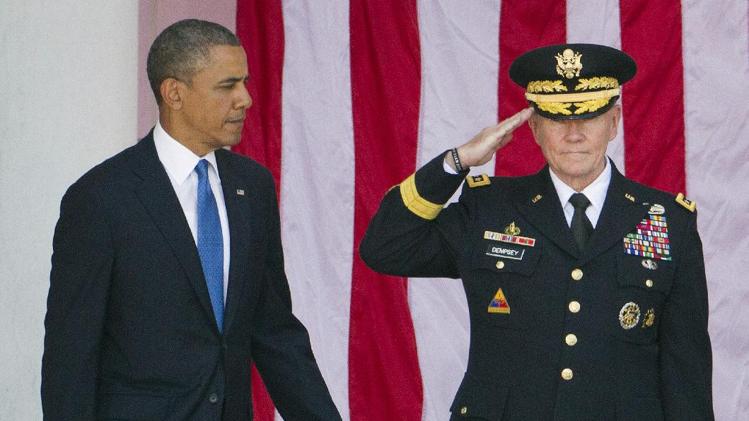
    Martin Dempsey

    The UK’s Mirror reports that the UK and US are forming a team from Special Forces and Special Air Services troops who will hunt the leadership of the ISIS/ISIL/Islamic State. They’re calling the new unit Task Force Black, which should attract a good number of phonies to their ranks after a few successes;

    British special forces will work with America’s Delta Force and Seal Team 6. The move sees a rebirth of top secret Task Force Black, which helped defeat al-Qaeda terrorists in Iraq .

    This time the counter-terrorist ­experts will be targeting Abu Bakr ­al-Baghdadi, leader of IS and now the world’s most wanted terrorist.

    A source said: “We need to go into Syria and Iraq and kill as many IS members as we can. You can’t ­negotiate with these people.

    “This is not a war of choice. They are cash rich and have a plentiful ­supply of arms. If we don’t go after them, they will soon come after us.

    That “they will soon come after us” doesn’t square with the Chairman of the Joint Chief’s assessment of the situation, though, according to CBS News;

    Gen. Martin Dempsey said Sunday that once he determines the Islamic State of Iraq and Syria militants in Iraq have become a direct threat to the U.S. homeland, he will recommend the U.S. military move directly against the group in Syria.

    But the chairman of the Joint Chiefs of Staff said that right now, he still believes the insurgent group is still more a regional threat and is not plotting or planning attacks against either the U.S. or Europe.

    But, we really can’t ask Dempsey about current stuff, apparently, he’s in Afghanistan making plans for withdrawing from that war which he doesn’t want to win, according to the Canadian Press;

    Shortly before landing in Kabul for a visit, Gen. Martin Dempsey, chairman of the Joint Chief of Staff, told reporters accompanying him on the trip that under optimal circumstances the U.S. would need about 120 days to pull all troops and equipment out of the country if there is no agreement allowing them to stay into 2015.

    But Dempsey also said the U.S. can act quickly to pull out if necessary. And he added, “We’ve got our own planning mechanism in place should this thing extend a little further than we hoped it would.”

    “This thing…” Nice way to describe the war we’re fighting to defeat the same types of people we’re fighting all over the world. I sure hope no more US troops die for “this thing” while Dempsey does his level best to encourage world terrorism.

  • Pentagon guidance on ice bucket challenge

    Pentagon guidance on ice bucket challenge

    Ice bucket challenge

    Apparently, there are too many lawyers at the Pentagon who are not engaged in rewriting the rules of engagement every minute of every day for the troops who are involved with fighting the war against terror, so some of them got together and wrote rules of engagement for the ALS Ice Bucket Challenge. From the Stars & Stripes;

    An Army spokeswoman, asked to clarify the service’s position on the trend, cited the Defense Department’s Office of General Counsel Standards of Conduct Office. She said uniforms and civilian clothes “clearly showing an Army relationship” cannot by worn by employees performing the challenge and posting a video online. A soldier also can’t give his Army affiliation aloud or his rank, the spokeswoman, Tatjana Christian, wrote in an email.

    “ALS Association is a national non-profit organization,” Christian wrote. “As such, participating in this event is subject to concerns about implied endorsement.”

    But I think of all of the things over the last 13 years or so in which people in uniform have been used inappropriately, this is probably the least offensive. I see beer commercials, USAA commercials, Wounded Warrior Project, political campaigns, etc…, which all have people in uniform talking about their rank, jobs, and so on, but this is where they’re going to draw the line? Seriously?

    I just think that it’s strange timing – because earlier this week, I challenged Sergeants Majors of the Armies (I wanted to make sure I got enough plurals in there for you USASMA grads) Ray Chandler to the Ice Bucket Challenge by email and I think this is his way to get out of it.

  • The fix is in on the M4

    The fix is in on the M4

    Colt M4 Carbine

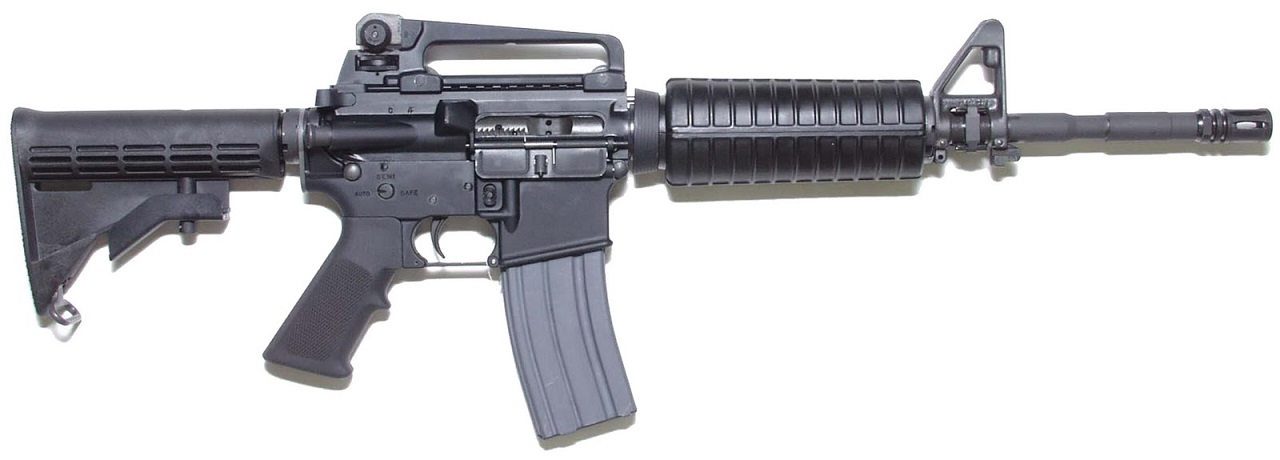
    Rowan Scarborough at the Washington Times writes that the Army abruptly ended tests seeking to select a new main battle rifle when at least one rifle showed signs of outperforming the M4A1;

    The report also says the Army changed the ammunition midstream to a round “tailored” for the M4A1 rifle. It quoted competing companies as saying the switch was unfair because they did not have enough time to fire the new ammo and redesign their rifles before the tests began.

    Exactly how the eight challengers — and the M4 — performed in a shootout to replace the M4, a soldier’s most important personal defense, has been shrouded in secrecy.

    […]

    Congress pressed the Army to hold the shootout in the face of mounting criticism from soldiers that the M4 is unreliable. The M4 is perhaps the most deployed weapon system in the war on terror — essential firepower in combating the Taliban, al Qaeda and other insurgents at close range during raids and firefights.

    The Times earlier this year published a two-part series on the M4 revealing that, as the war on terror began, the carbine flunked several reliability tests when subjected to rapid fire.

    Thanks to Chock Block for the link.

  • Hagel: The world is exploding

    Hagel: The world is exploding

    Kerry Hagel

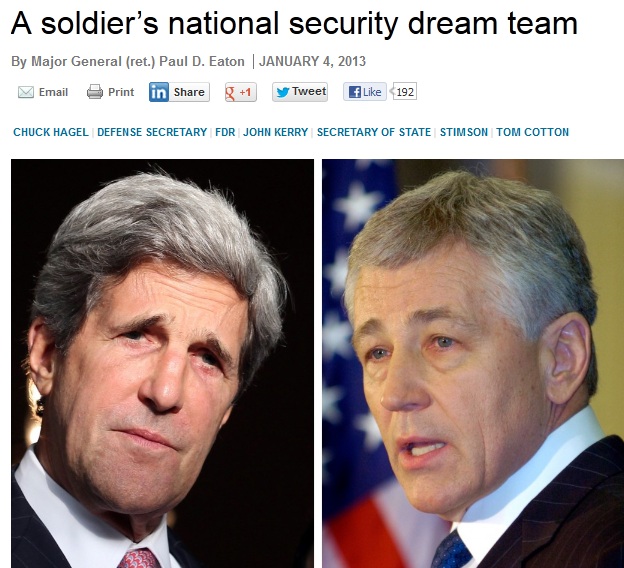
    On Tuesday, Defense Secretary Chuck Hagel was addressing a group of Marines in San Diego after he returned from a trip around Asia. He was asked a question by a Marine;

    Q: Good afternoon, sir. My question is that, given that the administration’s primary focus is on the Pacific theater, how has all of the issues popping up in the world today, Russia, Iraq, Africa, the rest of the theaters pretty much affected that current mission? And how do you foresee that affecting the mission in the future?

    SEC. HAGEL: Thank you. That’s a — go ahead, sit down — that’s a question I got often when I was in India and Australia. And the trip I just came from was my sixth trip to the Asia Pacific area in the last year-and-a-half. I’ve got four planned this calendar year. And so I get that question all the time. It’s a legitimate question for the very reasons you asked.

    The world is exploding all over. And so is the United States going to continue to have the resources, the capabilities, the leadership, the bandwidth to continue with the rebalance toward the Asia Pacific? And the answer is yes.

    […]

    And I think, as what I did in taking questions yesterday on this, it is pretty clear on where we are today and what we have committed to do, we are continuing to do. Start with the fact that both Secretary Kerry and I, the secretary of state, secretary of defense, were just in that area for a few days. I’ve been there six times in the last year-and-a-half. Look at the new things we have done in the Asia Pacific, the new initiatives.

    […]

    Now, that said, as I’ve said, with that rebalance, which will continue, and we are committed to do that, we’re not retreating from any other part of the world. Great powers can’t pick and choose which challenges and threats they’re going to deal with. There is no power on Earth like the United States of America.

    I guess what all of that means is “When you wish upon a star Makes no difference who you are Anything your heart desires Will come to you. If your heart is in your dream No request is too extreme, When you wish upon a star As dreamers do. Fate is kind She brings to those who love
    The sweet fulfillment of Their secret longing”.

    But that “the world is exploding” line should show up in some campaign literature this season, wouldn’t you think? The world is exploding everywhere but in the Pacific, but guess where this administration’s focus is. But, if we wish real hard, all of the world’s problems will just disappear and maybe the Chinese will do us a solid and start some shit in the Pacific for us.