Category: Big Army

  • The Little Drummer Boy . . . General

    We often say that truth is stranger than fiction. We say that because, well, it’s true.

    If someone told you that a lad had (1) run away from home to join the Army at age 9; (2) was a Sergeant at age 12; (3) by age 13 was a twice-wounded, exchanged POW, and had been discharged; (4) made the Army his career; and (5) retired as a General . . . well, you’d probably accuse the person telling you that of telling tall tales, or talking about some third-world country. Or maybe engaging in an episode of “better living through recreational chemistry.” (smile)

    Problem is, they’d be talking about US history. They’d be talking about John Lincoln Clem.

    They’d also be telling the truth.

    . . .


    John Joseph Klem was born in Ohio in August 1851. (He later adopted the spelling “Clem” for his last name; as a youth, he adopted the middle name “Lincoln” in place of his given middle name Joseph). When he was 9, his mother died.

    Clem’s earliest military history is not well documented. However, generally accepted history is it that he ran away from home at age 9 after his mother’s death and attempted to join multiple Union regiments forming after the outbreak of the Civil War. Some research casts doubts on this, and indicates he actually left home a year or two later.

    Clem’s earliest documented service was with the 22nd Michigan. He was initially rejected by the 22nd Michigan as well, due to his young age and small size. However, accepted history is that Clem followed the regiment anyway; after a time, the regiment’s officers adopted him as mascot and drummer boy, chipping in to give him a “regular soldier’s” pay. After a time (in May, 1863), Clem was allowed to formally enlist – at age 12.

    Though often rumored to have served at the Battle of Shiloh and been the “Johnny Shiloh” of Ray Bradbury short-story and Disney movie fame, the former claim appears almost certainly apocryphal. The 22nd Michigan, with whom Clem did serve, was not at Shiloh. However, it appears that Clem’s service at Chickamauga was indeed the inspiration for the Civil War song “The Drummer Boy of Shiloh”, which was first published after Chickamauga and which doubtless inspired Bradbury’s story and the Disney movie.

    Clem is documented to have served at the Battle of Chickamauga in 1863. At Chickamauga, Clem did more than merely beat a drum. During the Union retreat, Clem is reported to have served with an artillery caisson withdrawing from the battlefield. That caisson was reportedly intercepted by a Confederate Colonel, who demanded Clem surrender. Accounts state that Clem – using a musket with a stock shortened so that he could carry it properly – shot the Confederate Colonel vice surrendering, and escaped with the caisson.

    Though later research has cast some doubt on the “shot a Confederate Colonel” portion of this account – Confederate records do not show a Colonel to have been wounded at Chickamauga – the Union Army accepted the story at the time. Clem was promoted to Sergeant not long afterwards, becoming the youngest NCO in Army history (age 12). He was also later decorated for his actions at Chickamauga.

    Clem was taken prisoner in October 1963 while serving as a train guard. (Other accounts indicate he was taken prisoner during the latter stages of Chickamauga.) He was returned to Union control as part of a prisoner exchange not long afterwards; he resumed service with Union forces of the Army of the Cumberland, serving in multiple battles as a mounted orderly. While serving, Clem was wounded twice. In September, 1864, he was discharged.

    After the Civil War, Clem completed high school. He applied for admission to West Point, but failed the entrance exam and was refused admission. Almost certainly because of his well-known wartime record, President Grant appointed Clem a Second Lieutenant in 1871. While the appointment may have been political, it turned out to be an excellent move on Grant’s part.

    As a Lieutenant, Clem served initially with the 24th US Infantry. He later attended artillery school, then was transferred to the Army’s Quartermaster Department in 1875. He was to remain a Quartermaster officer the remainder of his career.

    Clem retired from active duty on 13 August 1915 – on reaching the Army’s mandatory retirement age of 64. He’d attained the rank of Colonel. As was customary for retiring Civil War veterans who had achieved that rank, he was promoted to Brigadier General on retirement – indeed, Clem was the last Civil War veteran to serve on active duty. A bit over a year later, he received a promotion on the retired list to Major General.

    Clem lived more than two decades after his retirement from the Army. Just before World War II, a ship was named after him – the USAT (later USAHS) John L. Clem.

    Clem died on May 13, 1937 – roughly seventy-six years after he’d reportedly run away from home to join the Army. He is buried at Arlington National Cemetery.

    Drummer boy at Chickamauga. WIA twice, without permanent disability. POW. Youngest NCO in Army history. Direct commissioned by the President. Last Civil War veteran to serve on active duty. Retired a General.  Ship named in his honor.

    Yes, I’d certainly call that the proverbial “life well-lived”. We all should be so lucky.

    Rest in peace, General Clem. Rest in peace.


    Sources:

    http://www.civilwar.org/education/history/biographies/john-clem.html
    http://en.wikipedia.org/wiki/John_Clem
    http://www.arlingtoncemetery.net/jlclem.htm
    http://www.ohiohistorycentral.org/w/Johnny_Klem
    http://www.patheos.com/blogs/mcnamarasblog/2011/09/johnny-clem-%E2%80%9Cthe-drummer-boy-of-chickamauga%E2%80%9D.html
    http://histclo.com/bio/c/bio-clem.html
    http://www.old-picture.com/defining-moments/Boy-Soldier.htm
    http://www.gacivilwar.org/story/john-lincoln-clem-an-american-legend
    http://en.wikipedia.org/wiki/USAT_John_L._Clem

  • Just When You Thought the Army’s Uniform Games Had Ended . . .

    . . . it turns out that’s not the case.

    According to the Army Times, the Army has announced that, because of adoption of the new Operational Camouflage Pattern, additional new uniform items will be required. Specifically, soldiers will need new boots, t-shirts, and belts to go with the new camouflage uniforms.

    Now, maybe new boots make sense; the desert tan boots used with the ACU were somewhat lighter than the new OCP.  The new boots are coyote brown.

    But new T-shirts and belts are just stupid, at least if they’re going to be mass-issued gratis.  What, has RIT quit making freaking dye?  And a new belt?  C’mon, folks – the belt isn’t even freaking visible.  The only time it’s seen is when you take off the jacket.  And if you’re taking off the jacket in combat, well, I think that means you’ve got worse problems than a mismatched belt.

    But I guess the DA part of the Five-Sided Asylum had to find something for some of its staff to work on.  This must have been really important.

    The Army Times article has more details.  It’s worth reading – unless you are having high blood pressure problems today.  Then maybe you might want to wait a while.

    One of those details:  the new OCP isn’t designed to be “universal”.   Jungle and desert variants will soon be announced.  I bet at least one of those will need “new boots, t-shirts, and belts” too.

    Sheesh.  GMAFB.

  • Mustangs bear brunt of Army manpower cuts

    The New York Times reports that Mustangs (officers who were once enlisted soldier) are three times more likely to get their pink slip than a West Point grad;

    Many of those former enlisted officers had been encouraged to make the jump to the officer corps between 2006 and 2009 when the Iraq war was raging and the Pentagon was struggling to replace junior officers who were leaving the Army as soon as their initial commitments were over, often because they were worn out by multiple deployments.

    The soldiers who volunteered to fill the gap — older than most junior officers because they had already served in the enlisted ranks — were picked from the best of the ranks, and some had to earn bachelor’s degrees to make the cut.

    I remember after Vietnam, the Army gave 90-day-wonder folks the option of returning to the enlisted ranks to draw down the officer corps, but apparently, that’s not an option in this case.

    A Haitian immigrant who enlisted as a teenager, [ Capt. Elder Saintjuste] deployed three times to Iraq, missing so many birthdays and Christmases that he sometimes felt he barely knew his four children. He hid symptoms of post-traumatic stress so he could stay in the Army, because he loved his job and believed that after 20 years he could retire with a captain’s pension.

    Then this summer, on the day Captain Saintjuste reached his 20 years, the Army told him that as part of the postwar downsizing of the force he would have to retire. And adding insult to injury, he would have to retire as a sergeant, earning $1,200 less per month, because he had not been a captain long enough to receive a captain’s pension.

    Well, at least he made it to 20. I guess that the last time he held a rank for three years was as an enlisted man. His retirement rank might be sergeant, but I’m pretty sure that they averaged my last three years for my retirement pay. The New York Times spelled his name wrong – it’s Edler, and he’s a Transportation Corp officer in an MI battalion at Bragg – not that it has anything to do with the story.

    But all of you officers raise your hands if you’re surprised by this story…yeah, me neither. Its not what you know, it’s who you know.

  • Amy Apodaca; stolen smarts

    Amy Apodaca; stolen smarts

    Amy Apodaca

    Kevin sends us an Associated Press article about Amy Apodaca, an Army contracted civilian who was a statistician at the Army Institute of Surgical Research in San Antonio until early this year when it was discovered that she had none of the college education that she claimed when she was hired;

    Officials at both schools [University of Texas at San Antonio and the University of Maryland at College Park] said their records show her registered for classes there, but that she didn’t earn any degrees.

    Apodaca did earn a B.A. in sociology in 2003 at the University of Texas at Austin, but not a B.S. in biomedical engineering, as she listed on her LinkedIn page, according to that institution.

    Despite the Texas and Maryland LinkedIn entries, Apodaca convinced many co-workers she had earned her Ph.D. from Yale, records show. In one case, she put a Yale insignia next to her name in an Army slide show.

    A Yale spokeswoman said there is no record of anyone by that name holding any degree from Yale.

    Oh, yeah, she had a security clearance, too, but no one uncovered the discrepancies until she pissed off a co-worker who raised concerns about her lack of training;

    Suspicions about Apodaca’s degrees were first raised by a former co-worker, who refused to be quoted by name because she feared being labeled a troublemaker in future jobs. On Jan. 21, the whistleblower says, she raised concerns about Apodaca with Dominique Greydanus, a contracting officer representative. He responded by defending Apodaca and calling the co-worker a troublemaker and mud-slinger, the co-worker said.

    Her duties included performing statistical analyses that were sent to the military treatment facilities in war theaters, where doctors used them to evaluate treatment decisions about injured soldiers, according to documents and interviews. She also contributed to scholarly research published in medical journals. She had access to the military’s classified network.

    Apparently she’s in Scotland, according to AP, ducking AP’s questions. So, I guess any liar off the street can be a statistician for the government.

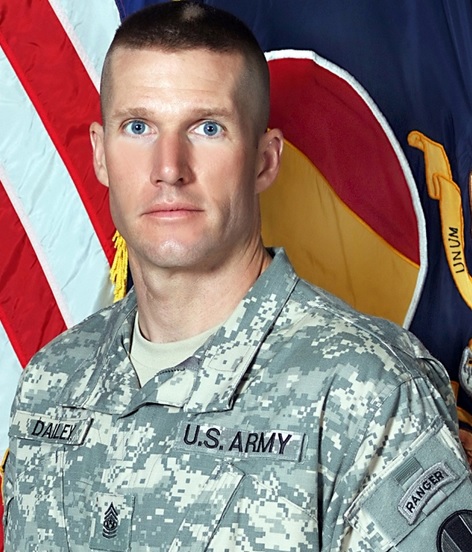
  • CSM Daniel A. Dailey named Sergeant Major of the Army

    CSM Daniel A. Dailey named Sergeant Major of the Army

    Command Sgt. Maj. Daniel A. Dailey

    The Stars & Stripes reports that Command Sgt. Maj. Daniel A. Dailey has been named the new Sergeant Major of the Army – an infantryman and a Ranger.

    Dailey joined the Army in 1989 and served in Germany as a radio telephone operator and rifleman for his first assignment, according to his Army biography. He deployed to Operation Desert Shield and Desert Storm and was soon after promoted to sergeant in 1993. After a series of assignments, he deployed to Iraq in 2003, and was promoted to command sergeant major in 2004. He would return three more times to Iraq by 2009 before taking on his current assignment.

    Among his awards are the Legion of Merit, a Bronze Star with Valor, a number of Bronze Stars, Meritorious Service Awards and Army Commendation Medals. Dailey received a bachelor of science degree, summa cum laude, from Excelsior University, the Army said.

    SMA Ray Chandler has set the bar pretty low, I’m sure SMA Dailey will exceed the standard that Chandler left for him. Back to the days of Glen Morrell, Julius Gates and Richard Kidd, CIBs and Tabs all around.

  • Army drawing down too fast?

    Chief Tango sends us a link to the Army Times which quotes Lieutenant General James McConville, the Army’s G-1 guy who thinks that maybe the Army is down-sizing a little too quickly;

    “We are very concerned that because of the strategic considerations, we may be driving very close to the curve as we move forward,” said Lt. Gen. James McConville, the service’s chief personnel officer (G-1), in an interview with Army Times.

    The budget picture remains unclear at the same time the service is ramping up global missions. This has led to uncertainties relating to the future size of the Army, and as a result, McConville cannot accurately project how many soldiers will be forced out of service by the retention boards that will meet in 2015.

    In terms of planning for the drawdown, McConville said, “we made some assumptions in 2012 regarding what the environment was going to be today,” but that picture has changed with what we are seeing with the Islamic State in Syria and Iraq, the Russian incursion in Ukraine and the Ebola outbreak in Africa.”

    According to Robert Burns, “The best-laid plans of mice and men often go awry.” Especially when those men are short-sighted and have no plans related to the world’s realities. The Clinton Administration realized the same thing in the 1990s. At least when they drew down the force in 1993, folks left the service with a good taste in the mouths, and some even went back in when the Clinton Administration realized they had drawn down too fast and too much. Good luck trying to get this last bunch to come back in.

    Of course, in all of it’s wisdom, the Army is driving ahead;

    For now, the coming year is projected to look much like 2014. There will be a series of retention screenings, force-outs and reduced promotions as the Army drives toward an end strength of 490,000 soldiers by Sept. 30, the end of fiscal 2015, according to the senior Pentagon officials who oversee personnel policies. Fiscal 2014 ended with 508,000 soldiers in the active component.

    The accession missions of 57,000 enlisted soldiers and 4,100 officers for this year are designed to support a much smaller Army, but the service will have to work aggressively to retain those soldiers as they move through their career timelines.

    Yeah, it’ll be the next President’s problem.

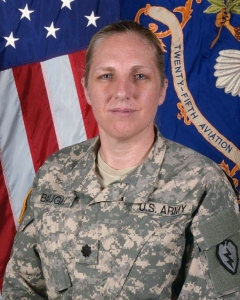
  • “Toxic” LTC Tammy Baugh back on the job

    “Toxic” LTC Tammy Baugh back on the job

    Tammy Baugh

    The Stars & Stripes reports that an aviation battalion commander, Lieutenant Colonel Tammy Baugh was removed from her position, along with her sergeant major when the Fort Carson command structure received complaints that she had been verbally abusive to her subordinates, threw things at them and stormed out of events and meetings when she was displeased. Her response to the complaints? “You want toxic? I’ll show you toxic.”

    Well an investigation revealed that the complaints were true, and the investigators recommended that she be removed from her command. But, you know, she was returned.

    Dozens of soldiers were interviewed, with most calling the climate bad, or worse.

    Baugh told investigators she was misunderstood.

    “My passion can sometimes be confused with anger,” she wrote.

    […]

    Fort Carson confirmed that Baugh returned to command, but didn’t respond to questions on what steps were taken to change the command climate in her battalion.

    “The suspension imposed on the leadership has been lifted and both have resumed command responsibilities,” Fort Carson said in a statement Tuesday. “Neither the commander nor the command sergeant major are facing any disciplinary action and have been cleared of any wrong doing.”

    In her statement, Baugh said her critics are slackers.

    “It seems that those who cannot meet the standard have the loudest voice,” she wrote.

    Yeah, and a good commander would know how to address those issues without throwing things and publicly belittling people. Baugh isn’t a good commander. A male commander would be looking for a nice ROTC assignment near his retirement home at this point. Army Chief of Staff Ray Odierno promised to remove toxic commanders from their jobs, but I guess there were limitations to that promise that we didn’t anticipate.

  • Eye pro

    Eye pro

    Some of you said that you knew Richard Rahn wasn’t a real sergeant major because he had his Eye Pro on his noggin;

    Richard Rahn1

    So I guess this guy isn’t a real sergeant major either;

    SMA

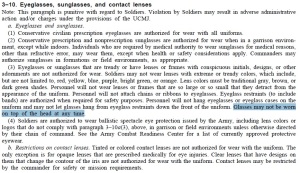
    Actually, it’s Sergeant Major of the Army Raymond Chandler, my old friend, and taken at the Army 10-Miler at the Pentagon last weekend. Here’s the reg.

    Sunglasses AR 670-1

    Thanks to Hondo for the link.