The following is not fiction. But first, a bit of background.
I’d also suggest grabbing a Kleenex or two.
. . .
Depending on which source you consult, there are either six or eight Celtic nations. Five of the six commonly-accepted ones are the Irish, Welsh, Bretons, Scots, and the original inhabitants of the Isle of Man.
The sixth commonly-accepted Celtic nation is the Cornish: the inhabitants of Cornwall, the south-westernmost part of Great Britain. Though today part of England, the people there are of Celtic origin; they are descendants of the Celtic Cornovii tribe. They are today a recognized minority nationality within Great Britain.
They were referred to in early English accounts as the “West Welsh”. Their culture, though Anglicized, is considered to be based on Celtic vice Anglo-Saxon traditions.
Celtic peoples have traditionally been considered brave, stouthearted people, both in peace and war. The Cornish are no exception.
Though small in population and area, Cornwall has produced a number of persons of noted accomplishment. This article deals with one of them.
. . .
Roughly 100 days before the start of World War II, a boy was born in a small town in Cornwall.
During the war, his hometown was headquarters to a US Army unit preparing for D-Day – as were many other towns in the UK. The boy came to idolize the GIs. His association with them led to his desire to be a soldier.
The boy grew to be a young man. He was gifted athletically, was smart and perceptive, and was charismatic.
At age 16, he left home to join the Army. At 17, he joined and trained with the British Parachute Regiment. He then served in an intel assignment in Cyprus between 1957 and 1960.
It was hardly a quiet assignment. This was during the height of the EKOA insurgency in Cyprus.
At the end of this assignment, the man accepted an assignment as a paramilitary police inspector for the Northern Rhodesia Police – today, the Zambia Police Service. He served there from 1960-1963.
This assignment changed his life – again, at least in part due to the presence of an American soldier. In Northern Rhodesia the Cornish man became lifelong friends with a US soldier who was there at the time. He also developed a lifelong hatred of Communism.
In 1963, the Cornish man returned to England and became a policeman for a short time. He then emigrated to America. Accounts vary whether it was because “Britain is fresh out of wars” or not. But his hatred of Communism was indeed part of the reason.
Since World War II, he’d always wanted to be a soldier. Now, he again became one – for his new country. He joined the US Army.
The Army saw potential in the young British immigrant. They sent him to OCS, and then to Vietnam.
In Vietnam, unlike most new “90 day wonders” he actually knew what he was doing. (That stands to reason, since before going to Vietnam he had close to 6 years of military and/or paramilitary experience during times of hostilities – including 3 years in the African bush.) He was tactically proficient, leading from the front; he maintained a hard but upbeat attitude that was infectious. He was also a calming influence during combat. During truly nasty times, he sang to his men to keep their spirits up and to keep their mind off their peril.
He was highly decorated during his time in Vietnam, earning the Silver Star and Bronze Star for Valor. He was WIA and received the Purple Heart.
He also cared deeply for his men. If they were wounded, he’d spend time with them, trying to reassure them.
He did this even when they were mortally wounded.
After Vietnam, the man became a US citizen. But not long after that, he left active duty – though it was obvious he was destined for high rank if he stayed. Many who knew him think dealing with the loss of his troops in combat was what finally led him to leave active service after Vietnam. He simply couldn’t stand the thought of losing any more of his men.
The man went to school, earning a degree, then a law degree. He taught college. And the man remained in the Army Reserve. He retired from the Army Reserve in 1990 – as a Colonel.
In many cases, that would be the end – early active duty including war, retirement from the Army Reserve after a successful career, then a quiet normal life thereafter.
But for this man, that was wasn’t the case at all.
. . .
In the mid-1980s, the man decided to return to the security business from academia. He became chief of security for a large Wall Street firm.
That firm had offices in the World Trade Center. The man was worried; he thought that the building was insecure, and that his charges were at risk.
He contacted his old friend from his days in Northern Rhodesia – that same US soldier who’d been instrumental in convincing him to come to America in the first place. The two of them inspected the building from a security perspective.
His friend told him that the parking garage was the primary place of vulnerability. He pointed out that the major load-bearing columns supporting the building were exposed there. He also said that a truck full of explosives could be parked next to one of them, and might bring down the building.
If this sounds eerily familiar – it should. That’s precisely what happened several months afterwards – in February, 1993, during the World Trade Center bombing. The Cornish man and his friend had been unable to convince those managing World Trade Center security to implement adequate security measures for their parking garage.
In the aftermath, though the tower did not collapse 6 persons were killed; over a thousand were injured; and the building suffered serious damage. A larger bomb using better explosives (the one used was estimated to have been only around 600kg of improvised ANFO explosive) could well have dropped the tower.
Adequate security measures for the parking garage were implemented afterwards.
. . .
The Cornish man was still worried, however. He thought that the attack would be repeated; he just didn’t know how. So he again reached out to his former Army friend, and asked him his opinion on how a future attack would occur.
His friend, after viewing the building’s physical security, predicted an attack from the air. He specifically predicted that the World Trade Center would likely be rammed by a cargo plane, possibly carrying explosives or some form of non-nuclear WMD, and would cause the building to collapse.
Yeah. Really.
The man from Cornwall tried to get his employer to move the firm’s offices to a complex outside the World Trade Center. Unfortunately, their lease ran through 2006 – so the move would be delayed that long.
As chief of security, the Cornish man did what he could. He implemented regular emergency evacuation drills, and convinced management to back them. They were inconvenient, yes. But the man from Cornwall was resolute – he knew somehow that a future attack would come, and that they’d be needed. And management kept backing him.
. . .
The Cornish man had developed cancer. And by 2001, he was 62 years old.
His daughter was getting married in mid-September of that year. However, one of his subordinates had planned an overseas family vacation including at least part of the second full week in September. The Cornish man was covering for his subordinate until he returned.
He was thus at the World Trade Center on the morning of 11 September 2001 – in Tower 2. He heard the impact of the first plane striking Tower 1, then saw it burning.
World Trade Center authorities advised everyone to shelter in place. The Cornish man’s response to that order has been variously reported as being typically British – and rather coarse. The rough equivalent of his actual words appears to be, “Screw that, I’m getting my people out of here.”
The evacuation began prior to the second plane hitting Tower 2. Fortunately, that plane hit above the floors on which their firm’s offices were located. The building shook violently, but held; the evacuation continued.
During the evacuation, as he’d done in Vietnam the Cornish man sang to those evacuating – to calm them, and to keep their mind off the danger and on more immediate matters. As before . . . it worked.
His employer had nearly 2,700 personnel who worked at the World Trade Center complex. All but a handful of them – various accounts put the total lost from his company at between 6 and 13 – got out alive.
When the vast majority of people from his firm had been evacuated, the man from Cornwall was told by a colleague he needed to evacuate himself now. His response? “As soon as I make sure everyone else is out”.
The Cornish man was last seen on the 10th floor of the South tower, heading upward. Shortly thereafter, the South Tower collapsed.
His remains were never found.
. . .
Why does an individual do something like this? How do they find the strength of will, and the guts, to face virtually certain death to save others when they have an honorable “out”?
Honestly, I don’t know. IMO it’s simply off the scale of normal human behavior.
Perhaps the man feared he was eventually going to die from cancer, and that emboldened his acts that day. A cynic might even say he chose intentionally to end his life quickly, and took foolish chances that day because he had little to lose.
Perhaps that was a part of it; perhaps not. However, I don’t really think so. I think the man from Cornwall simply felt it was his duty to get everyone out of that building that he could.
Remember: he was chief of security for his company, and this was an emergency. He was therefore the site commander; everyone else there that day were his troops. He was simply doing his duty – and taking care of his troops.
. . .
The Cornish man’s given name was Cyril. He didn’t much care for it, and on joining the British army chose to go by a diminutive form of his middle name – “Rick”, short for Richard.
His full birth name was “Cyril Richard Rescorla”. Much has been written about him. I’ll not attempt to list those various sources here; a quick Internet search will yield more than I care to list. But reading even a fraction of that will show I’ve only scratched the surface concerning his life and heroism. He truly was an example for all – and a living definition of the word “hero”.
Here are two rather famous photos of the man. The first shows him as a young man:
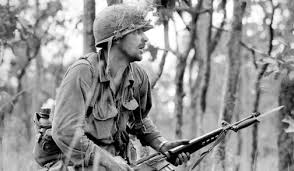
Yes, this was indeed the same “Rick Rescorla” who fought at the Battle of Ia Drang in 1965. That’s his photo on the cover of “We Were Soldiers Once . . . And Young.”
The second photo, nearly as iconic, was taken nearly 36 years later during the evacuation of the World Trade Center. It shows him in action that day – as well as the bloating caused by some of the anti-cancer treatments he’d been taking:

. . .
There is a theory that some men are simply not destined to die in bed, but are fated instead to die on their feet. Perhaps that’s true.
If that’s true, Rick Rescorla was certainly one such man.
Rest in peace, Colonel. In the words of a great British poet: “You’re a better man than I am.”
(Author’s note: the title of this article comes from the last telephone conversation between Rescorla and his second wife, which occurred as he was evacuating the Morgan-Stanley offices in the World Trade Center complex. The full quote from which that is taken is as follows:
“Stop crying. I have to get these people out safely.
If something should happen to me, I want you to know I’ve never been happier. You made my life.”
At the time of his death, Rescorla and his second wife Susan had been married just over 2 1/2 years.)