Author: Hondo

  • Well, This Could Get Interesting

    It seems that 3-D printing has achieved another milestone.

    Recently, a group of gunsmiths put together a working rifle. No great surprise there.

    Specifically, they put together an AR-10 – the NATO 7.62mm version of the AR-15. Again, no big surprise there, either.

    However, precisely how they did it was a bit unusual. It seems they used a 3-D printer to produce the lower receiver. (The remaining parts were stock.) And after assembling the weapon, the creator of the receiver claims to have fired over 100 rounds using it without visible signs of wear and tear.

    Yeah, that’s a bit . . . different.

    Look for the calls for “printer control laws” from your friendly neighborhood gun control advocates any day now. Once they wake up after fainting due to hyperventilation, of course.

  • “Bad Idea, Sir. A Really Bad Idea.”

    It didn’t take too long. Some [insert adjective of choice here] individuals in the 5-sided asylum have sent the Good Idea Fairy over to the new SECDEF’s office to whisper a batch of nonsense in his ear.

    Personally, I wish someone would grab that little winged troublemaker and . . . “give them a firm handshake and a warm cup of soup.” Then clip their wings and send them on a one-way journey to the Aleutians.  (smile)

    Unfortunately, it looks as if the SECDEF apparently is seriously considering implementing some of the nonsense

    Why do I say that? Well, the other day Fox News reported that the SECDEF is considering allowing the military to relax certain military entry standards to “attract more qualified manpower” (or some similar wording). Entry standards being considered for relaxation include current physical, pre-entry conduct, and age restrictions.

    Frankly, I’ve got no problem with relaxing age restrictions; I’ve never really understood the rationale behind those. If a person is physically qualified and can do the job at age 40, in my book they can serve. If they won’t be able to serve long enough to qualify for retirement because of age restrictions on military service in Federal law, have them sign an acknowledgement of that fact on entry – but still let them serve. We found in World War II that older troops generally worked out OK.

    It’s the other standards being considered for relaxation I find troubling.

    Relaxing physical standards IMO is hugely problematic. People in uniform – regardless of their MOS – can end up in combat. That’s true of clerks, mechanics, supply specialists, truck drivers, HQ staff, you name it. The enemy gets a vote in what happens, and sometimes hits areas we don’t expect.

    If new troops are not physically capable of performing to current standards due to a relaxation of same, then IMO they stand a much better chance of coming home in a body bag than someone who can.  And while that’s bad enough, they’ll also quite possibly bring their battle buddy along with them for the ride.  That’s even worse.

    I don’t know about you, but the prospect of seeing that doesn’t thrill me at all. And I’m guessing it doesn’t thrill the people who might have to fight alongside those who are admitted under relaxed physical standards, either.

    Bottom line: the military’s current physical standards have, by and large, worked. There’s no compelling reason to change them.

    Lowering standards for pre-entry conduct is similarly problematic. We’ve done that multiple times in the past. Each time we’ve done that, we’ve ended up with a marked increase in “problem children”. So the argument in this area strikes me as specious as well.  Seems to me that we’ll be buying more problems than it’s worth.

    But that’s not what bothered me most about the SECDEF considering this. Rather, it was one particular career field singled out as an example where relaxed standards would help.

    The career field specifically discussed as an example in the article linked above was the cyber career field. Lowering physical and pre-entry conduct entry standards for that field is IMO a monumentally bad idea.

    Cyber workforce authorizations can be either civilian or military. So, if a cyber “slot” is military, presumably there is a good reason for it being so coded – e.g., that the individual has a reasonable probability of being deployed to combat, or that military knowledge and experience is essential to their performance of duty in a noncombat environment.  Ergo, that means there’s a good reason for them to meet the military’s physical requirements.  Period

    If a qualified individual interested in such a position cannot (or doesn’t want to) meet military physical requirements, then perhaps they should be offered one of the civilian positions instead.  Why?  Well, for starters:  because meeting those physical standards just might save their butt one day if and when the organic fertilizer impacts the rotating air circulation device.

    Second: it’s my understanding that the vast majority of cyber slots tend to be at major HQs (which tend to be located in relatively safer rear area) and in CONUS. In today’s DoD, there is no shortage of civilian employees in either CONUS or major headquarters – including those HQs located in combat zones. Further, DoD can require prospective civilian employees to sign a mobility agreement acknowledging the fact that they may be sent anywhere in the world, to include hazardous locations, as a condition of employment.

    This further undercuts the argument that military-side physical standards need to be “relaxed” for the cyber career field (or pretty much any other career field, for that matter).  If push comes to shove, DoD can augment any military shortfall with civilian personnel.  Lowering current military physical entry standards simply isn’t necessary.

    But it’s that other standards area being considered for relaxation – pre-entry behavior – that really bothers the hell out of me when you’re talking cyber.

    You see, DoD’s cyber workforce is typically highly cleared.  That’s necessary given what they do and the knowledge required to do it.

    If you can’t get them cleared, then there’s no point in recruiting them in the first place.  So it seems logical that relaxing pre-entry conduct standards when recruiting them also strongly implies  relaxing the standards governing the process of granting those same individuals security clearances.

    Doing the latter is IMO a monumentally bad idea. Why? Two words. The first is “Manning”. The second is “Snowden”.

    The SECDEF IMO desperately needs someone to come talk to him about this subject. And that individual needs to read the title of this article to him.

    We don’t need a bunch more body bags coming home because we’re recruiting people who are not physically able to perform routine military duties if push comes to shove. And we damn sure don’t need any more Mannings or Snowdens with access to the nation’s secrets, either.

  • Another Bit of US History Passes

    Another Bit of US History Passes

    Robert Hite
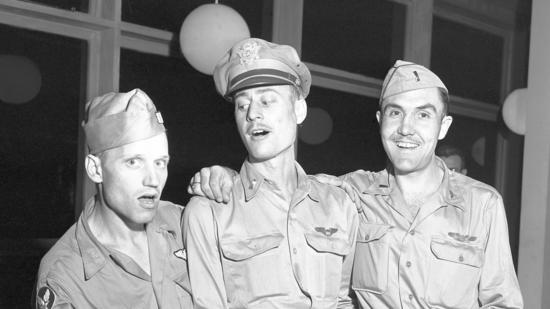
    One of the last 3 surviving Doolittle Raiders has passed.

    Lt. Col. Robert Hite passed away on Sunday, 29 March 2015, in Nashville, TN. He was 95.

    Hite was one of the 80 men who participated in the Doolittle Raid on Tokyo on 18 April 1942. That raid was launched from the USS Hornet using specially-trained Army Air Corps crews flying B-25 medium bombers.

    It was also a true “one-way” mission. While the B-25 could take off from a carrier under favorable conditions, it could not land on one. The mission plan was to fly on to China after bombing Tokyo, and land there afterwards in airfields controlled by friendly Chinese forces.

    However, the task force was spotted by a Japanese patrol boat approximately 200 miles farther east than the planned launch point; the raid was executed immediately afterwards.  This meant the originally planned landing fields in China would almost certainly be unreachable before the aircraft ran out of fuel.

    They went anyway.

    Three US personnel were KIA during the raid; eight US personnel were captured and became a POWs afterwards.  Hite was one of these unfortunate eight.  He was held in captivity by the Japanese for 40 months.

    Of those eight individuals captured by the Japanese, 4 died while POWs – three were executed, and one died of other causes. Hite was the last remaining living POW from the Doolittle Raid.

    Hite left the service after World War II. However, during the Korean War Hite returned to duty from 1951 to 1955.

    Hite was awarded the Distinguished Flying Cross for his participation in the Doolittle Raid.   He also earned the Purple Heart during his captivity.  Last year, Congress authorized a Congressional Gold Medal in honor of the Doolittle Raiders. Unfortunately, it is not scheduled to be formally presented until the raid’s 73rd anniversary – less than 3 weeks from now.

    Hite’s death leaves alive only two of the Doolittle Raiders – Lt. Col. Richard “Dick” Cole and SSgt. David Thatcher.

    Rest in peace, my elder brother-in-arms. You’ve certainly earned that.

  • NSA Gate Shooting Gets . . . Weird

    We now have a bit more news about that NSA gate shooting the other day.  And it’s gotten a bit strange, to put it mildly.

    The FBI has now identified the dead guy as “Ricky Shawatza Hall”.  He was the driver of the stolen car.  The passenger, who remains hospitalized, has not yet been publicly identified.

    What’s a bit odd is the “rest of the story” that was released today.

    The accounts you heard about the two guys being “cross-dressed”?  Yeah, they were correct.

    Seems Hall and his “buddy” had been picked up in Baltimore earlier that day – or maybe the previous night – by a Baltimore resident. They then drove to a motel in nearby Elkridge to “party”, checking in at 7:30AM.

    The two cross-dressers then apparently stole the guy’s car and left the area.  Unfortunately for them, they managed to screw up and ended up at the gate of the NSA compound at Fort Meade.

    My guess is that the two crooks took a wrong turn after stealing the guy’s car, then freaked when they saw the police.  They then chose to ignore police instructions – picking precisely the wrong place to do that (NSA police do not play games).  They then compounded the error by try to run for it and ended up getting shot.

    At this point,  it doesn’t look like terrorism had anything to do with the incident.  That it happened is unfortunate, but as the saying goes:  “Play stupid games, win stupid prizes.”

    Fox News has a few more details. Check out this Fox News story if you’re interested.

    Sometimes truth really is stranger than fiction.


  • More VA “Good News” Stories

    VA management is in the news again. And not in a good way – as if I really needed to say that last.

    First, we have the highly efficient administrator of the VA Hospital in Puerto Rico. The man is amazing. He’s getting paid nearly $180k a year – but he’s worth every penny. He’s so good that he can get his job done while only showing up for work at his primary duty station about two-thirds of the time. In a one year period, he delegated authority for someone to act in his absence on about 80 days.

    Did I mention that during one of his absences, at 2AM one morning he was arrested in Florida – while sitting in a car, reportedly reeking of alcohol?  Or that he also reportedly refused twice to take a breathalyzer test?  And was also apparently in possession of oxycodone for which he had no prescription? Well, I guess I just did.

    Second, there’s that enterprising VA manager in Hawaii. He had a claims backlog problem, and HQ was wanted the processing time shortened.

    His solution? Cook the books. He figured out how to bypass controls in the VA’s system that tracked the progress of claims so he could make his team’s performance look better than it really was.

    Doing that also had some other effects, though. Specifically, it also delayed the actual processing and payment of valid claims for qualifying vets.

    The individual no longer works for the VA, thankfully. He resigned. That’s good – because based on what we’ve seen in other cases recently, I have my doubts whether the VA would have fired him.

    I’m really starting to wonder whether “raze and rebuild” isn’t a better option for the VA at this point than “repair”. It’s looking more and more like they may really be FUBAR.

  • A Sunday “Walkabout”: Some Thoughts About Power and Character

    Jonn lets me do a verbal, off-topic “walkabout” here from time to time. What follows is such a ramble – an off-the-wall thought or two that’s not necessarily directly concerned with one of TAH’s normal topics.

    Consider yourself forewarned.

    . . .

    We’ve all heard Lord Acton’s axiom: “Power tends to corrupt, and absolute power corrupts absolutely.” It’s perhaps one of the most widely-known quotations in the English language.

    Most regard it as a truism. And on the surface, it does indeed appear to be on the mark.

    Even in the military examples seem to be common.  It’s hard to argue against it when you see things such apparently confirmatory examples as Gerald “PX Ranger” Green; the aptly named James “Two-Timing Fraud” Johnson; former BG, now retired LTC Jeffrey “Coersion” Sinclair; and Generals David Petreaus and Kip Ward.

    Enlisted personnel and civilian defense officials to a lesser extent show the same faults from time to time as well. Witness the periodic drill sergeant scandals, the antics of former SMA Gene McKinney, and the former Acting Secretary of the Army John Shannon.

    It’s not just an Army problem. Examples exist from all services that seem to confirm Acton’s thesis.

    You also find similar conduct in other professions that are based on trust. Don’t believe me? Just take a look at clergy and cops. Finding public examples of corrupt conduct in either profession isn’t particularly difficult.

    Until recently, I thought Acton was probably right, at least to some extent. I don’t believe that any more.

    I now think Acton got it wrong; that’s not what’s going on here. I don’t think power itself is to blame at all.

    Power doesn’t corrupt. Rather, power reveals.

    I didn’t come up with that thesis.  At the end of this ramble, I’ll give credit to the unusual source that to my knowledge first voiced that thesis – and convinced me that’s the case.

    . . .

    We seem to see so many such examples of corrupt behavior by people in positions of high trust. Yet in truth, such instances are rare. Consider:

    •  For every Gerald Green, there are literally hundreds of LTCs who played it straight and advanced on their own merit.
      For every James “Bigamist” Johnson, there are hundreds of Colonels who didn’t commit bigamy and defraud the government to support their mistress.
      For every Jeffrey Sinclair, there are dozens of GO/FOs who did not attempt to strong arm subordinates into a sexual relationship.
      For every Kip Ward, there are dozens of GO/FOs who followed the rules concerning TDY travel to the letter.
      For every David Petraus, there are dozens of GOs/FOs who did not retain and store classified materials improperly, then show them to his biographer afterwards.

    If Acton were right, then those kinds of corrupt conduct would be the rule at high levels. But it’s not. It’s the gross exception, not the rule.

    We hear about such behavior today when it happens. The media – both traditional and electronic – thrive on scandal. Given advances in technology they’re more efficient today than they were even 20 years ago about getting the story out. The traditional media today also seem to be more concerned with deadlines than accuracy. So when something along these lines happens, we hear about it relatively quickly; they don’t bother to wait and “check it out” first.

    In short, the conduct we’re talking about is IMO quite rare. The vast majority don’t engage.

    However, the conduct we hear about does appear to be concentrated at higher ranks. Why is that?

    . . .

    Part of the reason IMO is simply selective reporting. Think about it for a moment – is it really news if some PFC or 2LT (or even a CPT) does something bad? No, not really – though you might hear about it, briefly, in the case of the CPT. Even then, unless the case is sexually tawdry or involves a great deal of money, for most misbehavior below the grade of E9 and O5, you’ll likely not hear about it.

    Why? Unless big dollars or sex is involved, the media just doesn’t seem to care all that much. Outside of training commands, contracting, and comptroller positions, most junior officer and NCO assignments don’t really provide the opportunity for a scandal that the media will find “interesting”.

    IMO, that’s part of the reason. But it’s not all. Another factor is at work.

    . . .

    The military does a pretty good job of screening its people as they advance. Those with a tendency to abuse either the public trust or their subordinates tend to get weeded out as they progress.

    However, like any process created or implemented by humans, the military’s screening process is imperfect. Some with seriously flawed character slip through from time to time.

    Why? Sometimes their bosses simply are biased in their favor, or are flawed themselves. Maybe their supervisor has an inkling of the problem, but isn’t sure (or doesn’t realize it’s as serious a flaw as it really is) and in today’s “zero defect”, highly inflated evaluation system doesn’t want to kill a promising career – so he/she gives them the benefit of the doubt. Sometimes they’re good actors and manage to hide the flaw. Perhaps they are forced by supervision and lack of authority to “toe the line” and suppress the flaw. Dunno.

    Hell – perhaps they actually change over time. I personally don’t think that happens often if at all, but I’m not a shrink and I guess it is at least theoretically possible.

    For whatever reason, some that shouldn’t slip through the cracks. They get promoted until they are selected for and placed in a position of wide-ranging authority – a position of high trust, with less direct supervision and where their decisions are less likely to be questioned.

    I can’t speak for the other services, but in the Army – outside of contracting and comptroller work – a position involving truly serious authority over hundreds or serious financial clout generally doesn’t happen until O5 for officers, and really not until the CSM level on the enlisted side. (Company commanders and First Sergeants just don’t typically have enough authority over enough people and resources IMO to qualify.) So it’s not until the E9 and O5 grades that individuals with such flaws have the opportunity to show it.

    But now . . . for the first time in their career, they actually have the power to do something they’ve been disposed to do all along, with what they believe is a reasonable chance of evading detection. So they do.

    “Corrupted by power?” Hardly. Their attaining power simply revealed what was there all along.

    . . .

    I said earlier I’d give credit to the individual who convinced me Acton was wrong. That individual is in many ways somewhat surprising; it was Robert A. Caro. He’s neither government nor military; he’s a biographer, and has done some truly fascinating work. Caro wrote an acclaimed biography of NYC’s Robert Moses, and has done a multi-volume biography (still incomplete) of LBJ. All of his work I’ve read so far is an excellent read; I’d highly recommend it.

    Caro has been fascinated by power and its use his entire career; he’s studied it in detail. Here’s what Caro had to say on the subject:

    We’re taught Lord Acton’s axiom: all power corrupts, absolute power corrupts absolutely. I believed that when I started these books, but I don’t believe it’s always true any more. Power doesn’t always corrupt. Power can cleanse. What I believe is always true about power is that power always reveals. When you have enough power to do what you always wanted to do, then you see what the guy always wanted to do.

    I think Caro, not Acton, nailed this one. Power doesn’t corrupt; power is neutral.  Achieving a position of power merely gives those who possess it the opportunity to reveal their true nature.

    . . .

    That’s the end of the ramble for today. Back to the res.
  • Just When You Think You’ve Seen It All . . .

    . . . you get your nose rubbed in the fact that you haven’t.

    Well, ladies – you’d best get on-board and start supporting those restrictions on carbon dioxide.

    Why? It’s causing global warming – right? And according to Rep. Barbara Lee, D-CA, global warming is especially bad for women.

    Per a resolution introduced by Rep. Lee two days ago, one of the effects of global warming will be to force women into the sex trade to obtain basic necessities. So you ladies had best start protesting against global warming to protect your virtue!

    I wish I was joking above. But, sadly – I’m not joking. The “esteemed” Congressditz really did introduce a resolution to that effect.

    Sheesh. And she’s allowed not only to walk around without supervision – she also votes on bills being considered by Congress to become law.

    Only in America.

  • Gee . . . That’s . . . Just . . . Too . . . Bad

    Headline says it all:

    Senate Democratic Leader Reid announces retirement

    I guess not being in charge made serving the people of NV in the Senate not worth it any more.

    Good riddance.