DPAA has identified and accounted for the following formerly-missing US personnel
From World War II
SSgt. Vincent J. Rogers, Jr., US Army, assigned to 38th Bombardment Squadron (Heavy), 30th Bombardment Group, US Army Air Forces, was lost on Tarawa Atoll on 21 January 1944. He was accounted for on 28 March 2019.
From Korea
None
From Southeast Asia
None
Welcome back, elder brother(s)-in-arms. Our apologies that your return took so long.
You’re home now. Rest easy.
. . .
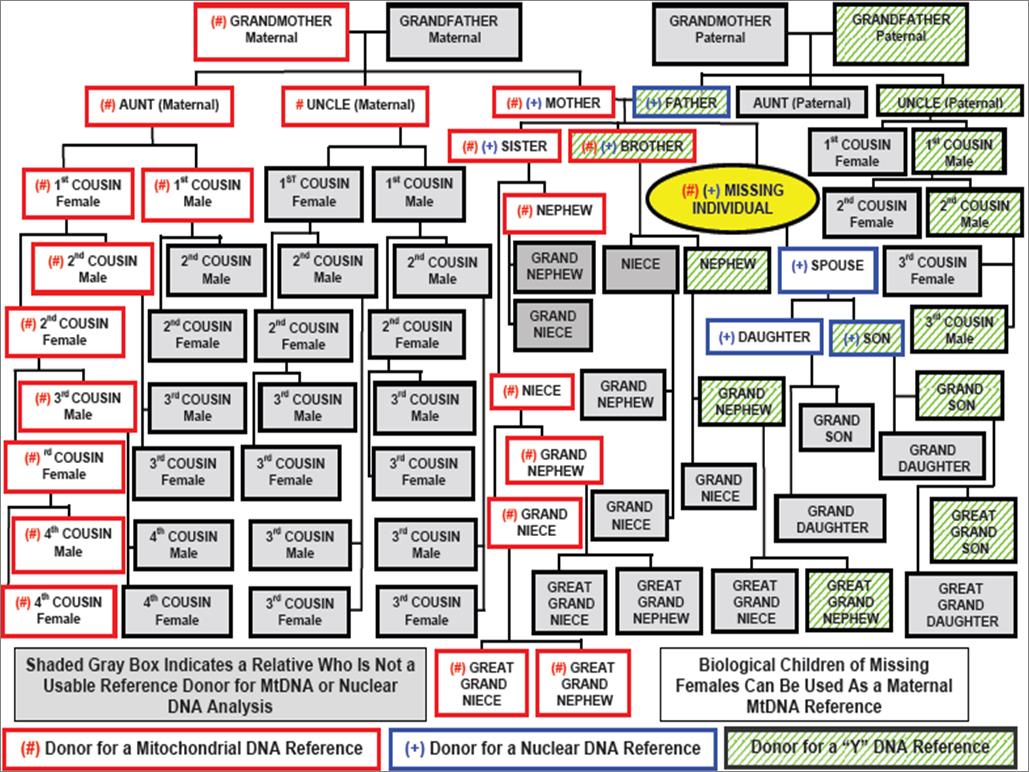
Over 72,000 US personnel remain unaccounted for from World War II; over 7,600 US personnel remain unaccounted for from the Korean War; over 1,500 remain unaccounted for in Southeast Asia (SEA); 126 remain unaccounted for from the Cold War; 5 remain unaccounted for from the Gulf Wars; and 1 individual remains unaccounted for from Operation Eldorado Canyon. Comparison of DNA from recovered remains against DNA from some (but not all) blood relatives can assist in making a positive ID for unidentified remains that have already been recovered, or which may be recovered in the future.
On their web site’s Contact Us page DPAA now has FAQs. One of those FAQs describes who can and cannot submit DNA samples useful in identifying recovered remains. The chart giving the answer can be viewed here. The text associated with the chart is short and is found in one of the FAQs.
If your family lost someone in one of these conflicts and you qualify to submit a DNA sample, please arrange to submit one. By doing that you just might help identify the remains of a US service member who’s been repatriated but not yet been identified – as well as a relative of yours, however distant. Or you may help to identify remains to be recovered in the future.
Everybody deserves a proper burial. That’s especially true for those who gave their all while serving this nation.

Welcome Home SSGT Vincent J. Rogers Jr. We Salute and Honor your Service and Sacrifice.
Thanks Hondo….Awaiting the “rest of the story” from AnotherPat (rtr)
Ditto what 5th wrote…Thank You, Hondo, again, for providing us updates for our Missing In Action.
Salute. Never Forget. Bring Them All Home.
hbtd
There are several sites that have nice pictures of SSG Vincent Jerome Rogers, Jr in his uniform. There is also a very touching story about Vincent as he relayed his life in the Army thru letters he wrote his family before he was lost at sea at the young age of 21. Vincent was born in New York on 1 June 1922 to Vincent Jerime and Ruth Tolson Rogers, perhaps in Buffalo, NY. He resided in Erie County, New York prior to the war. He enlisted in the Army on October 20, 1942 in Buffalo, New York with Service # 12169863. He was noted, at the time of his enlistment as being Single, without Dependents. Vincent served as a Staff Sergeant & Asst. Radio Operator / Gunner on B-24J #42-72982, 38th Bomber Squadron, 30th Bomber Group, U.S. Army Air Force during World War II. B-24J #42-72982 took off from Helen Island, Tarawa Atoll, Gilbert Islands on a combat mission. The pilot had trouble keeping altitude and the B-24 crashed shortly after take off. Vincent was declared “Missing In Action” in this crash during the war. He was awarded a “Distinguished Flying Cross”, Air Medal with 1 Oak Leaf Cluster, and the Purple Heart. He also has a “Cenotaph” in the Yorks Corners Cemetery, Willing, New York: https://www.findagrave.com/memorial/56120827/vincent-jerome-rogers The following is an exermpt from the story. Rest In Peace, SSG Rogers. Salute. “Lost World War II Airman Lived On in Letters. Now He Has Been Found.” https://www.nytimes.com/2019/04/04/us/vincent-j-rogers-ww2.html “For nearly a decade, hundreds of letters that Staff Sgt. Vincent J. Rogers Jr. wrote home have been displayed at a California museum, bearing witness to the transformation of a New York teenager into a World War II radio operator deployed in the Pacific.” “Scrawled with folksy good humor, the letters have been all that was known of Sergeant Rogers since Jan. 21, 1944, when the bomber he was on crashed after takeoff from Tarawa Atoll.” “More than 230 letters written by Sergeant Rogers between 1942 and 1944 have been on display at the March Field Air Museum in Riverside, Calif., since 2010. Like… Read more »
AnotherPat, again, many Thanks and much appreciation to and for you bringing the research and additional details in the stories of these young Warriors. We know that it is a labor of Love for your fellow Veterans to do this work. A picture may say a thousand words, but the printed words bring out the story behind the picture.
This particular Service Member, just one of what 16 some odd million that served then, could be typical of that generation. An only child that could have avoided dangerous service volunteered and after training, probably volunteered again for Combat Duty. By that time was well aware of the dangers he would face. Must have been a squared away on the ball troop to advance in rank that quickly. We can only imagine the pain and suffering of his parents to lose that only child and then not ever having the closure of knowing what all that happened or of bringing him home to rest. For those of us who believe in an afterlife, what a glorious reunion it was when his Warrior Spirit greeted his Father and then his Mother when they passed over.
Kudos to the anonymous distant relative who found the stored away box of letters and delivered them for safekeeping and sharing with what should be a grateful nation.
Sad part of this are the non recoverable that will never bring complete closure to their families. We will never be able to get a full disclosure of all the POW’s that were held and died in their captivity, ones aboard ships and planes lost at sea or over hostile areas. One can only hope that continued cooperation between all parties will work together till all avenues of recovery are exhausted and hopefully other countries that were involved in the wars in the past will join and help. In Vietnam alone there are 488 out of close to 2,000 that are determined to be lost forever. Sadly the majority of these will most likely be Aviation types as so many were lost in the north and in the swamps and jungles that access is pretty much non existent.
Did a little research and from site I found as to loss of A/C, fixed wing and rotary, USAF 2251, USN 532, USMC 463, USA 5557, of this last total, USA lost 5195 rotary aircraft. Comes up to a total of 8803 total aircraft lost during the Vietnam War war by the US.
Welcome home.
Welcome Home.