Category: Who knows

  • A Nation at War? Hardly.

    Recently, Enigma4you contributed another fine article here at TAH. If you haven’t read it yet, you can read it here. It’s not terribly long – and it’s worth your time.

    But I have to disagree with him on one key point.

    In his article, he states, “We live in a nation that has been at war for 13 years.” Sorry, my friend – but from my perspective, that’s simply not true.

    IMO, the US military has indeed been at war for the past 13 years. The nation? No – not really. IMO, as a nation we’ve been at war for maybe one year out of that period: late 2001-late 2002. The rest of the time has been pretty much nothing more than “business as usual” for America.

    Maybe that sounds odd or wrong to you.  If so, hear me out – though I warn you that this article is a bit longish.

    . . .

    A nation is involved in a war when its military deploys. In contrast, a nation is at war when its population becomes intimately engaged in, and cares about, the conflict.

    Think back a few years. After 9/11, the US indeed was a nation at war – from 11 Sep 2001 through some hard to identify date in 2002. We were committed; we’d been attacked, and we wanted payback. The US population supported going to war. It was as united as I’ve ever seen America during my lifetime – even more than during the immediate aftermath of the Persian Gulf War.

    But that condition didn’t last. I’d put the break point during the summer-fall of 2002, after Anaconda and before the winter set in in earnest. Before then, the US public was involved. But some time that summer or fall (or maybe early winter), IMO the US public “tuned out”.

    We were no longer a nation at war. The US military stayed engaged. But the US public didn’t.

    . . .

    Historically, this isn’t unprecedented. We have not been a nation at war during many conflicts during my lifetime. The Dominican Repuplic? No. Grenada? No. Panama? No. In each of these, the relatively small size and short duration of the conflict, plus the fact that it really didn’t affect the US public all that much, kept the public from mentally and physically “mobilizing for war”.

    And for those conflicts that was apropos. In truth, they were smallish expeditionary operations.  They were not major wars and/or threats to national existence.

    But there have been three other, larger conflicts during my lifetime: Vietnam, the Gulf War, and the current post-9/11 Global War on Terror (GWOT). And this last is IMO very different from the other two regarding the American public’s engagement..

    For the other two, the US public seemed to care – and care a lot. For the GWOT, after 2002 I’m not sure in general they particularly did.  No, not everyone was apathetic.  But those who cared seemed to be mainly friends and family of those in the military. The US public as a whole? Um, IMO . . . not really.

    . . .

    The US was indeed a nation at war during Vietnam. Approximately 1.7% of the entire US population served in-theater during that conflictapprox 3.4 million out of an average population of around 202 millio, with nearly 2.6 million serving in-country in Vietnam proper. The vast majority of these individuals did so during a 6 -year period:  1965-1971. US demographics and the relatively short period of major US involvement meant that Vietnam veterans formed a big fraction of the US 18-25 year old population during that conflict. Though about 2/3 of those who served in Vietnam were volunteers, the draft did ensure some degree of diversity. The end result was that pretty much everyone knew someone who’d served in Vietnam.

    The Vietnam War also had an impact on the nation at home. Overall taxes increased substantially during the Vietnam War – as did inflation, interest rates, and prices. Due to the LBJ administration’s insistence on hiding the true cost (human and financial) of the war, it also touched off the inflation spiral that was to culminate in the “stagflation” of the Carter years. So the US public was not untouched by the war, even though the impact was not as severe as was seen during either Korea or World War II.

    The public felt the economic impact personally. And they almost certainly knew someone who’d served there.

    Vietnam was also a conflict about which the US population cared greatly – with some in favor and some violently opposed. Part of this was due to knowing people who were/had been there; ideology also played a role (on both sides). But regardless or why or point of view, the US public was engaged.

    In short, during Vietnam the US was indeed a nation at war.

    The Gulf War was in some respects similar – with some substantial differences. While a smaller portion of the population fought during the Gulf War, the widespread mobilization of Reserve Component units (not seen during Vietnam) meant that the US population was similarly exposed to the war’s human side.  The substantial pike in oil prices caused by Hussein’s pre-war invasion of Kuwait drove home to the US public the economic seriousness of the matter; to a limited extent, the US public shared a bit in the pain.

    Further, the conflict was too short (and too overwhelmingly victorious) for much opposition to arise. So during the Gulf War, the US was also a nation at war – perhaps a lesser degree than during Vietnam, but on balance still thus.

    The same was IMO true for roughly the first year of the current GWOT. Due to the 9/11 attacks, initially the US population was deeply engaged – more than at any time in my lifetime except perhaps during the height of the Vietnam war protests – and was also united. At that time, we were indeed a nation at war.

    For a little while, anyway.

    . . .

    And then . . . we “won” in Afghanistan (summer/fall 2002). We’d routed the Taliban, and Afghanistan was now reasonably peaceful.

    But unlike after the Gulf War, we didn’t come home immediately – because in reality, we hadn’t yet truly won a damn thing (though the public perceived we had). The Taliban and al Qaeda was hiding, not finished. But we didn’t apply the resources needed to finish the job.

    Why? IMO, because we allowed ourselves to become distracted from the business at hand. We should have concentrated on completely destroying al Qaeda and its allies – as an example to the world of what happens when you screw with Uncle Sam. Instead, we immediately jumped into another war that was IMO a few years premature. I’m certain we’d have fought Hussein in Iraq eventually, but IMO 2003 simply wasn’t the correct time. We had other business we needed to finish first.  And we didn’t.

    The Iraq conflict similarly didn’t seem to affect the US all that much, either. Oh, sure, everyone paid attention to the invasion, and cheered when Saddam’s statue fell. But that war too was over quickly – except it wasn’t really over yet, either, though the public believed it was.  We tried to do that one “one the cheap”, too.  It similarly blew up in our face.

    When the Taliban started getting restive in 2003, and the same occurred in Iraq in 2004, the public just wasn’t ready for another war – or for a continuation of two that we’d already “won”, either.  Neither conflict was affecting them all that much, either.  So the US public started tuning out.

    That “tune out” has IMO continued to this day. We haven’t been a nation at war since maybe late 2002. Rather, we’ve been a nation who’s military has been at war.

    There is a difference.

    . . .

    Why? Part of the difference may be societal changes. The US public has never exactly been known for having a long attention span; barring a truly existential threat, it’s simply difficult to keep the public’s attention. They love the next “bright shiny object”.  And that tendency has accelerated over time as available distractions increase.

    Don’t believe me? OK, then just watch the news channels for a few days and keep track of the top stories. No story stays “on top” for very long.  They come and go.

    Next, go look at newspapers today and compare them with those of 40 years ago.  You’ll see the same thing.  All sound bites and fluff; precious little substance.

    The American public gets bored quickly.  They want to be entertained; they don’t really seem to want to have to think.  And they’re willing to pay to be entertained.

    A second factor is the fact that even though the GWOT is now the longest in our history, the GWOT has involved far fewer Americans than you might think. Between FY2002 and FY2012, the total “boots on the ground” strength in Afghanistan and Iraq totaled less than 1,425,000 (see Table 1 in this document). Assuming the total to date is now about 1,550,000 and allowing for 1/4 to 1/3 of that total to be repeat tours (more common today than during Vietnam), that likely means somewhere between 1 and 1.2 million individuals have served in Afghanistan and Iraq. That’s at best barely 1/3 of 1% of the US population – over a time frame over twice as long as the 6 year peak involvement in Vietnam.

    The fact that the US military is now largely all-volunteer – and smaller – also plays into this.  Not only are far fewer people serving, proportionally speaking; they tend to come from a somewhat narrower demographic today.  The result? Even after approaching 14 years of “war”, a much smaller fraction of the US population knows anyone who’s served in Afghanistan or Iraq – or in the military, for that matter.  Indeed, I’d guess much of the public doesn’t know anyone who’s been to Iraq or Afghanistan. And if they do know someone who’s served there, chances are it’s a passing acquaintance rather than someone they really care about.

    So as a result . . . the public just lost interest in Iraq and Afghanistan. They went back to watching “American Idol”.

    Sure, they knew there was fighting happening somewhere. Many even knew that we had troops in Afghanistan and Iraq. But it didn’t really concern them, they didn’t know anyone involved, and it didn’t seem to matter that much to their daily lives. So they tuned it out and ignored it.

    After a while, those serving in-theater realized this too. Even in Iraq you heard it from time to time: “America’s military is at war.  America is at the mall.”

    . . .

    None of this detracts from the quality or heroism of the troops who fought in Iraq or Afghanistan – any more than the fact that the Vietnam War was unpopular lessened the heroism of the troops there. Sol diers do not choose the wars in which they fight; their political leaders do that. And our troops didn’t fight in Iraq and Afghanistan merely because they were ordered to do so, either.

    Rather, they fought for their brothers-in-arms; they fought because it was their duty; they to protect their nation. And they did so magnificently – just as their older brothers/fathers did in Desert Storm, and as their fathers/uncles/grandfathers did in Vietnam.

    Still: for pretty much everyone in America except the military, since 2002 by and large it’s been life as usual vice wartime. “American Idol” and the latest tweets from the Kardashians have been far more important that what’s been going on in Iraq and Afghanistan – to all but military family and friends, of course. Most Americans neither knew nor really cared what was happening in either place; hell, I’d guess half couldn’t find them on a world map. And I’d hazard a guess that many Americans still don’t know anyone who’s served there.

    In a way, that’s preferable and as it should be – a “good thing”, even. It means our military has done its job, protecting our nation and way of life. I’d rather we fight on foreign soil rather than our own. It’s far, far better that war’s destruction and horrors be something on a TV screen vice being seen “up close and in person”.   9/11 showed us that all too clearly; I have no desire to see anything like that on US soil again.

    Still, it would be nice if the rest of the nation would wake the hell up and realize that the world isn’t a nice, safe place. There are violent, evil bastards elsewhere who would slit our throats in a second without remorse. And wishing things were different . . . does absolutely nothing to make it so.

    But it would also be nice if the US public realized sometimes that the world doesn’t revolve around McDonalds, American Idol, and the Kardashians.   And it would be nice if they occasionally realized that they can sleep peacefully at night – and have the leisure time, and the freedom, to be interested in American Idol and the Kardashians – only because of the efforts of those “rough men who stand ready to do violence on their behalf” about which Orwell spoke decades ago.

    McDonalds and the mall are only safe because those evil bastards who wish us ill are not here today. And it’s not diplomacy – or goodwill, or the strains of Kumbaya sung around a campfire – that keeps it that way.
     

  • “Oh. I guess maybe you are setting the right example.”

    Dave Hardin’s comment here about a LSoS former cook, fake SF, and congressional candidate reminded me of one of the funniest things that I ever saw in the military. So I thought I’d relate it here.

    At Fort Bragg years ago, the XVIII Airborne Corps at one time had a formal IG Inspection – and no, I’m not talking about what later came to be called an “IG assistance visit”. This was a freaking formal, unannounced, full-blown no-notice inspection.

    I understand the change to a different form of IG inspection (the IG assistance visit) happened during the early 1980s. However, my unit was one of the ones tagged for the formal hoo-hah before the change occurred. Lucky us. (smile)

    Under the old-style IG inspection procedure, a unit would be called at 0500 and would be notified it was having an IG inspection that day. You might hear a rumor that your unit was a “possible” beforehand, but the date was almost never known.  Or you might get completely blindsided.  That depended on how good your higher HQ was at working the “BRAGG RUMINT” pipeline.

    After notification, the unit would recall its personnel, get gear and records laid out for inspection.  Everything had to be ready for inspection by 0900 that same day.

    The IG Inspection team – a slew of folks – would then descend on the unit like ravening locusts, looking for whatever they could find wrong. Equipment, personnel, unit area, arms room, operational/maintenance/supply/administrative records – you name it, the team looked at it.

    Some of it was kinda over the top.  One example:  the arms room inspector used a damn dental pick – the kind a dentist uses to probe for cavities – he’d obtained somewhere when inspecting rifles and pistols in order to find traces of carbon.

    Good times. (smile)

    The formal inspection began with an in-ranks inspection of the unit, in unit formation arranged by MTOE slot number, by the inspection team. Dogtags and ID card out, checked against unit roster – the whole bit. That formal in-ranks inspection was conducted by the head of the IG team and his NCOIC.

    The IG Team OIC at the time was a Major (remember, this was the XVIII Airborne Corps IG conducting the inspection). The guy wore an eyepatch; as I recall, he was indeed a Ranger – though not, as I recall, SF.  He appeared to have been fairly recently injured (hence the eyepatch and probably the assignment to the IG team). But regardless, he was still a rather imposing, mean looking SOB – especially to a youngster like myself.  And from having crossed paths with him elsewhere, I knew he could indeed be a SOB at times.

    At the time, my duty assignment put me fairly close to the unit’s Mess Sergeant in the unit formation – but not immediately next to him. During the inspection, out of the corner of my eye I could see the IG Inspection Team OIC talking to our Mess Sergeant – first quietly, then rather angrily. Then suddenly the IG Team OIC stopped talking, went quiet for a second or so, said something quietly to the Mess Sergeant – and moved on to the next soldier in the ranks.

    The inspection took a few hours, but was done that afternoon. We did well as I recall – not 100% perfect, but well enough to stay off the Corps (and our Brigade’s) “sh!t list” and out of trouble. No serious problems or issues were found.

    After the outbrief, I ran into our Mess Sergeant, SFC Smith (I’ve changed the last name here). He was smoking a cigarette, and chuckling to himself.

    A bit of background: SFC Smith was a damned fine Mess Sergeant. He ran a good mess hall, and could – within limits – still do a bit of wheeling and dealing to take care of the troops, food wise (that had become much more difficult in the late 1970s and early 1980s than it had been a few years earlier).

    He obviously enjoyed good food, too – like many mess sergeants of the day, he was a touch heavy. Not sloppy-fat heavy, but maybe 5 to 10 pounds over the screening weight for his height.

    This was also about the time the Army had started to tighten up on height/weight standards.

    Our conversation went something like this (SFC Smith’s words in italics):

    . . .

    “Hey, Sergeant Smith – what’s so funny?”

    “You wouldn’t believe me if I told you.”

    “Try me.”

    “Remember the in-ranks inspection? What happened there still cracks me up every time I think about it?”

    “Yeah, I was wondering about that. It looked like the Major was reaming you a new one. What was that all about?”

    “Damnedest thing I ever saw. He looked at my ID card and asked me my name. I told him. He looked at my uniform.

    Then he asked me how tall I was. So I told him that, too.

    Then he asked me, ‘How much do you weigh, Sergeant Smith?’ So I told him.

    Then he kinda went off. He told me, ‘That’s more than Army regs say you should. That’s unacceptable.  Sergeant, you’re setting a poor example for your soldiers! Sergeant, what is your job?!!”

    So I told him, ‘Sir . . . I’m the Mess Sergeant.’

    Then the major’s face went blank and he was quiet for a little while. Then he told me, ‘Oh. I guess maybe you are setting the right example.’ And after that, he made a right-face and went to inspect the next guy in line.”

    . . .

    Personally, IMO the Major had a point.  Think about it – would YOU really want to eat at a mess hall that had a skinny Mess Sergeant? (smile)

    And, for what it’s worth:  as I recall there was no mention of SFC Smith being over his DA screening weight in the IG Inspection Report.

    No, I’m not making this up – this actually happened.  I was there to see it myself.

  • The cost of Leadership

    From my seat here atop a West Virginia mountain, totally immersed in the electronics available in every home across the country, I see dark days ahead. This, despite the statement from the Secretary of State yesterday who told us that the world is more peaceful now than it was five years ago.

    The Russians menace commerce in eastern Europe, Hamas is expending the missiles that they’ve accumulated over the last three years at Israel, the Islamic State caliphate has cut a swath through Syria and Iraq, Boko Haram murders thousands of villagers at a time when they take time off from kidnapping teenage girls in Africa, Iran still refuses to abandon it’s nuclear weapon program, Libyan terrorists attack Egyptian border posts, tens of thousands of illegal immigrants are being ferried around the country to be warehoused at taxpayer expense, millions of Americans have been out of work since forever, veterans wait for every little thing they need for treatment of their various maladies, the IRS intimidates the president’s political opponents.

    We were told five years ago that the money that we would have spent on the wars in Iraq and Afghanistan was going into the new healthcare plan, but as we get closer to the end of the Afghan War, the Defense Department is dipping into that money to fund the countless operations around the world caused by our abrupt withdrawal from Iraq and Afghanistan – and, oh, by the way, the military is hemorrhaging the experienced combat veterans it will need to train the force for the next war (that’s not prognostication, the next war is inevitable).

    You can’t save money on defense. Sure you can cut the money available to the defense structure, but, the withdrawal from the world has a cost somewhere in the future. We are not the world’s police, but when we stop leading in the world, there is no one to step in and take that position – and we get stuck with the resulting chaos. For some reason, the Putins, the al-Baghdadis, the Khameneis, the Mohammed Yusufs, the folks who do step into those various vacuums created by our absence, don’t seem to care much about order and peace in the world.

    Yes, we can complain that Europeans are unwilling to shoulder their share of task, but those complaints don’t make these situations any better. Sure, the Chinese should keep their neighbor, North Korea, under their thumb, but they don’t. The Russians should be able to prevent their clients in the Ukraine from shooting down commercial airliners, but, well….

    The world is a dangerous place and it happens every time that we try to let others be the leaders. It happens every time that we try to live with less Defense Department and more empty rhetoric. There is a cost for leadership in the world, and there is a cost if we abrogate that leadership. We just have to decide which is the better investment in our future.

  • America in an Hour

    Recently, I had a chance to listen to a collection of tunes that I’d not heard in a while. That collection was The Band’s 2000 Greatest Hits compilation CD.

    While listening, an idea finally “clicked” into place.   It’s something I think I realized subconsciously.   But it wasn’t until now that I could finally put it into words.

    The collection is a wonderful description of American life.

    Maybe add Arlo Guthrie’s City of New Orleans if you want a bit more background and/or the sense of things lost due to change.  But even without Guthrie, the set IMO explains much.

    No, it doesn’t cover everything. But it gives a pretty decent overview, IMO – even if heavily weighted towards rural and Southern.

    It’s worth a listen, especially if it’s been a while. So enjoy the links above if you like.

    Damn, those guys were good.

    . . .

    And before I forget:  happy 4th, all.

  • Arlington Cemetery gun shot victim identified

    Our friends at the Army Times report that Army CID has identified the gun shot victim found at Section 64 in Arlington Cemetery last week as 92-year-old Air Force Colonel Robert Stanton Terril.

    “Although we have not completely ruled it out in order to conduct a complete and thorough investigation, we do not suspect foul play at this point in the investigation,” said Chris Grey, spokesman for the Army’s Criminal Investigation Command, the lead agency investigating the death.

    Terrill’s neighbors confirmed that his late wife, Helen, who died in 2009, is buried at Arlington. The cemetery’s online grave finder lists Helen Terrill as being buried in Section 64, where Terrill was found dead.

    I hope the colonel found the peace for which he ached silently. However, I’d point out that suicide is never the right answer, no matter how attractive it seems at the time. I’m sure that the folks that the colonel left behind would agree.

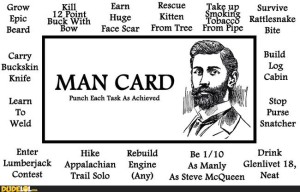
  • Be a Man

    Man Card

    Today is my 46th Birthday, as I sit and have my morning Mt Dew and think about the events that brought me to this point in my life it occurred to me that I enjoy being a man. There is a certain amount of skill involves and over time a set of values and morality are developed.

    There are very few times in a man’s life that the playing field is equal. For me the navy was one of them. On my first day of boot camp, after the haircut and first clothing issue we were all in a room with a pile of clothes learning how to stencil our names on them in the Navy way. We took of our civvies and were standing there ib nothing but a new pair of tighty whiteys when our Company Commander called us to attention and introduced the Chaplin. I do not remember all of his words but one part of his talk has stayed with me. He said “ Take a look around you, everyone in this room is equal to everyone else. It does not matter how much money your parents have, It does not matter how you did it school, no one on this room has any advantage. What you make of your life and your Navy career is up to you”.

    To be a real man there are some absolute truths that must be embraced. I think the first is the fact that you are expendable. You have to be willing to put yourself in harm’s way to protect those around you. You must be willing to work at any job to provide for those who depend on you. There is nothing degrading about doing a hard day’s work. There are few things more satisfying than going to bed dog ass tired but knowing you did your best.

    Being a man also means that you have to learn to be humble. When you are wrong admit it. Ask for advice. You also have to be outspoken, correct an injustice. Stand up for what you believe in.
    There are some other skills that must be learned,

    Learn how to shave like your grandfather did. Get a shaving brush and safety razor and learn to use them. A disposable Razor is 3 bucks, canned shaving cream sucks. A safety razor blade cost 25 cents and you will get a better closer shave, plus its fun.

    Learn how to tie a tie in at least 3 different ways. Ditch the clip on, 4 in hand, Windsor and Double Windsor are the absolute minimum. Untie them when not in use. Bonus point for a bow tie.

    Learn how to wear clothes like a man. Men’s clothes are more expensive than women’s clothes. We wear them longer. Tuck in your shirt, wear a belt. Carry a handkerchief. It doesn’t matter if its Jeans and a T-shirt or a tuxedo. Get clothes that fit right and have them altered to you. It’s not expensive and its way more comfortable.

    Learn how to use tools. Not all of us a handy men but there is no excuse for not knowing how to change a tire or jump-start a car. Most home repairs are very simple with the right tools. Fixing a dripping faucet or replacing a light switch should not involve more than a trip to a hardware store.

    Use manners, hold open doors, say yes ma’am and no sir. It’s all about respect. If you give it, you will get it.

    Carry a pocket knife and wear a watch. I almost included it with tools but a watch and a knife will keep you out of trouble and get you out of a bind. There is a lot to be said for a good pocket knife.

    Learn how to write a letter. We live in an age on instant gratification. Writing a real letter and mailing it show the person receiving it that this is important. Write thank you notes, condolence letters or a well worded letter to someone you are at odds with goes a long way.

    Learn how to cook, that one is important. Guys cooking is important. You get to eat what you want and its fun. I love being able to go into a kitchen and fix something from the odds and ends. Plus cooking for your wife, kids girlfriend ect shows them that you are versatile.

    Boys are born, men are made. It has nothing to do with how tall or strong a man is. It has everything to so with character. The art of being a man is slipping away more and more with each generation. Terms like baby daddy are replacing words like Father and Dad. Punk kids think that being a man mean being a bully or how many different women they can get pregnant. Now we have kids who will spend all day inside playing video games, they have no clue how to be social or how to have fun that does not involve electricity. Boys learn from example and emulation. Don’t be afraid to show emotion. Get involved. Be a man.

  • The Three Stooges Administration

    That happy little convocation in the Rose Garden that transpired a couple of weeks ago, where our oh so solicitous POTUS, provided a presidential imprimatur and a platform backed by the full faith and credit of the U.S. government to the father of Bowe Bergdahl, may very well being heading south at warp speed.

    The online version of the Brit newspaper, Daily Mail has posted an article that rather detracts from the strong moral position that Bergdahl’s father supposedly occupied as the distressed but now relieved father of a young man held by a terrorist group for five years. So noble was his cause that our nation’s president invited him and his wife to participate in that Rose Garden photo opportunity that Obama’s staff had assured him would make him appear as a strong leader, a commander-in-chief who cares for the families of our warriors and leaves no man behind.

    Well, if what the Daily Mail has published proves to be true, Barry may find himself wishing he’d swapped Bergdahl senior for Bergdahl junior rather than five deadly terrorists. According to the Daily Mail, Bergdahl senior is…you ready for this?

    A Peeping Tom

    Yes, that noble, bearded father who faced this nation from a podium in the Rose Garden and praised Allah while our president smiled with benevolent warmth appears to have a police record in Idaho for sexual harassment of a pair of young women who were not so receptive to his stalking and his uninvited advances. Impossible you say? Our presidential handlers could not possibly have allowed our esteemed leader to be so embarrassed? Here you go.

    Folks, our White House is being run by the staff equivalent of the Three Stooges.

  • Yer Friday Funny: Stupid Criminal Tricks, Part . . . Whatever

    A guy got busted the other day for trying to sell marijuana. Nothing terribly unusual there.

    Well, except for maybe three little details that were a touch unusual.  He tried to make his sale

    1. while pushing a stroller containing his 2-month-old child;
    2. to a cop in uniform; and
    3. while out on bail after being busted for burglary earlier this year.

    Seriously.