Category: Who knows

  • Ebola news

    Ebola news

    I guess you’ve already heard that our Ebola patient has died from the disease. Folks who get their news from Twitter claim that it was racism that killed him, says Twitchy, but the CDC is sticking with a virus. From the New York Times;

    Mr. Duncan died at 7:51 a.m. at Texas Health Presbyterian Hospital, more than a week after the virus was detected on Sept. 30. His condition had worsened in recent days to critical from serious as medical personnel worked to support his fluid and electrolyte levels, crucial to recovery in a disease that causes bleeding, vomiting and diarrhea. Mr. Duncan was also treated with an experimental antiviral drug, brincidofovir, after the Food and Drug Administration approved its use on an emergency basis.

    The Associated Press says that there are whole crowd of people who were exposed to Mr. Duncan;

    Health officials have identified 10 people, including seven health workers, who had direct contact with Duncan while he was contagious. Another 38 people also may have come into contact with him. The four people living in the northeast Dallas apartment where Duncan stayed have been isolated in a private residence.

    Meanwhile, over in Africa, according to the Washington Examiner, health care folks are “fleeing” from their treatment facilities.

    A new and remarkably candid on-the-ground audit from the Centers for Disease Control and Prevention of the Ebola crisis in Liberia said that doctors and nurses have fled hospitals in the infection zone and that obstacles to killing the virus remain.

    The analysis of four remote Liberian counties conducted by local and CDC officials that were Ebola-free in August revealed that massive amounts of aid are still needed in the areas to fight the virus, which can be spread as simply as by burying a dead victim.

    The Washington Post reports that the CDC is sending their workers to five airports to shut the barn door after the horses are out. They’ll be taking the temperature of people as they arrive here from West African countries.

    Travelers originating in West African countries will be given questionnaires and have their temperatures taken at these U.S. airports, the Centers for Disease Control and Prevention said Wednesday.

    “We work to continuously increase the safety of Americans,” CDC Director Thomas Frieden said in a statement Wednesday. “We believe these new measures will further protect the health of Americans, understanding that nothing we can do will get us to absolute zero risk until we end the Ebola epidemic in West Africa.”

    Mr Duncan, the deceased victim, was given a questionnaire when he left Liberia, but he lied and didn’t tell officials that he had escorted an Ebola-infected pregnant woman (who has since perished) to the hospital. Lucky for us, Liberia has issued a arrest warrant for Mr Duncan because he lied on the form. So he’ll get his, by gum.

  • Talk About Bad Timing

    Headline from the cover of the issue of Dallas Weekly magazine released on 25 September:

     “Taste of Africa Comes to Dallas”

    Seriously.

    Yeah, the timing on that one . . . kinda sucks.  They obviously didn’t have a working crystal ball.

  • First US case of Ebola suspected

    First US case of Ebola suspected

    I have no idea why an American would be in Liberia, but this person was, and the CDC suspects that the traveler has Ebola, says Fox News;

    CDC Director Dr. Tom Frieden said that the patient arrived in Texas from Liberia earlier this month and exhibited no symptoms. The patient sought care last Friday and has been hospitalized in isolation since the weekend. Frieden said that officials don’t believe there is any risk to anyone who was on the flight at that time.

    State health officials say no other cases are suspected in Texas.

    The Washington Post says that it’s been confirmed by the Center for Disease Control;

    State and federal health officials announcing the confirmed case repeatedly stressed the difficulties of contracting Ebola, which can be spread through bodily fluids or infected animals but not through the air or by water.

    This person who is infected left Liberia on Sept. 19 and arrived in the U.S. the following day to visit family in this country.

    By the way, if you need a reminder, Liberia is where we’re sending those 3,000 troops.

  • THIS Kind of “Green” Initiative I Can Stomach!

    In order to minimize damage to a Medieval Belgian town’s environment, one Belgian brewery is doing its part.  In order to preserve the town’s ambiance – and reduce truck traffic, emissions, and pollution – the De Halve Maan brewery is building a 2-mile beer pipeline to get its product to the nearby factory that bottles it.

    Yes, you read that correctly.  A beer pipeline.  And it will handle 1,500 gallons per hour.

    Now, that’s one “green” project I can support!  Think we can get them to run a branch line this way – for QC purposes?  (smile)

  • White Horses

    Seeing TSO’s article from last night regarding the ongoing Left Coast “Saga of Teh Stoopid” reminded me of something I’ve been pondering for a while. So since Jonn lets me wax foolish here from time to time, I decided I’d share it.

    Yeah, that means I’m about to ramble “off the res” a bit again. Consider yourselves warned. (smile)

    . . .

    TSO ended his article with a lyric from Emerson, Lake, and Palmer – ELP, for short. It was thoroughly apropos for his purposes.

    But it brings to mind another tune from ELP. And I’d guess that one resonates even more strongly, if perhaps a bit ambiguously, with many of TAH’s readers.

    The tune is Lucky Man. For those readers who might be unfamiliar with it, I’ve linked a clip below.

    Released in 1970, the song was not written to protest the Vietnam War – though many at the time and since doubtless took it to be exactly that. Greg Lake, the song’s author, wrote in 1959-1960, when he was 12 years old. It sat unrecorded until the sessions for ELP’s first album – and ended up on that self-titled record.

    It’s not a typical ELP tune.  It’s written more-or-less as a piece from an English Medieval traveling minstrel, updated to be more modern lyrically.  Lake wrote it on and for the acoustic guitar.

    On the surface, the song addresses the futility of war and the waste of life inherent in same. A man who “had everything” goes to war and loses it all when he’s killed in battle. It makes a powerful, if perhaps unintended, anti-war statement.   Many doubtless see the tune as a paean for pacifism.

    And yet . . . I think most of us who’ve served may view it a bit differently.

    In the song, yes – the main character dies. And he’s understandably sad on realizing he’s about to die.

    But consider:  he dies voluntarily. He dies while serving a cause greater than himself. And he dies doing his duty to that greater cause – in this case, his nation.

    His nation called. He answered. It cost him dearly.  But he died honorably and true to himself nonetheless.

    Each of us who has served has given that possibility some thought. Anyone who’s served and hasn’t (or didn’t) is IMO a complete and utter fool.

    And anyone who’s served voluntarily has decided – implicitly or explicitly – “I’m OK with that”.

    . . .

    Anyway, my take is this: yes, the story is sad. Life is sad sometimes. Not all stories have happy endings.

    But in at least one respect, IMO the title is apropos. The man in question’s life was forfeit while serving a cause that mattered. He spent his life willingly. While not perhaps the end he wanted, he went out on his own terms while doing what he wanted to do.  The ending to his life was honorable.

    Some aren’t so lucky. They never do anything meaningful in their lives. They never serve a cause larger than themselves.   And whatever they do, it’s about their wants and needs – not about serving a greater cause.

    So you tell me: was the man lucky? I don’t know. Everyone has to decide that for themselves. I’ve got somewhat mixed feelings personally.

    But on balance, I’d have to say – yes he was. He died doing his duty, voluntarily serving his nation.  He died doing something that mattered.

    I’d guess many of our readers feel the same.

    . . .

    Enough rambling for today.  Heading back to the res.

  • Life Imitating Art

    In keeping with today’s “theater of the absurd” theme:  I’d guess many TAH readers are fans of the late Douglas Adams – author of The Hitchhikers Guide to the Universe and a number of other works. So the name Eccentrica Gallumbits, Adams’ fictional triple-breasted whore from Eroticon Six, probably rings a bell.

    Well, apparently that’s not just a joke (or a sick fantasy) any more.

    While I’m not calling the individual in question a prostitute . . . I’m not kidding, either.

    “People are strange, when you’re a stranger . . . “

  • Some Thoughts Regarding MoH Awards

    Jonn’s earlier article concerning the scarcity of Medal of Honor (MoH) recipients during the GWOT piqued my curiosity. So I decided to do a little digging  and number crunching – and see just where the numbers led.

    Here’s the data I was able to find quickly, from various internet sources, for 5 major US conflicts since 1900. These conflicts were World War I, World War II, Korea, Vietnam, and the post-9/11 GWOT. I didn’t look up data for the first Gulf War; no MoHs were awarded during that conflict. I also excluded Somalia; that conflict, while arguably the real opening shots of the GWOT, is generally not considered a part of the GWOT. But even including the 2 MoHs awarded in Somalia doesn’t change what follows substantially. .

    Here are the numbers.

    World War I:
    Number serving in-theater:  approx 2.2M
    Number of MoHs: 119
    Rate: 0.00541% (5.41 per 100,000)
     
    World War II:
    Number serving overseas:  approx 12M
    Number of MoHs: 472
    Rate: 0.00393% (3.93 per 100,000)
     
    Korea:
    Number serving in-theater:  approx 1.789M
    Number of MoHs: 146
    Rate: 0.00816% (8.16 per 100,000)
     
    Vietnam:
    Number serving in-country:  2.6 M
    Number of MoHs: 258
    Rate: 0.00992% (9.92 per 100,000)
     
    GWOT:
    Number serving in-country:  approx 1.3M
    Number of MoHs: 16
    Rate: 0.00123% (1.23 per 100,000)

    . . .

    I think the numbers rather speak for themselves. But I’ll give my 2 cents worth about them anyway.

    Yeah, the current conflict got the short end of the stick with respect to the number of MoHs awarded so far.  The numbers make that pretty damn clear.

    A few further thoughts:

    1. Prior to the GWOT, the historical modern rate of award for the MoH during major conflicts ranged between 0.00393% and 0.00992%. That’s a rough range of somewhere around 4 to 10 out of every 100,000 military personnel deployed in harm’s way.

    2. World War I was primarily an infantry war, but at that time the concept of handing out medals was still relatively new; processes for doing so in a modern large war were developed on the fly. Still: with only a year or so of real combat, the rate of award for the MoH seems reasonable to perhaps a bit low, historically, for a largely infantry war like World War I.

    3. Prior to the GWOT, World War II saw the lowest MoH rate. It is also the US war where Naval and Air Corps service in harm’s way was most extensive. No slight to our nautical or aeronautical sister services – but service at sea or in the air in general offers far fewer opportunities for the level of heroism required for award of the MOH than does land combat, so a lower rate of MoHs for this World War II should be expected. Fewer opportunities means fewer awards. Also, during World War II there were multiple theaters; multiple theaters means more of those deployed overseas were likely in relatively “safe” rear areas providing support. I couldn’t find or derive a good number for those serving where shooting was actually happening in World War II; the best I could find was that 75% of the military served “overseas”.

    4. Korea and Vietnam were, in essence, infantry wars in Asia against foes that didn’t “play nice” with respect to the Geneva Convention. Their rates of MoH award are, as might be expected, higher than in other conflicts.

    5. That said, the Vietnam War MoH rate numbers give me pause. Many units did acquire a reputation for being “easy” regarding awards during Vietnam. A man I once knew (an artillery officer who served in Vietnam) once told me that it was a running joke when he served there that officers inprocessing to Vietnam should have just signed for their award “packet” (BSM, VSM, VCM, and possibly Air Medal) during in processing in order to streamline things when they left. Award inflation reputedly included many awards for valor. Stories of undeserved Silver Stars being relatively commonplace exist; I can’t assess whether such stories are accurate or not – but where there’s smoke, there’s often fire. While I believe the services all avoided MoH inflation during Vietnam, I guess it’s possible some might have occurred. And the rate of MoH award in Vietnam is unusually high when compared to other US major conflicts – nearly 1 in 10,000. Dunno.

    6. During the GWOT, the MoH has been awarded at a rate of nut much more than 1 out of every 100,000 troops serving in harm’s way.  That’s barely 1/4 as often as during World War II, and about 1/8 as often as during Vietnam.  And the GWOT – like World War I, Korea, and Vietnam – has been primarily a single-theater, “up-close-and-personal” infantry war.  Something just doesn’t seem right.

    . . .

    Why? Well, I personally think it’s probably one last institutional legacy of Vietnam. Specifically, I think this is an over-reaction to the perception of awards abuse and inflation in Vietnam – which was, to some degree, IMO  accurate. (How much is another question entirely.)  But the correction has been far too severe. American troops haven’t become less brave today than they were in previous conflicts, and during the GWOT substantial opportunities for battlefield heroism have existed. The reluctance to award the MoH seems to me to be due to an excessive and misplaced fear of “cheapening” the MoH as is perceived happened to some awards in Vietnam. That’s a valid concern – but if anything, the effect appears to have been to slight many deserving heroes.

    This has an unintended consequence: it sends an unintended message to the military itself, and to America. Few or no MoHs implies almost no one was no one worthy, that the fighting wasn’t severe and protracted, and that there simply wasn’t much battlefield heroim. But that’s decidedly not the case for either Iraq or Afghanistan.

    Bottom line: the process appears effectively broken. IMO, it needs fixing.  “Poor is the nation that has no heroes; but beggared is the nation that has and forgets them.”

    Just my thoughts, and I might well be out to lunch. But my gut tells me I’m not.

    _________________

    Postscript:  I’m still not personally convinced no one in the 1991 Gulf War was worthy of the MoH. However, ground operations during that war were short enough and the enemy so clueless that maybe that was the case. 

    Dunno.  I wasn’t on active duty during the Gulf War; and I wasn’t mobilized during that conflict.  So I don’t really have any personal experiences on which to form an opinion about the matter. 

    But I still have trouble believing it.
  • Soldier stopped from entering school

    Soldier stopped from entering school

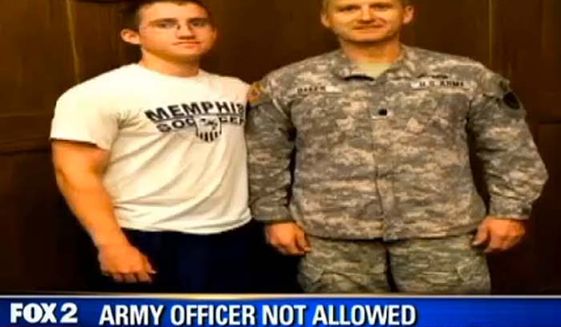
    Lt. Col. Sherwood Baker

    According to the Washington Times, Army Lieutenant Colonel Sherwood Baker was denied entry to his daughter’s school while he was wearing his uniform because some rental cop told him that the sight of it might offend someone. Soon after the incident, my inbox started filling up;

    “Before he was allowed in, the security guard stopped him and said sorry you’re not allowed in the school. Security told him men and women in uniform weren’t allowed because it may offend another student,” Lt. Col. Sherwood Baker’s wife, Rachel, told a local Fox affiliate.

    I tried to get indignant about this, but I can’t. It was a handful of security guards that told the LTC that, not the school. In fact the superintendent of the school system, Robert Shaner, was a Marine and he apologized quickly;

    Mr. Shaner’s statement read: “The district has apologized for any perception that individuals in uniform are not welcome in the school. The district does not have a policy excluding individuals in uniform and will be working with administration and the firm that handles our security to make sure district policies are understood and communicated accurately.”

    The security guards probably need a block of instruction, but it’s not a school policy, so I’m just telling you that it happened.