Category: Who knows

  • In Honor of the Previous Article . . . .

    With apologies to someone once called by a comic the “butt-ugliest man in Rock and Roll”, the incredibly talented Tom Petty.

    Hat tip, Jonn. This one’s for what you do; hope you don’t mind me speaking for you – and likely for damn near everyone else here, too.


    Quit Lyin’ to Me

    Busted, caught in a corner
    Trapped up against the wall
    Liar got nowhere to go
    Liar got nowhere to fall

    No help from “old buddies”
    Your shame is guaranteed
    Take back your bogus claims
    All that drama we don’t need

    You’re lyin’ to me
    You’re lyin’ to me
    Quit lyin’ to me
    ‘Cause now you’re caught trapped in a corner
    Just stop lyin’ cause now it’s over

    Tool makes some angry threats when
    Someone questions his claims
    Of SF, and bein’ Ranger
    Turns out his lies are lame

    Jonn nailed another liar
    Tool’s named Chris Piscopo
    Exposed his phony tab and
    Told him just where he should go

    You’re lyin’ to me
    You’re lyin’ to me
    Quit lyin’ to me
    ‘Cause now you’re caught trapped in a corner
    Just stop lyin’ cause now it’s over

    Take back yer bogus Ranger
    Take back yer false SF
    Come clean about yer record
    Can’t stand to hear those lies no more

    You’re lyin’ to me
    You’re lyin’ to me
    Quit lyin’ to me

    See now, I got your FOIA
    I know just what ya did
    I know you were no soldier
    Just a boot camp washout squid

    You’re lyin’ to me
    You’re lyin’ to me
    Quit lyin’ to me
    ‘Cause now you’re caught trapped in a corner
    Just stop lyin’ cause now it’s over

    Oh, you’re lyin’ to me
    Quit lyin’ to me
    You’re lyin’ to me
    Quit lyin’ to me
    Quit lyin’ to me
    Yeah, you’re lyin’ to me
    You’re lying’ to me

  • Manning attempts suicide

    manning tears

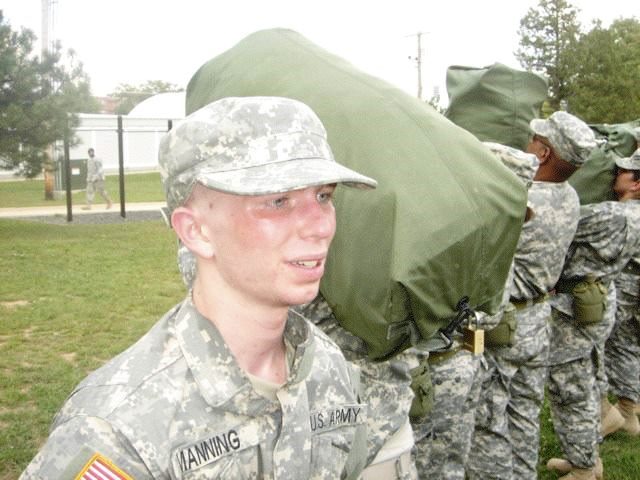
    Fox News reports that traitorous Leavenworth inmate, Bradley Manning tried to hang himself.

    Manning recently wrote a column from prison for The Guardian about the new U.S. rules allowing transgender people to openly serve in the military.

    “Gender presentation should reflect the person that you are,” Manning wrote. “When you lose control of your gender presentation you lose an important aspect of your identity and existence. By setting so many caveats, time lines, standards, and training, the military is making this far, far, more complicated and bureaucratic than it needs to be. The simple reality is that we are who we say we are.”

    So, I guess in order to prove to the rest of us how normal transgender people are, he tried to hang himself.

  • Jason Galvin rescues an eagle

    Jason Galvin rescues an eagle

    Save Eagle

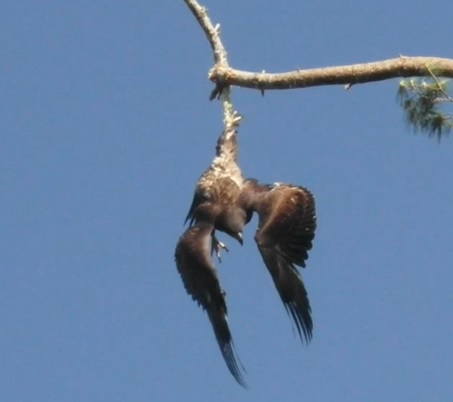
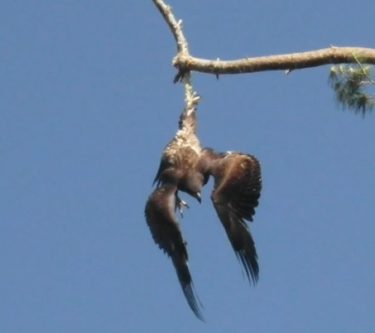
    Clamsgotlegs sends us the story of Jason Galvin, an Afghanistan veteran who discovered an eagle who was wrapped up in a rope and hanging from a tree.

    Galvin was on a bait run in his pickup, when he spotted the bird above a gravel road about a mile from his family’s cabin, upside down and struggling. By then the eagle had already been hanging more than two days, as neighbors called the Minnesota DNR and the Rush City police and fire departments, only to be told there was nothing the agencies could do.

    Galvin’s wife Jackie began making calls too, with similar results. “They just couldn’t get up there high enough and they just unfortunately deemed this was going to be a loss.”

    “Right then I thought, ‘Man, that just doesn’t look good.’” Jason Galvin said.

    As he assessed the situation Galvin joked that he might have to shoot the eagle down. His wife responded in a more serious tone. “Yup, that’s what you’re going to do.”

    It took him 150 .22 rounds from his Ruger 10/22, but he shot through the entanglements to free the bird. The eagle is recoverin at the doc’s office and it will be released back into the wild.

    I couldn’t help but wonder through the story where he bought 150 of .22 ammo. It’s been pretty scarce for the last few years. But, good shootin’, Jason. It’s a good thing that he had witnesses, or I wouldn’t have believed the story.

  • Wrong Restaurant, Apparently

    I’m old enough to remember the “Cola Wars”, but this is ridiculous.  Headline says it all:

    Ronald McDonald shot at NC Sonic

    Seriously.

     (smile)

  • National PTSD Awareness Day

    National PTSD Awareness Day

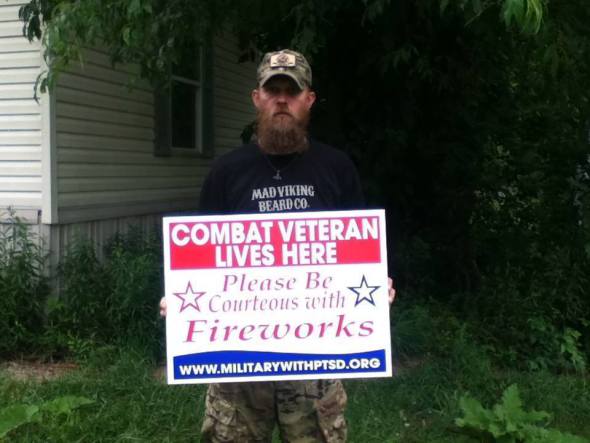
    HMC Ret reminds us that today is National PTSD Awareness Day. So, if you’re not aware of PTSD the rest of the year, you should be aware of it today. It’s probably not a coincidence that it comes just before July 4th;

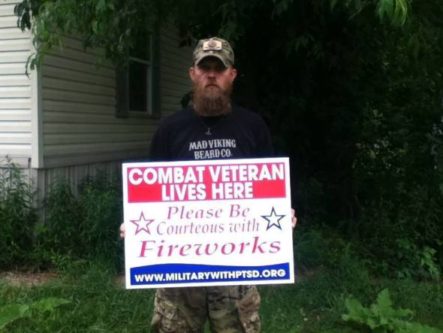
    William Mayor-sign

    If you need a sign, like Mr. Mayor here, you can get one at Military With PTSD – it’s run by Jason Gourley who caught the PTSD in a classroom where someone talked about terrorism.

    Military with PTSD provides us with a helpful map of where they’ve sent their signs;

    No one in my county has a sign yet.

    I’m not saying that PTSD isn’t a real thing and that there aren’t people who really suffer from it, but I’m pretty sure they don’t make a point of being a dick about it. People who go around waving a sign about their PTSD probably don’t have it. That’s the unfortunate part of PTSD, you know besides the symptoms. Pretenders use it to their advantage, because we’re not supposed to doubt them – and they can use it to their advantage to explain their bad behavior and no one doubts them in public.

    I know a number of my readers suffer from PTSD, many of you have shared that with me and I don’t doubt you, and I sympathize with you, I really do. What I hate are the people who hide behind signs and use it for an excuse. You know what I mean.

    Anyway, happy PTSD Day to everyone.

  • Enablers – Part 2

    Some weeks ago, Jonn wrote about the tool who claimed to have “created the POW/MIA logo” – the logo actually designed by World War II veteran Newt Heisley.  I’ll refer to that individual hereafter as “Logo-boi”.

    “Logo-boi” even managed to get honored by both the IL State House (2013) and the US House of Representatives (2014) for “his design for the POW/MIA logo”.  However, those honors were false; “Logo-boi” wasn’t the one who designed it.  And when when presented with definitive evidence that he wasn’t the originator of the logo, “Logo-boi”  then backtracked his claim – kinda.

    While “Logo-boi” now acknowledges he did not create the POW/MIA logo, he still claims to have “independently” come up with the same design”, but at a later time – though he does now allow that his design was “unknowingly inspired by the original POW/MIA flag designed by Newton Heisley in 1971”.

    “Unknowingly?”  Yeah, right.  Just like I’m the last of the Romanovs – and therefore the rightful Tsar of all Russia.

    But “Logo-boi” isn’t really what this article’s about.

    Predictably, the guy had his defenders and enablers.  Fakes always do; Jonn’s written an article about that as well.

    Notable among “Logo-boi’s” defenders was Rep. Linda Chapa LaVia, his representative in the Illinois State House of Representatives.  She’s also the one who rather foolishly introduced a resolution in the IL House commending the guy for “creating the POW/MIA Logo” when he didn’t.  That state resolution in turn resulted in a similar resolution erroneously praising “Logo-boi” for same being introduced in, and passed by, the US House of Representatives.

    Rep. LaVia continued to support the guy even after clear and convincing evidence was available that he was NOT the creator of the POW/MIA Logo.  Rep. LaVia – referred to in the last linked article as “a retired Army officer”, and chair of the Illinois House Veterans Affairs Committee – may well be supporting the guy to avoid admitting she screwed up.  That’s understandable; people hate to admit they’ve been “had”. Or maybe she truly does believe him.

    But perhaps there’s another reason.

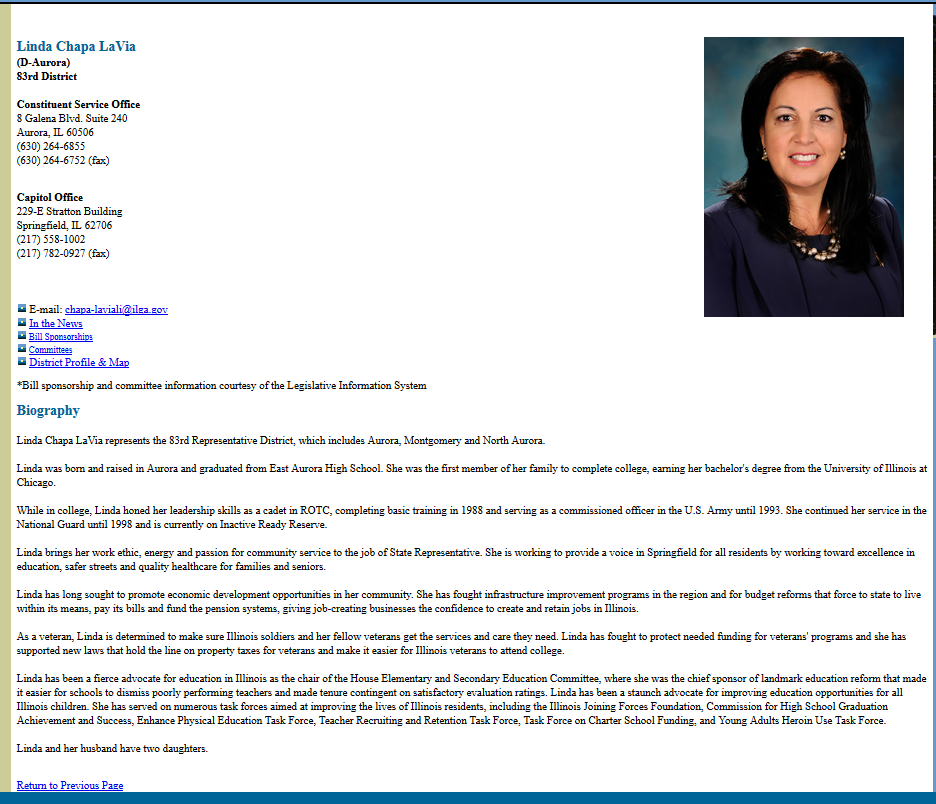
    Here’s Rep. LaVia’s bio, taken from her official IL House website (click image for larger version).  A PDF print of the webpage including this bio can be found here.

    In that bio, downloaded/captured as of the morning of 23 June 2016, Rep. LaVia appears to claim she’s still serving as a member of the “Inactive Ready Reserve”.  That’s at odds with the article in which Rep. LaVia defends “Logo-boi”; it refers to her as a “military retiree”.  However, it’s unclear where that article’s author got the word that Rep. LaVia was a “military retiree”; it might not have been from Rep. LaVia herself.

    Either way, it looks to me like Rep. LaVia needs to contact NPRC.  Because it seems to me that her records on file there may be “inaccurate or incomplete”.

    Specifically, the service listed in NPRC’s records doesn’t seem to match that in her official bio.  Nor do those records seem to say she’s a military retiree.

    It appears  Rep. LaVia’s maiden name was very likely “Erlinda Chapa”.  Rep. LaVia’s bio indicates she graduated from East Aurora High School – and an individual by the name of “Erlinda Chapa” apparently graduated from East Aurora High School in 1984.  Graduating from high school in 1984 is consistent with Rep LaVia’s published year of birth (1966).  Graduating from high school in 1984 is also fully consistent with someone graduating from college and receiving a commission in 1988.

    The above dovetails nicely with Rep. LaVia’s official bio. Moreover, “Chapa” is also now her middle name – a not uncommon practice for many women who marry and elect to adopt their husband’s family name.  Finally, it seems quite likely that her current first name “Linda” is a variant of “Erlinda”.

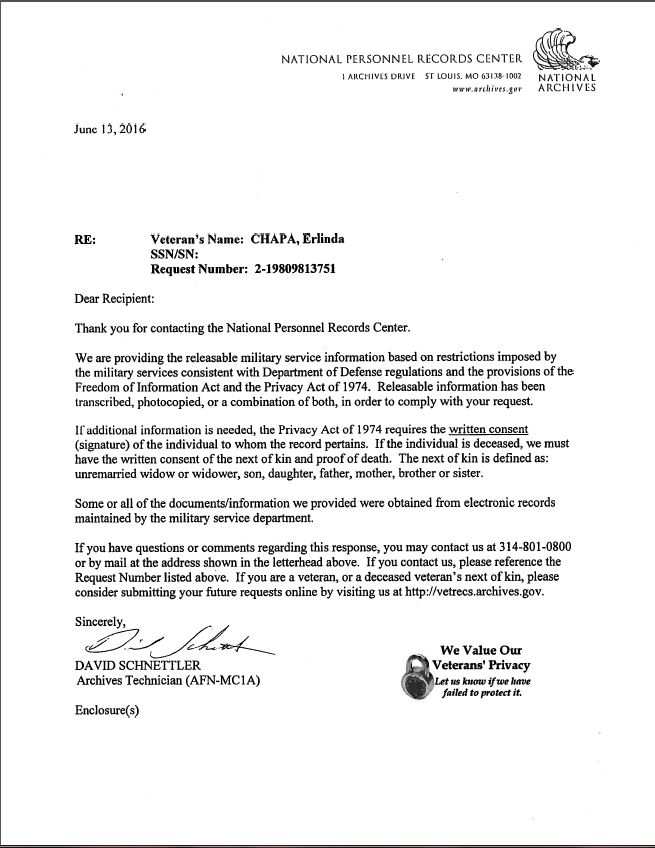
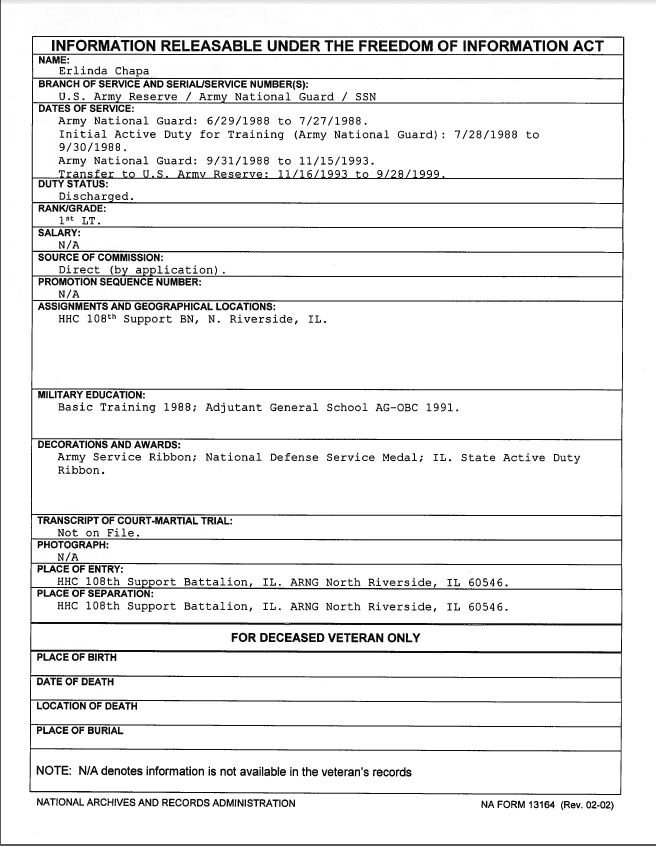
    If this “Erlinda Chapa” from 1984 is indeed today’s “Rep. Linda Chapa LaVia” – and I’m fairly sure they’re the same person – here’s what NPRC had to say about their military career.  What follows was obtained pursuant to a FOIA request made using the name “Erlinda Chapa”, Rep. LaVia’s published DOB (from Wikipedia), and the place of birth of Aurora, IL.  You can view the information below in PDF format here.

    Now, “discharged as a 1LT with 11 years 3 months total Reserve Component service” is indeed honorable (if unspectacular) service.  But last time I checked, that generally was not the same as either being a current member of the IRR or being a military retiree.

    There are also other “disconnects”.  NPRC says she served in the IL ARNG from 1988-1993 and in the USAR from 1993-1999.  Her official bio says she served in the IL ARNG starting in 1993, serving in the “US Army” before then – and doesn’t mention her 1999 discharge from the USAR at all.  NPRC also shows no extended active duty other than for IET – something that Rep. LaVia’s biography IMO implies she did between 1988 and 1993, but doesn’t unambiguously claim.

    Perhaps this is all due to a mistake on the part of NPRC.  Maybe Rep. LaVia’s records there are not complete.  Maybe her bio is simply wrong.  Maybe the reporter who wrote that article that refers to Rep. LaVia as “a retired Army officer” misunderstood something she was told.

    Or maybe not.

    Hopefully Rep. LaVia or her staff can fill in the blanks here.

  • Drawing the Bow: Archery in the Modern Gun Culture

    Drawing the Bow: Archery in the Modern Gun Culture

    From the pen of Pinto Nag;

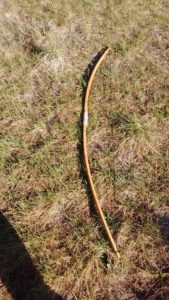
    longbow Otzi 2016

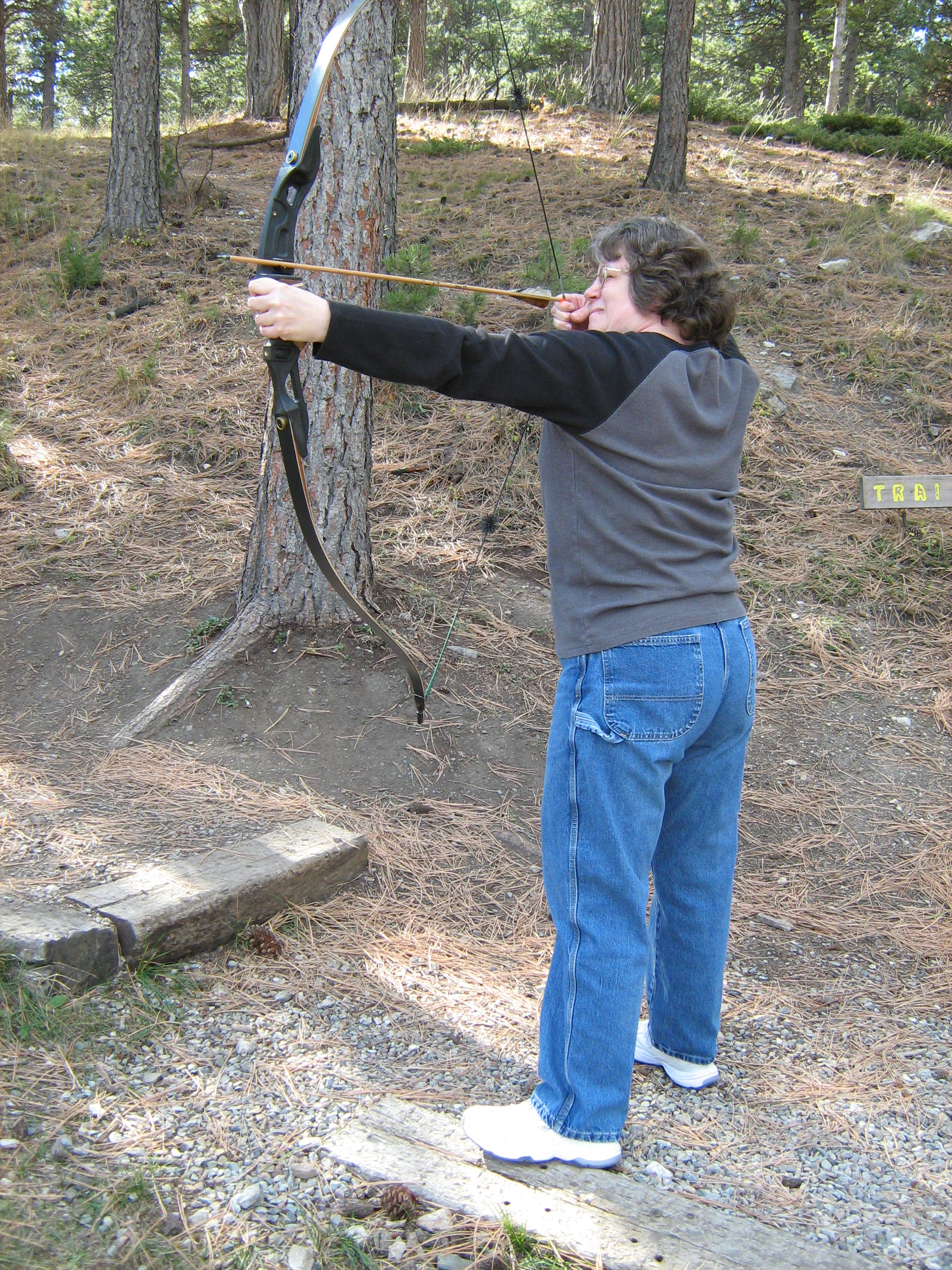
    Me and Ishi Oct 2014

    I’m pointing the finger of blame squarely at Ex-PH2; she’s the one who suggested an article on archery for TAH. I am not a writer like she is, so I hesitated at first; however, the idea grew on me. Perhaps, in the lines that follow, you’ll see why.

    I’ve owned and handled firearms all of my life, and didn’t pick up a bow until I was 50 years old. That is one of the great regrets of my life now, and if you were to ask me why I never shot a bow until recently, the only answer I could have given you was that it never occurred to me. Having been an archer for about three years, I wonder why it never occurred to me.

    The bow is an ancient weapon, and archeologists keep pushing the age of the weapon back further and further as evidence is found around the globe for older and older examples of this tool. 3000 years would be a practical working age – the classic shape vividly depicted in art on walls and pottery — but there is evidence its existence goes back much further than that. Today, an echo of this practical weapon is found in modern armies, in the example of the crossbow, still used now as it was so long ago, to carry cord across rivers and silently remove sentries.

    There are two major tracts in the current archery world, modern compound bows versus traditional bows. I have never shot a compound bow; I began with a traditional recurve bow, and have since begun the shift to primitive archery, now working with a longbow. I have gone from composite arrows with state-of-the-art steel arrowheads, to wooden arrows with hand forged, iron arrowheads. The local archery shop where I shot my first target bow is both bemused and fascinated by my work with “stick and string.” I am very much out of place on their indoor range, with my hickory longbow and wooden arrows, amid rows of beautifully modern, technically advanced compound bows; and yet, they make me welcome – and ask questions. Why do I shoot a primitive bow? Why not take up a fine new compound bow, a powerful and certainly lethal weapon? I do have several reasons, which are why I decided to write this article for TAH. Those reasons are the bedrock of why I shoot a primitive bow.

    As I have mentioned in the past, I consider myself a prepper, and with that mindset comes the question of weapons. Very simply, bows are sustainable weapons. Not only do the bows and arrows last for a long time and are reusable, but they are renewable. It does take skill to build both bows and arrows, but nothing compared to attempting to make, or repair, a modern firearm. Another reason is a major attraction of this weapon – it is silent. Not only does it not push animals out of an area with loud noise, it also does not alert other people in the area to your presence. Another reason is that a bow is a lightweight weapon, and easily carried over long distances. My personal opinion is that primitive bows are better for prepping than compound bows, because of their simplicity, but someone skilled with compound bows may wish to differ with that opinion. For someone of basic skills such as myself, the primitive bow is more attractive.

    And what about my firearms? As a prepper, my collection of firearms has simplified; the bow has taken the place of all of my medium range weapons. If you should decide to join the ranks of modern archers, you will have to answer this question for yourself. I can tell you that the bow sings a siren’s song, the song of an ancient weapon that even today, maintains pride of place as both a practical and lethal weapon. In Zen, it is said that a master archer first takes aim at himself. I invite you to explore the mystery that awaits you as you bring your first bow to full draw.

  • Truth?  Yeah, It Matters.

    Truth? Yeah, It Matters.

    I’m probably going to catch some grief for what follows.  No matter.  Some things are worth saying, popular or not.

    Jonn wrote an article the other day concerning the famous Joe Rosenthal Iwo Jima flag raising photo.  The bottom line:  one of the individuals identified 7+ decades ago as being part of the “flag raising” – PhM2c John Bradly, USN – was recently determined by the USMC not to have actually been in that photo.

    Predictably, since it concerned an icon this caused consternation – and accusations.  Some commenters indicated that to them it “didn’t matter”.  Others indicated a belief that it was part of some Leftist attempt to “smear” a hero.

    It’s a free country, so to each his own. But I have a different point of view.

    The photo is also part of US history.  And accurately recording that history is damned important.  We owe that much to future generations.

    We also owe that to those who are now gone.  We need to get their story as close to correct as we can – even when sometimes that’s painful.

    What follows is a bit longish.  Read or not as you desire.

    . . .

    Flags and Iwo Jima

    It turns out that “flag raising at Iwo Jima” is actually a quite  complex subject.  In truth, the famous and iconic flag raising photo on which the USMC Monument outside Arlington National Cemetery is modeled is only one of multiple different “flag photos” taken atop Mount Suribachi on 23 February 1945 – three of which have some degree of publicity.  All three of those published photos are very different.  Two of them were taken by Joe Rosenthal; the third was taken by SSgt Louis R. Lowery, USMC.  There’s also newsreel footage corresponding to one of the three – Rosenthal’s famous photo – which was taken by yet a third photographer:   SSgt. Bill Genaust, USMC.

    It gets even more complex.  There were actually two different “flag raisings” on the summit of Mount Surabachi on 23 February 1945.  The photos Joe Rosenthal took – two different photographs, one of which became world-famous – were photographs of the SECOND flag raising that day.  The first flag raising and its photos, though not completely unknown, are nowhere near as well known as the second.  They are only rarely seen or discussed.

    Two of the three famous photos taken that day were candid.  One was indeed staged – and no, it wasn’t Rosenthal’s famous photo, which in turn means that the newsreel footage taken that day was also candid.

    And to make the situation even more convoluted:  Bradley does indeed appear in two of the three publicly-known flag raising photographs taken that day atop Mount Suribachi.  However, per the latest USMC investigation announced last week he does not appear in Rosenthal’s iconic photograph.

    Given the complexity of the situation and the fact that it occurred in combat, it’s perhaps understandable if not inevitable that errors were initially made in identifying the participants.  But such errors can often be corrected – and if they can be corrected, they should be.

    The Flag Raisings and the Photos

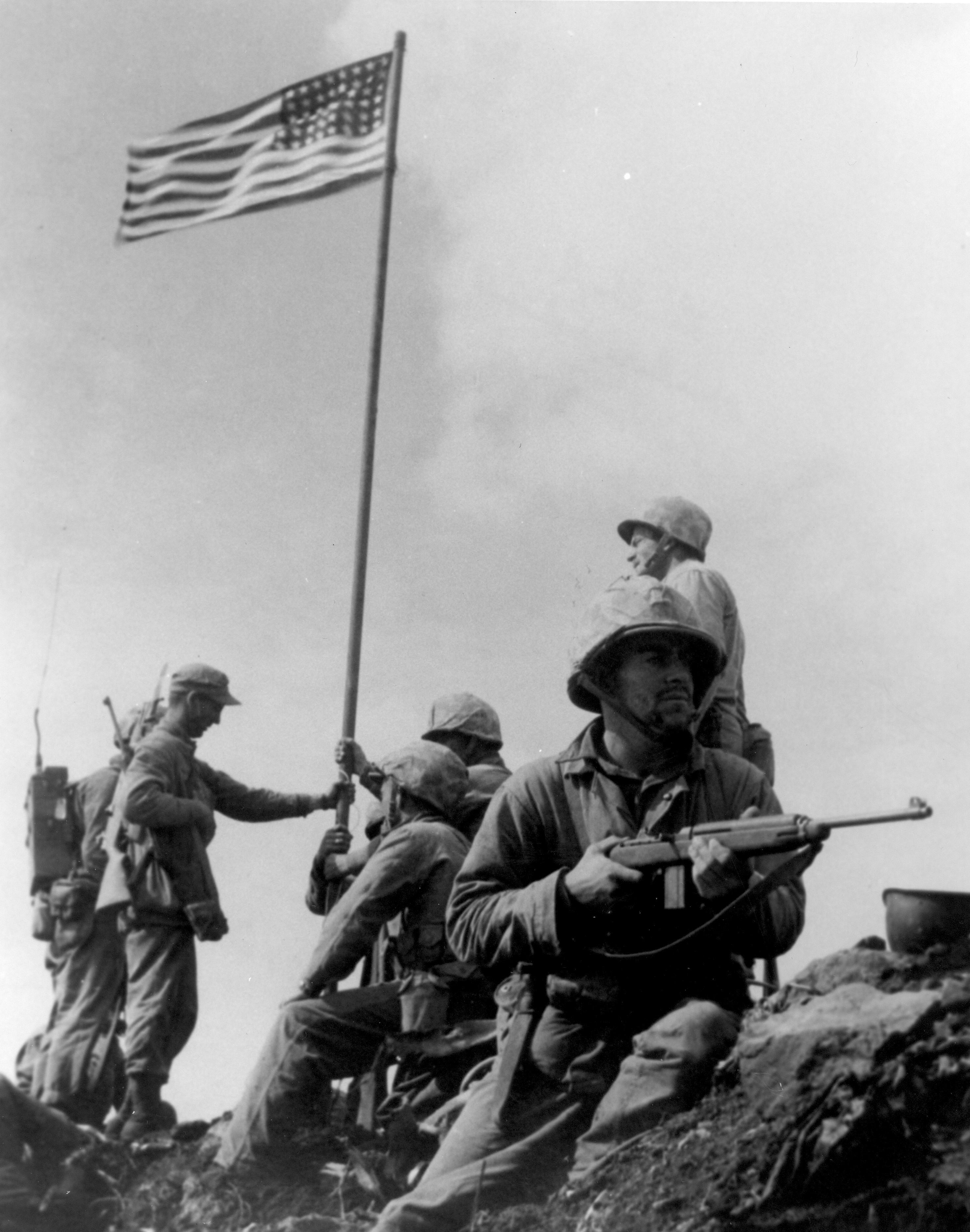
    The first flag raising photo on Iwo Jima is not particularly well known.  It was taken by SSgt. Louis R. Lowery, a USMC photographer.  It is a photograph taken shortly after the first flag raising atop Mount Suribachi.  (Lowery apparently took multiple photographs at the time; this is the most well-known one of the batch.)  John Bradley appears in this photo; he’s the individual near the center of the group, standing and wearing a helmet, with his hand holding the flagstaff.
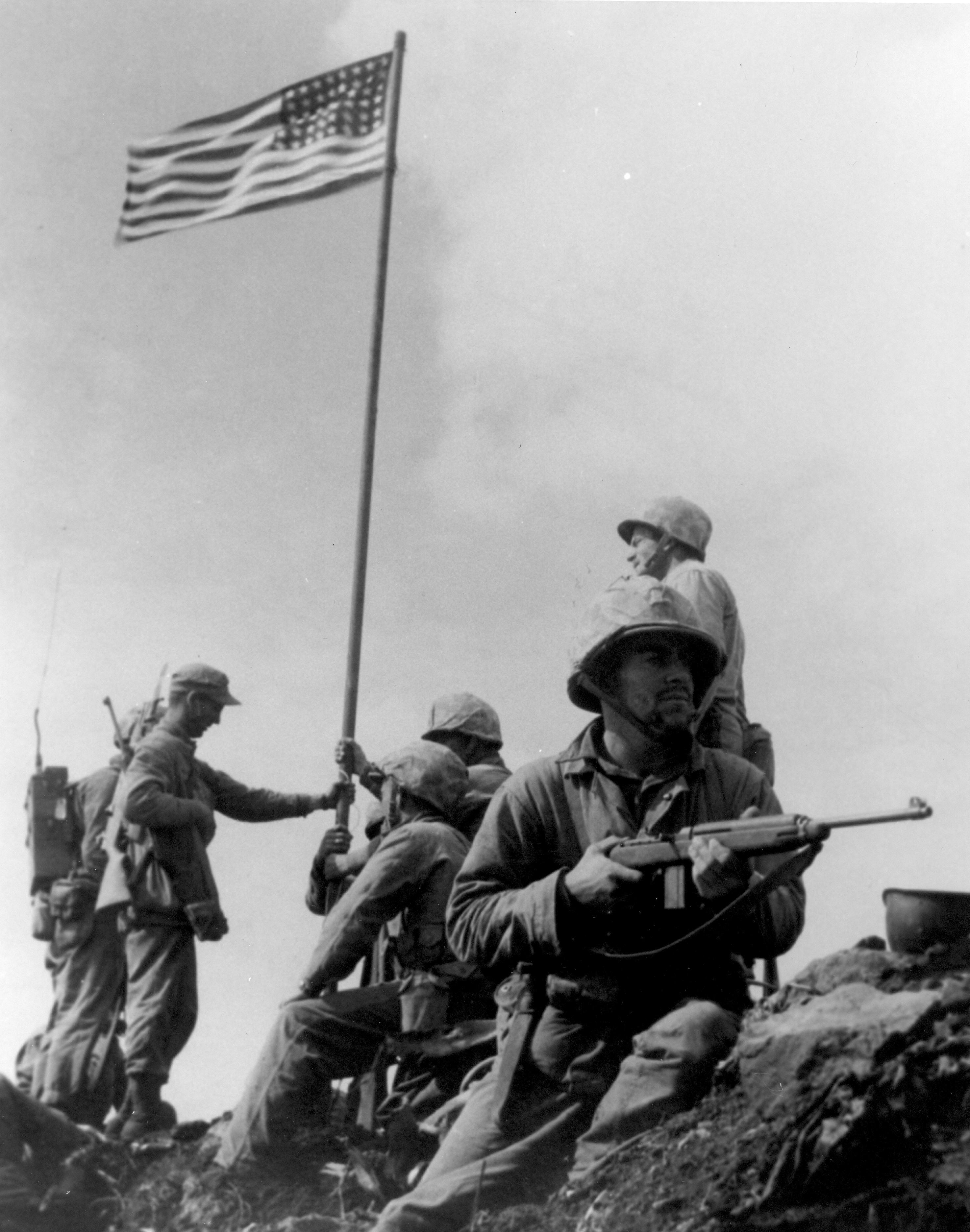
     

    Historical accounts indicate that three Marines raised this first US flag on Mount Suribachi:  1stLt Harold G. Schrier, who led the patrol that took the flag to the top of the mountain; PltSgt Ernest Thomas, his Platoon Sergeant; and Sgt Hank Hansen.  None of the three participated in the second, iconic flag raising photographed by Rosenthal.

    So, why was there a second flag-raising at all?  Well, it seems that a high Navy Department official – SECNAV James Forrestal, to be precise – had accompanied the landing force to Iwo Jima.  On seeing the first flag raised on the summit of Mount Suribachi, Forrestal indicated he wanted that flag.

    That order was in turn relayed to LtCol Chandler Johnson, the Battalion Commander of 2nd Bn, 28th Marine Regiment, 5th Marine Div, whose forces had topped Suribachi and erected that flag.  Johnson’s exact words on receiving this order are recorded as being, “To hell with that!”  He then ordered his subordinates to obtain a second flag and raise it – “And make it a bigger one.”  A team of four Marines – led by Sgt Michael Strank and including Cpl. Harlon Block, Pfc Franklin R. Sousley, and Pfc Ira H. Hayes – was given the mission of raising the second flag.

    One of the battalion’s runners (messengers) – Pfc Rene Gagnon, who also ended up participating in the second flag raising – ended up in possession of this the larger flag (historical accounts differ on precisely where that larger flag was obtained and who obtained it). He took it to SGT Strank’s team atop Mount Suribachi.

    The flag and flagpole used in the second flag raising were quite heavy, weighing together well over 100lbs; there was also considerable wind.  When Gagnon arrived with the flag, Sgt Strank ordered Gagnon and another individual already on the summit to help.  Strank and his team – augmented by Gagnon and the other individual – raised the second flag.  (Bradley was apparently also on or very near the summit at the time, as he’s known to have assisted in stringing and securing the rope installed shortly afterwards used to stabilize the makeshift flagpole after erection.)  The original flag was lowered and returned to the Battalion’s command group.

    This second flag-raising was captured in-progress on both still film and newsreel footage.  Joe Rosenthal took the iconic still photo; he damn near missed it, as he was piling rocks to stand on for a better vantage point when the Marines involved started to raise the flag and had to shoot hurriedly.  SSgt Bill Genaust, USMC, took the newsreel footage while standing about 3 feet away from Rosenthal.  Below is Rosenthal’s original photo; the more famous version is a cropped version of this one.


    Genaust’s newsreel footage of the 2nd flag raising is found beginning at approximately 1:30 in the video below.


    Rosenthal later had a largish group of Marines from the unit pose for a second, “gung-ho” photo with the second flag atop Mount Suribachi.  This was the third Iwo Jima flag photo taken that day.  Three of those who participated in the second flag-raising (Hayes, Strank, and Sousley) appear in this photo as well.  Bradley also appears in this photo.


    Of the six men who raised the flag in Rosenberg’s iconic photo, three (Strank, Block, and Sousley) were later KIA on Iwo Jima – as was the photographer who took the newsreel footage, Genaust.  The other three in the iconic photo survived the war.

    To recap: Bradley was indeed on the summit of Mount Suribachi during or very shortly after each flag raising on 23 February 1945. He was not one of the three that raised the first flag on Mount Suribachi, but does appear in both Lowery’s first Iwo Jima flag photo and in Rosenthal’s “gung-ho” posed version relating to the second flag.  Per the recently-concluded USMC investigation, he was not in Rosenthal’s iconic photograph of the second flag raising; another individual was in that photograph and was afterwards erroneously identified as having been Bradley. Bradley did assist immediately afterwards in placing rope used to stabilize the newly-erected second flag. However, he does not appear to have personally and directly participated in the act of raising either flag.

    Prior Controversies

    As you can see from the above, the circumstances surrounding the Iwo Jima “flag photos” are complex and somewhat confusing.  There were two different flag raisings that day; none of the personnel who raised in the first flag participated in the second flag raising. There are also three different flag photos – but there is personnel overlap among those photos. There is also newsreel film of one flag raising (the famous one).  And this all occurred during combat, where things are often of necessity not neatly organized or accurately recorded at the time.

    As a result, there has been much confusion and multiple controversies concerning the events.

    Initially, Hayes didn’t want to be identified as being one of the “flag raisers”; he wanted to remain anonymous.  He secured a promise from Gagnon, who knew Hayes had participated in the second flag raising, not to reveal his identity.  It took an order – and a blunt reminder that refusal to obey orders was a crime subject to prosecution – before Gagnon identified Hayes as being one of the six in the photo.

    At the time and afterwards, there were accusations concerning Rosenthal’s iconic photo that “the photo was staged”.  And indeed, one of the photos taken that day was staged.  But the “staged photo” wasn’t the iconic photo taken by Rosenthal; it was his second photograph, which is very obviously not a candid shot.  Confusion on this point has led to numerous arguments over the years.

    There have also been previous errors concerning the identities of those in Rosenthal’s iconic photo.  Originally, there was another error in identifying the participants.  Cpl. Harlan Block was not identified as being one of the six in that iconic photo; Sgt. Hank Hansen, one of the three individuals involved in raising the first flag to be raised on Mount Suribachi, was mistakenly identified as being in the photo in Block’s place (at the base of the makeshift flagpole).  It took two years and a Congressional investigation to sort that out.  Indeed, had Pfc. Ira Hayes – one of the six individuals in the Rosenthal photo – not come forward and spoken up regarding the misidentification, that error would likely never have been corrected.

    “At this point, what difference does it make?”

    Well, I guess that depends.  And yes, the choice of language above was intentional – and was done to make a point.

    IMO whether it matters or not depends on what you think is more important:  truth, or appearances.

    If you think appearances are more important, well, I guess then it doesn’t really matter who’s in Rosenthal’s iconic photo.  That photo – regardless of who’s actually in it – is uplifting, stirring, and heroic.  It projects the image of the heroic American fighting man quite well.

    In that case, I guess it also doesn’t really matter if it was staged.  Or if it was even taken in combat or on Mount Suribachi at all.  Or if it was created out of whole cloth by an artist, for that matter.

    In short, it doesn’t matter if it’s true or not. The image is still effective, and it supports the cause.

    If that’s your point of view, well, have at it.  But I can’t buy that.

    I can’t buy that, because truth matters.  The event indeed really happened. It was iconic, and special.  Real people did that, in a real war.  It’s part of US history.

    The people involved are also part of US history. And they deserve to be remembered – accurately.

    And I also can’t buy it because of what happened next.

    The surviving “flag raisers” were turned into celebrities.  They were pulled from combat duty; they were used to headline a War Bond drive.  In at least one individual’s case, it was done very much against their will.

    In short, they too became a part of US history.  So yeah, IMO “getting it right” here matters – a great deal.

    It matters because history is what really happened.  If an account is known not to be accurate, it’s not history; it’s at best fiction, and at worst propaganda.  And when an account is known to be inaccurate, but is nonetheless provided as a description of what actually happened, well . . . that’s called a lie.

    As I said before: to each his own.  To me, truth matters.  One helluva lot.

    YMMV.

    Truth Is . . . Truth

    There are some who might say that this doesn’t matter for a different reason:  because John Bradley was a hero, and this is just an example of “someone trying to tear down a hero”.  I can’t say I agree with that, either.

    John Bradley was indeed a true battlefield hero; his Navy Cross Citation speaks for itself on that score.  He deserves credit and honor for his heroism; for that he has my respect.

    But regardless, facts are facts – even when they’re troubling.  Bradley was indeed in two of the famous Iwo Jima flag photos – but it now appears he was not in Rosenthal’s iconic photo.  He didn’t help raise either flag atop Mount Suribachi.  And try as I might, I simply cannot see any way around one conclusion:  that John Bradley knew – full well – that he didn’t participate in raising the flag in Rosenthal’s photo.

    Yet he kept silent.

    I can perhaps understand why he kept his mouth shut while he was in uniform.  Hell, I suspect he may have been ordered to do so.

    But he was discharged from the Navy in late 1945. After that, he could speak his mind.  Ira Hayes certainly did to correct the record regarding Block.

    Bradley didn’t.  He kept his mouth shut for almost 49 years.

    Still:  truth is . . . truth.  It doesn’t change because we don’t like it – or because we don’t like what the truth implies.

    . . .

    Coda

    There’s also one final thing to consider.  Or, more precisely – one other individual.

    I have to wonder how the real sixth “flag raiser” in Rosenthal’s photo – now determined to have been Pfc Harold H. Schultz, USMC – felt about how this situation and its aftermath.  Because IMO if anyone got the short end of the stick here, it seems to me that he did.  Bigtime.

    Schultz was a legitimate part of US history.  He was the one in the photo. He deserved recognition and remembrance for what he did, even if it was done while simply obeying orders. His actions merited being recorded for posterity; he deserved to be remembered.

    But he wasn’t.

    By all accounts, after World War II Schultz lived a full and apparently good life.  But he had to live the rest of that life knowing someone else got the credit for what he’d done at Iwo Jima – and as a result, became famous.

    Think about that for a moment.  Schultz had participated in something iconic and had played a central role.  He was someone who had literally made history – history that would be remembered for decades if not centuries. By that act he’d achieved some small measure of immortality. People would remember what he’d done – and his name – long after he was gone.

    Then, afterwards, his rightful place in history was taken from him and given to someone else.  The other man was remembered; he was forgotten.

    Maybe Schultz was OK with that; maybe it p!ssed him off daily.  I never met him, so I can’t say.

    But what Schultz did certainly deserved then and deserves now to be acknowledged.  And now, after 71+ years, it has been.

    There’s just one small problem.  The wrong done to Schultz can never be fully righted.

    You see, Harold H. Schultz died on 16 May 1995 – more than 21 years ago.  He went to his grave never receiving his due.  And he died knowing someone else still was receiving credit for doing what he’d done.

    He died knowing someone else had been given his rightful place in history.  He never knew that his role in history had been acknowledged.

    And that . . . is a shame.  A damn shame.


    (Multiple sources were used in preparing this article.  However, the Wikipedia article entitled Raising the Flag on Iwo Jima is a good – and as far as I can tell, accurate – rundown on this somewhat complex and confusing subject.)