Category: Who knows

  • Photogenic arrest

    Photogenic arrest

    bikini cop

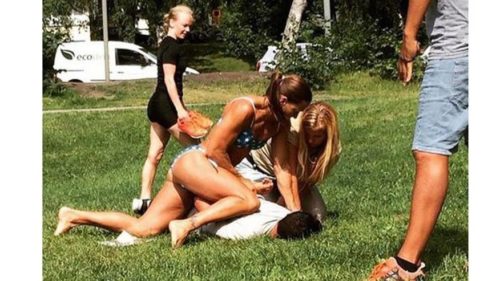
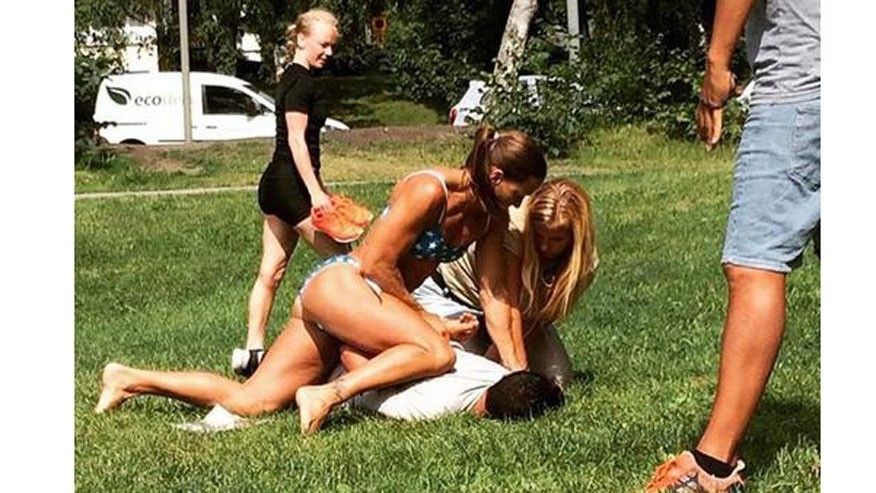
    This photo has been on social media the last few days. SPGhost sends us the link to the story on Fox News about Swedish police officer Mikaela Kellner who was sunbathing in a Stockholm park with friends when newspaper vendor stole her cell phone and she made this take down.

    Kellner said she didn’t hesitate to make the arrest while wearing a bikini.

    “If I had been naked I would have intervened as well,” she said.

    Hopefully someone will get the picture of that arrest, too.

  • “This thing just happened!”

    “This thing just happened!”

    Luke Aikens

    This fellow, Luke Aikens, just did a 25,000 foot free fall without a parachute into a net. I’m ashamed to say that if I were a betting man, my money would have been against him, but he made it. From Fox News;

    “I’m almost levitating, it’s incredible,” the jubilant skydiver said, raising his hands over his head as his wife held their son, who dozed in her arms.

    “This thing just happened! I can’t even get the words out of my mouth,” he added as he thanked the dozens of crew members who spent two years helping him prepare for the jump, including those who assembled the fishing trawler-like net and made sure it really worked.

    Well, congratulations to him – I’m glad he made it. I hope it was worth the two minute ride for him.

  • Yer Sunday Smile: the Old Man from Nantucket

    There was an old man from Nantucket
    Who kept all his cash in a bucket
    His daughter named Nan
    Ran away with a man
    And as for the bucket, Nantucket.

    Now, aren’t you all ashamed at what you were thinking when you read the title for this article? (smile)

  • The serious consequences of Post Traumatic Sex Disorder

    The serious consequences of Post Traumatic Sex Disorder

    Yesterday Jonn ran an article about some Harvard yo-yo wanting to award the Purple Heart for PTSD, post-traumatic stress disorder. Most of the comments were in opposition to the idea, as am I. But then right after reading that, I surfed over to Daily Caller where I found this article about this poor high school football player down in Louisiana who had the misfortune to fall victim to his hottie high school teacher who engaged him in sexual hijinks 46 times in 39 days climaxing in an all-night threesome with another, younger, hottie high school teacher.

    Teacher

    The poor kid sought help from his fellow football team members by showing them pictures and videos and recounting blow by blow descriptions of the horrific assaults on his studly young manhood by these prurient and predatory pedagogues. That blew the deal of course with everything coming to a head, criminal charges and civil suits being filed, the latter by the young victim’s parents on his behalf to seek recompense for the enduring trauma he is sure to experience for the remainder of his existence. Call it Post-Traumatic Sex Disorder, a condition your gravely wounded Ol’ Poe has carried with him for sixty years.

    You see, dear readers, this sort of schoolhouse shenanigans is not new; Young Poe made his cherry jump between the sheets more than sixty years ago with his pretty young sophomore English teacher. Unfortunately she was about the size of the two Louisiana lovelies combined, which left Young Poe with a serious Post-Traumatic Sex Disorder, an aversion to fatties, a condition requiring him to don his beer goggles all too frequently when he was a young single soldier. Even as I type this my mind is filled with the revulsion of awakening next to a snoring mountain of pink flesh that had somehow slipped in during the night and supplanted the Miss Hopkinsville I’d left the bar with the night before.
    So I’m sympathetic to the kid’s lawsuit; just like Ol’ Poe, that poor boy’s gonna have to live with that trauma forever. Oh, the horror!

  • A Day of Rage in Salt Lake City

    A Day of Rage in Salt Lake City

    B. Woodman went to his local “Day of Rage” in Salt Lake City and sends this report;

    I went to the so-called “Day of Rage” yesterday, for ?#?BLM?, just to see how many, and what kinds of, people would show up. How out”Rage”ous would this event be? Actually, it turned out to be not much of an event at all. A fizzle.

    I arrived at the SLCC (Salt Lake Community College, 4600 S Redwood Rd) campus shortly before 5PM (when it was supposed to start), guided in by two TV camera vans, Channel 4 KTVX ABC, and Channel 13 Fox. No one else was there yet.
    After a few minutes, close to 5 o’clock, some people started trickling in, a pair of older (ancient) hippie types, and a few younger people.

    Several other cars, and people drifted in, and a few minutes after 5, there were maybe a dozen people gathered. They were just chatting among themselves, apparently renewing acquaintances. No protest, no podium, no microphones.
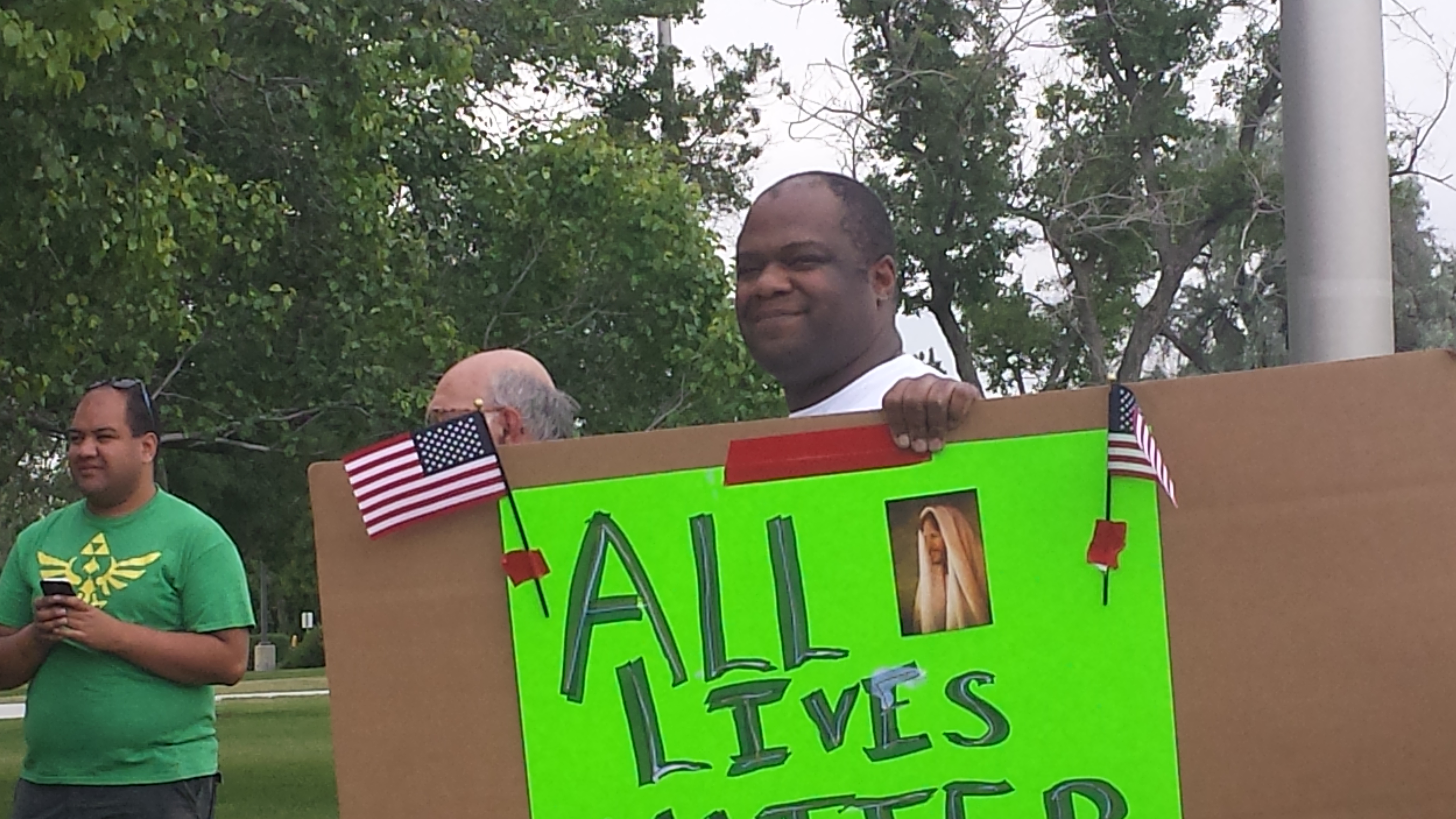
    Some ten minutes later, one black dude started chanting the tired refrain, “Black Lives Matter”. So I challenged him on that, asking him, “What about me? Doesn’t my life matter? Don’t white lives matter? Or Asians? Or anyone else?” That quieted him down.

    Then some white woman, wearing a pink blouse, came over to me and told me that I was disrupting this event, and to go away. Must have been feeling the “white privilege guilt”. Of course, I didn’t leave. At least, not right away. I wanted to see what else (if anything), might happen. And, unsurprisingly enough, nothing else happened. So about 5:30, I left to go home. (I had the Missus Woodman and dinner waiting for me)

    There were a few counter-protesters there (“All Lives Matter”), so we high-fived and hugged each other.

    Before I left, I took a rough count of the people there, total maybe two dozen.. As I mentioned before, there were roughly a dozen (very quiet) “protesters”. There were about half-a-dozen counter protesters. Oh, and four TV people, two reporters, and two cameramen. Can’t forget them. After all, “All Lives Matter”, especially the people who get your message out to the rest of the world. And another half-dozen or so people just hanging around the edges, taking pictures and notes of this non-“event”.

    I was there to do a little of both, to take pictures, and to “stir the pot”. So I guess I succeeded in that.

    20160715_165528[1]

    20160715_165534[1]

    20160715_165544[1]

    20160715_165709[1]

    20160715_170619[1]

    20160715_170635[1]

    20160715_170642[1]

    20160715_171056[1]

    20160715_171318[1]

    20160716_103320[1]

  • Daniel Pai; Grandmaster Korean War vet

    Daniel Pai; Grandmaster Korean War vet

    2f288eb0

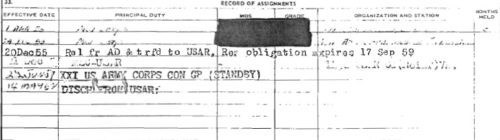
    Someone sent us this fellow, Daniel Pai in hopes that we could prove he lied about his service. He died in 1993, so I guessed this would be difficult right from the start. He’s still the main figure in some sort of karate cult and that’s completely outside my lane. But mostly this bio is the one most often quoted about him;

    In 1951, Daniel Pai joined the U. S. Army and was stationed on the Mainland. He opened his first school in the back of his Sunset Boulevard home just before leaving to fight in the Korean War. He reenlisted in 1953, and spoke of being in Vietnam in 1954. He retired from active duty in December 1955 and in May 1962 he was given an honorable discharge after completing his military obligation. During his service to his country, Daniel Pai was awarded 4 Bronze Stars, Korean Service Medal, U. N. Service Medal, and the National Defense Medal.

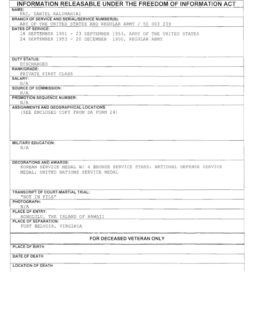
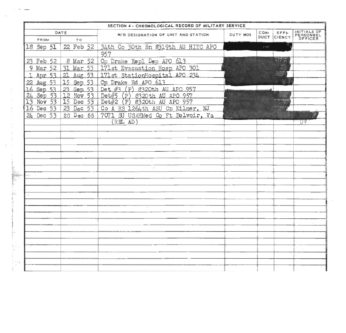
    Most of that is true, according to his records. He was stationed at Schofield Barracks in Hawaii until 1952, then he worked in a hospital in Japan, then he went to Korea in March 1952 – August 1953 and he worked at a hospital in the war. The shooting war ended in July 1953. From there he went back to Japan. The only thing that I can find that is wrong is the statement that he was awarded four Bronze Stars. He was awarded four Bronze Service Stars on his Korean Service Medal, which means that he served in Korea during 4 campaigns. He didn’t earn four Bronze Star Medals. Here’s a Korean Service Medal with two service stars;

    Korean Service Medal with stars

    However, I’m not going to blame him for that. It could be that someone misinterpreted his records – it happens a lot;

    Pai FOIA

    Pai  Assignments

    Pai Assignments2

    The bio says that he mentioned that he was in Vietnam in 1954. He wasn’t – he was working in a hospital in Fort Belvoir, Virginia, still in the Army. But, again, I don’t have proof that he claimed that he was in Vietnam, only a second-hand story that he had mentioned it once. Hardly evidence.

    I’m sorry to disappoint the folks who were hoping that I could bust the guy, but, as near as I can tell, he didn’t lie about anything.

  • A Blast from the Past: The “Other” Fab Four

    The term “Fab Four” is well known as a reference to the Beatles.  But at one time, there was an aspiring “other” Fab Four – another English group linked to the Beatles, and at times seen as a Beatles “knock off”

    Most today don’t know of them; their popularity was fleeting.  But had things broken for them differently, they could have easily ended up being the “next big thing” from England.  Unfortunately, for the most part they ended up broke, forgotten – and in two cases, dead far too young.

    But they were talented as hell, and were far from being “Beatles clones”.  They deserve a bit better than that.

    Yeah, I’m about to go on another “walkabout”.   Consider yourself forewarned.

    . . .

    In the 1960s, a musical group formed in Swansea, Wales.  For years, they were poor and struggling.  They called themselves the Iveys.

    They were talented, if young.  And one night, they were seen by the right person.  They became the first act (other than the Beatles) signed by Apple Records.

    They sounded much like the Beatles, actually – understandable, since Liverpool is not far at all away from Wales, and weren’t far off from the Beatles in age.  (The singing voice of one in particular sounded similar to that of Paul McCartney.)  Their first hit was also written by Paul McCartney.

    This created an association between the band and the Beatles that was to persist.  Though a long-term detriment, it indeed helped their early rise.

    The band renamed itself before their first Apple release.  Their new name:  Badfinger.

    They were to prove much more than mere Beatles clones.  And they were fated to be both popular and short lived.

    Arguably, they invented the “power ballad”.    Don’t believe me?  Listen to the three below that are identified as such – and find an earlier example that “charted big”.  Not sure you really can.

    I’m not going to write a “blow-by-blow” about the band’s history.  Instead, I’ll just present a few of what I consider their better tunes – along with a few brief comments of my own.

    If you’ve never heard much of their music – or if you haven’t heard it in a while – grab a good set of headphones and listen.  I think it’ll be worth the time.  (For a couple of the tunes, depending your your own past close relationships you might want to grab a tissue, too,)

    . . .

    Come and Get It
    Paul McCartney tune, written for the movie “The Magic Christian”.  It got them started as their first hit.

    No Matter What
    First hit for the band written by Peter Hamm.  The tune established the band as independent, but was still very much “Beatle-esque” in sound.

    Without You
    Written by band members Peter Hamm and Tom Evans, and established the band as having their own unique style.  It’s perhaps the first rock “power ballad”.  Written by splicing two songs written by Hamm and Evans together, it’s become a modern-day standard.  (Harry Nillson’s definitive version can be found here..)

    (Short sidebar: the members of Badfinger ran into Nillson in the studio while he was recording the album to contain Without You. They heard Nilsson’s version – which was reputedly recorded in a single take – and were floored by it.  Nilsson’s version received a Grammy in 1973.)

    Day After Day
    Another truly beautiful power ballad by Peter Hamm.  Musicians who played on the tune include George Harrison (slide guitar solo) and Leon Russel (piano).  It was their biggest hit, chart-wise.

    Baby Blue
    Probably the best known of their tunes due to being featured as the finale (literally) of Breaking Bad.  It’s another absolutely gorgeous power ballad, also by Peter Hamm.  The song was based on real events – specifically, Hamm’s relationship with Dixie Armstrong on their final US tour.  It became popular again recently when it was featured in the final scene of Breaking Bad – where it fit perfectly.

    Apple of My Eye
    The band’s last well-known single, from their final Apple album.  It’s reputedly about the end of their contract with Apple records vice about a relationship.

    Perfection
    A tune you probably haven’t heard from their consensus best album, Straight Up.  Yeah, the lyrics today may seem a bit “hippy-esque” and a touch naive.  Hey, it was recorded in the early 1970s – what do you expect?  But it’s still a helluva tune that takes a far more realistic look at things than did many contemporary tunes of its genre.

    Name of the Game
    Another one you probably haven’t heard – it wasn’t a single, though it did get some airplay.  Great tune, and one of my favorites by the band.

    . . .

    By the early 1970s, the band was primed for stardom – hell, they were stars, coming off four straight multinational hits from three straight successful albums.  They’d also been the backing band for George Harrison at his “Concert for Bangladesh”.

    And then it all abruptly ended.

    So, what happened?  Bad timing, money – and dirty dealing.

    The bad timing:  Badfinger got caught up in the fallout over Apple Records going belly-up.  This tied up royalties for much of their early work for years.

    Plus, to put it bluntly:  the band got screwed.  They were somewhat naive, business-wise.  When they became big, knowing that fact, before touring America they signed with an American manager – Stan Polley.

    Exceptionally bad choice.

    Polley was later named in a Senate investigation as having mob connections, and years later was convicted of fraud.  He reputedly screwed the band royally, both financially and contractually. While the band was big, they were also damn near broke – their money was being “held for investment” and the band members were living on relatively paltry salaries.  The rest of their income was being “held” by Polley for their future use.

    In reality, the money was disappearing.

    The band’s first Warner Album didn’t do well. And their second Warner album, considered by some one of their two best, was also short-lived. Their new label (Warner) got wind that something shady might be going on with respect to the band’s finances.

    When Polley couldn’t answer (or, some accounts say, sidestepped if not outright refused to answer) Warner’s questions about what had happened to the band’s contract advances, Warner demanded an investigation into the band’s finances.  Warner also pulled the plug on both promotion and distribution of their albums released in 1974, withdrawing the second from sales entirely as it was rising in the charts. They also and blocked release of a third album the band had completed by refusing to accept the master tapes.

    Warner also began legal action against Polley.  And since he had control of the band’s finances, well, . . . .

    This cut off the bands’ income; it also prevented them from releasing any new work. It virtually put a stop to their public performances.  And the financial and legal wrangling dragged on for months – then years.

    Despondent, Hamm – the band’s primary creative force, who’d also apparently believed in Polley far longer than his bandmates before realizing the truth – hanged himself in April 1975.  (His suicide note effectively blamed Polley for driving him to suicide.)  The band for all practical purposes broke up afterwards, though survivor-led versions with different lineups persisted for years (one persists to this day).

    The legal wrangling (and financial standstill) over past recordings by the band continued on an on.  Evans hanged himself in 1983 for much the same reasons as had Hamm – continued legal wrangling over past band royalties.

    . . .

    Well, that’s a short version of the band’s story. It’s not pretty – but some of their music is truly timeless.

    A short (30 min) video history of the band from BBC – titled “They Sold a Million” – exists. If you’re interested in the band and its music, IMO it’s certainly worth a look.

    It’s a shame they weren’t able to carry on.

    ———-

    Postscript: the title for Badfinger’s last album released in 1974, which was pulled from sales due to investigation into the band’s finances, was “Wish You Were Here”. About 10 months later, Pink Floyd released an album by the same title.

    The English rock music world wasn’t all that large in 1974-1975. The members of Pink Floyd certainly would have heard about Pete Hamm’s suicide – and would have also certainly have heard the story behind Badfinger’s collapse. Word gets around in a smallish, closed community.

    Pink Floyd’s album title – and the entire album – was indeed a reference to former Pink Floyd founder Syd Barret. But I can’t help wondering if maybe the title was also a bit of a double-entendre.

    And I also believe I know who Roger Waters might well have used as the inspiration for the record producer character in his song “Have A Cigar” from that album.


    Multiple Internet sources were used in preparing the above.
  • Are Minorities Treated More Violently by Police? Yes – and No.

    I’m guessing everyone is familiar with the Black Lives Matter group – and their contention that African Americans (and, by implication, minorities in general) are currently being treated with disproportionate and unnecessary violence by law enforcement.

    Years ago, in parts (maybe much) of the country that was indeed true.  But the recent BLM allegations raise an interesting question:  is it still true today?

    The conventional “wisdom” is that it is – and the media has done far more than its share to reinforce that conventional wisdom.  However, in reality it’s a surprisingly hard question to answer.

    One can’t simply count arrests, or even incidents of police use of force – because in some cases police use of force is clearly warranted, and arrests (and crime) are decidedly not distributed uniformly, either geographically or among racial and ethnic groups.  So determining whether one racial/ethnic group is being treated “better” or “worse” than another with respect to police violence is not an easy problem.

    . . .

    Indeed, one reason that the question hasn’t been studied is that meaningful data needed to study the problem wasn’t readily available.

    That’s no longer the case.  It seems as if one guy – a man named Roland G. Fryer, Jr. – decided to study the problem.  He and a group of people working with and for him have conducted a survey of data from multiple representative jurisdictions and data sources to attempt to extract such meaningful data.  They’ve also rigorously analyzed the extracted data.  The project took an aggregate of 3,000+ staff-hours of work.

    The conclusions of Fryer’s study are quite interesting.  Per his study, it turns out that minorities are more likely to be on the receiving end of police violence.  That is, they are . . . until they aren’t.

    I’ll explain.

    The study included data from three metro areas in Texas (Houston, Dallas, and Austin); six counties in Florida (Brevard, Jacksonville, Lee, Orange, Palm Beach and Pinellas – which include the St. Petersburg, Fort Myers, Jacksonville, and Orlando metro areas as well as a good portion of Florida’s east coast north of Miami); LA County in California; and NYC.   Arrests reports and NYC “stop and frisk” data from a fifteen-year period (2000-2015) were studied; the relevant data was extracted and characterized.  This extracted data was combined with public survey results concerning citizen perception of police use of violence.  Control measures to remove bias due to officer race, gender, experience level, precinct, and location of crime were also developed.

    After doing this, a rigorous statistical analysis of the resulting data set was conducted.  It sought to determine whether minorities taken in to custody by LE were more or less likely to receive varying degrees of violent treatment.  Violent treatment was defined as consisting of multiple escalating categories, beginning with being being pushed/shoved, and including being handcuffed, put forcibly on the ground, batoned, having a weapon drawn or pointed, being pepper-sprayed, and ending in being tazed or shot with a firearm by LE personnel.

    The results showed that yes – minority citizens did appear statistically substantially more likely to receive nonlethal rough treatment from LE.  But then they looked at more extreme levels of violence – and a curious result emerged.

    As the level of violence increased, the difference between treatment of minority subjects and the treatment of white subjects remained roughly constant.  That is, it remained roughly constant until the most extreme levels of police use of force (taser or firearms) were reached.

    At that point . . . the bias against minorities vanished.  In fact, it actually appears to have reversed.

    The study extensively studied the most extreme uses of police force – shootings and the use of a taser.   And when it came to being on the receiving end of a shooting, well  . . . Black Americans were statistically substantially less likely – specifically, greater than 20% less likely – to be shot during a police encounter than their white counterparts.  This seemingly aberrant result held true (though the magnitude was reduced) even after multiple corrective measures were applied to the data to correct for various sources of possible unrelated correlations leading to false indications of bias.

    The same appears to be true for incidents involving use of a taser (extensive data on that form of incident from Houston, TX, was available).  However, the study doesn’t directly address that issue in its conclusions.

    The result observed for raw data relating to these shootings was well outside the statistical standard error for the data on hand.  That means the result appears to be statistically significant – and thus real.

    These results also held true even when type of encounter was considered as a factor – e.g., when attempts were made to categorize police shooting incidents by whether or not police use of deadly force appeared clearly justified.  Even in events where a police officer would appear to have been clearly justified in shooting, minority offenders appeared to be statistically less likely to be shot than white offenders under similar circumstances.

    The study also found that both Black and white suspects involved in a police shooting were roughly equally likely to have been armed.

    The same general results, with smaller magnitude, for shootings were observed in the raw data for police shootings involving  Hispanic Americans – that is, Hispanics were also observed to be somewhat less likely to be shot (about 8.5%) during a police encounter than white Americans.  However, in the case of Hispanic Americans the difference appears to have been within the statistical standard error of the data set, so the result cannot be considered statistically significant.

    In short:  the study found no evidence of racial bias in police shootings.  When police were forced to shoot, race was apparently not a factor.  In fact, if anything white citizens seemed statistically a bit more likely to be the ones on the receiving end of police lead, statistically speaking.

    There may well be a problem with police using rough treatment inequitably.  But any inequity doesn’t appear to extend to shootings.  Those appear to be race-neutral.

    . . .

    So, you ask:  just who is this Roland G. Fryer, Jr.?  Is he some John Birch Society type, or perhaps a KKK or Aryan Brotherhood member?  This study is all just bogus claptrap cobbled together by some ignorant racist – right?

    Hardly.

    Fryer happens to be a university professor with a doctorate degree – a professor of economics, specifically.  So he knows a thing or two about data collection, data reduction, and statistical analysis.

    Fryer also isn’t some some second-rate academic teaching at some non-accredited college run by religious fanatics, or at some local community college or small, second-rate college.  The guy happens to be a tenured professor at Harvard.  Yeah, that Harvard.

    Finally:   Fryer happens to be African-American.  In fact, he’s the youngest African-American professor ever to receive tenure at Harvard – as well as the first to receive recognition as the most promising US economist under the age of 40, the John Bates Clark medal.

    Fryer has indicated that his result concerning shootings and minorities are “the most surprising result of my career”.  But he appears to be standing by his conclusions – though he does offer the standard caveats (i.e., incomplete data, possible data unreliability due to voluntary participation, etc . . .) one would expect regarding any such study.  He also indicates that more research is needed to reach a definitive conclusion regarding police use of violence nationwide.

    Fryar has offered a theory concerning the disparity, one which is supported by his data but which he admits that though descriptive may not be correct.  His theory is that police essentially “do what works”, and that some fraction of police are indeed racially biased.  But shooting or tazing someone impose high negative consequences on a policeman even if justified, so at that point reason takes over from bias in those individuals who are racially biased and they act responsibly.

    FWIW:  I think Fryar may well be on to something with his theory.  Racism does still exist, but IMO it’s hardly the pervasive conspiracy some claim.  Learning the truth – vice listening to BS from those with an agenda, or who profit from stirring up trouble – is the first step to improving the situation.  IMO Fryer has made a contribution to learning the truth here by creating the first data set suitable for detailed study, and for conducting the initial analysis.  I hope he manages to get the wherewithal to study the matter further.

    . . .

    You can read an article about Fryer’s study published by the NYT here.  (It’s the NYT, so if anything IMO it somewhat downplays Fryer’s conclusions.)  Or you can read the study for yourself here – and can read the appendix to the study, which gives additional details, here.  Fair warning:  there is indeed math involved.  (smile)

    Unfortunately, I’m guessing Prof. Fryer is about to become persona non grata among his leftist academic colleagues.  And I’m guessing those leftist colleagues will pull out all the stops in an attempt to block publication of his study or to convince him to change it substantially (it’s currently in pre-publication draft and has yet to be published).

    Sometimes the truth is indeed inconvenient.  Especially when it’s backed by hard data and doesn’t “support the agenda”.