Category: War Stories

  • Memory Lane: R&R Fun With MAC and SATO

    One of the “bennies” you get while deployed to an existing, established theater  is something called “R&R Leave”.   Vietnam had it; so did today’s GWOT.  Formally, it’s “Rest and Recuperation Leave”.  I’ll spare everyone the older, very politically-incorrect “informal” names.  (smile)

    Today’s rules may be a bit different than the Vietnam era.  So for the benefit of those who’re unfamiliar with today’s policies and rules I thought I’d write this to describe those policies, circa late 2007.  I’m pretty sure the policies and procedures are pretty much the same today.

    And they’re indeed a sterling example military bureaucracy at its finest.  (smile)

    The bennies associated with R&R in 2007 – and, presumably, today – were twofold.  It wasn’t a complete “freebie”; you did have to use accrued (or advanced) leave.  However, the US Government paid for your round-trip transportation to your R&R leave destination.  You could go to Australia or Spain if you wanted to (I know folks who went to each location on R&R).  But Uncle Sam only paid for your ticket; if others joined you there, that was on your nickel. (My spouse and I met in Munich and spent my R&R at the Eidelweiss AFRC in Garmish.)

    The second bennie was that only the time spent at your R&R location was counted as leave.  Travel time to/from that destination was not.  The net result is that you got to spend all of your leave time at your R&R destination.

    Of course, some would say that the simple fact that you’re allowed to spend some time outside of a combat zone is a third bennie in its own right.  To some extent they have a point – but that’s not entirely an unalloyed good thing.  Some folks found coming back in-theater rougher than deploying in the first place.

    Did I mention that this is all governed by numerous rules, regulations, policies and the like?  Leave it to military bureaucracy to make something like going on R&R just “oh so much fun”, and damn near more trouble than it was worth.

    (more…)

  • Military Bureaucracy – Ya Gotta Love It!

    All of us here at TAH probably have funny stories about run-arounds, SNAFUs, and the like involving military bureaucracy or paperwork.  So it occurred to me that posting an article on the subject and inviting comments from TAH’s readers might be worthwhile.

    Since I’m posting the article, I guess that means I’m “on the hook” for the first such story.  Fair enough; here goes.

    Each service has its own admin practices and procedures.  Most of the time, they actually work fairly well.

    Even the Army’s orders process generally works – though like a dancing bear, it often does so somewhat less than gracefully.  Once it took 3 tries for DA to slide a reporting date of mine 30 days “to the right” (later).   I guess that change must have had the same clerk-typist processing it that had trouble spelling “Fort Rucker” in this article.  (smile)

    But that’s not the funniest admin SNAFU that ever happened to me personally.

    In 2007-2008, I was ordered back to active duty for a tour in the CENTCOM AOR.  I spent virtually all of that year serving in either Afghanistan or Iraq.

    During January 2008, my duty station was in Iraq – Baghdad, to be precise.  Except for R&R, I’d been there since August and in theater since April.

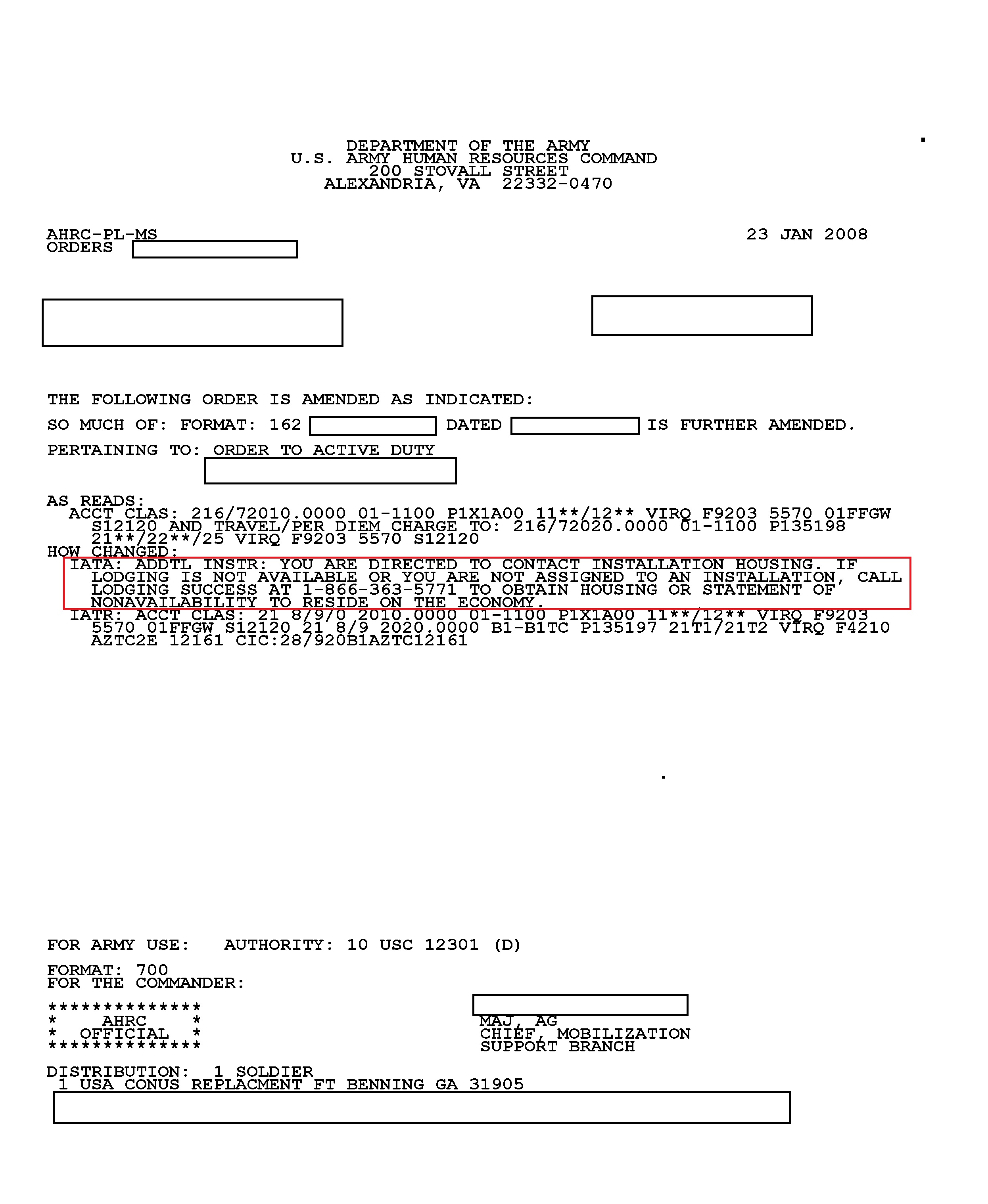
    Well, in January 2008 I got the following amendment to the orders recalling me to active duty and sending me to the sandbox.  It was sent to me at my home of record; my spouse forwarded me a copy.

    I’ve redacted PII and a couple of other bits of info.  Take a look at the text in the red box.  (Click on the image to enlarge it.)

    Yep, you read that right.  I’m deployed to the sandbox, stationed in Baghdad and have been there for months, in the middle of a no-joke shooting war.  And the Army sends me an amendment to my freaking orders telling me I need to check in with Post billeting and reminding me that if I want to live “on the economy” I need a statement of nonavailability.

    I got a really good laugh out of that bit of bureaucratic idiocy.  (smile)

    — — —

    OK, there have to be better stories than that out there.  Fire away!

  • A Morning to Remember

    Live long enough, and you’ll see some interesting things.  If you’re lucky enough, it’s possible you’ll see or be a part of something truly memorable and unusual.  Maybe even something historic.

    During my lifetime, I’ve been that fortunate twice.  The first time was when I was lucky enough to be in Korea when Reagan visited the DMZ, and to provide support for that mission (though I didn’t get to see the actual speech).   I’ll always feel honored to have been there.

    The second time occurred some 24 years later.  And it was, perhaps, even more memorable than the first.

    January 11, 2008 dawned in Baghdad.  Just another brutal, muddy, nasty, cold day – right?

    Yes, I did say cold.  Although Baghdad and surrounding area indeed gets hellish hot during the summer, during the winter it also gets colder than you might think.  Baghdad’s at about the same latitude as Columbus, GA, or Dallas/Fort Worth, TX –  and like those cities, it’s inland.  So it does get pretty cool in the winter; today’s high and low there are predicted to be 59 F and 34 F, respectively.

    Frost was not common, but was also not unknown.   And the winter of 2007-2008 was reputedly the coldest in at least a decade.

    Baghdad gets most of its rain during the winter, too.  And when that little bit of rain hits the finely-powdered silt making up the soil in the Tigris/Euphrates valley system, the result is . . . different.  Think wet, sticky paste.  Slippery, medium yellow-brown paste.

    I think I gained an inch or so in height every time I went outside that winter when things were wet.  (smile)

    But January 11, 2008 was different.  The sky was steel-grey, and it was still.  Things simply felt different than normal.  Something was up.  And around sunrise, we found out what it was.

    It began to snow.  Big, wet flakes.

    It didn’t snow much – just a dusting on exposed items and surfaces; most of it melted on contact.  And what little stuck didn’t stay around for long at all.

    But it snowed.  In Baghdad.

    Those who’ve never lived in a hot, desert climate can’t really appreciate the impact of a low desert snowfall.  It is a truly magnificent sight – if for no other reason than because they’re generally exceptionally rare.  It’s like seeing a horizon-to-horizon double-rainbow.  Yes, they can happen.  But they’re rare enough that not very many people ever get to see one.

    Snow was indeed a rare thing in Baghdad. One source said it had been over 60 years since the last snowfall in the area.  Others said it had been over a century.

    I don’t know which is correct.  And, frankly, I don’t care.  I only know I was lucky enough to see it in person.

    Snow.  In Baghdad.

    And, for what it’s worth:  during the snowfall, reportedly things were rather quiet in the city.

  • Katie’s Song

    Author’s Note:  some indicate that this article brings back memories that aren’t necessarily good ones.  If you’re having a bad day along those lines, perhaps you might want to read this article another time.


    Humans have five senses.  But I’m personally convinced that two of these – smell and hearing – are more deeply embedded in the psyche, and are much harder to ignore.

    Or to forget.

    While experiences associated with touch may be the most intense, their memories – both pleasant and painful – fade with time.  One can remember pleasure and pain vividly; but the memories aren’t anywhere as intense as the original experiences.  The memories don’t seem to produce the same visceral reaction.

    My guess is that’s a psychological self-defense mechanism we humans have developed over time.  But I’m not a shrink; I could be wrong.

    Ditto for taste, and for sight.  Memories associated with these senses seem to fade too; the memories simply aren’t anywhere near as intense as original experiences.  At least that’s the case for me.

    But hearing and smell seem . . . different.

    There are some sounds in life you never forget; hearing them again grabs your attention with near-original intensity.  You may not immediately recognize someone’s face after several years – but once they speak, most of us have absolutely no doubt as to who they are.  There any number of other sounds each of us could name that are, for us personally, absolutely unforgettable and which hit home like few others.  The voice of a close friend or a loved one; the sound of a crashing car; certain music . . . the list goes on.  And the list is unique for each of us.

    Smells are similar.  Some are similarly unforgettable and immediate.  I suspect that is due to a different reason than for sound – my guess is that the tie-in for sound is more emotional and psychological, while that for smell is biological and evolutionary.  But I could be wrong about this, too.

    While deployed, I discovered a few such sounds and smells.  The sharp “crack” of small arms fire, and the lower “thump-thump-thump” of a heavy machine gun.  The low, sharp report of an explosion.  The smell of small-arms fire. The simultaneous “whop-whop-whop” combined with turbine-whine of rotary-wing aircraft.  The “click-clack” of a weapon chambering a round.  The unmistakable “burned-but-not-quite-completely” petrochemical scent of jet or turbine exhaust.

    To that list, add a couple of sounds.  And another smell.

    (more…)

  • The 8000-Mile Sniper Shot

    I wrote this post and published it tonight over at the blog of the Marine Infantry Veterans Foundation, a charity organization built by infantry Marines with the goal of taking care of our own. I’d really like more eyes on this post and more people to know about an issue that I’ve been personally touched by, and to learn of a couple of Marines who survived deployments to war, only to come home and take their own lives.

    When you leave the military, your mind is usually filled with a range of emotions. There’s joy over your newfound freedom, sadness at leaving brothers behind, and anxiety over the unknown. In June 2010, when I picked up my discharge papers from the Marine Corps, I lived through it and felt them all.

    Now two years later, I am close to graduation from The University of Tampa, run asuccessful military satire website, and am lucky to continue working with military veterans. It wasn’t an easy road, and many times I felt alone and helpless.

    For a heartbreaking and rising number of veterans, those emotions can lead to a devastating end: suicide.

    Navy Cross recipient and former Corporal Jeremiah Workman, who dealt with his own emotional trauma and thoughts of suicide, refers to it as an enemy making an 8000-mile sniper shot.

    That’s what happened with Seth Smith, from Kansas City, Missouri. I first met Seth on a training exercise in Okinawa, Japan with 3rd Marine Division. As one of a small handful of infantry Marines in a unit full of different specialties, it was a lonesome time for me.

    After seeing Corporal Smith directing forklifts — with his flak jacket set up much like an infantryman — I approached him.

    “Are you a grunt?,” I asked.

    He responded no, but after further questioning, it turns out that he was attached to my old unit, 3rd Battalion, 3rd Marines, for a deployment to Iraq in 2009. Instead of being an electrician like he was trained, he was put into an infantry squad with Lima Company. He was grunt-enough to me.

    We soon became friends.

    About six months after I said goodbye and good luck to 28 year-old Corporal Seth Smith as I left the Marine Corps, he was honorably discharged and returned home. The following April, he was dead.

    He didn’t give a warning, or leave a note. He was engaged and had a son named Carter.

    Please continue reading the whole piece here.

  • Farewells for the Fallen

    Stu’s article the other day – the one commenting on and quoting Dr. (COL) Frank’s 2006 Stars and Stripes article – brought to the forefront a memory or two of my own.  And while all memories aren’t necessarily pleasant, they’re all important.

    Like Dr. Frank, I spent some time at Bagram AB.  But unlike Dr. Frank, here I’m not addressing the obvious waste and personal losses inherent in wartime death. Since that was Dr. Frank’s intent his article only briefly mentioned the departure ceremony held at Bagram for the fallen.  His article therefore really didn’t convey the impact of that unique sendoff.  And even many who’ve served in Afghanistan may not have felt that impact; the public ceremony at Bagram is different than any other I’ve seen.

    So I thought I’d try and describe that ceremony, and its impact, a bit more fully. I apologize in advance if I’m not as eloquent as the good doctor.  And I also apologize if anyone finds what follows boring – or if it brings back memories that might be disturbing.  It wasn’t that easy to write, so if you’re having a bad day – well, maybe it’s best to read this another time.  Or not at all.

    Why write this at all?  Dunno.  I guess I thought it was just a natural follow-on to Stu’s article.  Or maybe I just needed to write it.

    While I’m using Army-centric language, there’s no intent to slight any other service.  My background is Army;  I’m simply speaking from a soldier’s point of view.

    ———

    In war, soldiers die.  That is and always has been a universal truth.  IMO it’s likely to remain true throughout mankind’s history. Plato was right.

    Soldiers understand all that.  And although we don’t like to think of it, I believe soldiers accept the possibility of disability or death as a normal, routine risk to an extent not seen in other professions.  We know there’s a good chance we won’t come home from war whole; or, perhaps, not at all.  Soldiers know that a primary product of war is death – ours, or the enemy’s – and that we may easily be the ones who end up dead.

    We understand, far better than most, that there’s no guarantee we’ll see tomorrow’s sunrise.

    Soldiers also understand that death isn’t limited to war.  The profession of arms is inherently dangerous; risk is simply another part of the military environment. Deaths occur regrettably often in peacetime, too – either in training, or from random chance.

    Acceptance doesn’t make such a loss any less painful.  But it does lead to a somewhat different perspective, perhaps, than that of most.  As well as to a more open, straightforward means of dealing with sudden loss.

    Still:  every loss remains painful; closure is required.  So whenever the Grim Reaper visits, virtually all units hold some sort of Fallen Comrade ceremony.

    ———

    Those who’ve been around the military for a while have almost certainly attended a Fallen Comrade ceremony – though the title may have been different.  In the Army the details of the ceremony may vary but in broad outline they’re similar, whether in peacetime garrison or in war zones:  a display of helmet/weapon/dogtags/boots, some words about the deceased, an opportunity to reflect, a brief prayer . . . .  All such ceremonies offer the opportunity to reflect on that absolute truth all of us know, but never like to think about: “There but for the grace of God . . . .”

    I’ve attended a number of such ceremonies over the years; more, frankly, than I prefer to remember.  And even some held in Afghanistan – specifically, those held in Kabul – were much like those elsewhere:  the standard display, the words about the deceased, the prayers, the brief time for reflection . . . and then back to duty.  For the living, duty calls and life goes on.

    But at Bagram, the final goodbye for Fallen Comrades was different. Very, very different.  And in a way that was dramatic, moving – and IMO, uniquely apropos.

    ———

    For those who haven’t been there:  Bagram AB is about 30 miles north of Kabul. It is the primary APOE/APOD for Afghanistan.  Virtually everyone in the military arriving in or departing that country does so through Bagram.

    It’s a base that’s seen much war during the last 35 years.  It was used by the Afghan government in the civil war which started in 1978; by the Russians during their nearly decade-long occupation of/war in Afghanistan, from 1979-1989; and by multiple factions during the more than decade of Afghan civil war which followed.  We took it over shortly after our intervention in Afghanistan began, and have been there since.

    Bagram AB  is oriented roughly southwest to northeast.  In 2007, the base was still rather long and narrow, with essentially one arterial road – Disney Avenue.  Most of the facilities were strung out along or within a couple of blocks of Disney to the east or west.  The runways are to the east of Disney; when I was there in 2007, a large and relatively undeveloped area existed west of the facilities clustered along the western side of Disney.  Things doubtless have changed somewhat since then.

    Bagram AB is also where a US KIA in Afghanistan begins the final journey home.

    I’d guess that units in Afghanistan hold internal, more private and traditional ceremonies for their fallen; my unit was fortunate enough not to have any KIAs while I was there, so we never held one.  However, at Bagram an additional, public ceremony was also held.  I understand it’s still done much the same way today as it was done 5 years ago.

    I’ll describe the Bagram public ceremony, as it was in 2007.

    The ceremony is announced over the base PA system.  The initial announcement tells everyone that a Fallen Comrade ceremony will be held at a future time.  That time may be hours in the future – or minutes.  The announcement is repeated periodically until shortly before the ceremony itself.

    The ceremony itself is very simple, even though it has many “moving parts”.  Every available person on base who can possibly be spared assembles along Disney Avenue. Time of day for such ceremonies is not set beforehand; it’s based on flight availability.   Return of KIA remains are accorded highest priority by CENTCOM, and change USAF mission flight schedules accordingly.  Thus, whenever the ceremony needs to occur, it happens.  0300?  Chowtime?  Mid-afternoon or mid-morning?  It doesn’t matter. Whenever a bird is available to depart and return the remains of those KIA to CONUS, the ceremony is held.

    If you’re not immediately required at your place of duty for operational reasons, you are expected to get yourself down to Disney posthaste and participate.  If you’re military, that means in proper uniform.  Civilians (there were some then, and are some today) wear their normal work attire.

    The assembled group along Disney Avenue is notified that the ceremony is about to begin.  Military assume parade rest; civilians stand quietly and respectfully.

    Near the western end of Disney, a vehicular procession begins.  (Though most of Disney runs generally northeast to southwest, near the south end of base it turns virtually due west – so as I recall, to avoid ambiguity the southern/western terminus is generally referred to as the “west end”.)   The procession begins at Mortuary Affairs

    In 2007, the vehicles used were generally HMMWVs pulling trailers; that may have changed since.  However, the trailers in the processions in 2007 – and presumably they still use trailers today – carry a particularly poignant cargo.

    The trailers carry the flag-draped coffins of US KIAs beginning their final journey home.

    As the procession nears, those lining the road come to attention.  As the procession passes, military personnel salute as a final token of respect to those in the coffins passing by.  Civilians cover their hearts with their hats or hands.  The salute/honor is held until after the last vehicle – with its mournful cargo – has passed by.   Then one returns to attention.

    The procession proceeds roughly a mile or so along Disney Avenue, receiving silent honors from those assembled as it passes.  It then turns east and proceeds to the Bagram flight line.

    At the Bagram flight line, the CG, his staff, and elements of all the units stationed at Bagram are assembled for the final send-off.  They render appropriate honors to those beginning their final journey home as their remains are loaded onto waiting aircraft.

    All remain at attention along Disney Avenue until the ceremony’s end is announced, paying their respects.

    The complete ceremony is recorded on video.  A DVD of the ceremony is made available to the families of the fallen.

    At the conclusion of the ceremony, an announcement is made that the ceremony has ended.  Personnel then return to whatever they were doing prior to the ceremony.

    Yes, it’s a short, simple ceremony.  I’d guess it takes 5 or 10 minutes.

    Yet the ceremony is also incredibly moving and powerful – so powerfully moving that I simply cannot adequately express the impact. It is a correct and dignified way of paying respects to a fallen brother- or sister-in-arms.  I personally cannot conceive of a more fitting farewell for a fallen comrade than for them to pass through a cordon of literally thousands of their peers rendering final honors.  It’s uniquely apropos.

    Standing alongside Disney Avenue, saluting, during one of these ceremonies is something you just don’t forget.

    ———

    On occasion, civilian visitors are present.  And on those occasions the impact of the ceremony on those visitors is particularly noticeable.

    One such ceremony occurred on an August day in 2007.  At the time, the NFL Cheerleading Squad for the Buffalo Bills – the Buffalo Jills – was visiting Bagram AB as part of a MWR tour; my duties also brought me to Bagram that day.   Prior to the ceremony, the Jills were a typically energetic, outgoing group of attractive young women. Indeed, their visit very nearly caused a fight – because during their visit, they’d all been convinced to sign a “Terrible Towel” belonging to an off-duty Pittsburgh Steeler fan.  The owner later very nearly went ballistic when he discovered what his buddies had convinced the Jills to do.

    Not long after the Jills had signed the Terrible Towel, there came the announcement of an immediate Fallen Comrade ceremony.  Immediate, as in 10 or 15 minutes from now.

    Along with everyone else, the Jills proceeded to Disney Avenue.  They stood with the troops, on the east side of the Disney near the entrance to the JOC compound.  I was standing across the road, and could see them clearly.

    That day, a procession of five flag-draped coffins traveled down Disney Avenue beginning their final journey home.

    The ladies from the Buffalo Jills were indeed properly respectful.  But afterwards, their demeanor was changed.  It was obvious that they now realized war wasn’t a “game” being played for dollars and accolades, like the sporting “combat” they were used to observing up close and personal.  And afterwards, they were – for a while, anyway – a much more somber group of women than they had been earlier in the day.

    How much longer, I can’t say.  They left not long afterwards; my duties required me to remain.

    It’s rather hard to forget standing at attention, saluting, on a hot summer day while 5 flag-draped coffins pass by a few feet away.  That’s true even when you’re a hardened-by-life, cynical middle-aged guy who’s seen a number of such ceremonies before, and who didn’t know any of those beginning their final journey home.  I can only imagine what it was like for a bunch of bubbly 20-something young ladies who’d possibly only attended one or two funerals in their lifetime.

    But if I had to guess, I’d be willing to bet that that was the event they will remember most vividly about their time in Afghanistan.  I certainly know it’s something I won’t ever forget.

    Rest in peace, my brothers- and sisters- in-arms.


    (Author’s Postscript:  the original version of this article contained a minor error.  It’s been revised to correct that error, as well as to include additional details concerning Bagram’s ceremony not previously known by the author.  Thanks to regular TAH reader TopGoz for the correction and new information.  TopGoz was personally involved in arranging these ceremonies in 2008-2009.  He was therefore privy to information concerning the ceremony I did not have when I wrote the original version.)
  • My Views on Afghanistan, ROE’s, & Losing A War

    So most of the time, I write made up and mostly hilarious stories at The Duffel Blog, but occasionally, I will take some time to write something serious. I don’t normally toot my own horn over here but since Jonn is away and won’t be posting it for me, I must break my own rule.

    Published at Business Insider, “MARINE: Strict Rules Of Engagement Are Killing More Americans Than Enemy In This Lost War“:

    When I returned and transitioned to a role as an infantry instructor in 2006, my peers—who only had deployed to Iraq—quipped that I was part of the “forgotten war.”

    And where are we today?

    Six years after hearing those jokes, the war is forgotten by everyone except the men and women who continue to fight it. My mostly quiet wartime memory of 2005 has exploded into a battlefield of heavy combat with the casualties to go along with it.

    And yet all the blood, destruction—all the efforts of our military—cannot change the unfortunate and highly probable outcome that our 2014 exit from Afghanistan will be marked as a failure.

    I don’t want to believe it, but we are losing this war.

    Each day our soldiers and Marines leave the wire, only to face increasing attacks from a determined enemy. An insurgency that continues to enjoy support—even from inside a corrupt government in Kabul as well as Islamabad.

    And they don’t just face Taliban AK-47s and improvised explosives. They also continue to face the guns of their supposed allies, Afghan National Army and Police forces, who have killed over 30 U.S. military personnel just this year alone.

    As we try to win hearts and minds, the Taliban uses fear—and in a culture of tribalism and tradition, it is fear that works.

    You can continue reading the whole thing here.

  • 22 Years Ago Today:

    I was in the middle of a body of water east of China/Russia, west of Alaska, when we got the news posted on the Forward Compartment Middle Level saying that the day before, Saddam Hussein had crossed over the border into Kuwait.

    The thing to know about boats, especially fast attacks, is that there’s no real means of contact with the outside world, or at least not at that time. Mail followed us from port to port, and any notifications from family were in 50-word “familygrams” that were the Navy equivalent of a postcard, with their words having been read upwards of a half-dozen times before finding their intended recipient. So even though all we got on Iraq invading Kuwait was about two sentences, we all knew it was serious.

    The day we got word (August 3rd), US Naval forces were committed to the Gulf region. While I never went to the Gulf for Desert Shield/Storm, there were a few guys on a few of the boats I knew who did (a couple of my buddies from the nuke pipeline were on the USS Chicago) make it there.

    Where were you when you got word troops were being committed to the Gulf in 1990?