
Category: Taxes

  • The Peasants are Rioting in Paris….

    The French are rioting over Macron’s increase in the carbon tax.

    https://www.atr.org/french-revolt-against-carbon-tax

    In France, diesel fuel is now at $8.20/gal and gasoline at $9.00/gal. The bulk of the price at the pump here is taxes, not fuel costs. Macron wants to increase the carbon tax in France to $63/tonne. There is no reason for it, other than his personal greed factor. It goes for absolutely nothing other than payola to IPCC and to line his pockets.

    From the article: The loudest and most famous voice from the weekend protest is that of Jacline Mouraud, a diesel owner from Brittany who has become the star of the yellow vest movement due to her YouTube videos and appearance on all major French news outlets.

    “You have persecuted drivers since the day you took office. This will continue for how long?” she said in a YouTube video that has millions of views. “You only need those taxes for new china in the Élysée palace or another expensive swimming pool for your private residence!”

    This seems to be a growing movement in France since 283,000 people in 2,000 locations rioted and burned stuff over it. I’m waiting to see how long it takes Macron to realize that  – well, the French generally hate him. But they voted him in over Marie LePen, and she warned them what would happen.

    The link to WUWT’s article is here: https://wattsupwiththat.com/2018/12/02/president-macrons-climate-change-fuel-tax-riots-continue-in-paris/

    It also appears that in Paris, some of the rioting is the work of groups closely resembling the antifas here this country. There is much damage in Paris, and Macron is ‘shocked’ about it.  Well, les Crapeaux had a chance to vote in Marine le Pen, but they went for this King of Disconnectedness instead. I wonder if he will offer the peasants cake to eat.

    It is not just in France that this tax-to-death attitude is going on. There is a proposed bill coming up to inflict a $55/ton carbon tax on us, the unsuspecting public.

    I’ve already discussed how a similar tax proposed by IPCC on my gas bill alone would cost me income I simply do not have.  I did the simple math to find out what this carbon so-called tax might cost me, the same as the IPCC’s carbon tax, which was a staggering $21,000 per month by 2030, based on cubic feet of natural gas usage.

    Converting therms to tons was easy enough. There is a site that does that. The result for me was 3.774892954361 tons in January 2018, which is about average for me. My January bill is usually $115 to $120, depending on the weather. The carbon tax is an incremental tax, meaning that it starts low but increases every year for five years to an unconscionable $55/ton, which in my case is $206.14, making my wintertime household gas bill $325.98, an amount that is unaffordable at best, and egregious at its worst.

    This proposed so-called tax is not meant to benefit any of us at the taxpaying end of the economic scale. It will simply go into a massive slush fund with an elaborate title that this bunch of tax-sucking slugs in Congress will be able to dip into at will.

    https://www.atr.org/details-horrible-carbon-tax-bill

    The real anti-growth economic impact for the USA is discussed here:  https://www.atr.org/study-shows-devastating-economic-impacts-carbon-tax

    From ATR:  A carbon tax will not be pro-growth. Most carbon tax scenarios reduce GDP for the entirety of the 22-year forecast period. 

    Better than break-even economic performance may not be possible unless revenue is devoted entirely to corporate tax relief. A lump-sum rebate results in lost GDP equal to between $3.76 trillion and $5.92 trillion over the 22-year forecast period.

    That is trillions, not millions or billions of dollars – trillions lost to this nonsense.

    If you want to drive a thriving economy into a profound economic Depression, you tax the living daylights out of it until it is squeezed dry. Keep raising taxes and before long, there will be no more taxes to be found. We had a revolution in this country a while back because George III imposed a Stamp Tax Act on everything that was printed, to squeeze colonists dry. We fought that, and won.

    Here’s something else that is disturbing: the Bill authorizes armed carbon tax enforcement agents:  The bill authorizes armed carbon tax enforcement agents to collect the new tax on energy used by Americans. As if customs enforcement doesn’t already have enough on its plate, the bill states:

    “The revenues collected under this chapter may be used to supplement appropriations made available in fiscal years 2018 and thereafter –

    “(1) to U.S. Customs and Border Protection, in such amounts as are necessary to administer the carbon border fee adjustment.”

    So, if you somehow don’t pay this energy tax into this slush fund, you’ll get arrested???? If it shows up on my gas bill, which is my only source of carbon, men with guns and badges are going to show up on my doorstep demanding money from me? Aside from this looney-tune proposal, this loudly smacks of Gestapo tactics to me.

    The true nature of this proposed tax is discussed at the links, but most egregious is the 2-child limit per household included in the language of the proposal.  Here it is, straight from the bill text:

    “A carbon dividend payment is one pro-rata share for each adult and half a pro-rata share for each child under 19 years old, with a limit of 2 children per household, of amounts available for the month in the Carbon Dividend Trust Fund.”

    The reasoning behind a limit of 2 children per household is not specified, not at all. Because it is poorly written, it can be read as a means of forcing population control on families, which is what the Chinese government has been doing for decades.

    You may want to call Florida Republican Congressman Francis Rooney at 202-225-2536 and ask him why he has signed onto this absurd and harmful Democrat tax proposed by Deutsch, which seeks to impose a tax that is nothing but a feed into a slush fund. You should also call your own Congress critters and tell them to vote against this bill. Or send them e-mails to that effect. And sounding angry about it, in a civilized way, is acceptable. It isn’t a sales tax. It is larceny.

    It is extremely necessary on the part of all of us to be aware of these vultures and give them as much room as possible to expose themselves for what they really are. Without awareness of them and their agenda, we will lose the very things we value most.

     

  • California Democrats craft bill to capture tax cut windfall

    I guess that companies that have passed on their expected tax savings from the Trump tax cut to their employees – you know, people who actually work for them – isn’t good enough for California Democrats, according to SFGate;

    A proposed Assembly Constitutional Amendment by Assemblymen Kevin McCarty, D-Sacramento, and Phil Ting, D-San Francisco, would create a tax surcharge on California companies making more than $1 million so that half of their federal tax cut would instead go to programs that benefit low-income and middle-class families.

    “Trump’s tax reform plan was nothing more than a middle-class tax increase,” Ting said in a statement. “It is unconscionable to force working families to pay the price for tax breaks and loopholes benefiting corporations and wealthy individuals. This bill will help blunt the impact of the federal tax plan on everyday Californians by protecting funding for education, affordable health care, and other core priorities.”

    California lawmakers are suddenly concerned about California taxpayers? Funny, I don’t see them cutting spending to give taxpayers a break.

    Someone should tell them that their tax hikes don’t happen in a vacuum – businesses can leave the State, businesses ARE leaving the State – then who will they tax? Luckily, the Democrats don’t control enough of the legislature to get this bill through, but, this is an election year.

  • Are the Gloves Off Yet?

    From Wattsupwiththat: Bodaprez’s climate ‘funding’ $77 billion(!!) stash has been found and is going to be gutted.

    https://wattsupwiththat.com/2017/03/16/obamas-77-billion-climate-funds-stash-found-will-be-gutted/

    It’s been hidden by not being specifically labeled ‘climate change’ or ‘climate related’ and buried in programs that have nothing to do with the climate or even with the weather.

    “In some cases, the idea was to make climate programs hard for Republicans in Congress to even find.” – WUWT article. That sentence alone should clue even a blunt instrument (like someone we know) into the deceptions practiced for eight long years by the previous administration.

    It’s far past time it was uncovered and the misuse of tax money brought to light. That should make us all feel a bit better, but there is another side to this climate fracas going on.

    Pres. Trump released a proposed budget on Thursday last week. We already know that he plans to increase defense spending, and has indicated that he can save $100 billion by cutting nonsensical (my term) federal spending on ‘climate change’, some of which is buried in programs that, as I said, have nothing to do with ‘climate’.

    Since the WUWT article is a summary, I suggest that you click on the link to the original article from Bloomberg News, and don’t get your undies in a wad over it, because it is not ‘managed’ by Mikey B. He merely owns it.

    https://www.bloomberg.com/politics/articles/2017-03-15/cutting-climate-spending-made-harder-by-obama-s-budget-tactics

    What you will see in the original article is links to other resources, including the expansion of existing programs to include ‘climate change’ in their curricula.

    When something like this hidden deep pocket is viewed as a ‘gravy train’, which it is, it becomes another drain down which your tax dollars flow without anyone checking on them.

    In this morning’s  paper there was a whine about losing the Great Lakes cleanup funding money, but the author of that article included the observation that such funding has been dwindling for some time now. Frankly, after watching the videos of carp shooting last week, I think it should be open carp season all year, just to clean out that pest. Bring some sturgeon into it, too. They’ll eat anything.

    I have said this before and will continue to do so: I have no issues with good meteorological research. It is vital to basic safety to be able to accurately predict severe weather such as blizzards, thunderstorms, hurricanes and tornadoes, flooding, short-term and long-term drought.  If the Army Corps of Engineers requires funding to do a better job of preventing flood damage from events like 2005’s Hurricane Katrina, as the linked article suggests, that makes sense, but it should not be coming from a hidden, mislabeled fund.

    The 1993 flooding of the Mississippi River caused between $15 billion and $20 billion in damages because the water volume flowing south was severely underestimated, despite the Army Corps of Engineers opening a lock at the northern end of the flow. Ole Man River, as I have said before, drains every waterway from North Dakota and Minnesota to the west and Pennsylvania, Ohio and Indiana to the east, and anything else that empties into it on its way south to the Gulf of Mexico.

    This problem has to do with correctly analyzing and predicting the rain volume in the water column of storms that produce floods like that, as well as a hurricane’s storm surge itself. The storm surge for the 2005 Katrina prediction was inaccurate.  The 1993 Mississippi River flow volume was severely underestimated, with the result that levees and dikes along the river were overwhelmed and/or broken by the flood.  I won’t bring up Hurricane Sandy, but it was a disaster that need not have happened.

    Weather forecasting is NOT, and never has been in any way, related to climate changes. We desperately need better meteorology. There is no reason to cut that kind of funding.

    Here is an example: in 2006, there was a heat wave and a drought in the corn belt. It was not predicted. The rains that would normally water alfalfa, corn, soybean and wheat fields went into the Dakotas, with a rain volume so heavy that it revived dormant anthrax spores in the soil, infecting cattle that had not been inoculated because anthrax was no longer a threat.  The anthrax organism can lie dormant for centuries and will revive under the right conditions, which is exactly what happened.

    In another example, last Monday, March 13, the forecast for snow in my general area was 2 to 6 inches. The actual amount that I measured at the end of the storm was 11 inches. That’s quite a difference. A much higher volume of snow went far to the south of me, as far south as 80 miles, because the forecasters had failed to take into account atmospheric humidity levels (as high as 92%), which feed the snow column along with open water in Lake Michigan.

    The inaccuracy of that snow volume prediction was not just for my area. It was quite widespread and included two states, not just a few counties. Fortunately, it melted quickly. While we’ve had a warm winter, we have not once lacked precipitation the entire time. It is raining lightly as I write this.

    Here’s a prediction for anyone who is interested, since it comes from two different people: the next two winters will be prolonged, with a high volume of precipitation (snow or rain, depending on where you are). That’s 2017-2018 and 2018-2019.  Prolonged means starting early and ending later than usual. Not my prediction, just passing it on. I’d say make sure there’s firewood if you need it, and plenty of staples in the pantry.  And ice cream. And pizza.

  • Common Leftist Economic Claims, Part II: Refuting the “Supply Side” Canard

    To continue from yesterday’s article:  in a previous article here at TAH, one of our frequent commenters made this unsupported claim:

    Additionally, inflation adjusted income is negatively correlated with tax cuts for the the top tax brackets.

    Presumably, the individual meant “increasing inflation adjusted income”.   I’ll make that assumption, because otherwise the statement doesn’t make much sense.

    The same commenter also posed this question.

    When in the history of human society has wealth ever flowed DOWN in any meaningful way?

    Essentially, these two items are a restatement of the old Leftist claim that “supply side economics doesn’t work”.

    Well, let’s look at that.   Luckily, data shedding light on the answer to that question is readily available.  That is, it’s readily available if you (1) actually know what to look for, (2) are willing to do some simple calculations using common software, and (3) are willing to believe your own eyes.

    And unlike our commenter above, I’ll provide a graphic that actually is relevant to the matter under discussion.  (smile)

    Data.

    The US Census Bureau collects tons of data.  One of the items they collect – and regularly publish – is data concerning US median household real (e.g., inflation-adjusted) income.

    Historical data regarding the top Federal income tax rate is also available from numerous sources.  I located one that contained data for the same period.

    Tables can be hard to interpret.  Most people have a much easier time grasping what’s going on if the numbers can be presented meaningfully in graphical format.  Luckily, common software (spreadsheets) today provide an easy way to do exactly that.

    So, I did two things.  I obtained the pertinent data for each item (top income tax rate and median US real household income) for the period 1967-2015.  I then used common spreadsheet software to compare this data graphically.  Let’s take a look at what the data shows.

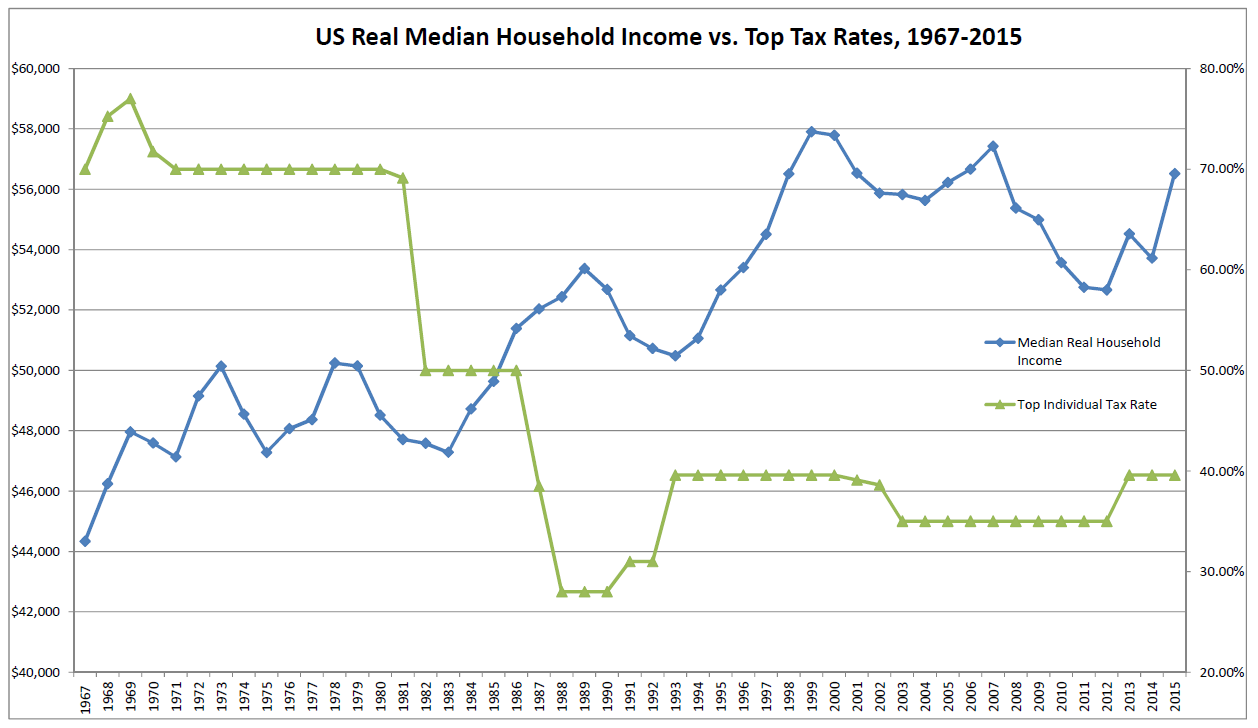
    Here’s a graph that plots US median household income, in real terms (e.g., after having been adjusted for inflation using the Bureau of Labor Statistics’ CPI-U-RS from 1977 on and the Census Bureau’s derived CPI-U-RS for the period 1967-1976) and the top marginal individual Federal income tax rate for the period 1967-2015.  Data sources are indicated at the end of this article.


    A larger version of the same image may be viewed here.

    Important Concepts .

    I’d like to emphasize a three key points before continuing.

    First, the chart above shows income in REAL terms – that is, after having been adjusted for inflation using the Census Bureau’s version of CPI-U-RS.  Thus figures from different years can indeed be validly compared.

    Second, the chart used median household income – not average (mean).  The median is defined as the midpoint of a given data set; half of the values in the data set  fall above that value, and half fall below.  It is NOT the average (mean).  Its use is significant because the mean of a data set can be grossly distorted by a small number of “outlier” data points at the extreme end of the spectrum.

    Don’t believe me?  Let’s look at the mean (average) and median of a data set consisting of a large set of data with two huge outliers. Specifically, let’s look at a data set consisting of a thousand and one values, the first 999 being the integers from 1 to 999  – and the other two each equal to ten million.  For this example data set, the mean is 20,479.02; in contrast, the median is 501.  Therefore, for that data set the median is far more generally descriptive of the data than the mean, which has been grossly skewed by two outliers.

    Income data is subject to similar skewing; one person who makes a killing in the market (e.g., several $M) or in real estate speculation in a given year can skew an entire town’s average (mean) household income for that year, but won’t markedly affect the median.  Thus, using the median vice the mean is a better choice.

    Third: an increasing median over time for a data set indicates that values of the individual data elements are in general getting larger.  (Remember:  median means half are larger and half are smaller.)  A rising median real income is thus indicative of a general increase in purchasing power across the board. – or a situation where virtually everyone is getting better off, economically speaking.

    Observations.

    Inspecting the above chart yields some interesting results.

    1. From 1967 to 1980, the top US tax rate was 70% or higher (in 1981, it was just below 70% – 69.12%, to be precise.) That’s not quite the absurd post-World War II confiscatory top tax rates of 90+% in effect until the early 1960s, but it’s still very high.  During this period, using the “eyeball” method the US median household income appears to have oscillated around a trend line of around (in real terms) $48,500.  If there was any trend at all for an increase with time, it was barely increasing.  It may have been decreasing slowly instead.
    2. In 1982, the top tax rate dropped to 50%. A year later, the median US real household income began rising.  It remained generally rising, with the exception of the Gulf Crisis period and its immediate aftermath (1990-1993), until 1999.
    3. The US tax rate dropped again in 1987, to below 40% (38.5%). It has remained below 40% ever since.
    4. The temporary downturn in median US real household income from 1990-1993 coincides with both the buildup to and the Gulf War itself, along with two rises in the maximum US income tax rate. The first increase was by over 10%, to 31%, in 1991; the second was by over 27%, to 39.6%, in 1993.
    5. The end of the rise in median US real household income coincides with the “dot.com bubble burst” that occurred at about that time. This was exacerbated by the events of 9/11 and the war years following.
    6. In spite of the “dot.com bubble burst”, 9/11, and protracted war in Southwest and Central Asia, in 2004 median US real household income began to rise again. This occurred shortly after a reduction of approximately 11.6% in the top US income tax rate over the period 2001-2003 – from 39.6% to 35%.
    7. The collapse in 2007 of the US real estate “bubble”, attributable IMO largely to shortsighted and unsound lending policies mandated by the Clintoon administration, and the resulting follow-on Wall Street financial crisis of 2008 ended the short-term rise in median US real household income. The median US household real income has yet to recover to 2007 levels.
    8. The top US income tax rate was raised again in 2013, by roughly 13%, to 39.6%. Leading economic indicators indicate that US economic growth over the 12-month period ending in August 2016 appears to have been a paltry 1.1% – well under that generally accepted as required to sustain a rising standard of living.  That’s troubling.
    9. At worst, the US median real household income appears to have reached a new stable level, albeit at a significantly higher stable level than before.  At best, the end of the current recession will return the US to continued real median household growth.

    Analysis.

    In reviewing the above the following becomes quite evident.

    • The top income tax rate has been at or below 50% every year since 1982. Prior to 1981, it was 70% or higher. (The top tax rate in 1981 was 69+%, but below 70%.)  It’s been below 40% every year since 1987.
    • Prior to 1982, the median US real household income seems to have been relatively stagnant, oscillating around a trend line with value of around $48,500.
    • Starting in 1983, the median US real household income began general rise lasting 16 years. Unfortunately, major perturbations caused by the burst of the “dot.com bubble”, 9/11, and the 2007-2008 financial crises ended this expansion.  Household income in real time appear since 1999 to have reached a new stability, a trend line in the neighborhood of $55,000 (and perhaps significantly more) after 1999.
    • Alternately, the 2007-8 financial crisis and policies since that date may still be depressing real household income growth. US employment is still grossly depressed (see the current US labor participation rate) vis-à-vis 2007 levels, so the latter is indeed a distinct possibility.
    • Between the low point of 1982 and today, median US real household income has increased by more than 19.5%. Every year since 1984 has had a higher median US real household income than the pre-1982 “eyeball” trend line of $48,500.
    • Since we’re dealing with median real US household income, the fact that the median has risen since the implementation of supply-side income tax cuts in 1982 implies that far more than half of US households are indeed better off today than they were prior to 1982.  Indeed, it is reasonable to conclude that virtually everyone who is able (or willing) to work – and who isn’t a total jerk – is almost certainly better off to some degree.  Only those who are unwilling or unable to perform gainful work (or unable to keep a good job due to personality or other issues) are likely no better off.
    • Time lags in response to changes are the norm for any large dynamic system. The US economy is nothing if not a large, complex system.  This explains, at least in part, the usual one to two year lag seen between tax cuts and tax cuts.

    And, finally, we have

    • Since the top Federal income tax bracket only affects those who have incomes that make them “wealthy”, that means that the “wealthy” received the bulk of the tax cuts. But guess what?  Over time, it certainly looks like virtually everyone ended up with a bigger real household income anyway.  So regardless of who got the benefit first, in relatively short order everyone benefited.  And those benefits appear to be permanent gains.

    Conclusions.

    When the top US income tax rate was cut substantially in 1982, this was an implementation of supply-side economics through tax policy.  After a short lag (about 1 year) US real household incomes – which had been stagnant in the long term, and had been in a multi-year decline during the years immediately before 1982 – began rising.  And if/when they stabilized some 17 or so years later (if indeed they’ve stabilized), real US household incomes stabilized at a substantially higher level than the previous norm.  The new level was roughly 20% higher, minimum, that the apparent previous norm; the new median may resume growth to even higher levels if the US median real household income is indeed still temporarily depressed by the 2007-2008 financial crises and resulting recession.  A resumption of real growth is indeed possible.  Finally, deviations from growth since 1982 appear to have an external cause unrelated to tax policies (Gulf War, “dot.com bubble”, 9/11, and 2007-2008 economic issues).

    In short:  yes, supply-side economics does work.  And in particular, the Reagan-era tax cuts do appear to have materially benefited everyone  – not just the rich.  In other words:  the benefits of those tax cuts “trickled down”, to everyone’s benefit.

    The data above shows that quite clearly – unless you’re wearing ideological blinders, of course.

    Assuming they’re seaworthy in the first place, a rising tide really does lift all boats.

    . . .

    That’s all for today.  The next article will address the Left’s misrepresentation that “wealth distribution is inequitable”, and “the Reagan era tax cuts are making the rich richer and the rest of the US poorer”.


    Author’s Note:  Data used in this article was obtained from the following sources.

    http://www2.census.gov/programs-surveys/demo/tables/p60/256/table3.xls (data used is for all races with one of the entries for 1988 omitted).

    http://taxfoundation.org/article/us-federal-individual-income-tax-rates-history-1913-2013-nominal-and-inflation-adjusted-brackets

  • “Toby Miles”, You Got Some ‘Splainin’ To Do

    In fact, it looks like “Toby Miles” could well be in big trouble.

    What, you don’t recognize the name?  Well, don’t feel bad.  That’s by design.

    That was the name used for the third email account Lois Lerner used to conduct “official business” while executing her politically-driven hatchet work at the IRS.  The IRS apparently “just realized that” while responding judge’s order to turn documents related to Lerner over to Judicial Watch .

    The Washington Times has a good article on this bit of new news.  It’s IMO worth a read.

  • States try to exempt veterans’ pension from taxes

    Chock Block sends us a link from Pew which talks about states’ taxes and military veterans’ pensions. It seems that some states want to appear more attractive to veterans by giving them a tax break. Of course, the big detriment to a tax break is that some people don’t realize that the money that we want to keep is ours and not the governments – we earned it in return for our service;

    …David Brunori, deputy publisher of Tax Analysts, a specialty publication, says any tax exemption of retirement income is bad policy.

    “Exempting military pensions from tax is good politics—everyone loves veterans,” he said. “But it is not targeted [to low-income people]. Some veterans go on to make a lot of money in the private sector and end up pretty well off. There is no reason in the world to exempt their income from tax.”

    Well, low income earners don’t pay much in taxes, if they pay any taxes, so why do they need a tax break? I’m sure States don’t need to attract more low income workers anyway. If you let veterans keep more of their own money, they’ll spend it and states will recover what they lost in income taxes with sales taxes and everyone is happy.

    Maryland voted to raise the threshold for the taxable portion of military pensions to $10,000, but it is still only half of West Virginia’s threshold. So folks can live in West Virginia and work in Maryland and cheat Maryland out of the whole enchilada completely. Or they can live in Virginia or Pennsylvania and work in Maryland still saving their own money.

    I’m for cutting taxes on everyone, I’m not jealous when someone gets a tax break that I don’t. Veterans or veterinarians. People keeping their own money is always a good thing.

    Eventually, the government will have to quit spending like drunken sailors on liberty what tax payers earn (apologies to drunken sailors on liberty). Tax cuts don’t have to be “paid for” like politicians say – the politicians should be cutting their wild spending instead of trying to make us feel guilty about wanting to keep more of our money.

  • This Could Be Interesting

    Can you say, “Lois Lerner”? Sure. I knew you could. (smile)

    For those who’ve forgotten: Lois Lerner was the former head of the IRS division that rules on nonprofit groups’ applications for tax-exempt status. That division was caught apparently blatantly playing politics with nonprofit applications – e.g., fast-tracking those of leftist groups, while slow-rolling and otherwise obstructing those of conservatives.

    Lerner later resigned, and has “taken the Fifth” when asked to testify in Congress. Conveniently, tens of thousands of her official IRS emails from the period greatest interest for the scandal were “lost”. The same happened to emails of some of her closest associates who were also believed to have been hip-deep in the scandal.

    Jonn and I have written numerous times about this and other instances of missing IRS email. Use the site’s search features if you want to see them.

    Lerner’s emails were initially held to be “lost permanently” – until very recently, that is. Now, it appears that the IRS has now magically “found” some “disaster recovery tapes” from the period in question that contain many if not all of Lerner’s missing emails.

    Now, maybe it’s just me. But if I had a bunch of, you know, missing email – and I had a disaster recovery system in-place that stored stuff like, say, copies of email traffic or email databases/transaction records – those records would probably be one of the first places I’d look for a bunch of missing emails to/from a high-ranking official. But apparently the IRS doesn’t do things that way.

    Or maybe it took so long because of, well, some little thing like an “upcoming Congressional election”. Nah – that can’t be it. The “most transparent administration in history” would never pull such an underhanded trick. Besides, that would require blatantly lying to Federal investigators and Congress multiple times. They’d NEVER stoop that low!

    In any case, it will still take a while to recover Lerner’s emails from those tapes. But you might want to follow this one for a while.  It looks like this just might get even more interesting.

    That just breaks my heart. (smile)

  • So, That “IRS Thing” Was Just a Rogue Operation, Eh?

    Well, then explain this:

    Sen. Shaheen briefed on IRS targeting plot in 2012, memo shows

    Sounds to me like someone in NH really needs to be sent packing.  And it also sounds to me like those claims that the scandal was due to a couple of folks gone rogue are, well, absolute bullsh!t.

    But we already knew that last point, didn’t we?