Category: Real Soldiers

  • DoD stingy with Medal of Honor?

    DoD stingy with Medal of Honor?

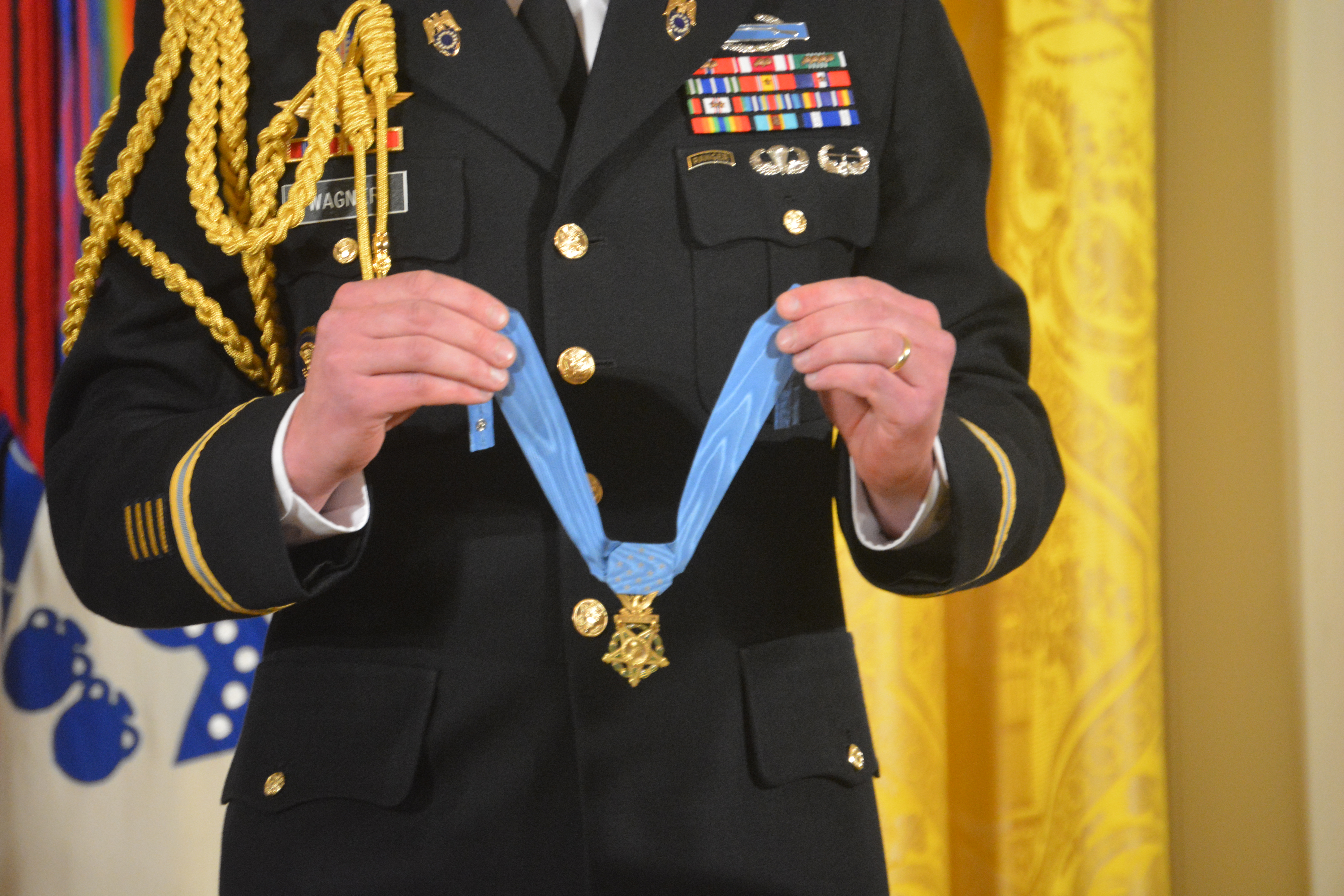
    DSC_0010

    CNN‘s Jake Tapper asks why so few Medals of Honor have been awarded during the Iraq and Afghanistan Wars as compared to our much shorter involvement in previous wars. Leading the charge in Congress is Iraq veteran Duncan Hunter;

    That reasoning drew ire from veterans like Rep. Duncan Hunter, R-California.

    “These are men rushing the enemy, looking them in the eye, and sometimes finishing them off with their knives, with their helmets, with empty rifles used as clubs. If that’s not close-quarter combat, I don’t know what is,” Hunter said in 2011. “Not recognizing them for what they’re doing is a travesty.”

    Our buddy, Doug Sterner, an expert on the awards system;

    Another theory comes from Vietnam veteran and historian Doug Sterner.

    “We have people at the top who are reluctant to admit that we have a broken awards system and fix it,” he said.

    The current generation of fighters is being denied recognition not because their actions are any less heroic, but because their leaders don’t know a medal contender when they see one, Sterner says.

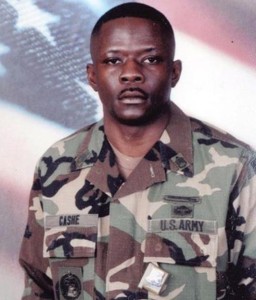
    My personal cause for the Medal of Honor is Sergeant First Class Alwyn Cashe, we were both Bradley platoon sergeants, but he is credited with saving the lives of six of his soldiers while he was on fire and under fire from the enemy. He repeatedly rushed into his burning Bradley and dragged his troops from it. From the New York Times;

    According to the narrative that accompanied [SFC Cashe’s Silver Star Medal], the Bradley was engulfed in flames and Sergeant Cashe, drenched in fuel that had been spewed by the explosion, pulled himself out of the gunner’s hatch and helped the driver escape. The narrative describes what happened next:

    “Without regard for his personal safety, S.F.C. Cashe rushed to the back of the vehicle, reached into the hot flames and started pulling out his soldiers. The flames gripped his fuel-soaked uniform. Flames quickly spread all over his body. Despite the terrible pain, [SFC} Cashe placed the injured soldier on the ground and returned to burning vehicle (sic) to retrieve another burning soldier; all the while he was still on fire.”

    The narrative said that Sergeant Cashe’s actions helped save the lives of six soldiers.

    After his death, Sergeant Cashe’s commanding officers learned that his platoon had come under enemy fire while the sergeant was rescuing his fellow soldiers — and as a result they petitioned for his Silver Star, the military’s third-highest valor award, to be upgraded to a Medal of Honor.

    SFC Cashe succumbed to his injuries after a final reunion with his family at Fort Sam Houston. And then we discovered that his headstone at Arlington listed the wrong medal.

    There are only four Medals of Honor for Iraq, SFC Cashe needs to be the fifth.

    Alwyn Cashe

  • SGM Bennie Adkins’ Medal of Honor

    SGM Bennie Adkins’ Medal of Honor

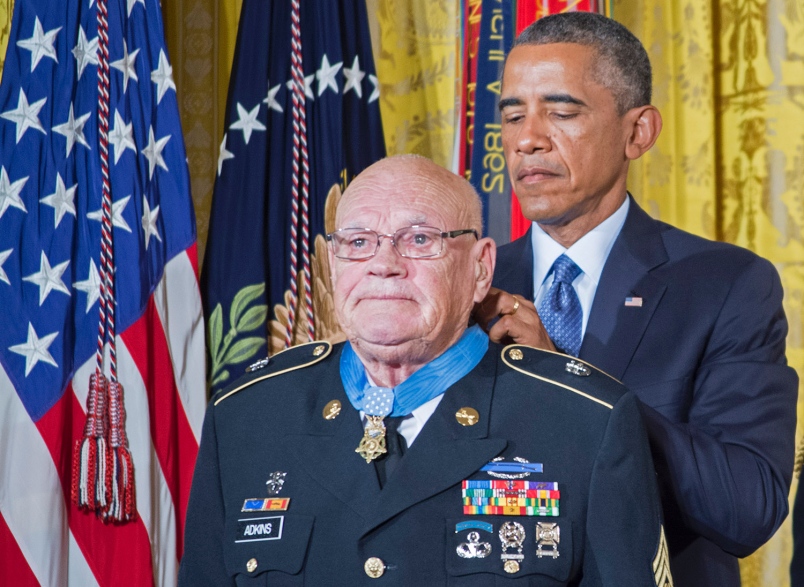
    Bennie Adkins

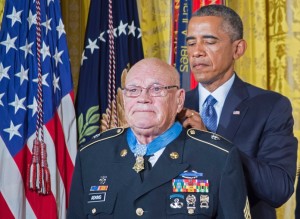
    Earlier today, the President draped the Medal of Honor around the neck of Sergeant Major Bennie Adkins 48 years after he earned the award. Specialist Don Sloat was also honored and his award was posthumously presented to his brother, Bill. 20-year-old Don Sloat used his body to shield three other soldiers from the blast, losing his own life.

    Now, 80 years old, former Sergeant First Class Bennie Adkins’ story was a little more complicated says CNN which recounts part of the story of the battle at A Shau, March 9-12, 1966;

    “Adkins rushed through intense enemy fire and manned a mortar position defending the camp,” the Army report says. “He continued to mount a defense even while incurring wounds from several direct hits from enemy mortars. Upon learning that several soldiers were wounded near the center of camp, he temporarily turned the mortar over to another soldier, ran through exploding mortar rounds and dragged several comrades to safety. As the hostile fire subsided, Adkins exposed himself to sporadic sniper fire and carried his wounded comrades to a more secure position.”

    From Army.mil, Adkins recounts the story;

    “It was just not my time that day,” Adkins said. “I was blown from the mortar pit on several occasions, and I was fortunate enough to go outside the camp amongst the enemy and get one of our wounded MedEvaced out. I also made a trip into the minefield to recover some supplies that were air dropped to us. The bottom line is that it was just not my day to go.”

    Adkins then withdrew to regroup with a smaller element of Soldiers at the communications bunker. While there, he single-handedly eliminated numerous insurgents with small-arms fire, almost completely exhausting his supply of ammunition. Braving intense enemy fire, he returned to the mortar pit, gathered vital ammunition and evaded fire while returning to the bunker.

    After the order was given to evacuate the camp, Adkins and a small group of Soldiers destroyed all signal equipment and classified documents, dug their way out of the rear of the bunker, and fought their way out of the camp.

    Because of his efforts to carry a wounded Soldier to an extraction point and leave no one behind, Adkins and his group were unable to reach the last evacuation helicopter.

    Adkins then rallied the remaining survivors and led the group into the jungle, where they evaded the enemy for 48 hours, until they were rescued by helicopter March 12.

    Adkins was credited with killing somewhere around 175 of the enemy but he’s more proud of the lives he saved;

    “I’m just a keeper of the medal for those other 16 (U.S. troops) who were in the battle, especially the five who didn’t make it,” he told Army News Service.

    “I can tell you every man who was there and the five who lost their lives. I can tell you how that happened. It diminishes, but it does not go away,” Adkins said.

  • Corporals David Qualls and Nathan Bryson saving the world

    Corporals David Qualls and Nathan Bryson saving the world

    Hero Marines

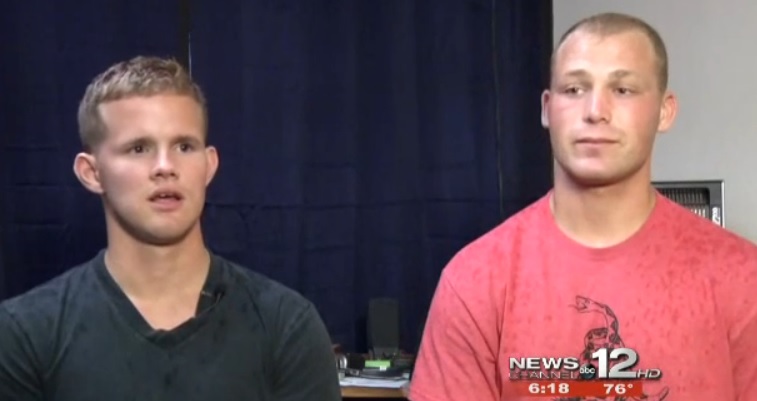
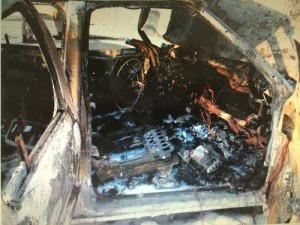
    SJ sends us a link from WCTI in regards to Marine Corporals David Qualls and Nathan Bryson, 22 and 21 years old respectively who came upon an automobile accident. Larry Flesher was trapped in his burning SUV – Qualls and Bryson leaped into action;

    Cpl. Qualls and Cpl. Bryson said they grabbed onto Flesher’s clothing and pulled him out through the back door of the burning vehicle to safety.

    “As soon as we got him out, the flames went straight through the firewall and into the car and it just lit the whole thing up,” said Bryson.

    Miles Bunn helped put the fire out with extinguishers. He watched in awe as the two young Marines went into action to save Flesher’s life.

    When NewsChannel 12 asked Bunn how he would describe what he saw, he said it was heroic.

    “Quitting wasn’t in their vocabulary. They weren’t going to leave a man behind,” Bunn said of the Marines.

    fiery-wreck-21-jpg

  • PFC Nathan Currie saving the world

    PFC Nathan Currie saving the world

    nathan-currie

    Chief Tango sends us a link from Military.com in regards to Army Private First Class Nathan Currie who was fishing on day at Holbrook Pond on Fort Stewart when he saw a car drive into the pond and sink below the surface;

    Currie, who hails from Oklahoma City, dove into the water to see if someone was in the car. He felt a body in the back seat and came back up for air. He then swam back into the car and pulled the woman from the vehicle.

    The woman had been under the water about five minutes and was turning blue. Currie revived her with cardiopulmonary resuscitation and stayed with her until paramedics arrived on the scene.

    Army Command Sgt. Maj. Wylie Hutchison, the senior enlisted leader for the Fort Stewart-based 188th Infantry Brigade, joined Currie at the scene and took part in the rescue. While Currie was performing CPR on the woman, Hutchison jumped in the pond and checked the vehicle three more times to ensure no one else was inside.

    “My Army training helped by preparing me to respond quickly and take action with courage and confidence under adverse conditions,” Currie said.

    The water isn’t the only hazard at Fort Stewart – it’s the only place I’ve ever been stationed where field exercises were cancelled because of snakes. I still have nightmares from being the guy to tie the far side knot on a rope bridge over the snake-infested creek. The place is also home to alligators.

  • TN National Guardsmen saving the world

    TN National Guardsmen saving the world

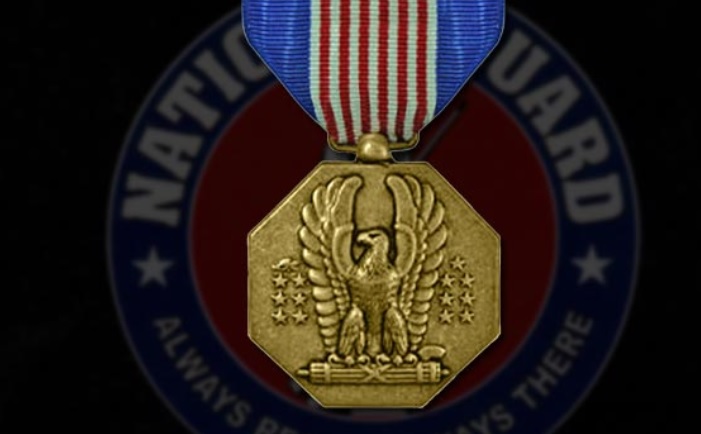
    Soldiers Medal

    Chief Tango sends us a link from the Associated Press which announces the award of four Soldiers Medal to Tennessee National Guardsmen, all from the TNNG Recruiting and Retention Command, for various acts of heroism not involving an armed enemy;

    Tennessee’s adjutant general, Maj. Gen. Max Haston, presented the medal to Lt. Col. Hunter L. Belcher, a Lebanon native; Maj. William J. Crawford, a Henderson native; and Command Sgt. Maj. Christopher T. Crawford, a Lawrenceburg native, were given the medal for their actions when an assailant entered the Millington Armory last October.

    Sgt. 1st Class Fred C. Mize III, a Strawberry Plains native, was awarded the medal after crawling into a burning vehicle and aiding three injured occupants in February 2013.

  • Major Adam Czekanski saving the world

    Major Adam Czekanski saving the world

    Major Adam Czekanski

    Major Adam Czekanski was awarded a Soldier’s Medal for his heroic rescue of a man who fell on the commuter train tracks near San Francisco. While other commuters froze at the sight, Major Czekanski, with three combat tours, leaped into action according to the Stars & Stripes;

    A man standing at the edge of the platform began slowly leaning forward and then toppled onto the tracks, directly in front of the oncoming train.

    The commuters on the platform froze in horror, “as if they were paralyzed,” Czekanski said later. But he knew exactly what to do. He ran from the top of the escalator to the edge of the platform and jumped onto the tracks to help the fallen man.

    “He was lying there flat on his back,” Czekanski said. “I pulled him away from the tracks and got him under the lip of the platform. I know it sounds like a cliche,” he said, “But I did what I had to do.”

    There’s a Ranger Tab, Jump Wings and a Sapper Tab under that rack, so I’m not really surprised.

  • President to award 3 Medals of Honor September 15, 2014

    President to award 3 Medals of Honor September 15, 2014

    DSC_0010

    TSO sends us the following press release from the White House;

    On September 15, 2014, President Barack Obama will award the Medal of Honor to Army Command Sergeant Major Bennie G. Adkins and to Army Specialist Four Donald P. Sloat for conspicuous gallantry.

    Command Sergeant Major Adkins will receive the Medal of Honor for his actions while serving as an Intelligence Sergeant assigned to Detachment A-102, 5th Special Forces Group, 1st Special Forces. Then-Sergeant First Class Adkins distinguished himself during combat operations at Camp A Shau, Republic of Vietnam, on March 9 through March 12, 1966.

    Specialist Four Donald P. Sloat will receive the Medal of Honor posthumously for his actions while serving as a Machine gunner with Company D, 2nd Battalion, 1st Infantry Regiment, 196th Light Infantry Brigade, Americal Division. Specialist Four Sloat distinguished himself during combat operations in the vicinity of Hawk Hill Fire Base, Republic of Vietnam, on January 17, 1970.

    President Obama also approved the awarding of the Medal of Honor to Army First Lieutenant Alonzo H. Cushing for gallantry in action at the battle of Gettysburg on July 3, 1863. Additional details on the award to First Lieutenant Cushing will be announced separately.

    First Lieutenant Alonzo H. Cushing will receive the Medal of Honor posthumously for his actions while serving as commanding officer of Battery A, 4th United States Artillery, Artillery Brigade, 2nd Corps, Army of the Potomac. Cushing distinguished himself during combat operations against an armed enemy in the vicinity of Cemetery Ridge, Gettysburg, Pennsylvania, on July 3, 1863.

    PERSONAL BACKGROUND:

    Command Sergeant Major Adkins joined the Army in 1956, at the age of 22. He served in the 2nd Infantry Division until leaving to join Special Forces in 1961. He deployed to Vietnam three times between February 1963 and December 1971; the actions for which he will receive the Medal of Honor took place during his second tour.

    After Vietnam, Command Sergeant Major Adkins served approximately two years as First Sergeant for the Army Garrison Communications Command in Fort Huachuca, Arizona. He then joined Class #3 of the Army Sergeants Major Academy in El Paso, Texas. After graduation, he served with Special Forces at Fort Bragg, North Carolina, and then led training at Fort Sherman’s Jungle School in the Panama Canal Zone. He retired from the Army in 1978.

    Command Sergeant Major Adkins and his wife of 59 years, Mary Adkins, currently reside in Opelika, Alabama. They will both attend the Medal of Honor ceremony at the White House.

    Specialist Four Sloat entered the Army on March 19, 1969 from Coweta, Oklahoma. After completing his training, he was assigned as an M60 Machine Gunner, to 3rd Platoon, Delta Company, 2/1 196th Light Infantry Brigade, Americal Division, in the Republic of Vietnam.

    Specialist Four Sloat was killed in action on Jan. 17, 1970, at the age of 20. On that day, his squad was conducting a patrol, when one of the Soldiers triggered a hand grenade trap placed in their path by enemy forces. Specialist Four Sloat picked up the live grenade, initially to throw it away. However, when he realized that detonation was imminent, he chose to shield its blast with his own body, sacrificing his own life to save the lives of three of his fellow Soldiers.

    Dr. William Sloat of Enid, Oklahoma, will join the President at the White House to accept the Medal of Honor on his brother’s behalf.

    First Lieutenant Cushing graduated, and was commissioned, from the United States Military Academy at West Point in the class of June 1861. Born in what is now Delafield, Wisconsin, he was raised in Fredonia, New York. Cushing was the commander of Battery A, 4th United States Artillery, Artillery Brigade, 2nd Corps, Army of the Potomac at Gettysburg.

    First Lieutenant Cushing was killed in action on July 3, 1863, at the age of 22. On that day, the third day of the battle, in the face of Longstreet’s Assault, also known as Pickett’s Charge, First Lieutenant Cushing’s battery took a severe pounding by Confederate artillery. As the rebel infantry advanced, he manned the only remaining, and serviceable, field piece in his battery. During the advance, he was wounded in the stomach as well as in the right shoulder. Refusing to evacuate to the rear despite his severe wounds, he directed the operation of his lone field piece continuing to fire in the face of the enemy. With the rebels within 100 yards of his position, Cushing was shot and killed during this heroic stand. His actions made it possible for the Union Army to successfully repulse the Confederate assault. First Lieutenant Cushing is buried with full honors at his alma mater, West Point.

  • Quotations From Some Old Pieces of Paper

    The papers in question concern events during a 3-day period in July, 1943.  What follows is an series of quotations from those pieces of paper.

    They’re a few of of literally hundreds of such pieces of paper from that era.

    What follows may not be comprehensive; I don’t have a copy, so I can’t say for sure.  However, other published accounts I’ve located give the following as quotations. I’m convinced they’re accurate.

    I’ve omitted names and certain other personal information as they’re not really pertinent to my point in writing this article.  Asterisks below are present in those secondary sources, and apparently represent information that did not scan to text correctly or was not legible.

    . . .

    The President of the United States of America, authorized by Act of Congress July 9, 1918, takes pleasure in presenting the Silver Star to Private XXXXX X. XXXXXXXXX (ASN: ########), United States Army, for gallantry in action while serving with Company I, 504th Parachute Infantry Regiment, 82d Airborne Division, in action on 9 July 1943, in Sicily. Private XXXXXXXX, with utter disregard for his personal safety, provided water to the soldiers of his company during the hours of **** – ****. During most of this time he was exposed to heavy machine gun and small arms fire of the enemy and was sniped upon on many occasions.
    Action Date: July 9, 1943

    The President of the United States of America, authorized by Act of Congress July 9, 1918, takes pleasure in presenting the Silver Star to First Lieutenant (Infantry) XXXXX  X. XXXXXXXX (ASN: 0-######), United States Army, for gallantry in action as a member of Headquarters Company, 1st Battalion, 505th Parachute Infantry Regiment, 82d Airborne Division, in action on 9 July 1943 south of ****, Sicily. Lieutenant XXXXXXXX landed by parachute in hostile territory with his section and immediately proceeded to secure his communications equipment in the face of intense machine gun fire. After destroying what he was unable to salvage, he organized his communications group as a rifle unit and led them through the subsequent action to successful completion of assigned missions.
    Action Date: July 9, 1943

    The President of the United States of America, authorized by Act of Congress July 9, 1918, takes pleasure in presenting the Silver Star to Private XXXXX X. XXXXXXXX (ASN: ########), United States Army, for gallantry in action while serving with Company A, 505th Parachute Infantry Regiment, 82d Airborne Division, in action on 9 July 1943, five miles west of ****, Sicily. An attack was launched on a fortified garrison by Private XXXXXXXX’s unit, during which Private XXXXXXXX after a hand-to-hand fight with two enemy soldiers, captured a light machine gun. Immediately following this action, a counter-attack was launched by the **** on the position and, under heavy artillery fire, the unit was forced to withdraw. Private XXXXXXXX and Lieutenant XXXXXXXX volunteered to stay in position until their unit completed withdrawal. Private XXXXXXXX and Lieutenant XXXXXXXX manned their post with enemy machine guns until another assault was made by the enemy. Seeing that their unit had by this time contacted friendly forces, Private XXXXXXXX and Lieutenant XXXXXXXX, although surrounded, began to withdraw. Lieutenant XXXXXXXX was killed. By passing through enemy lines, Private XXXXXXXX was able to rejoin his unit.
    Action Date: July 9, 1943

    The President of the United States of America, authorized by Act of Congress July 9, 1918, takes pleasure in presenting the Silver Star to Private First Class XXXXX  X.. XXXXXXXX (ASN: ########), United States Army, for gallantry in action while serving with Company B, 307th Airborne Engineer Battalion, 82d Airborne Division, in action on 9 – 10 July 1943, four miles southeast of ****, Sicily. Private First Class XXXXXXXX fractured his knee in a combat parachute jump southeast of ****, Sicily on 9 July 1943. He marched across country, taking part in guerrilla skirmished until the night of 10 July 1943, at which time he took part in the engagement northwest of ****, Sicily, against a portion of the **** **** **** Division. He made not complaint of the fractured knee during the two days of fighting. The morning of 10 July 1943, he reported to the medical aid station and was sent to the hospital to be treated for a fractured knee. In this gallant action Private First Class XXXXXXXX acquitted himself in a manner reflecting credit on himself and his country.
    Action Date: July 9 – 10, 1943

    The President of the United States of America, authorized by Act of Congress July 9, 1918, takes pleasure in presenting the Silver Star to Private First Class XXXXXX X.  XXXXXXXX (ASN: ########), United States Army, for gallantry in action while serving with Battery C, 456th Parachute Field Artillery Battalion, 82d Airborne Division, in action on 9 – 10 July 1943, about five miles southwest of ****, Sicily, and later about six miles northwest of ****, Sicily. In both instances, Private First Class XXXXXXXX, assistant gunner on a .50 caliber anti-aircraft machine gun crew, helped operate his gun against low-flying **** planes that were strafing the gun positions of his battery. Private First Class XXXXXXXX remained at his post in the face of heavy strafing. Two of the planes fired upon began to smoke heavily, rapidly lost altitude and are believed to have crashed. Later in the day, at another location, and again in the face of heavy strafing, a third **** plane was hit and observed rapidly losing altitude. In each instance the remaining planes flew away, permitting his battery to continue its mission.
    Action Date: July 9 – 10, 1943

    The President of the United States of America, authorized by Act of Congress July 9, 1918, takes pleasure in presenting the Silver Star to First Lieutenant (Infantry) XXXXXX X. XXXXXXXX (ASN: 0-#######), United States Army, for gallantry in action as a member of Headquarters Company, 3d Battalion, 505th Parachute Infantry Regiment, 82d Airborne Division, in action about five miles west of *** ***, in Sicily. Lieutenant XXXXXXXX, commanding a light machine gun platoon of the 505th Parachute Infantry Regiment, participated in the attack on Hill *** near Route *** which drove back a superior force approximately one-half mile. The enemy counter-attacked with support from heavy artillery, mortars, and***, *** and *** ** tanks. Lieutenant XXXXXXXX personally led his platoon in the face of the heavy enemy fire, through scanty orchard cover to within 50 yards of the tanks. He directed the fire of his men to such effect that the tanks were prevented from crossing the ridge, where they could have inflicted severe casualties on his battalion. In this gallant action Lieutenant XXXXXXXX acquitted himself in a manner reflecting credit upon himself and his country.
    Action Date: July 10, 1943

    The President of the United States of America, authorized by Act of Congress July 9, 1918, takes pleasure in presenting the Silver Star to Sergeant XXXXXX X. XXXXXXXX (ASN: ########), United States Army, for gallantry in action while serving with Company H, 505th Parachute Infantry Regiment, 82d Airborne Division, in action on 10 July 1943, six miles northwest of ***, Sicily. Sergeant XXXXXXXX was seeking to rejoin his regiment, having become separated during a night parachute descent on 8 July 1943. In response to the request of the Commanding Officer, 505th Parachute Infantry Regiment, 82d Airborne Division, Sergeant XXXXXXXX organized and led a squad of parachutists in a flanking attack on a strongly-held enemy position. Sergeant XXXXXXXX led his squad across the open terrain despite intense mortar and machine gun fire. They drove the enemy from the position, killing sixteen and capturing five enemy soldiers. The success of this attack was, in large part, due to the personal example and courage of Sergeant XXXXXXXX, and enabled the 505th Parachute Infantry Regiment to resume its advance.
    Action Date: July 10, 1943

    The President of the United States of America, authorized by Act of Congress July 9, 1918, takes pleasure in presenting the Silver Star to Private First Class XXXXXX X. XXXXXXXX (ASN: ########), United States Army, for gallantry in action while serving with Company H, 505th Parachute Infantry Regiment, 82d Airborne Division, in action on 10 July 1943, six miles northeast of ****, Sicily. Private First Class XXXXXXXX voluntarily entered an attack on an enemy position holding back the advance of the 505th Parachute Infantry Regiment, 82d Airborne Division,. During the attack a *** machine gun placed flanking fire upon Private First Class XXXXXXXX’s squad and pinned it down. Private First Class XXXXXXXX fired his rocket launcher at the enemy machine gun nest, but the launcher exploded. With utter disregard for his personal safety, Private First Class XXXXXXXX secured another rocket launcher and returned to his squad. Firing a second time, Private First Class XXXXXXXX blew up the enemy machine gun nest, killing its crew of four. This action permitted Private First Class XXXXXXXX’s squad to resume its advance to the successful accomplishment of its mission.
    Action Date: July 10, 1943

    The President of the United States of America, authorized by Act of Congress July 9, 1918, takes pleasure in presenting the Silver Star to Second Lieutenant (Infantry) XXXXXX X. XXXXXXXX (ASN: 0-#######), United States Army, for gallantry in action as a member of Headquarters Company, 1st Battalion, 505th Parachute Infantry Regiment, 82d Airborne Division, in action on 11 July 1943, south of ****, Sicily. Lieutenant XXXXXXXX rallied those around him to resist a hostile tank attack, and was eminently instrumental in preventing a general withdrawal. When his commanding officer was hit by a shell, Lieutenant XXXXXXXX attempted to render first aid under fire, and later, though wounded, refused to be evacuated until he had seen to the disposition of effects and burial of his commanding officer.
    Action Date: July 11, 1943

    And finally:  in the papers in question, the following text is repeated at least four times, and possibly more times than that.  The only change between the versions is different ranks and other personal information corresponding to the individuals involved. For what it’s worth:  the rank of at least 3 of the individuals was “Private”.

    The President of the United States of America, authorized by Act of Congress July 9, 1918, takes pleasure in presenting the Silver Star to Sergeant XXXXXX X. XXXXXXXX (ASN: ########), United States Army, for gallantry in action while serving with Headquarters Company, 3d Battalion, 504th Parachute Infantry Regiment, 82d Airborne Division, in action on 9 July 1943, northwest of ****, Sicily. Sergeant XXXXXXXX, Section Sergeant, together with seven other men, manned two anti-tank guns which had previously been captured from the enemy. The seven men and Sergeant XXXXXXXX knocked out an *** “tankette” while they were exposed to heavy enemy machine gun fire. This “tankette” was leading an estimated enemy battalion in the approach march. These men had no previous experience in the operation of the anti-tank guns. By their action the enemy battalion became disorganized and withdrew.
    Action Date: July 9, 1943

    . . .

    The quotations above come from General Orders No. 29, Headquarters, 82nd Airborne Division, dated 29 August 1943.  As I noted earlier:  it’s but one of literally hundreds of such documents issued by various division headquarters during World War II.

    People often forget just how bitter that war’s fighting was.  And we often forget just how many people exhibited extreme heroism during that conflict.

    It was my great good fortune – and my honor –  to know one of those men.  Sadly, he’s no longer among the living.

    Still, in looking over the above, I can’t help but feel that Patton was indeed right.  “It is foolish and wrong to mourn the men who died. Rather, we should thank God that such men lived.”

    Enjoy your Sunday, everyone.