Category: North Korea

  • Confronting Iran: The Trump Administration’s Strategy

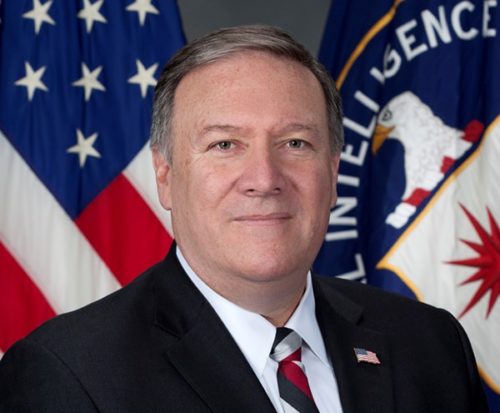
    sec state pompeo

    A very open and telling article by SecState Pompeo on the Trump doctrine, it’s objectives and differences from the previous administration’s policy of “leading from behind.”

    The end of the Cold War forced new thinking among policymakers and analysts about the greatest challenges to U.S. national security. The emergence of al Qaeda, cybercriminals, and other dangerous entities affirmed the threat of nonstate actors. But equally daunting has been the resurgence of outlaw regimes—rogue states that defy international norms, fail to respect human rights and fundamental freedoms, and act against the security of the American people, U.S. allies and partners, and the rest of the world.
    Chief among these outlaw regimes are North Korea and Iran. Their transgressions against international peace are many, but both nations are most notorious for having spent decades pursuing nuclear weapons programs in violation of international prohibitions. Despite Washington’s best efforts at diplomacy, Pyongyang hoodwinked U.S. policymakers with a string of broken arms control agreements going back to the George H. W. Bush administration. North Korea’s nuclear weapons and ballistic missile programs continued apace, to the point where after Donald Trump was elected, President Barack Obama told him that this would be his greatest national security challenge. With Iran, likewise, the deal that the Obama administration struck in 2015—the Joint Comprehensive Plan of Action, or JCPOA—failed to end the country’s nuclear ambitions. In fact, because Iran knew that the Obama administration would prioritize preserving the deal over everything else, the JCPOA created a sense of impunity on the part of the regime, allowing it to increase its support for malign activity. The deal has also given Tehran piles of money, which the supreme leader has used to sponsor all types of terrorism throughout the Middle East (with few consequences in response) and which have boosted the economic fortunes of a regime that remains bent on exporting its revolution abroad and imposing it at home.
    That the threats from North Korea and Iran grew in the post–Iraq war era has further complicated the question of how best to counteract them; Americans are rightly skeptical of the costs of a protracted military commitment in the name of protection from weapons of mass destruction. With the difficulties of Iraq fresh in mind, and with previous agreements to restrain the threats from North Korea and Iran having proved impotent, stopping these recalcitrant regimes from doing harm demands new diplomatic paradigms.
    Enter President Trump. For all of the Washington establishment’s fretting over his style of international engagement, his diplomacy is anchored in a deliberate approach that gives the United States an advantage in confronting outlaw regimes.

    There is considerably more to the article- highly recommended reading at Foreign Affairs
  • US, North Korea Resume Talks On Recovery Of War Dead Remains

    NK Parade
    While the United States and North Korea struggle to get nuclear talks back on track, negotiators moved forward with efforts to bring home the remains of more American troops killed in the 1950-53 Korean War.

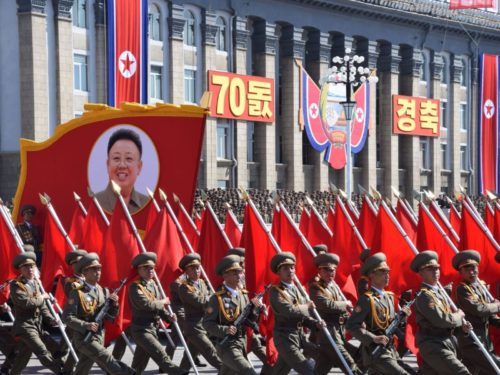
    Also of interest was North Korea’s 70th anniversary parade- no ballistic missiles were present for the occasion.

    U.S. and North Korean generals met Friday in the truce village of Panmunjom to discuss the way ahead, more than a month after the repatriation of 55 cases, said to contain the remains of U.S. service members.

    The talks came as the longtime adversaries are otherwise locked in a diplomatic stalemate over efforts to persuade the North to abandon its nuclear weapons program.

    “Participants discussed military-to-military efforts to support any potential future return of remains,” UNC spokesman Col. Chad Carroll said Sunday in an email. More details were not released.

    The return of the 55 cases in late July was the first such repatriation in more than a decade. President Donald Trump hailed it as a tangible outcome of his June 12 summit with North Korean leader Kim Jong Un.

    But experts noted it was just the start of a long process, with more than 7,600 Americans still missing from the war, including 5,300 believed to have been lost in North Korea.

    Trump and Kim agreed at the Singapore summit to resume the long-stalled search for the remains, “including the immediate repatriation of those already identified” as part of a four-point declaration that mainly focused on a promise to try to denuclearize the Korean Peninsula.

    The return of the 55 cases fulfilled part of that promise, but U.S. officials are pushing to resume searches in North Korea. The recently returned remains, mostly bones and other fragments, were flown to Hawaii for analysis and identification.

    Although unrelated, the resumption of talks concerning the repatriation of US war dead, and the lack of ballistic missiles in the 70th anniversary parade are promising signs.

    To view the article in its entirety, click on the link provided.
    Stars and Stripes Link

  • Dog Tag of 1st Cav Medic Missing From Korean War Returned to Sons

    Military Daily Link

    Military Daily Link

    Posted in its entirety at the request of AnotherPat.

    The name on the dog tag returned along with the remains of troops missing from the Korean War last week was that of Master Sgt. Charles Hobert McDaniel, an Army medic from Indiana who fell in battle nearly 68 years ago.

    “We were just overwhelmed,” McDaniel’s son, Charles Jr., said Wednesday of the phone call he received from the Army notifying him of the find.

    “I have to say, I didn’t think about the emotions that were very deep, even though I was a small boy and have very little memory of my father,” said the son, who was three years old when his father fell in 1950. “But I sat there and I cried for a while and it took a while to compose myself.”

    Charles Jr., 71, a retired Army lieutenant colonel and chaplain from Indianapolis, immediately called his brother Larry, 70, in Jacksonville, Florida.

    “I was just flabbergasted,” Larry McDaniel said, adding that his father was “just one of thousands of guys from that generation who did what they did” and never came home.

    The dog tag bearing McDaniel’s name, blood type and other information “was the only personal effect” found in the 55 boxes of remains that were brought back to Hawaii on Aug. 1, said Dr. John Byrd, a forensic anthropologist and director of laboratories for the Defense POW/MIA Accounting Agency (DPAA).

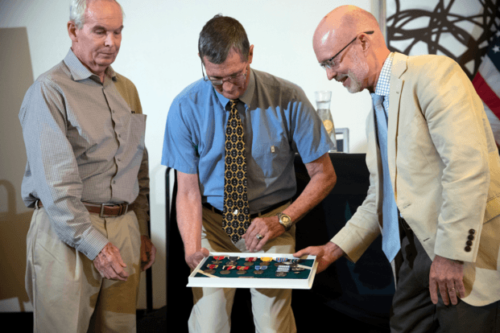
    Byrd, who led the U.S. team into North Korea on July 27 to receive the 55 transfer cases, joined the McDaniel brothers and DPAA and Army officials for a brief acceptance ceremony in Arlington, Virginia, ahead of meetings Thursday with more than 700 families of troops missing from the Korean War.

    McDaniel also served in Europe during World War II with the 83rd Infantry Division, where he earned the Bronze Star with combat “V” device, Charles Jr. said.

    In Korea, McDaniel was serving with the Medical Co., 8th Regiment, 1st Cavalry Division, as part of the U.S. Eighth Army in late October 1950. As they approached the Yalu River separating Korea from China, Chinese People’s Army forces attacked.

    The Americans and Republic of Korea forces were driven back. In a battle near Unsan, about 60 miles north of the North Korean capital of Pyongyang, McDaniel, who was with the 3rd Battalion of the 8th Regiment at the time, went missing.

    The DPAA said that an eyewitness — another medic — later said he believed McDaniel was killed in action. DPAA officials also said there was no evidence that he was ever captured and held in a prisoner of war camp. McDaniel was 33 years old when he went missing.

    According to the DPAA, about 7,700 U.S. service members are still listed as missing in action from the Korean War, about 5,300 of them in what is now North Korea.

    Charles Jr. said he and his brother consider themselves among the luckiest of those thousands of families still hoping they will have a chance to welcome their loved ones home.

    “We don’t know if my father’s remains will be found, but at least we have this,” he said while holding up the dog tag.

    The return of the remains was the result of weeks of haggling with the North Korean side and came amid mistaken claims by U.S. President Donald Trump that repatriations had already occurred following his June 12 Singapore summit with North Korean leader Kim Jong Un.

    North Korean military officials were no-shows for an initial meeting on repatriations, but a deal for the return of remains was finally worked out by Air Force Maj. Gen. Michael Minihan, chief of staff of the United Nations Command in Korea, in talks at the Panmunjom peace village on the Demilitarized Zone.

    On July 27, Byrd and a U.S. team flew to Wonsan on North Korea’s east coast, where they picked up the 55 cases and then flew to Osan Air Base, south of Seoul.

    Byrd said the North Koreans did not tell him of the possibility of finding personal effects in the cases. At Osan, Byrd conducted a preliminary review of the contents of the cases and found the dog tag. The McDaniel family was immediately notified, DPAA officials said.

    Byrd said the dog tag was individually wrapped in a bag that was included with a separate bag of remains in one of the cases.

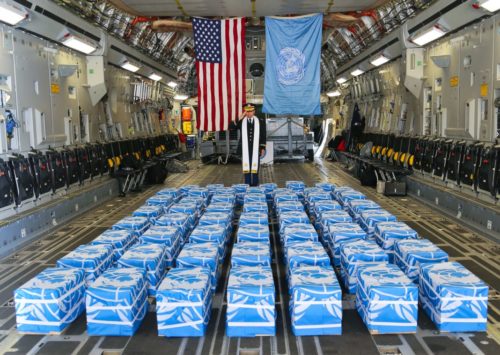
    On Aug. 1, the 55 cases were flown back to the U.S. aboard two Air Force C-17 Globemasters to Hickam Air Force Base in Hawaii for an “honorable carry” ceremony.

    “Our boys are coming home,” Vice President Mike Pence, who presided at the ceremony, said.

    It’s too early to say how many individuals may be represented by the remains in the 55 cases, Byrd said. In past repatriations, several individuals’ remains were represented in one box, he said.

    The early indications are that the remains in the 55 cases are those of Americans, and “they are certainly remains that can be looked at and tested,” he said.

    DNA samples from the remains are to be sent later this month to the Armed Forces DNA Identification Laboratories at Dover Air Force Base in Delaware to begin the process of matching them against the existing DNA database from more than 90 percent of the families of the missing.

    Charles Jr. had already given a DNA sample, but his brother had not. To aid in the identification process, Larry McDaniel had his mouth swabbed for a DNA sample right after he and his brother were presented with the dog tag.

    Again, a promising gesture from the North Koreans. Thanks for the update, AnotherPat.

  • The lone dog tag recovered from North Korea had a name

    home bound

    After a solemn ceremony at Hickam, the hard work begins in identifying the remains. One family is a step nearer to closure, with the discovery of a single dog tag among the relics that the North Koreans returned with the remains.

    The Military Times reports the military has contacted the family of a service member missing from the Korean War. whose dog tag was found among the 55 cases of war remains repatriated to the U.S. on Thursday.

    His family will be presented that tag in Arlington, Va., next week as they arrive with hundreds of others for an annual meeting on the efforts to find their missing family members.

    The dog tag was among the cases of human bones and a limited number of artifacts, such as boots, buttons and buckles that North Korea said came from the village of SinHung-Ri, location of the 1950 Battle of Chosin Reservoir, said John Byrd, chief scientist for the Defense POW/MIA Accounting Agency.

    More than 3,000 U.S. Marines and soldiers perished at Chosin, and more than 12,000 were wounded in one of costliest battles of the war. Byrd said the North Koreans said the bones came from the eastern side of the village, which leads him to believe they are likely Army remains.

    More than 5,300 U.S. remains are still missing in North Korea.

    Byrd, who participated in previous remains transfers from North Korea before those exchanges were suspended in 2005, rode on the C-17 into Wonson, North Korea, last Friday. There on the ground, he was greeted by North Korean officers who showed him the contents of the boxes. Byrd said he performed a cursory review of bones to verify they were human.

    “That was confirmed in Wonson before we actually loaded the boxes onto the C-17,” Byrd said.

    The article in it’s entirety can be found here:

    Military Times Link

    A promising gesture in relations with North Korea, but the path ahead is still in question.

  • North Koreans may repatriate 55 sets of servicemen’s remains next week

    AW1Ed sends us a link from Stars & Stripes which reports that the North Korean government may allow 55 sets of MIA/KIA remains to the United States as early as next week;

    The Americans planned to send transit cases via truck to the DMZ, where they would be given to the North Koreans to use for the remains. “They’re going to use our cases for the remains and give them back to us,” the official told Stars and Stripes.

    A U.S. delegation was expected to retrieve the remains in North Korea and fly them out on July 27, either to Osan Air Base in South Korea or Hawaii, the official said, adding that the date may change as the two sides planned to iron out final details during another meeting in the near future.

    The date would be symbolic as it marks the 65th anniversary of the signing of the armistice that ended the war instead of a peace treaty.

  • Norks show up for repatriation talks

    According to Stars & Stripes, a North Korean delegation showed three days late for talks about repatriation of missing US servicemen at Panmunjom;

    The North Korean side was led by a two-star general, according to the Yonhap News Agency, which said it was the first military talks between the U.S.-led United Nations Command and the North in more than nine years.

    More than 7,700 U.S. troops are still missing in action from the brutal, three-year war, with an estimated 5,300 believed to have been lost in the North, according to the U.S. Defense POW/MIA Accounting Agency.

    The agency says that North Korean officials have indicated they have “as many as 200 sets of remains” already recovered that could be ready for return.

    The meeting was supposed to be on Thursday, but the North Koreans rescheduled the meeting for today.

  • Norks are no-shows at repatriation talks

    Norks are no-shows at repatriation talks

    According to Stars & Stripes, the North Korean delegation was a no-show at scheduled talks for repatriation of servicemembers’ remains at Panmunjom today;

    The no-show fuels growing skepticism over the North’s commitment to the “complete denuclearization” of the Korean Peninsula as promised during the June 12 summit between President Donald Trump and North Korean leader Kim Jong Un.

    Secretary of State Mike Pompeo announced that the talks would be held in the truce village of Panmunjom after his fraught visit to North Korea last week, although he added the caveat that “it could move by one day or two.”

    Officials from the Defense POW/MIA Accounting Agency traveled to the U.N.-controlled area in the heavily fortified border for the meeting but the North Koreans never showed up, according to official sources.

    South Korean media also reported that the North Koreans didn’t show up, citing government officials.

    This is my shocked face. While I hoped against hope, I kind of figured that the North Koreans were just playing games. There’s still time for them to salvage the talks and peace on the peninsula, but my money is staying in the bank.

  • North Korea erasing most anti-US propaganda

    NORK Doves
    The New York Post reports the North Korean government is erasing much of its anti-U.S. propaganda following dictator Kim Jong-un’s sorties onto the world stage.

    Posters portraying the U.S. as a “rotten, diseased, pirate nation” and promising “merciless revenge” on American forces for any attack on the Hermit Kingdom have disappeared.

    In their place are cheery messages touting praising the prospects for Korean reunification and the declaration Kim signed in April with South Korean President Moon Jae-in promising “lasting peace,” according to reports.

    Still the most isolated country in the world, very few North Koreans have access to news and information from the outside world. So state propaganda plays a huge role in shaping their views.

    Murals, banners and posters displayed throughout the capital, Pyongyang, have for decades depicted the U.S. as a brutal, imperialist aggressor hell-bent on destroying the North Korean regime. South Korea and Japan were also frequently targeted as willing allies of the U.S.

    But things started to take an Orwellian turn in the run-up to Kim’s June 12 summit with President Donald Trump, with the old posters vanishing since then.

    “All the anti-American posters I usually see around Kim Il-sung Square and at shops, they’ve all just gone,” Rowan Beard, a tour manager at Young Pioneer Tours, told Reuters. “In five years working in North Korea, I’ve never seen them completely disappear before.”

    Infamous posters and postcards showing North Korean missiles on their way to Washington are a thing of the past. Also removed are the anti-American trinkets that used to be sold to tourists as souvenirs. In their place are items showing themes of Korean reunification.

    Meeting with Presidents Trump and Moon, removing the loud speakers at the DMZ, repatriating our KIAs, dismantling a nuke test site (OK, it was pretty much done anyway, but still…), no test missiles fired in months, talks involving removing artillery from the DMZ, and now a propaganda Sea Change. I’m still cautiously optimistic, but the facts on the ground thus far are the process seems to be working. Now if only the Lame Stream Media would take notice…