The Navy Times tells the story of Chief Petty Officer Aniahau Desha, Hospitalman Gaston Yescas, Petty Officer 1st Class Sheldon Lucius, and Petty Officer 3rd Class Joshua Essick, all members of the All-Navy Men’s Vollyball team, were at Naval Station Mayport beach in Florida with their families last week when they heard some women calling for help;
“We’d just sat down, and some ladies came up the beach were yelling for help, seeing that the girls were out in the waves, needing help. They were in trouble, so we just ran into the water and got them,” Desha told U.S. Armed Forces Sports.
The sailors, members of the All-Navy Men’s Vollyball team, pulled both girls out of the water, performing CPR on one until emergency personnel arrived.
“When we got on shore, as soon as I picked her up, I noticed that she wasn’t breathing. It was obvious that she wasn’t breathing. I checked for her pulse ? there was no pulse. So we immediately started chest compressions and mouth-to-mouth,” said Desha.
The girl has since been released from the hospital.
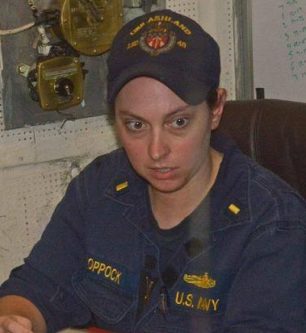
The Stars & Stripes reports that Lieutenant Junior Grade Sarah Coppock pleaded guilty to the charge of dereliction of duty in her role that caused the collision of the USS Fitzgerald with a civilian commercial vessel, ACX Crystal, on June 17, 2017 off the Japanese coast;
The Fitzgerald’s commanding officer, Cmdr. Bryce Benson, was not on deck at the time of the collision. Coppock was charged for failing to “communicate and coordinate with the Combat Information Center, report ship specified contacts to the commanding officer, operate safely in a high density traffic condition and alert crew of imminent collision,” according to the charge sheet.
Coppock was charged along with two unnamed junior officers on board the Fitzgerald.
The Fitzgerald was navigating out to sea near Yokosuka Port in Japan when it failed to recognize the dangers of three ships heading across its path.
They were close enough to present risk of collision, according to a U.S. Navy report. Two of the ships maneuvered to avoid a collision — one coming particularly close. The report said Coppock was responsible to alert the commanding officer after that close call. The third, called the ACX Crystal, did not.
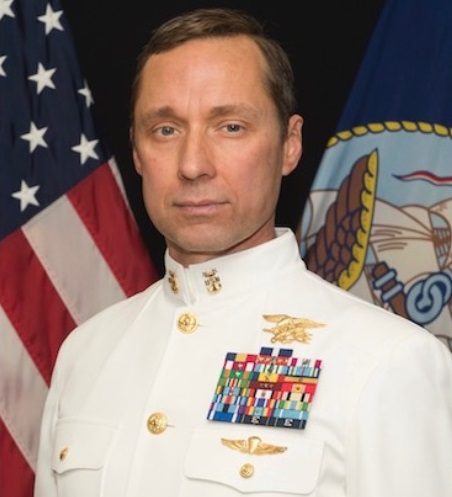
According to WhiteHouse.gov Retired Master Chief Special Warfare Operator Britt K. Slabinski will get his Navy Cross stepped up to the Medal of Honor on May 24th for his actions on Roberts Ridge on March 2002. His citation for the Navy Cross reads;
For extraordinary heroism as Sniper Element Leader for a joint special operations unit conducting combat operations against enemy forces during Operation Anaconda, Sahi-Kot Valley, Afghanistan on 3 and 4 March 2002, in support of Operation Enduring Freedom. On the evening of 3 March, Senior Chief Petty Officer Britt Slabinski led his seven-man reconnaissance team onto the snow-covered, 10,000 foot mountaintop known as Takur Ghar, to establish a combat overwatch position in support of U.S. Army forces advancing against the enemy on the valley floor. As their helicopter hovered over the mountain it was met by unrelenting rocket propelled grenade (RPG) and small arms fire by entrenched enemy forces. As a result of several RPG hits, a member of Senior Chief Petty Officer Slabinski ‘s team was ejected from the helicopter into the midst of the fortified enemy positions. The badly damaged helicopter conducted a controlled crash, at which time Senior Chief Petty Officer Slabinski immediately took charge and established security on the crash location until the crew and his team were recovered to a support base. At this point, Senior Chief Slabinski fully aware of the overwhelming, fixed, enemy forces over the mountain, but also knowing the desperate situation of his missing teammate, now reportedly fighting for his life, without hesitation made the selfless decision to lead his team on an immediate, bold rescue mission. He heroically led the remainder of his SEAL element back onto the snow-covered, remote, mountaintop into the midst of the numerically superior enemy forces in a daring and valiant attempt to rescue one of their own. After a treacherous helicopter insertion onto the mountaintop, Senior Chief Petty Officer Slabinski led his close quarter firefight. He skillfully maneuvered his team and bravely engaged multiple enemy positions, personally clearing one bunker and killing several enemy within. His unit became caught in a withering crossfire from other bunkers and the closing enemy forces. Despite mounting casualties, Senior Chief Petty Officer Slabinski maintained his composure and continued to engage the enemy until his position became untenable. Faced with no choice but a tactical withdrawal, he coolly directed fire from airborne assets to cover his team. He then led an arduous movement through the mountainous terrain, constantly under fire, covering over one kilometer in waist-deep snow, while carrying a seriously wounded teammate. Arriving at a defensible position, he organized his team’s security posture and stabilized his casualties. For over fourteen hours, Senior Chief Petty Officer Slabinski directed the defense of his position through countless engagements, personally engaging the enemy and directing close air support onto the enemy positions until the enemy was ultimately defeated. During this entire sustained engagement, Senior Chief Petty Officer Slabinski exhibited classic grace under fire in steadfastly leading the intrepid rescue operation, saving the lives of his wounded men and setting the conditions for the ultimate vanquishing of the enemy and the seizing of Takur Ghar. By his heroic display of decisive and tenacious leadership, unyielding courage in the face of constant enemy fire, and utmost devotion to duty, Senior Chief Petty Officer Slabinski reflected great credit upon himself and upheld the highest traditions of the United States Naval Service.
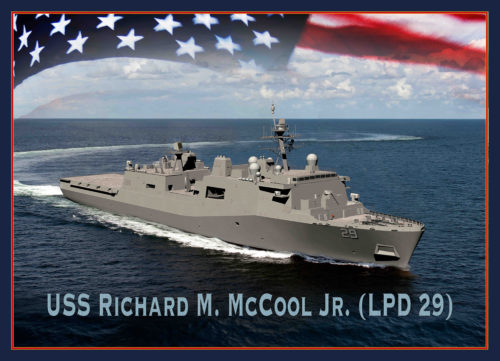
The Navy News Service reports that SecNav Richard Spencer has announced the Navy’s newest San Antonio-class amphibious transport dock ship, LPD 29, will be named in honor of Navy veteran and Medal of Honor recipient, Capt. Richard M. McCool Jr.
He was born on 04 January 1922 in Oklahoma. He graduated from high school at the age of 15, and from the University of Oklahoma with a degree in political science.
After the bombing of Pearl Harbor in 1941, he was accepted into a new Navy ROTC program, and later then was appointed to the Naval Academy. He graduated from the U.S. Naval Academy in 1944 (his class of 1945 graduated a year early).
By June 10, 1945, he was serving as a lieutenant, commanding USS LCS(L)(3)-122, a Landing Craft Support ship. On that day, off the coast of Okinawa Island, McCool helped rescue the survivors of sinking destroyer USS William D. Porter, (DD-579). The next day, his own ship was hit by a Japanese kamikaze. Although he suffered severe burns and shrapnel wounds in the initial explosion, McCool continued to lead his crew in the firefighting and rescue efforts until relief arrived.
He continued to serve in both the Korean and Vietnam Wars. He retired at the rank of Captain in 1974 after a 30-year career. McCool passed of natural causes on 05 March 2008, at the age of 86 in a hospital in Bremerton, Washington.
On 18 December 1945, President Harry S. Truman presented McCool with the Congressional Medal of Honor for his heroism.
Lieutenant McCool’s official Medal of Honor citation reads:
For conspicuous gallantry and intrepidity at the risk of his life above and beyond the call of duty as commanding officer of the USS LCS(L)(3)-122 during operations against enemy Japanese forces in the Ryukyu chain, 10 and 11 June 1945. Sharply vigilant during hostile air raids against Allied ships on radar picket duty off Okinawa on 10 June, Lt. McCool aided materially in evacuating all survivors from a sinking destroyer which had sustained mortal damage under the devastating attacks. When his own craft was attacked simultaneously by 2 of the enemy’s suicide squadron early in the evening of 11 June, he instantly hurled the full power of his gun batteries against the plunging aircraft, shooting down the first and damaging the second before it crashed his station in the conning tower and engulfed the immediate area in a mass of flames. Although suffering from shrapnel wounds and painful burns, he rallied his concussion-shocked crew and initiated vigorous firefighting measures and then proceeded to the rescue of several trapped in a blazing compartment, subsequently carrying 1 man to safety despite the excruciating pain of additional severe burns. Unmindful of all personal danger, he continued his efforts without respite until aid arrived from other ships and he was evacuated. By his staunch leadership, capable direction, and indomitable determination throughout the crisis, Lt. McCool saved the lives of many who otherwise might have perished and contributed materially to the saving of his ship for further combat service. His valiant spirit of self-sacrifice in the face of extreme peril sustains and enhances the highest traditions of the U.S. Naval Service.
The Navy returns to the tradition of naming warships after significant events, places, and most importantly, people. It’s a welcome change from the previous administration’s practices.
According to Stars & Stripes, Gunner’s Mate 2nd Class Aaron A. Booker stole 20 MK3A2 concussion hand grenades from a locker aboard USS Pinckney, a San Diego-based Navy destroyer. Only 15 sailors had access to the locker containing 60 grenades. An inventory early last year revealed the loss of 20 grenades at about the same time that Booker was transferring to a new assignment at Great Lakes.
Booker denied involvement in the loss to NCIS investigators;
About a month later, on April 20, 2017, the grenades turned up — or most of them.
An off-duty Orange County sheriff’s deputy was driving on Interstate 15 in northwest Arizona and spotted a backpack leaning on a guardrail on the side of the road. The black backpack was standard-issue military with “GM2 Booker” handwritten on an inside tag.
Arizona highway patrol officers and the FBI found inside 18 grenades with the same lot number as the missing explosives.
In a second interview, Booker admitted that the bag was his and that he’d taken the route, but said the backpack had been stolen from him about a year ago after he’d left it in the Pinckney’s armory. He stated he was especially upset about the theft because the bag had a GM pin on the front that was hard to replace.
Then he called NCIS and told them that the two missing grenades made their way to Tijuana with a motorcycle club.
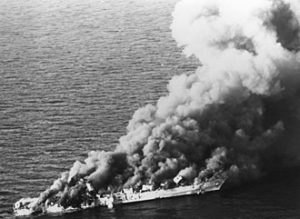
U.S. Navy photograph of Iranian frigate, Sahand, burning.
Three years ago, the Iranians demonstrated how they were going to defeat the U.S. Navy. Center to their demonstration was a life-sized mock aircraft carrier. Just sitting there waiting to be punished.
Their media was there, so where high-ranking Iranian politicians, generals, and admirals.
Then, their demonstrations began. One wave of war craft after another conducted “complex” military maneuvers before assaulting the “US aircraft carrier”. They approached and reenacted Rambo on water, showing that carrier “who was boss”.
The Iranians had a message. It went something like this, “Mess with us America and we will send you to the bottom of the Persian Gulf.”
However, they didn’t just have a message for us. They had a message for their rivals in the region. It was something like this, “Don’t mess with our interests and us, we intend to expand and strengthen our influence.” They also had a message for their own people, something like this, “Glory to the revolution, we are here to stay.”
We know; however, that they’re going to pretend all they want. A look at history three decades ago, this day, should remind them of a message that we sent them… If they even bothered learning from their own mistakes.
Our message went something like this, “Mess with us and we will pulverize you, send your ships to the bottom of the Arabian Gulf, sweep them aside, etc, and show you and the Iranian people how terrible your military is.”
It was priceless when U.S. Navy personnel informed the Iranian Navy personnel that the former intended to hammer the later.
This was Operation Praying Mantis, a sea battle between the U.S. Navy and the Iranian Navy that took place 30 years ago today:
Naval aircraft and the destroyer USS Joseph Strauss (DDG 16) sank the Iranian frigate Sahand (F 74) with harpoon missiles and laser-guided bombs. A laser-guided bomb, dropped from a Navy A-6 Intruder, disabled frigate Sabalan (F 73), and Standard missiles launched from the cruiser USS Wainwright (CG 28) and frigates USS Bagley (FF 1069) and USS Simpson (FFG 56) destroyed the 147-foot missile patrol boat Joshan (P 225). In further combat, A-6s sank one Bodghammer high-speed patrol boats and neutralized four more of the speedboats.
Other branches of the military also participated in this operation. This was part of a larger operation, Operation Earnest Will.
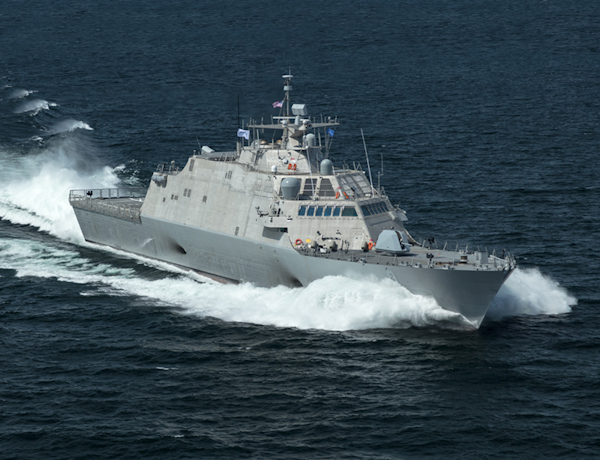
Because no one in the Navy is familiar with winter months and the effect those months have on the Saint Lawrence Seaway, USS Little Rock had to spend the season in Montreal when the Seaway, for some odd reason, froze over after the christening ceremony for the ship in Buffalo last December.
Mother Nature finally allowed the littoral combat ship through to return to Naval Station Mayport, Florida according to reports;
USS Little Rock is the 11th littoral combat ship (LCS) to be delivered to the Navy and the fifth of the Freedom variant to join the fleet. The U.S. Navy accepted delivery of the vessel during a ceremony on September 25, 2017 at the Fincantieri’s Marinette Marine (FMM) shipyard in Marinette, Wisconsin, where the Freedom variant ships are built.
Little Rock’s departure from Montreal comes just a few days after the opening of the St. Lawrence Seaway’s navigation season.
She is expected to arrive in Florida next month after making several port visits along the way.
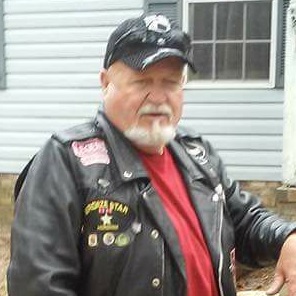
Someone sent us their work on this Kelly Clark fellow. The leadership of the Combat Veterans Motorcycle Association tried to get him to remove the Bronze Star Medal patch on his vest (in the picture above), but he refused claiming that he had been awarded the Bronze Star Medal. The Association stuck by their guns and Clark quit.
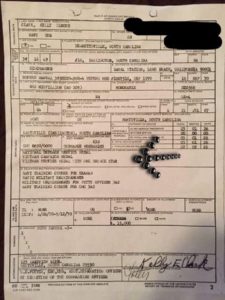
Looking at his DD214, Clark served aboard USS Mispillion (AO-105), an Ashtabula-class oiler, probably while it was stationed off the coast of Vietnam for seven months in 1967 servicing the ships involved in Yankee Station.
Clark left the Navy in 1970 as an E-3 Gunner’s Mate. His discharge says that he was awarded a Vietnam Service Medal with a Bronze Service Star, meaning that he was stationed off the coast of Vietnam during a particular campaign. A Bronze Service Star is very different from a Bronze Star Medal and Mr Clark should know that without being told.
He has a reenlistment code of RE-4 which means that he wasn’t eligible for reenlistment for some reason or another.