Category: Navy

  • “What do they call the Anchor Man at USNA?”

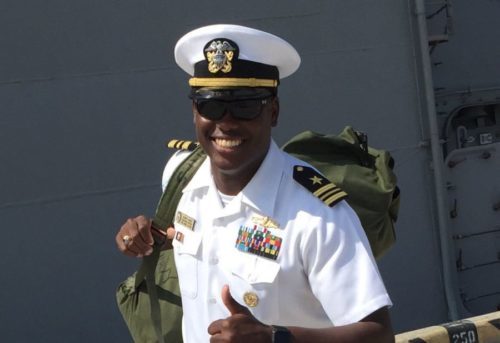
    JonesBobby Rashad Jones was the midshipman with the lowest grade-point average in the Naval Academy Class of 2001, known as the anchor — so when he walked across stage at graduation, he was so overcome with emotion that he gave then-President George W. Bush a bear hug. After overcoming the embarrassment, Jones soon took that experience and transformed it into a successful Navy career.

    “Ensign” if he can keep it. The link and story was forwarded to me by a member who wishes to remain anonymous. So in acknowledgement of the season, here’s a “hometown lad does good” feel good story.

    Whatever happened to the Navy midshipman who gave President Bush a bear hug? Discipline — then redemption.By BROCK VERGAKIS | The Virginian-Pilot

    VIRGINIA BEACH, Va. (Tribune News Service) — Bobby Rashad Jones couldn’t help himself.

    He was the midshipman with the lowest grade-point average in the Naval Academy Class of 2001 – known as the anchor – and was overwhelmed with joy to receive his commission after spending years on academic probation.

    President George W. Bush was the commencement speaker in Annapolis and cordially shook hands with each graduate. But as Jones walked across the stage at Navy-Marine Corps Memorial Stadium, the crowd roared in support for the “anchor.”

    Jones was a football player who was well known on campus, partly because tradition calls for each graduating midshipman to pay the class anchor $1.

    He could’ve chosen a more glamorous life and played football at a powerhouse program like Florida. Or he could’ve done without the stress of military life by going to an Ivy League school. And he could’ve left the academy when it all seemed so overwhelming after his first semester to join friends at the University of North Carolina.

    But he stayed because he wanted to be part of something bigger than himself – and he had made it.

    As he walked toward Bush, the excitement was too much to contain.

    He jumped up and down. His head shook. He pumped his right fist in the air.

    A presidential handshake simply wouldn’t do.

    The former linebacker grabbed Bush’s hand, pulled him in and hugged the commander-in-chief. And not just any hug; a bear hug that briefly lifted Bush off the ground as part of what Jones would later describe as an “out-of-body experience.”

    “I’m thinking it’s not a serious hug, not realizing I just got through playing football. The president is not that heavy. I didn’t realize I picked the man up,” Jones said in an interview this week at his office at Joint Expeditionary Base Little Creek.

    The academy’s sports information department said he was listed as 6-foot-2, 235 pounds when he played football.

    “My sister thought I was going to get shot, my mom was trying to take pictures and my dad was like ‘What the hell is he doing?’ ”

    A lot of people laughed. Navy leadership did not. An officer on stage physically pulled Jones off the president by his uniform.

    The article goes on to describe how Bobby began with a rocky start, but through perseverance and hard work overcame the challenges, and succeeded. It’s a bit lengthy, but worth the read. Find it here at The Stars and Stripes.
  • 1919 – Yeomen (f) and Marinettes Final Pass in Review

    1919 – Final Pass in Review of the US Navy’s Yeomen (f) and female Marinettes – the film is of Secretary of the Navy Daniels inspecting the female volunteers, the Yeomen (f) and Marinettes.

    http://www.criticalpast.com/video/65675027182_girls-of-navy_Secretary-Daniels_farewell-to-girls_officers-walking

    That video is brief, is available at Critical Past, where a lot of archival footage is being held and restored. If you look closely, you may see some young versions of people like Franklin Roosevelt included in this footage.

    The history of the US Navy’s recruiting women for positions as Yeomen (f) and as Marinettes came about under the Naval Act of 1916.

    https://www.archives.gov/publications/prologue/2006/fall/yeoman-f.html

    “The Act’s vague language relating to the reserve forces did not prohibit women from enlisting. The act declared that the reserve force within the U.S. Navy would consist of those who had prior naval service, prior service in merchant marines, were part of a crew of a civilian ship commissioned in naval service, or “all persons who may be capable of performing special useful service for coastal defense.” This last element contained the loophole that allowed women to enlist.” – Archives.gov.

    Although recruited ostensibly for clerical work, these women filled many other positions, to relieve men in stateside slots for duty at sea and in Europe.

    Their service officially ended in 1919. A few remained in service in the Reserves until 1922, but the last Yeoman (f) was discharged in March 1921. This led into the creation of WAVES in World War II, recruiting women for almost all positions normally filled by men to release men on shore duty to overseas and shipboard positions.

    And we have never stopped serving since….

  • Argentine Navy submarine may have ‘imploded’

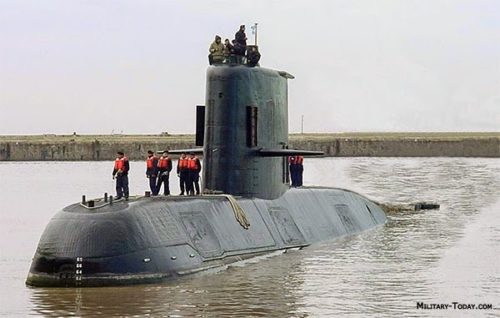
    tr1700The missing Argentinian submarine has been discovered 2,600 feet deep in the Atlantic Ocean.
    photos show wreckage on sea floor
    By Travis Fedschun | Fox News

    The Argentine submarine that was lost deep in the sea with 44 crew members on board may have suffered from a partial implosion close to the seabed, a senior official said Sunday as officials released photos of the wreckage.

    The country’s navy announced Saturday that the ARA San Juan was discovered at a depth of 2,975 feet in the waters off the Valdes Peninsula and was surrounded by a field of rubble, with underwater turbulence making visibility difficult.

    Naval Capt. Enrique Balbi said the working theory was that the vessel had partially imploded while at sea, deep down near the seabed, Sky News reported.

    Photos released on Sunday showed the wreckage of the submarine in the Atlantic Ocean, with sections of the vessel lying on the ocean floor. Parts of its propellers were buried and debris was scattered up to 230 feet away.

    The pieces of the submarine, which included a propeller and the sub’s bow with torpedo launching tubes, had been “crushed inwards,” according to Balbi.

    Fair winds and following seas.

    The rest of the article may be found at Fox News

  • SEAL Murders ISIS fighter, Holds Ceremony on Scene

    In the PSYOP community, a joke goes around about how a PSYOP team could “Go rogue”. Psychological Operations teams are attached to units to provide PSYOP support to the unit’s commander. Not permanently assigned, they could fall though the cracks if they don’t keep engaged. Of course, this doesn’t involve violations of war crimes, laws, or regulations. The team just “does its own thing”. Not encouraged.

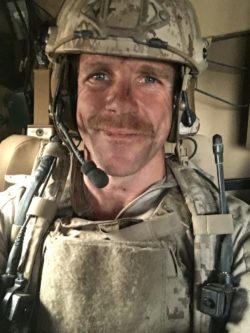
    What’s definitely frowned upon is going rogue with regards to violating the rules of land warfare. In this situation, we have a Navy SEAL who murdered an ISIS combatant, then conducted an enlistment ceremony in the area.

    Special Operations Chief Edward Gallagher would’ve been eligible to retire, from active duty, next year. Instead, he’s looking at another future. From NBC San Diego:

    U.S. Navy prosecutors accuse Gallagher of premeditated murder for the stabbing death of an injured ISIS fighter who they estimate was about 15 years old.

    And

    On Wednesday, the Navy outlined its evidence including cell phone photos that show Gallagher holding the severed head of the fighter during a reenlistment ceremony.

    According to the article, Gallagher was ranked as number one SEAL chief, his platoon was also ranked as number one. He once had the option to either retire proudly, or continue his service facing better opportunities than others.

    Underneath the high praises; however, those who served with him associated him with poor judgement. This includes shooting into Iraqi civilians.

    The New York Times was graphic with its description:

    But now, less than a year later, Special Operations Chief Gallagher, 39, is locked in the brig, facing charges that during that same deployment — his eighth — he shot indiscriminately at civilians, killed a teenage Islamic State fighter with a handmade custom blade, and then performed his re-enlistment ceremony posing with the teenager’s bloody corpse in front of an American flag.

    Navy SEALs who were with him reported the things that he did, to include:

    * Being reckless
    * Being bloodthirsty
    * Firing into crowds of noncombatants
    * Shooting a walking girl
    * Shooting an old man
    * Threatening to kill those that intended to report these events

    It got to the point that his own team members messed with his weapon’s accuracy. They also benefited civilians with warning shoots to give them a chance to escape. His actions took away from efforts needed to engage the enemy.

    You could read more here and over here. Good reads. The above photo is from the New York Times.

  • 108 years ago, the Navy launched a plane from a ship for the first time

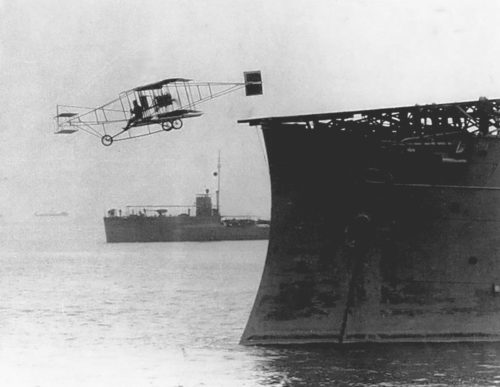
    first launchEugene Ely flies his Curtiss Pusher biplane from the USS Birmingham, in Hampton Roads, Virginia, on Nov. 14, 1910. (Navy)
    On Nov. 14, 1910, the U.S. military took its first step toward linking flight and naval operations when Eugene Ely made the first carrier takeoff, guiding a Pusher biplane off the deck of the light cruiser USS Birmingham in the waters of Norfolk, Virginia.

    The Navy tapped Capt. Washington Irving Chambers — who has been called “the father of naval aviation” — earlier that year “to observe everything that will be of use in the study of aviation and its influence upon the problems of naval warfare,” according to the Smithsonian.

    Chambers recognized the utility of shipborne landings and takeoffs.

    At a flying event in Belmont Park, New York, in October 1914, Chambers asked planemaker Glenn Curtiss and Ely if they would attempt to land on a ship if he supplied one. (Another account has Curtiss and Ely making the offer, and Chambers saying he had no money to finance the experiment but would provide a ship.)

    On November 14 — a Monday soiled by fog and intermittent rain — a Curtiss Pusher biplane with floats mounted under the wings was loaded aboard the Birmingham. The U.S. Naval Institute identifies the aircraft as a Hudson Fulton Flyer.

    The cruiser was equipped with an 83-foot runway on its deck, but that length meant Ely only had 57 feet to take off.

    The original plan was to steam into the Chesapeake Bay and launch the plane while underway, which would provide extra lift, but it was foiled by the weather.

    That afternoon, Ely launched his biplane from Birmingham’s deck while the ship was as anchor.

    After his wheels left the deck, Ely guided the plane toward the water to build up speed. But he miscalculated, and witnesses watched as the plane smacked into the water and bounced back into the air. The collision damaged the propeller and sprayed Ely’s goggles with saltwater.

    After less than five minutes in the air, Ely set the plane down on a nearby beach. He had flown less than 3 miles.

    And they said it would never fly. From that first take-off, they were nearly right!

    Read the entire article at The Navy Times of course.

  • Navy Mines Explode near Vietnam

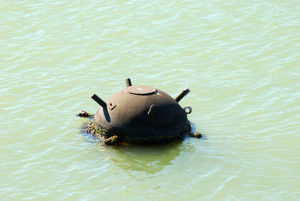
    In 1972, the US Navy dropped sea mines off the coast of Vietnam south of Haiphong to disrupt supply shipping to North Vietnam. No, not like the mine in the photo. They looked more like torpedoes.

    In August of 1972, Navy ships’ crews watched while these mines detonated for no obvious reason. In reviewing archived and now declassified materials, the conclusion is that a magnetic solar storm on the order of a Carrington event caused the detonations.

    Space Weather has published a report on the solar research involved in this. It is available as a pdf at this link: https://agupubs.onlinelibrary.wiley.com/doi/full/10.1029/2018SW002024

    This is one part of the abstract:

    Abstract:

    Today the extreme space weather events of early August 1972 are discussed as benchmarks for Sun-Earth transit times of solar ejecta (14.6 hr) and for solar energetic particle fluxes (10 MeV ion flux >70,000 cm?2·s?1·sr?1). Although the magnetic storm index, Dst, dipped to only ?125 nT, the magnetopause was observed within 5.2 RE and the plasmapause within 2 RE. Widespread electric and communication grid disturbances plagued North America late on 4 August. There was an additional effect, long buried in the Vietnam War archives that add credence to the severity of the storm impact: a nearly instantaneous, unintended detonation of dozens of sea mines south of Hai Phong, North Vietnam on 4 August 1972. The U.S. Navy attributed the dramatic event to magnetic perturbations of solar storms. Herein we discuss how such a finding is broadly consistent with terrestrial effects and technological impacts of the 4 August 1972 event and the propagation of major eruptive activity from the Sun to the Earth. We also provide insight into the solar, geophysical, and military circumstances of this extraordinary situation. In our view this storm deserves a scientific revisit as a grand challenge for the space weather community, as it provides space?age terrestrial observations of what was likely a Carrington?class storm.

    The original and now declassified report from 1972 is held in Texas Tech University’s Vietnam archives. It is 143 pages long, divided into 3 pdfs, if you want to read it.

    The pdfs are at this link:  https://vva.vietnam.ttu.edu/repositories/2/digital_objects/83295

    Title: U.S. Navy Report, Mine Warfare Project Office – The Mining of North Vietnam, 8 May 1972 to 14 January 1973

    Item Number: 1070416001

    A Carrington event refers to the extreme solar storm and flare that overheated telegraph wires, which were noninsulated copper, and set some telegraph offices on fire. The solar storm of 1859 was a powerful geomagnetic solar storm during solar cycle 10 (1855–1867). A solar coronal mass ejection (CME) hit Earth’s magnetosphere and induced one of the largest geomagnetic storms on record, September 1–2, 1859.

    Things have changed considerably since then, including several solar CMEs that just missed our planet by a hair.

    As everything moves more and more toward high-end technology dependent on what are essentially radio signals, there is widespread speculation on what will happen to all of that technojunk that people depend on now.  Maybe the old-fashioned windup stuff isn’t so dated, after all.

  • Navy crew ejects from strike fighter over Philippine Sea

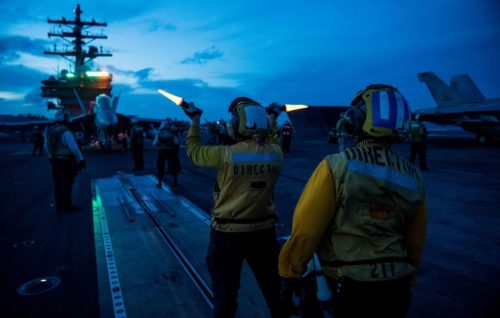
    flight deckCrew members from the aircraft carrier Ronald Reagan on July 6 direct an F/A-18F Super Hornet from Strike Fighter Squadron 102. The Reagan was sailing the Philippine Sea. (MC2 Kenneth Abbate/Navy)
    …cause of mechanical glitch under investigation
    By: Carl Prine

    An F/A-18F Super Hornet strike fighter assigned to the aircraft carrier Ronald Reagan suffered what authorities say was a “mechanical issue” during “routine operations” on Monday over the Philippine Sea, forcing the crew to eject.

    A search and rescue MH-60S Seahawk from the “Golden Falcons” of Helicopter Sea Combat Squadron 12 retrieved the Carrier Air Wing 5 crew, and medical personnel aboard the Reagan pronounced both aviators to be in “good condition,” according to the Japan-based 7th Fleet.

    Officials said that the carrier had resumed normal operations and the crash is under investigation.

    The F/A-18F is the two-seat variant for the Super Hornet.

    Not the E Ticket ride I would want to take. The good news is both were recovered. A large part of that outcome is the emergency radios and other signaling devices that were available to them, and they were trained to use. Its a very big ocean, SAR crews need all the help they can get for a sucessful rescue.
    The rest of the article may be found at The Navy Times

    lima beans

  • Valor Friday

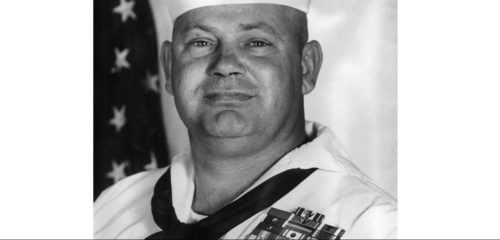
    Willy WilliamsWilly Williams, the most decorated enlisted sailor in Navy history

    In the history of the U.S. Navy only seven men have earned all of the “Big Three” valor awards: Medal of Honor, Navy Cross and Silver Star Medal. Six were World War II officers, including one aviator and four submarine commanders. The seventh was enlisted sailor James Elliott “Willy” Williams in Vietnam.

    In 1947, Williams, a 16-year-old from Fort Mill, South Carolina, enlisted in the Navy with a fraudulent birth certificate. His first 19 years in the Navy included service aboard the destroyer USS Douglas H. Fox during the Korean War and tours on a variety of naval vessels from 1953 to 1965.

    In May 1966 Boatswain’s Mate 1st Class Williams was assigned to River Squadron 5 in South Vietnam to command Patrol Boat, River 105. The approximately 30-foot fiberglass boat usually carried a four-man crew who patrolled inland waterways to prevent the Viet Cong from using them to transport troops and supplies.

    On July 1 Williams led a patrol that came under fire from a Viet Cong sampan. His deft maneuvers and accurate fire killed five VC and resulted in capture of the enemy boat, earning Williams a Bronze Star Medal with a “V” for valor. Twenty-two days later the capture of another sampan brought Williams a second Bronze Star for valor. Less than a month later, he received a Silver Star and his first Purple Heart.

    On Halloween, Oct. 31, 1966, Williams was commanding a two-boat patrol on the Mekong River when he was fired on by two sampans. He and his crew killed the occupants of one and then went after the other. That pursuit put the Navy boats into a VC staging area containing two junks and eight sampans, supported by machine guns on the river banks. Williams called for helicopter gunship support while holding the enemy at bay. During this movement he discovered an even larger force. Not waiting for the armed helicopters, Williams attacked. Maneuvering through devastating fire from enemy boats and the shore, his two-boat patrol fought a three-hour battle that destroyed or damaged 65 VC boats and eliminated some 1,200 Communist troops. For his actions, Williams was nominated for the Medal of Honor.

    On Jan. 9, 1967, the Navy dredge Jamaica Bay was blown up by mines in the Mekong Delta, and PBR-105 arrived to pick up seven of the survivors. Another man was trapped in the rapidly sinking dredge. Williams dove into the water and, with a rope attached to a nearby tug, pulled clear an obstruction, then swam through a hatch to recover the sailor.

    Six days later Williams was wounded while leading a three-boat patrol that interdicted a crossing attempt by three VC heavy-weapons companies of 400 fighters. He and his boats accounted for 16 VC killed, 20 wounded and the destruction of nine sampans and junks. Williams was awarded the Navy Cross.

    When Williams returned home in spring 1967, he had a list of awards unmatched by any enlisted man in Navy history. He retired after 20 years of service and began a career in the U.S. Marshals Service.

    During his last seven months in the Navy, Williams received every sea-service award for heroism including the Legion of Merit with “V,” two Navy Commendation Medals for valor and three Purple Hearts.

    Williams died on Oct. 13, 1999, and in 2003 his widow, Elaine, watched the launching of the Arleigh Burke class destroyer, USS James E. Williams.

    MEDAL OF HONOR CITATION:

    For conspicuous gallantry and intrepidity at the risk of his life above and beyond the call of duty. BM1 Williams was serving as Boat Captain and Patrol Officer aboard River Patrol Boat (PBR) 105 accompanied by another patrol boat when the patrol was suddenly taken under fire by 2 enemy sampans. BM1 Williams immediately ordered the fire returned, killing the crew of 1 enemy boat and causing the other sampan to take refuge in a nearby river inlet. Pursuing the fleeing sampan, the U.S. patrol encountered a heavy volume of small-arms fire from enemy forces, at close range, occupying well-concealed positions along the river bank. Maneuvering through this fire, the patrol confronted a numerically superior enemy force aboard 2 enemy junks and 8 sampans augmented by heavy automatic weapons fire from ashore. In the savage battle that ensued, BM1 Williams, with utter disregard for his safety exposed himself to the withering hail of enemy fire to direct counter-fire and inspire the actions of his patrol. Recognizing the over whelming strength of the enemy force, BM1 Williams deployed his patrol to await the arrival of armed helicopters. In the course of his movement he discovered an even larger concentration of enemy boats. Not waiting for the arrival of the armed helicopters, he displayed great initiative and boldly led the patrol through the intense enemy fire and damaged or destroyed 50 enemy sampans and 7 junks. This phase of the action completed, and with the arrival of the armed helicopters, BM1 Williams directed the attack on the remaining enemy force. Now virtually dark, and although BM1 Williams was aware that his boats would become even better targets, he ordered the patrol boats’ search lights turned on to better illuminate the area and moved the patrol perilously close to shore to press the attack. Despite a waning supply of ammunition the patrol successfully engaged the enemy ashore and completed the rout of the enemy force. Under the leadership of BM1 Williams, who demonstrated unusual professional skill and indomitable courage throughout the 3 hour battle, the patrol accounted for the destruction or loss of 65 enemy boats and inflicted numerous casualties on the enemy personnel. His extraordinary heroism and exemplary fighting spirit in the face of grave risks inspired the efforts of his men to defeat a larger enemy force, and are in keeping with the finest traditions of the U.S. Naval Service.

    Navy Times Link

    Navy Memorial Link