Category: Reserve Issues

  • Registration open for 2014 U.S. Army Small Arms Championships

    The Army Marksmanship Unit wants us to tell you about registration for the 2014 U.S. Army Small Arms Championships;

    The U.S. Army Marksmanship Unit (USAMU), in conjunction with the Maneuver Center of Excellence, will host the 2014 U.S. Army Small Arms Championships Jan. 26-Feb. 1. The “All-Army” competition is open to all Soldiers – active and reserve component — of all ranks including, West Point and Reserve Officer Training Corps cadets.

    The USAMU hosts the “All-Army” in order to raise the standard of marksmanship across the force and increase overall Army combat readiness.

    There is no cost to compete in the championship and ammunition is provided to all competitors. USAMU Soldiers will conduct small arms firing schools and hands-on training prior to each match. Instructors include Olympians as well as world, national and interservice champions. As the Army’s critical intent is to develop combat firing skills at the entry and intermediate level (as well as recognizing superior skill at the highest levels), Soldiers will compete in separate Cadet, Novice, Open and Pro classes based on their competition experience. Soldiers will fire M-16 or M-4 service rifles at distances between 25-500 yards and M-9 pistols between 7-35 yards in a variety of courses of fire. There is also a combined arms match, where competitors employ the rifle and pistol in a number of exciting stages of fire that simulate close-quarters marksmanship.

    During the pistol and rifle matches, there will be an Excellence-in-Competition (EIC) Match where all Soldiers can earn points toward their EIC Marksmanship Badges. The prestigious EIC badge takes precedence over standard qualification badges. In addition to individual awards, battalion-level and up teams can compete for team awards and unit recognition.

    Range capacity for this event is 240, so early registration is encouraged. Once registration exceeds that number, Soldiers will be placed on a stand-by list for the competition.

    For additional information and to register, visit the USAMU website at www.usamu.com or contact Michael Behnke, the USAMU chief of competitions, at (706) 545-7841 or michael.j.behnke.civ(at)mail(dot)mil.

    So, go shoot some paper for freedom.
  • “Someone May Have Some ‘Splainin’ to Do . . . . “

    . . . about a practice bomb that apparently was dropped a bit off-target.

    How far off-target?  Try in the parking lot of a Sudlersville, MD, tavern – the parking lot of “Darlene’s Tavern”, to be precise – at just after 9PM this past Thursday evening, while people were sitting at nearby outside tables.

    The MD National Guard has confirmed that one of their aircraft dropped the training device.

    The incident is under investigation, and mayi in fact have been due to a mechanical malfunction.  But if not, I’m thinking someone just might find themselves in a bit of a bind.

  • In Memoriam: Ten Years Ago

    On 23 March 2003, the US military suffered its first wartime “fragging” incident since Vietnam.  On that date Hasan Karim Akbar – then a soldier assigned to A Company, 326th Engineer Battalion, 101st Infantry Division – conducted a grenade and firearms attack on fellows soldiers at Camp Pennsylvania, Kuwait. 

    To execute his attack, Akbar first disabled a generator to disrupt lighting during the early morning hours while most troops were asleep. He then threw four grenades stolen from supply into three sleeping tents. In the resulting confusion,  he fired at other US troops with his assigned weapon.

    Akbar’s attack killed two US personnel – CPT Christopher S. Seifert, 101st Airborne, and Maj. Gregory L. Stone, 124th Air Operations Squadron, who was attached to the 101st Airborne at the time.  Fourteen other US personnel were wounded.

    Akbar was apprehended after the attack.  He was tried by court-martial and found guilty of premeditated murder in April 2005.  During his court-martial, he attacked and injured an MP escorting him to the latrine with a smuggled sharp object. 

    Akbar was convicted of murder and was sentenced to death.  His case was automatically appealed to the Court of Military Appeals, which heard his appeal in 2012.  A decision on his appeal is still pending. 

    Rest in peace, Maj. Stone and CPT Seifert.  You’re not forgotten.

    And as for you, Akbar: it may take a while, but I’m guessing that your days are indeed numbered.  I’m also guessing that you won’t die of old age.

    I recommend you start making your preparations to meet Shaytan. 

  • Congress Gets One Right

    This story has gotten some publicity elsewhere.  But  I haven’t seen an update on TAH since Jonn’s original article, so I thought I’d do one.

    Apparently a key Senate committee recently refused to recommend approval for one Navy Reserve Captain recommended for promotion to RDML.  The guy they’re”blackballing” is a former naval aviator – with a confirmed air-to-air kill!  The nomination was returned to the White House without action, effectively killing it unless the POTUS chooses to nominate the individual a second time.

    Personally, I’m OK with that.  The air-to-air kill occurred in September 1987, during a training exercise.  And the jet he downed – a RF-4C – happened to belong to the USAF.

    (more…)

  • WV National Guard on the job

    The devastation on the eastern seaboard kind of sucked all of the oxygen out of the news when Hurricane Sandy struck last week. Mostly because that’s where the media elite are and they can report on conditions by looking out their windows.

    But some folks in West Virginia suffered just as much. The southern part of the state got hammered with three feet of snow overnight which followed the hurricane through. My part of the state didn’t get snow but a good number of people are still without power. Zero Ponsdorf is still without power, but he has a generator, so he’s still kickin’ ass.

    Although I didn’t even experience a flicker in my power, or a flake of snow (knock on wood), I noticed that there are still power company trucks reacting to outages down in the valley.

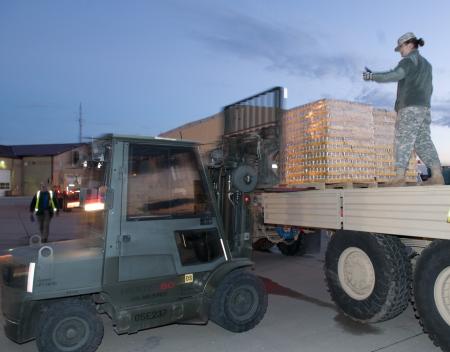
    But the folks from DVIDS sent us some pictures of the West Virginia National Guard on the job getting relief out to the far-flung places which are mostly isolated even without the snow.

    I’m thankful that even though I didn’t need them this time, that they’re out there when the time comes that I do need them.

  • A New Mission for the Federal Reserves

    Well, it looks like the Federal Reserve components (USAR, USAFR, USNR, and USMCR) now have a new mission. A recent change in law explicitly authorizes state governors to request and receive extended support from Federal reserve forces in the event of a disaster. The previousl law/policy was that such support could only be given for a short period of time (72 hours) without Federal orders.  Federal law now allows up to 4 months of such support with the President’s/Pentagon’s approval.

    On the surface, this seems like it should be a good idea. However, as with many things the “devil is in the details”. And there are indeed many potential devils here.

    First, this adds yet another rock to the Reserve rucksack. They’re already stressed heavily by current operations.

    Second, Federal Reserve units will have to be prepared to respond more often and longer to state authorities. This potentially provides a confused chain-of-command.  While providing support, to whom does the unit commander turn for definitive direction – the State AG? The governor?   His/her normal Reserve chain-of-command?  All of the above?  Confused chains-of-command are not a good thing.

    Third, I can easily see cash-strapped state governments requesting Federal assistance in lieu of fully mobilizing state resources – e.g., before calling up all appropriate state National Guard units – to save money.  But disaster support is one of the primary reasons states have National Guard units in the first place.  And last time I checked, the Federal budget is in bad shape too.

    Finally, this also may make Federal Reserve units more subject to political pressure from state authorities. Because if a unit commander knows he might have to work for the State AG or governor for long enough to get an OER or letter input to same – well, let’s just say that commander might be a bit more willing to bend a few rules if asked.

    As I said: on the surface, this looks like a good idea. I’m hoping this is not a case where good intentions end up paving the road to hell. Because IMO that potential certainly exists here.

    Thoughts?

  • Training to increase for Guard and Reserve troops

    I know you guys have been discussing the cuts that are being eyed to the pay of National Guard troops. I noticed that some of you were complaining, and rightly so, about the time you spend during the week preparing for your drills. Well, I’m sure this won’t do much for retention, either. From the Stars & Stripes:

    [Guard and Reserve soldiers] will keep preparing for war, with training periods away from home each year that would grow from a two-week block to up to seven weeks, Gen. Ray Odierno, Army chief of staff said in an interview Monday with USA Today. Drilling one weekend a month would continue.

    “As they go through it, their readiness will increase, the number of days training will increase,” Odierno said.

    And the Pentagon is mouthing the words that they’re ready to accept the retention losses;

    “You might have some guys who will be OK with that and some people who will part ways,” [Army Maj. Michael] Moricas said.

    They claim that the upside for soldiers is their five-year plans, so the troops will know when their training is coming up. Of course, they’ll also know if they should stay or leave the service. The brass acts like retention is a steady number that won’t changed because of their policies. What they’re actually admitting is that, by cutting the active force to make the White House demands on their manpower reductions will impact readiness.

    This has the fingerprints of the White House all over it. In their planning, everything remains constant irrespective of the effect their planning will have – like planning on higher tobacco taxes funding their healthcare not figuring that people will quit smoking and that revenue won’t come in like they thought it would.

    So, by planning readiness based on the Guard and Reserves manpower remaining constant, isn’t planning at all. Just hoping with your fingers crossed that people are too stupid to toss their Reserve and Guard careers aside.

    Odierno said that National Guard members and reservists acquired combat skills the Army sorely needs now as it tries to save money by reducing its ranks of full-time soldiers from 570,000 to 490,000 by 2017, and cuts the number of combat brigades from 45 to 32.

    So it only makes sense that you drive those skills that “the Army sorely needs” away from military service. Or something.

  • A Current and QRMC Reserve Retired Pay Estimator

    It occurred to me that the spreadsheet I prepared to produce estimates for my previous article about the QRMC recommendations  could be modified to serve as a simple, general-purpose retirement pay calculator for Reserve personnel under both options.  While others Reserve retirement pay calculators exist (most notably this one at US Army Human Resources Command), they appear to make various assumptions concerning future pay raises and inflation that may or may not be accurate.  They also don’t seem to attempt to convert their calculated future value to current dollars, thus making interpretation of the result difficult.  And they and also don’t seem that easy to use for “what if” drills concerning future correspondence work, voluntary active duty, mobilizations, and the like.  So I decided I’d make this spreadsheet available.  You’ll need software that can use a MicroSoft Excel (97-2003) format workbook in order to use it.

    The spreadsheet calculates, under both current and QRMC rules, the Reserve pension that a reservist will earn under each system, plus the percentage reduction under the QRMC proposal.  Users must enter their actual and estimated yearly retirement points and selected other data.  The procedures which follow describe that other data and tell the user how to obtain or calculate it. (more…)