Category: Reserve Issues

  • Russell Thomas Langford threatens mosque

    Russell Thomas Langford threatens mosque

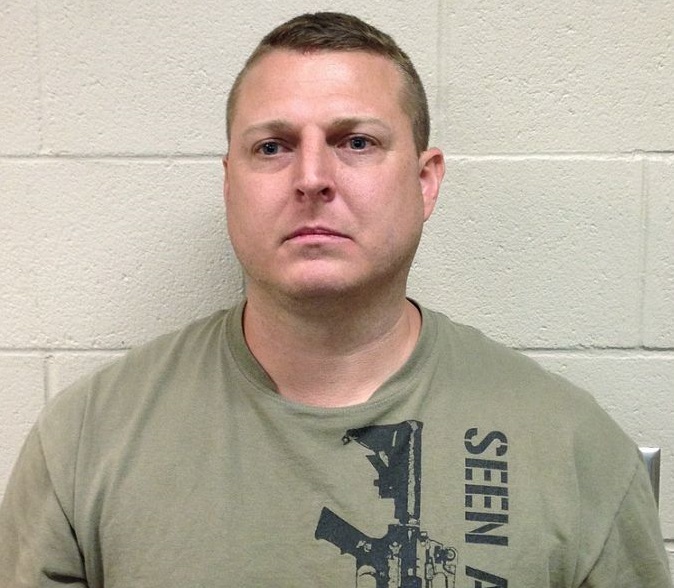
    Russell Thomas Langford

    According to the Associated Press, this fellow, Russell Thomas Langford, got mad at a neighborhood mosque in Raeford, North Carolina. He left packages of bacon at the entrance of the mosque then drove off in his Chevy Tahoe, he returned several times and threatened the people outside the mosque.

    Authorities found several handguns and other weapons, plus about 500 rounds of ammunition in Langford’s vehicle, Kivett said. He said Langford didn’t make specific threats about a mass shooting other than to say he wanted to kill mosque members.

    Langford made his initial court appearance Friday, posted a $60,000 secured bond and was released, Kivett said.

    Since posting bond, Langford has been placed under the control of his commander on base at Fort Bragg, said Army Reserve spokesman Capt. Eric Connor. He said what Langford is charged with doing is “totally contradictory to Army values.”

    Langford, who works full-time as a major in the Army Reserve, served two tours in Iraq while on active Army duty and earned the Bronze Star for “outstanding dedication to duty during combat” while with a military police battalion, Connor said.

    CAIR is asking that Langford be charged with a hate crime, whatever that means.

    Personally, I blame the Chevy Tahoe. Those people who drive those things can’t be trusted. Did you notice the first three letters of TAHoe.

  • Rowan Elijah Feldhaus hits legal snag

    Rowan Elijah Feldhaus hits legal snag

    Rowan Feldhaus

    TSO sends us a link to the story about how Columbia County Superior Court Judge J. David Roper told this chick, an Army reservist, formerly known as Rebeccah Elizabeth Feldhaus that she couldn’t change her name to Rowan Elijah Feldhaus because Feldhaus, who decided that she’s a man now, didn’t pick a feminine name according to the Atlanta Journal Constitution;

    “I don’t know anybody named Elijah who’s female,” Roper said, according to a transcript of the hearing. “I’m not going to do that. I’ve never heard of that. And I know who Elijah was, one of the greatest men that ever lived.”

    Feldhaus, a sergeant in the Army Reserve and a student at Augusta University, said in statement that he felt insulted and objectified to be told he can’t use the name that family, friends and co-workers already use.

    “It can be a scary situation when I show up for work or the first day of class and my legal name does not match my public presentation and my gender identity,” Feldhaus said. “I just want to change my name so that it reflects who I am.”

    In my opinion, the judge is clearly firing outside his lane. The court was provided with statements from Feldhaus’ doctor claiming that Feldhaus needed to change her name for part of her treatment for gender dysphoria. I don’t know if that’s true or not, but its not up to the judge to decide what we can call ourselves. I’m thinking that he’s going to get thrust into the twenty-first century in a very abrupt manner.

  • Lieutenant Deshauna Barber; Miss USA

    Lieutenant Deshauna Barber; Miss USA

    Deshauna Barber

    The big news this morning is that Army reservist Lieutenant Deshauna Barber won the Miss USA title last night. Her question from the judges was, according to CNN;

    When asked by judge Joe Zee whether the Pentagon’s decision to open up all combat roles to women had “put political correctness over our military’s ability to perform,” 1st Lt. Barber responded:

    “As a woman in the United States Army, I think it was an amazing job by our government to allow women to integrate into every branch of the military.”

    She continued: “We are just as tough as men. As a commander of my unit, I’m powerful, I am dedicated and it is important that we recognize that gender does not limit us in the United States.”

    She says that she intends to highlight veterans’ issues during her reign, according to Fox News;

    Barber said she plans to use the pageant’s spotlight and her title to support veteran’s causes and tackle the issue of suicide and post-traumatic stress disorder among military members. When asked what message she had for the presidential candidates — including former pageant owner and presumptive Republican nominee Donald Trump — Barber said they should focus more on veteran’s issues, including the backlog at veterans hospitals.

    That’s laudable, I suppose.

    She’s going to ask for a break from her reserve obligation;

    In a press conference following the event, the 26-year-old lieutenant from Northeast DC said she plans to take a break from the Army Reserve and had already discussed with superiors the possibility of going inactive for a couple of years should she win the title. She said she currently serves two days per month.

    “My commander should be watching right now,” Barber said. “Two days a month is definitely not active duty. It is an obligation that I signed up for but they are very flexible in the United States Army Reserves.”

    She should be aware, however, that when she’s running for President in 20 years, she’ll have to explain those “not observed” entries on her Officer Evaluation Reports by her rater.

  • Two Cautions for Our Military Reservist Readers

    A number of our readers are current or former Reserve Component (RC) personnel. Some of those may be still serving in the Reserve Components while also approaching the age at which contingency service would allow early receipt of retired pay.

    For that likely small subset, I’d like to offer two points for consideration.

    First: early receipt of retired pay does not equate to all of the bennies of full military retirement. Specifically, RC personnel receiving early retired pay are NOT eligible for normal military retiree TRICARE coverage.  Full TRICARE entitlement for those who retire under RC rules does not happen until age 60, regardless of retired pay status. So even if you qualify for early receipt retired pay, you’ll need to plan on obtaining healthcare from other than TRICARE until you hit the big six-zero.

    Second:  if you’re a serving reservist, have recently been promoted, and are getting close to or are eligible for early retired pay – you might want to check time-in-grade requirements for your current grade before you apply for that early receipt of retired pay.  The ABCMR recently ruled that such a retirement is voluntary vice involuntary.  Thus, TIG requirements to retire at that grade are not waived; if you don’t have enough TIG to retire at that grade, you won’t.

    While the linked case is Army-specific, I’m also reasonably sure that that’s the case for all services.  Applying for retired pay – early or otherwise – under RC rules is a voluntary action.

    Everyone’s situation is different. In some cases the grade reduction might be worth it to receive retired pay earlier; in others, it won’t. Everyone has to make that decision on their own.

    Just be forewarned if you’re in that situation.

  • Guard and Reserves can’t account for their troops

    Chief Tango sends a link from Stars & Stripes which reports that the Government Accountability Office has determined that the National Guard and the Reserves have no idea how many of their soldiers are ready to deploy. You might remember that is important because the Pentagon and the White House are expecting the gaps in staffing and manning in the active force left by sequestration are supposed to filled by the part-time services.

    The nonpartisan GAO also determined that hundreds of soldiers who were reported as ready to to serve were actually ineligible to mobilize and deploy under Army guidance.

    The inconsistencies suggest the components’ overall nonavailability rates as of January — 22 percent in the Reserve and 21 percent in the National Guard — could be even higher.

    […]

    Without quality data that is readily available to leaders at all levels … the Army and its Reserve component leaders will not be able to adequately monitor and manage the availability of soldiers who make up over half of the total Army force,” the GAO said.

    The GAO blames the inconsistencies on the inability of some data systems to interface. Gee, where have we heard that before? Also, that personnel clerks are improperly trained and units have staffing shortages.

    So basically, the Pentagon cobbled together a plan to deal with personnel cuts and presented it to the White House, but they didn’t have a way to implement that plan. That’s the first time that’s ever happened.

  • Thoughts on the WaPo-Graham Brouhaha

    Jonn recently wrote an article about Senator Lindsey Graham’s military service, and how the WaPo was questioning same.

    Ever since, there seems to have be a bit of confusion about Senator Lindsey Graham’s military career. In particular, his service has raised a number of questions here – and has garnered a rather large amount of negative comment.

    I was curious, so I decided to research the situation. Time to kick the anthill; here are the facts.

    1.  Wikipedia – which I’ll trust in this case to be correct – says Graham graduated from law school in 1981. He received a USAF commission in 1982. He served on active duty as a USAF JAG from 1982-1989, including 4 years in Germany. He then served in the SC ANG from 1989-1995; and in the USAFR from 1995 until his retirement from the USAFR earlier this year.

    2.  Graham has been a member of Congress continuously since 1995.

    3.  DoDD 1200.07, defines the term “key employee”. Further, para E2.1.4.1, specifies that a Member of Congress is by DoD policy designated a “key employee” of the Federal government.

    4.  DoDD 1200.07 also defines the members of the Standby Reserve, as follows (para E2.1.9):

    The Standby Reserve consists of personnel who are maintaining their military affiliation without being in the Ready Reserve, but have been designated “key civilian employees,” or have a temporary hardship or disability. Those individuals are not required to perform training and are not part of the Ready Reserve. The Standby Reserve is a pool of trained individuals who may be mobilized as needed to fill manpower needs in specific skills. The Standby Reserve consists of the active status list and the inactive status list categories.

    5.  DoDI 1200.15, para 5.1.3, mandates that “key employees” who are members of the Reserve Components be transferred to the Standby Reserve.  DoD 1200.07 further specifies that such individuals will be placed on the Standby Reserve – Active Status List (SR-ASL).

    6.  DoDD 1235.09 describes organization and management of the Standby Reserve.  In particular, para 2.b. states that individuals on the SR-ASL may participate in military activities in both active duty and inactive status, but also appears to specify that any such service will be for “points only” – e.g., without pay and allowances.

    7.  Finally, 10 USC 12306 appears to allow individuals on the SR-ASL to request to serve temporarily on active duty in an imminent danger zone.  With the approval of their Service Secretary, they may receive orders to do so.

    The Standby Reserve and how it works (and what it does) is not something that’s exactly common knowledge.  I’d run across it some years ago, and remembered it existed and had something to do with key personnel. But I didn’t really know much about it (or had forgotten the pertinent details) until I looked it up again in connection with this flap.  If you’re curious about the Standby Reserve, this article from the US Army Human Resources Command gives a pretty good overview. I’m reasonably certain that all services handle their SR-ASL reasonably similarly, so it should be pertinent to any RC element.

    . . .

    So, to recap: Graham has been a member of Congress since 1995. He was an ANG officer – with 12+ years TIS, probably a Major – when he entered Congress. When he was sworn in as a Member of Congress, DoD policy allowed him to retain his commission (and transfer to the USAFR) – but required him to be placed in the Standby Reserve.

    Regardless of what you think about Congress, serving as a Member of Congress is definitely a full-time job.  (If you doubt that, find a copy of P. J. O’Rourke’s book Parliament of Whores and read the chapter where he describes a typical Member’s daily schedule – usually nonstop from 7:30AM or so until after 9PM most days, choreographed to the minute much like that of a GO.) We’d expect  someone in a senior elected position in the Federal government devote the vast majority of their time and effort to the job he/she was elected to do, so that’s as it should be.

    DoD also recognizes that being in a key Federal/state/industry position (some key positions are in industry) may preclude normal participation in Reserve duties.  DoD has also decided that allowing Reservists who also serve in one of these key positions to continue their Reserve service is in DoD’s best interests.  That’s almost certainly one reason that the Standby Reserve was created.

    Finally, Graham’s placement in the Standby Reserve wasn’t his choice – DoD told him, “Standby Reserve, or resign your commission.”  So Graham stayed in the USAFR, and played by the rules DoD dictated.

    My take is that Graham seems to have done what he could to remain as active as time permitted in the Reserve Components. I’m guessing he “dotted the I’s and crossed the T’s” with respect to getting SECAF approval for all of his time spent in military training/active duty while serving in Congress.  In fact, IMO he seems to have gone out of his way to do considerably more than was required for someone in his position.

    For what it’s worth: if the dates listed in this article are correct (hat tip to TAH commenter AZtoVA), Graham appears to have considerably more than enough service in Afghanistan to qualify for the Afghanistan Campaign Medal and thus legitimately call himself an “Afghan veteran”. If those dates are correct for his military service time in Afghanistan, I counted over 100 days of nonconsecutive service in-country.  (He’s got over 30 days service in Iraq as well, albeit nonconsecutively.)  And if I’m reading the DoD regs correctly, since 1995 he did it without receiving anything but retirement points – e.g., no military pay and allowances.

    I’ve never met Senator Graham. I don’t much care for some of his positions and recent actions, either. But he in my book he served honorably in the USAFR, and appears to have done far more than he was obligated (or would be expected) to do for someone in his position. The WaPO article attacking his service was IMO nothing more than a biased political hit piece.

    And I’ll also say this: in my book, people who denigrated his service in comments here IMO owe Senator Graham an apology.

  • Veterans Trading Company fires exec for military service

    Wendell sends us a link to the story of the Veterans Trading Company, a Service-Disabled Veteran-Owned, HUBZone-certified Small Business, that fired it’s President, Paul Costello, a Navy Reservist and a plot, because he went on active duty with his unit and refused to rehire him when he finished his committment. VTC initially filed a law suit against Costello to recover the wages and expenses they had compensated him. Now, the DOJ is taking up Costello’s cause under the Uniformed Services Employment and Reemployment Rights Act;

    The government is pursuing damages equaling Costello’s lost wages and forfeited ownership and distribution shares in the company since June 2013, as well as compensation for legal fees.

    Veterans Trading Co. filed a lawsuit against Costello in April, alleging he was compensated improperly in his role as president of the company while on military leave. Federal lawyers are seeking a dismissal of that lawsuit and claim Costello took “personal leave” during his military service to conduct company meetings.

    From Market Watch;

    On April 30, 2015, Veterans Trading Company, LLC (VTC) filed a lawsuit in Utah State under Civil No. 150902921 against a former officer of VTC for the return of monies paid to him during a time when he later claimed he was on active duty for the United States military. That suit claims fraudulent non-disclosure, conversion, and breach of fiduciary duty in connection with his employment.

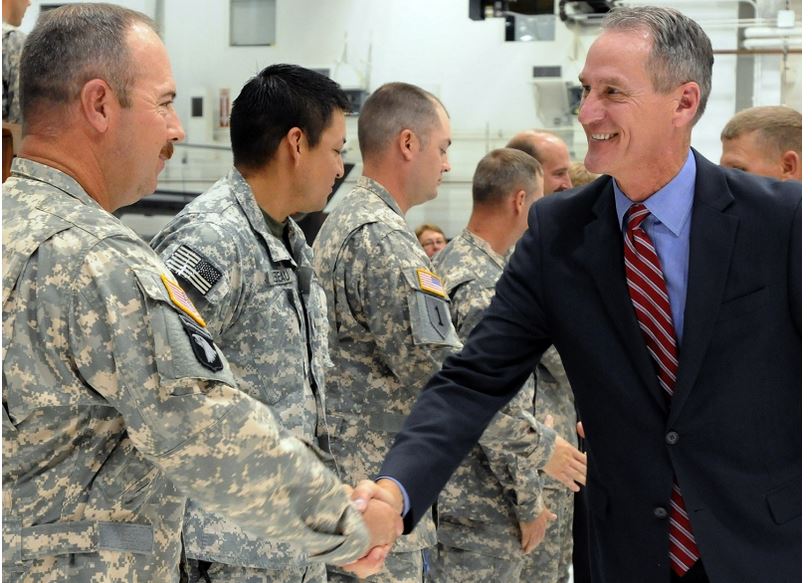
  • South Dakota redefines “veteran”

    South Dakota redefines “veteran”

    SD-Gov

    According to our friends at Weaselzippers, in a link sent by MustangCryppie, the State of South Dakota has redefined the term “veteran” to include reservists and National Guardsmen.

    Overwhelmingly supported in the Legislature during the recently concluded 2015 session, House Bill 1179, signed into law by the Republican governor on March 13, changed the status of the title “veteran” to include military reserve or National Guard members, which means those individuals can qualify for additional benefits.

    Of course, there’s opposition among veterans;

    A number of combat veterans in the state have spoken out against the bill, arguing that the measure means war veterans will get less of the benefit pie and that it waters down the meaning of the title.

    “It makes things more difficult for legit combat veterans,” said Ted Fowler, a Vietnam War veteran from Aberdeen who served in the U.S. Army. “If this were high school, what they’d be doing is passing out letterman jackets to junior varsity players who have never seen any varsity action. Those folks haven’t earned the title.”

    As the author of the article at WZ, Dapandico, notes, in the picture at the link, there are at least two guardsmen with combat patches and there are career active duty soldiers walking around today who haven’t deployed, some who actively avoided deployments to the war on terror. While I understand Mr Fowler’s concerns, things have changed since Vietnam. The reserve side of the house has been pulling their weight over the last twenty years or so.

    TSO was a guardsman, yet he has deployments to the Balkans and to Afghanistan. The Guard and Reserve isn’t the weekend keg party that it was in the past. In fact, the Pentagon plans to use the reserves to cover deployments as they draw down the active force.

    I’d remind Mister Fowler, the Vietnam veteran quoted above that there are ninety-nine Guardsman who are named on the Vietnam Memorial.