Category: Military issues

  • Up-Armored Police

    Lorenzo Franceschi-Bicchierai at The Danger Room reports that police departments across the country have gone fifty-one-fifty buying up surplus military equipment to deck themselves out in unneeded tactical finery. Tanks, helicopters, assault-style weapons that mostly collect dust. Thermal sights and infra-red and night vision goggles all lay unused on the shelves or in the trunks of patrol cars;

    The Nebraska State Patrol has three amphibious eight-wheeled tanks. Acquired almost three years ago, their highest achievement has been helping with a flood last year and with a shooting a couple of weeks ago. Overall, it has been deployed five times. At least, officers love driving them. “They’re fun,” said trooper Art Frerichs to the Lincoln Journal Star in 2010. And the ride, according to Patrol Sgt. Loveless, “is very smooth.”

    Yeah, yeah, I know “if it saves one life, it’s worth it” – but three tanks? Seriously? If it’s so much fun to drive tanks around, why do all of the tankers I know scowl all of the time? I’ll admit that I liked tooling around in a Bradley – but that’s why I joined the Army and not the Nebraska State Police.

    Personally, having a bunch of untrained yahoos running around with assault rifles and night vision gear doesn’t make me feel all that safe. We had a company of trained experienced tankers open fire at night on a Bradley platoon, and they lived with those thermal sights every day and night, still they didn’t correctly ID their targets.

    Now they get the stuff at a discount – they get it free and just pay the shipping charges – just like the “free” stuff you get on TV, but that doesn’t always work out for them;

    In Tupelo, Mississippi, home to 35,000, the local police acquired a helicopter for only $7,500 through the surplus program. The chopper, however, had to be upgraded for $100,000 and it now costs $20,000 a year in maintenance.

    I’m sure taxpayers are excited about that price tag. But, a helicopter at least has some daily use potential. Tanks and night-vision hardware, not so much. Nothing ever scared me so much as a private on the night fire range with NVDs for the first time. Imagine a whole police department of untrained privates running through your neighborhood with that shit on, fingers on their triggers of their assault weapons with large capacity magazines.
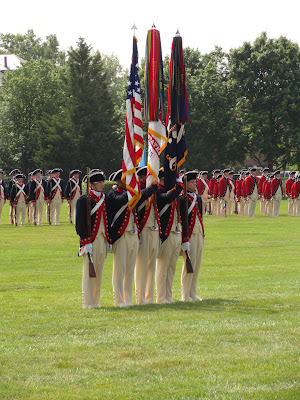
  • Col. James Markert’s CoC at the 3rd Infantry Regiment

    I was supposed to be there at Fort Myers last week when Col. James Markert assumed command of the 3rd Infantry Regiment, The Old Guard, but real work interrupted. Luckily, our buddy, Parachute Cutie made it along with that guy from Blackfive.

    Mrs. Markert has invited me down there to attend Twilight Tattoo some Wednesday night to make up for missing the change of command, so maybe I’ll get some pictures when I can break away. But in the interim, Parachute Cutie took some great pictures of the professionals of the 3rd Infantry at their peak. You should go see her excellent photos.

    I’m glad I’m too short for the Old Guard, because I just don’t have what it takes to be one of those guys, but I admire the Hell out of them.

    Congratulations to Colonel Markert for the honor that it must be to command a regiment of soldiers like that.

  • Does it really matter? I mean seriously.

    Beretverde sent us a link to an MSNBC article about the Army wasting $5 billion on research for the perfect camouflage uniform for soldiers.

    According to insiders, the design was selected after the Marines had switched to an eye-catching pixel-driven pattern. “That’s what this really comes down to,” the editor of Soldier Systems Daily said. “‘We can’t allow the Marine Corps to look more cool than the Army.’”

    Yeah, I really don’t get this whole discussion. I’ve never seen a camouflage pattern that hides soldiers, and after a few hours in the field, all uniforms look the same – dirt. Of course, the last line of that paragraph above is what it’s all about anyway – the coolest pattern. So uniforms are a recruiting tool now, functionality is secondary.

    With so many other things they could be spending money to protect the force, things like training which effectively make up for the fact that uniform camouflage patterns don’t do anything, why is Big Army mostly concerned with fashion?

    And if a trainee is more attracted the Marines than the Army because of a camouflage pattern, does either service really want such a superficial dork anyway?

    All it really is about is job security for those POGs at Nattick.

  • ‘Kelly Temps’ In Uniform

    Yeah, I’m about to get a bit long-winded – and some might say, “wax ignorant” – again. And this article is somewhat (but not exclusively) Army-specific, so read on at your own risk. (smile)

    Much of the readership here at TAH has a military background. (Duh!) But even within the military, experiences and commitments vary. There’s a huge difference in terms of experiences, careers, and commitments between those who on active duty and those who serve “part time” – e.g., in the Reserve Components.

    That dichotomy is largely by design, and is to be expected. So is a substantial back-and-forth banter – and at times, some animosity – between the Active and Reserve Components. The roles are different, and what’s required and expected of each is different. The Active Component is there 24/7/365, and provides the primary military response in times of crisis.  The Reserve Component, by design, is there to augment the active forces when required.

    At least, there’s a difference during peacetime service. During wartime, when serving together those distinctions blur. My background is Army, so I’ll discuss the Army; other services may be different.  When you serve on active duty and deploy to a combat zone, the uniform says “US Army”; it doesn’t say “Active Army”, “Army Reserve”, or “Army National Guard”. So when it hits the fan, so to speak, the distinctions fade. Mission and imminent threat forces that.  But the distinctions resume when one redeploys.

    There’s no argument that the Active Component forces have the harder role. They’re required to be fully ready 24/7/365, and to deploy and fight on much shorter notice than the Reserve Components. They train more, and suffer more as a result – e.g., earlier casualties, more time away from family due to training, more peacetime training injuries, etc . . . . They’re doing their job full time; it’s their livelihood and (for many) their career. Yes, the Active Component forces have a more comprehensive support infrastructure. So? They’re serving full-time, after all. The Reserve Components aren’t.

    That was once clearly true. But is that really quite true any more – particularly for the Army?

    Time for a historical sidebar. And yes, it is related – though it might not initially seem relevant. (more…)

  • One officer’s perspective on Afghanistan

    The following comes from an email we received from a young officer currently serving in Afghanistan. Given the vocal propensity of the crowd at This Ain’t Hell, he’s interested in your feelings and perspectives about what he reports to us from the front;

    Writing tonight out of a strange combination of frustration and hopefulness. Before I begin my question/rant, I’d like to caveat by saying that in no way do I not support the war effort. I’d think that would be obvious since I’m over here playing an active role in the prosecution of this conflict. (11 series is my MOS (Military Occupational Specialty) for those of you who are curious) However, I still wanted it make that clear before I began.

    The progress in this war is very different depending on the viewpoints you solicit. At the higher [command] levels, we (DOD) are crowing about the massive advances the Afghan forces are making without US/ISAF (International Security Assistance Force) support.

    We talk about the provinces that have been handed over to the Afghan government for security and stability (none of these are “high-threat” areas). We speak about them being able to “stand alone” against an ever weakening enemy. Unfortunately it seems as if this war has become a house of cards waiting to tumble down. The arbitrary timetable of withdrawal has led to a rushed mentality where we choose not to fully reveal the true nature of things on the ground here, including ourselves (US Military).

    Briefings sent higher [up the chain of command], created for the purpose of highlighting the actual status of our Afghan partners are “modified” to reflect a more rosy perspective. When partnership percentages are too close to the chilling reality (11 ANSF (Afghan National Security Forces) contribute to a company “Joint” mission) we massage the numbers, removing our enablers and counting support ANSF soldiers who will not actively support the mission to more aptly reflect the illusion that we are making progress in this handover.

    ANSF are isolated and distrusted, with good reason. Theft, desertion, outright attacks (Green on Blue events), and intelligence leaks that are so pervasive we may as well just air-drop our CONOPs (Concept Of Operation) over Taliban villages infect every level of their military organization.

    The reality is these people (Afghans) are no closer to ensuring their own sovereignty than they were when our first SF teams began to descend on this wonderful country over 11 years ago. Corruption cannot be understated, and as a way of life is completely incompatible with our goals for this war effort.

    Alright, that’s just one officer’s two cents. Rant is now over. What I’d really like to hear is the perspectives of you “old-timers”, no offense meant, who were there in the closing days of ‘Nam. What was the perspective of the troops on the ground when they were asked to fight and die for a nation populated by people who had no desire to improve their lot in life through hardship or shared danger? Is this way off-base? Maybe the final days of Vietnam were so dissimilar as to be incomparable, but I’d still welcome the feedback.

    The perspective here is that we could win this war if we could actually fight it. Endless restrictions and “risk-averse” policies that filter down from higher [headquarters] in an endless deluge only stunt our actual progress on the ground. In an effort to stay positive I’d like to know if any of you share similar views, or if not, could offer some perspective to an officer leading men who, when asked why they’re still fighting reply: it’s for the paycheck.

    I’ve edited some of this email for spelling and defined some of the terms that might not be familiar to the whole crowd. Other than those few edits, the rest of this are the words of that young officer.

  • Big Red One earmarked for Africa

    Those of you at Fort Riley, KS, who thought your deployment days were over once Iraq and Afghanistan ended have a another “think” coming. According to the Stars & Stripes, you guys are scheduled to support the special forces operations currently going on in Africa;

    The soldiers in the brigades will be trained on the culture and languages of the region using a training model similar to those used for Iraq and Afghanistan, said Col. Andrew Dennis, the Army’s chief of security cooperation policy and concepts.

    The Fort Riley brigade is the first to be aligned under the new strategy.

    “This does NOT mean 2-1 BCT is going to deploy, en masse, to Africa,” Dennis said.

    Rather, smaller units from the brigade may be called at different times to do security force assistance and partnership-building missions, then return to the home base in the United States, with about 60 to 70 percent of the brigade deploying over the course of the regional alignment period, Dennis said.

    So, I guess there will be squad-sized ice cream trucks for you to spread good humor throughout the region. It will probably involve no-bid contracts with Baskin-Robbins and Little Caesar’s Pizza (-Pizza). You’ll be supported by contractors from Chuck E. Cheese and will be charged with changing the meaning of “the happiest place on Earth”.

    I noticed that “nation-building” has been altered to “partnership-building”. The goal hasn’t changed, but the name makes me feel warm and fuzzy. And putting a half-of-a-brigade on the ground insures that the hippies will be pleased about it – it’s not enough to have an impact on the strategy in the region, and still enough of a force to be a target for local insurgents.

    By the way, where are the ANSWER creeps protesting our planned “occupation” of Africa? They were protesting a war in Afghanistan before we had one pair of boots on the ground there.

  • US to station 13k troops in Kuwait

    So it’s back to the nineties when we had 5000 troops stationed in Kuwait to be a speed bump in the event that Saddam Hussein tried to to retake Kadhima, his 19th province, because we didn’t have the guts to remove him in 1991. The Associated Press reports that this Administration plans to station almost three times the size of that force there to react to military emergencies in the Gulf region based on a John Kerry-inspired study.

    Senate Foreign Relations Committee Chairman John Kerry, D-Mass., who asked his staff to conduct the study, said in a statement: “This is a period of historic, but turbulent change in the Middle East. We need to be clear-eyed about what these interests are and how best to promote them. This report provides a thoughtful set of recommendations designed to do exactly that.”

    I’m not sure it’s particularly smart to put US troops in a region that is as unstable as the Gulf States have been without a clear mission, except to train. The report specifically mentions our interests in the outcome of the Arab Spring uprisings. Do we plan to be able to inject “boots on the ground” to prop up the Gulf monarchies or will they be employed on behalf of the rebels?

    The Left is fond of preaching about how our presence in the region creates terrorists – bin Laden’s big complaint was the presence of US forces in Saudi Arabia. I don’t particularly subscribe to that theory, mostly because the Left are basically idiots with big mouths and buy in to easy memes. But, how could the Obama Administration explain this particular decision to his base?

    And, it might not create terrorists, but it will create targets for terrorists. Khobar Towers and the Marine barracks in Beirut make appropriate examples. Democrats are always willing to make speed bumps out the troops, but they’re never willing to let them fight wars to a successful and victorious conclusion.

  • Silly Marine?

    OWB alerted me to this a while ago, but I didn’t keep track.

    My name is Jamie Summerlin and I’m a 39-year-old former Marine from West Virginia.

    On March 26, 2012, I will start a 100-day cross country run as a fundraiser to support my fellow military members through the Wounded Warrior Project (WWP) and other Veteran’s organizations. It’s going to take 30-40 miles a day to complete the run, starting in Coos County, Oregon, where my wife is from, and finishing on July 4, 2012 in Annapolis MD, a total of just over 3300 miles.

    Everyone I have talked to has said I am slightly insane, but they support me 100%. My wife is behind me completely as well, which makes this all the more possible.

    OWB and her crowd helped him move through her patch in Charleston and now I have to get organized to, at least, cheer him on.

    Looks like overnight stops are planned for Gassaway, Jane Lew,  and Morgantown. if I can find him I WILL have pictures.

    Minor update: I’m aiming for Jane Lew this Saturday.